
What Is Expansion Strategy? Types, Examples and Risks
What Is Expansion Strategy? Types, Examples and Risks


Expansion can bring in new customers, reach new places, or add products. Many businesses now consider international growth, but growth alone does not guarantee success. A company can be profitable at home and still struggle to repeat its results in a new market.
The order of decisions matters. A team may choose a country or customer segment and commit money before confirming that it can deliver consistently, support new customers, or measure whether the move is working. It's like opening a second kitchen before checking whether the first one's recipes and routines can be repeated.
A safer approach is staged: check readiness first, choose an entry mode next, then test the idea with a pilot. Set a loss limit and clear stop rules before launch, so the team knows when to pause rather than keep spending. Scale only when the pilot shows the business can serve the new market reliably.
What Expansion Strategy Means in Plain English
Say a pizza shop has been busy for four years. The owner wants to grow, and there are at least four ways to try: push a Tuesday-night deal to the regulars who already order, open a second shop across town, start delivering to neighborhoods the shop has never served, or launch a frozen pizza for grocery stores. All four count as growth. Each one has a different bill and a different way to fail.
The definition stays that simple. An expansion strategy is the deliberate plan a business uses to increase revenue, customers, geographic reach, product coverage or market share, which is exactly the job the Ansoff product-market framework does when it splits one vague ambition into four distinct options with different capability requirements and different risk levels.
What turns the wish into a strategy is answering four linked questions: which target market you're going after, when you'll move, how large the first push will be, and how you'll enter. Those four answers set the budget, the timeline and the exposure.
What doesn't count as expansion
Spending more on ads to the same customers for the same offer isn't expansion. It's a bigger version of today. Neither is a revenue goal with no named new buyer, channel or product attached, because there's nothing to test and nothing that can prove you wrong.
If you can't name the new customer group and the new thing you're offering, you've got a wish with a deadline.
The one-sentence test: name the customer, the place and the offer in a single line. "We're going to sell our keyword cleanup workflow to agencies in the UK" passes. "We're going to grow 30% this year" doesn't.
Try it this week. Write your next move as one sentence with the customer, the place and the offer, then underline the part you're least sure about. That underline is your first thing to test.
The Four Ansoff Growth Options Explained
Igor Ansoff published the product-market grid in Harvard Business Review in 1957, and it runs on two questions: is the product new or existing, and is the market new or existing? Answer both and you land in one of four boxes.
| Option | What Changes | Keywordme Example | Risk Level |
|---|---|---|---|
| Market penetration | Same product, same customers | Getting current Google Ads users to run more campaigns | Lowest |
| Product development | New product, same customers | Adding new PPC features for existing users | Moderate |
| Market development | Same product, new customers or countries | Pitching agencies or advertisers in new countries | Moderate |
| Diversification | New product, new customers | Launching an unrelated service for new buyers | Highest |
Market penetration is the cheapest box. Same product, same people, more of them or more often. For a Google Ads tool business, that means getting current users to add a second account or a third campaign type.
Product development keeps the buyers and changes the offer. New PPC features for the people already paying you, sold on the strength of the relationship you've built.
Market development keeps the offer and changes the buyers. Agencies instead of solo freelancers, or advertisers in countries where you've never sold. Diversification changes both at once, which is why it sits at the bottom of the risk column.
Market development is not product development
Readers get stuck here, and it changes what you have to build. Market development sells an existing product to new customers, whether that's a new country, a new demographic, a new distribution channel or a repositioning for another industry, as the EBSCO Research Starters overview of the Ansoff matrix sets out. Product development keeps the customer market broadly familiar while changing or expanding the offering.
One asks whether new buyers want what you already have. The other asks whether current buyers want something you don't have yet. Cross-border moves bring a messaging problem even when the product is untouched, and localized marketing strategies covers how to adapt the copy without rebuilding the thing underneath.
Diversification deserves its own warning. You have no track record in the product category and none with the buyer, and a published analysis of the matrix identifies that simultaneous new-product, new-market move as the defining mechanic of the option. Budget for it like a startup, not like an extension of the current line.
Pick the one option that matches your next move, then write the single assumption that has to be true for it to work. That assumption is what your pilot tests.
Why Companies Expand and What Scalable Growth Means
Two different things get called growth. Expansion adds customers, segments or geographies. Scaling means output rises faster than the cost of serving it. You can expand without scaling, and that's how revenue climbs while margin slides.
Software shows the difference cleanly. When a new customer segment can be served with the same product, the same automation and the same support articles, the fixed cost of building it gets spread across a bigger revenue base, so the cost per customer falls. That's operating scale in plain words: the second customer is cheaper to serve than the first.
Here's the picture many have in mind when they plan growth, several people gathered around one chart.

Reaching new markets is also the default plan now. Censuswide research commissioned by Phrase surveyed 2,000 business leaders and found 90% planned international expansion within the next five years. Large manufacturers have worked this way for decades: in fiscal 2024, Japanese manufacturers produced 36.1% of output overseas and took 40.9% of sales from overseas markets, according to the Japan Bank for International Cooperation's FY2025 survey.
How you get there shapes how long the gains last. HEC Paris strategy research notes that acquisitions can create immediate bargaining power, but those advantages tend to dissipate quickly, while organically developed growth can produce longer-lasting operational efficiency.
The numbers worth watching instead of total sales
- Incremental revenue: the new segment's own top line, not the blended total.
- Variable cost per customer: support, infrastructure and onboarding per account.
- Support load: tickets per hundred accounts, tracked weekly during a pilot.
- Gross margin: measured on the new segment alone.
- Customer acquisition cost and marginal payback: what the last cohort cost, and how long it takes to earn that back.
Quick check: if each new customer costs less to serve than the last, you're scaling. If not, you're adding work.
Confirm Readiness Before You Expand
The question most guides skip is simpler than market selection. Should this business expand at all?
Sometimes the answer is no, and the reasons are operational rather than strategic. Canada's 2025 trade report lists market knowledge, administrative obstacles, border issues, logistics, financial risk and financing or cash flow as the major export barriers, and more than 90% of SMEs that don't export cite the local nature of their business as the main reason, per Global Affairs Canada's state of trade report. That's the useful split: a software tool travels well, while a business built on local labor, physical delivery, licensing or location-specific trust often doesn't travel at all.
Drop the myth that the fastest-growing market is the right first market. A slightly smaller market with clearer rules, existing customer networks and lower localization costs usually produces better risk-adjusted growth.
Regulatory discovery belongs in the plan, not in the footnotes. The European Commission's 2025 report on SME scaling found cross-border SMEs struggle most with different business environments (33%), access to information about rules (30%), taxation (29%) and authorizations (28%).
The five-point readiness check
- Repeatable delivery: could a new hire run your process next month without you in the room?
- Cash-flow resilience: can you absorb the pilot's full loss without touching payroll?
- Regulatory ownership: does one named person own tax, privacy and licensing questions for the new market?
- Local distribution: do you have a route to buyers that doesn't start from zero?
- Support capacity: can your team answer questions in the new segment's hours and language?
Standardize before you translate. Get onboarding, reporting, pricing and measurement into one shape first, then pick markets where that shape needs the least bending.
If two or more of those checks come back weak, fix them before you name a market. If all five hold, name one market and one assumption to test.
Small operational wins count toward readiness too. Trimming wasted spend is its own form of preparation, and how to improve marketing efficiency walks through the workflow side. When you run the test, expand ad groups by building high-intent keyword lists pulled from Keyword Planner or ad group level keyword suggestions, so results read on intent rather than volume. Our Pro plan bundles one-click negative keyword list building, match type configuration and search-term-based campaign expansion, which keeps a pilot readable while it runs.
Entry Modes and What Each One Costs
An entry mode is the way your business reaches a new market. Each choice trades off control, cash, speed, and local risk. Exporting is like testing a route before building a base: it needs little capital and offers limited control. Buying a business gives you more control and a faster start, but requires more capital and brings higher local risk.
| Entry Mode | Control | Capital Needed | Speed | Local Risk |
|---|---|---|---|---|
| Exporting | Low | Low | Fast | Low to moderate |
| Licensing | Low | Low | Fast | Shared with partner |
| Franchising | Medium | Medium, franchisees fund units | Medium | Shared with franchisees |
| Joint venture | Medium | Medium | Medium | Shared with partner |
| Acquisition | High | High | Fast | High |
| Wholly owned operation | High | High | Slow | High |
What franchising actually costs
Franchising lets independent operators use your brand, operating model, and systems in return for fees and ongoing payments. Franchisees fund their own units, sharing the cost and local work, while you give up some control over how the model is run. Industry guidance puts the initial franchise fee at roughly $25,000 to $50,000, continuing royalties commonly at 4% to 8% of gross revenue, and separate marketing contributions often at 2% to 5% of gross revenue, according to this guide to the steps to franchising a business.
In the United States, the Federal Trade Commission's Franchise Rule requires a Franchise Disclosure Document before a prospective franchisee signs an agreement or pays money. That requirement makes legal preparation part of the entry cost, alongside fees and the work of documenting a repeatable operating model.
Franchising works best when the business can run consistently without the founder overseeing each location. Franchise Foundry on franchising readiness offers guidance on assessing whether your processes are ready for independent operators.
For a digital business, franchising may not fit. Partnering, acquiring, or building directly can be a better match. A small paid test can help assess demand before making a larger commitment; this guide to online advertising for small business covers that approach.
Use partner-based modes when speed matters and shared control is acceptable. Choose an owned operation when control over the brand and process matters more, and the business can fund it. Treat the mode as a go/no-go choice: first confirm readiness, then select how to enter, and only scale after a limited pilot meets its targets and stays within its loss limit.
How to Run an Expansion Plan in Stages
How can you tell whether an expansion deserves more investment? Treat it as a sequence of go/no-go decisions: first check readiness, then choose how to enter, then test on a limited budget before scaling. Setting a loss limit and investing in stages keeps an international entry test affordable and makes its results easier to judge.
The infographic below maps out six stages, along with the common mistake at each one.
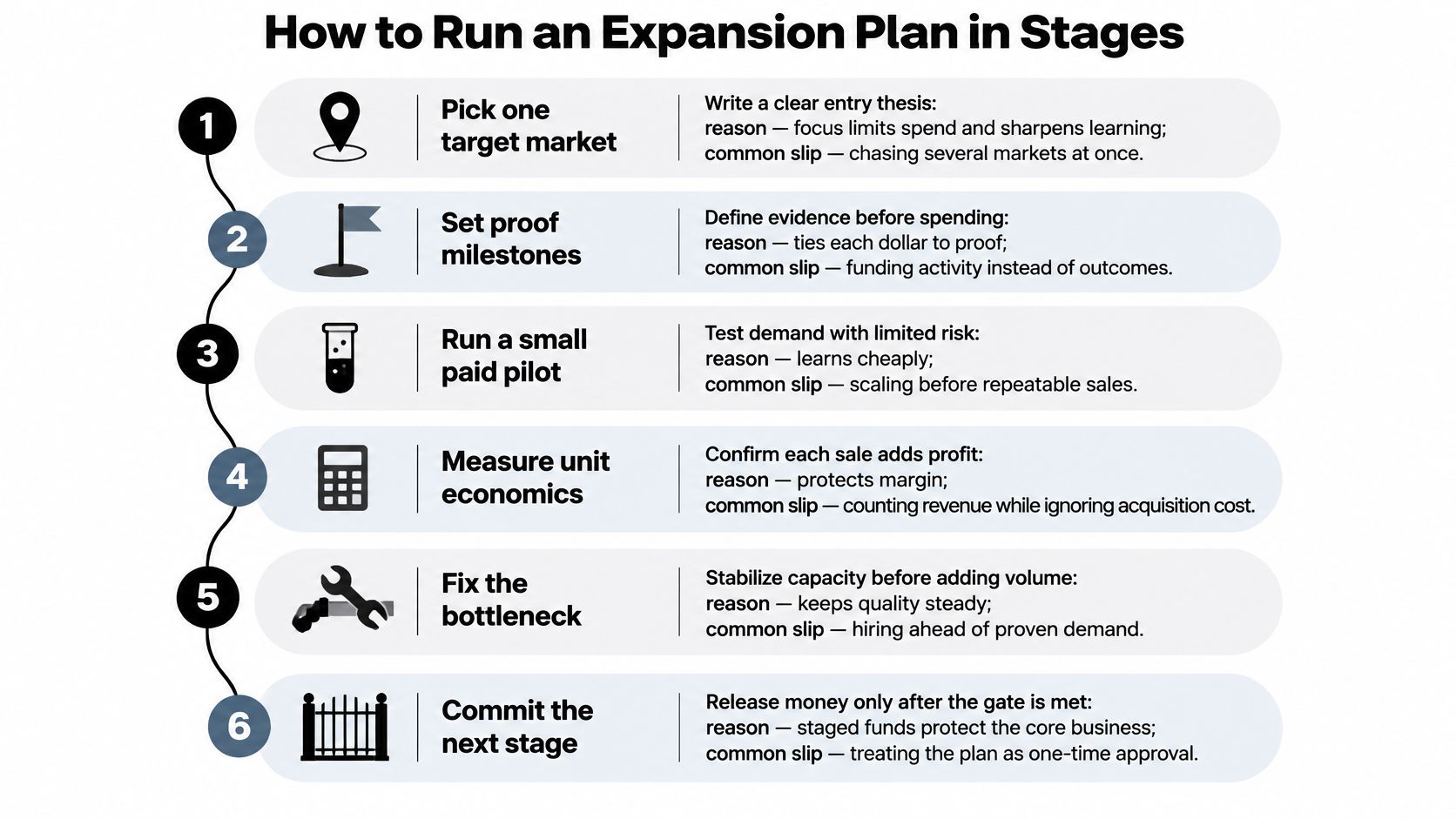
Pick one target market and write a hypothesis. State who might buy and why in a sentence that can be tested. “Small businesses” is too broad: a useful hypothesis names a more specific audience and gives you a result that could prove it wrong.
Set a maximum affordable-loss budget before spending. Decide what the full test can cost, and treat that amount as already spent. Without a limit, a pilot can turn into a much larger commitment.
Run a limited pilot. Test one small offer or controlled campaign with one segment. Keep the scope narrow enough that you can tell what affected the result, rather than mixing several changes together.
Measure conversion, retention, contribution margin and payback period. These measures help show whether customers are responding and whether the opportunity can make money. Clicks alone show attention, not proof of a workable expansion.
Compare results with thresholds set in advance. Write down what counts as success before the test begins. That way, you judge the outcome against the same standard instead of shifting the goal after seeing the numbers.
Scale, adjust the offer or stop. If results meet the threshold, expand in measured steps. If they fall short, decide whether a limited adjustment is worth another test. If the loss limit is reached, stop; protecting the core business is a valid outcome.
Rule of thumb: a pilot you can't afford to lose twice isn't a pilot.
A short pilot is like a small rehearsal: it reveals where the plan needs work before you commit to a larger launch. For a cross-border move, scaling beyond the UAE market offers an example of sequencing a regional launch market by market.
For a Google Ads test, start with one industry segment and one controlled campaign. Review search term quality and cost per conversion before deciding whether to widen spend. The same staged logic applies across expansion choices: check readiness, select an entry mode, set limits, and let the pilot earn the next investment.
Expansion Strategy in Action From Start to Finish
Run the whole system once and the logic stops feeling abstract. Here's a Keywordme hypothesis: agencies that manage several client accounts want keyword research tied directly to campaign builds, so some of them might pay for it.
Before any spend, write down two numbers. One is the maximum affordable loss for the whole test. The other is the conversion threshold that counts as proof, say a set number of agencies moving from a trial to a second campaign. Both go in the same document, dated, so nobody can move the goalposts at the end.
Then run one controlled campaign aimed at that single segment with a single offer. Track search term quality, cost per conversion, and how many agencies come back for a second campaign. At the end of the test window, put those numbers next to your thresholds.
Three outcomes, three moves. Clear the threshold and you widen spend in small steps, keeping the same measurements in place. Miss narrowly and you adjust the offer once, then run one more short pilot with the same limits. Miss badly, or hit the loss limit, and you stop, close the test and put the budget back into the core business.
That same loop works for a new country, a new product line or a new channel. Readiness first, entry mode second, pilot with a stop rule third.
Keywordme is built for the campaign side of that pilot. You can expand ad groups with high-intent keyword lists, promote search terms into keywords with the match type you choose, and build negative keyword lists in one click so your test results reflect real intent instead of junk traffic. Start with the seven-day free trial at Keywordme and see how much faster a controlled test reads when the keyword work isn't spread across five spreadsheets.
