
Online Advertising for Small Business: A Practical Guide
Online Advertising for Small Business: A Practical Guide


Online advertising is your secret weapon for getting in front of customers at the very moment they're looking for what you offer. It lets you go toe-to-toe with the big guys, targeting the exact people you want to reach with a budget you control. It's all about turning clicks directly into customers.
Why Online Advertising Is a Small Business Superpower
Let's face it—when you're running a small business, every single dollar counts. You need to know your marketing efforts are actually bringing in business, not just costing you money. This is where online advertising really shines.
It’s no longer a game just for huge corporations with massive marketing departments. Platforms like Google and Meta (Facebook) have democratized advertising, giving you the tools to pinpoint your ideal customer with surgical precision. This is a world away from the guesswork of old-school tactics like dropping flyers in mailboxes.
Find Customers The Moment They Need You
Gone are the days of the "spray and pray" approach. Now, we can connect with people right when they're searching for things like "emergency plumber near me" or "custom dog collars." This is the magic of search advertising, and it's a cornerstone of any smart small business ad strategy.
You're not interrupting their favorite show; you're showing up with the answer to their problem, right when they're asking for it. This intent-based targeting is incredibly powerful and efficient.
The real beauty of digital ads is that they're completely accountable. You can track every click, every lead, and every sale. This gives you a crystal-clear picture of what's working, so you can double down on your winners and stop wasting money on ads that fall flat.
Even a small, well-managed budget can pack a serious punch. The numbers don't lie: paid search ads for small businesses see a response rate of 2%, which easily beats email (1%) and social media (less than 1%). When you dig into small business marketing stats, the opportunity becomes obvious.
Making a Big Impact on a Small Budget
A smart, targeted ad budget will always outperform a large, sloppy one. It's not about how much you spend, but how you spend it. Small businesses prove this every single day. If you want to get a better handle on this, understanding the importance of ads in digital marketing and how to use them to grow your business is a great place to start.
At the end of the day, online advertising isn't just a "nice to have" anymore—it's an essential engine for growth. It’s how you get seen, get clicks, and turn those clicks into happy, paying customers.
Laying the Groundwork: Goals and a Budget That Actually Work
Diving into paid ads without a clear plan is the fastest way to burn through your cash. It's like trying to navigate a new city without a map—you’ll get lost, frustrated, and end up right back where you started.
Before you even think about writing an ad, you need to answer one simple question: What do I actually want to achieve? That single answer will shape every decision you make from here on out.
First, Define What a "Win" Looks Like
Your main goal could be anything from getting more people through your front door to building an email list. Every objective demands its own unique game plan.
Let's break down a few common ones:
- Generating Leads: Are you a plumber, a consultant, or a local service provider? Then your goal is probably to get a name, email, and phone number. Your ads will be all about driving people to a simple contact form.
- Driving Online Sales: For e-commerce businesses, it’s all about the "buy now" button. You'll want to run ads that show off your products and send people straight to your product pages.
- Increasing Brand Awareness: Sometimes, you just need to get your name out there. This goal isn't about immediate sales but about making sure the right people know you exist when they are ready to buy.
Once you’ve figured out your "why," it's time to tackle the "how much."
How to Set a Smart Ad Budget (Without Breaking the Bank)
The word "budget" often sounds scary, but it doesn't have to be. You don't need a huge war chest to get started. In fact, many small businesses kick things off with a daily budget of just $20 to $50.
This lets you dip your toes in the water, see what's working, and gather real data before you start spending more. You can scale up once you find a winning formula. It’s a smart, low-risk way to learn.
While 41% of small businesses keep their ad spend under $500 a month, the ones who invest more report 88% sales stability. It’s a clear sign that a strategic investment pays off.
Think of your budget as a learning tool, not just an expense. Every dollar spent is a piece of data. It tells you something valuable about your audience, your message, and what makes them tick. Listen to those early lessons.
To make sure every penny counts, you need to know exactly who you're talking to. Don't try to appeal to everyone. Get specific. Create a simple profile of your ideal customer. What keeps them up at night? Where do they hang out online?
This profile is your North Star. It keeps your ad copy sharp and your targeting focused, so you’re not wasting money on people who will never buy. For a more detailed walkthrough, check out our guide on how to set smart Google Ads budgets. It’s packed with practical tips to help you get this right.
Choosing Your Battleground: Search, Social, or Display Ads?
Alright, let's talk about where you should actually spend your ad money. Not every ad platform is a magic bullet, and what works wonders for a local bakery could be a total flop for an online consultant.
The key is picking the right tool for the job. Getting a handle on the "big three" — Search, Social, and Display — is the first step to making sure your budget goes where it’ll actually make a difference.
Meet Customers Who Are Ready to Buy with Search Ads
Search ads, the kind you see on Google, are my absolute favorite starting point for most small businesses. Why? Because they're all about capturing "I need this right now" moments.
When someone frantically types "emergency roof repair near me" into Google, they aren't just window shopping. They have a serious, urgent problem and are actively hunting for a solution. This is what we call high-intent advertising.
You’re not trying to convince someone they need you; you’re just putting your business right in front of them the second they realize they do. If you solve a specific problem—whether you’re a plumber, a tax accountant, or a dog groomer—search ads are almost always the most direct path to profit.
The power of search is its directness. It connects your business with a customer's immediate need, creating a clear and efficient path from problem to purchase. This is the low-hanging fruit of online advertising for a small business.
Build Your Tribe and Find the Perfect Audience on Social Media
Now, let's talk about social media ads on platforms like Facebook and Instagram. If search ads are for capturing existing demand, social ads are brilliant for creating it.
The real magic here is the ridiculously detailed targeting. You can zero in on people based on their interests, age, location, life events (like getting engaged!), and even their online behavior. This is a game-changer for businesses with products that look great in a photo or appeal to very specific groups of people.
Think about a local boutique. They can run an ad targeting women aged 25-45 who live within a 10-mile radius and are interested in sustainable fashion. That’s a level of focus that’s just impossible to get anywhere else. Social ads are perfect for introducing your brand to a highly relevant audience that didn't even know you existed yet.
When (and if) You Should Use Display Ads
Finally, there are display ads—those visual banner ads you see splashed across various websites and apps. I’m going to be blunt: for most small businesses just starting out, these are probably not your first stop.
Display ads are primarily a brand awareness play, not a direct sales driver. Their biggest strength is in retargeting (showing ads to people who’ve already visited your website), but they typically have a much lower click-through rate than search or social ads.
When your budget is tight, it’s far smarter to pour it into the higher-impact channels first. If you're curious and want to learn more about the nitty-gritty, we break down the critical differences between search ads vs. display ads in another one of our guides.
Crafting Your First Ad Campaign That Actually Works
Alright, let's get our hands dirty and build your first campaign. This is where all that planning turns into a real, live ad that can start making your phone ring or your inbox ping.
We'll kick things off with the absolute bedrock of any search ad campaign: keywords. These are simply the words and phrases your ideal customers are typing into Google. Getting this part right is everything.
Finding the Keywords Your Customers Actually Use
Don't try to boil the ocean here. The goal isn't to find a thousand keywords on day one; it's to find the right ones. The best way to start is by putting yourself in your customer’s shoes. If you run a local plumbing service, people aren't searching for "hydro-jetting pipe diagnostics." They're searching for "leaky faucet fix" or "emergency plumber near me."
Here are a few dead-simple ways to unearth some gems:
- Think Like a Customer: Just grab a notepad and jot down 5-10 phrases you’d personally search for if you needed what you sell. Get specific!
- Listen to Your Language: Pay close attention to the exact words people use when they call or email you. That language is pure keyword gold.
- Use Free Tools: The Google Keyword Planner is built for this. It’s a great way to check search volume for your ideas and discover new ones you hadn't thought of.
Once you have a tight, relevant list, you're ready to write the part everyone actually sees: the ad.
Writing Ad Copy That Gets Clicked
You have about three seconds to grab someone's attention on a search results page. Every single word has to earn its spot. Your ad needs to be crystal clear, compelling, and feel like a direct answer to what they just searched for.
A solid search ad has three key ingredients:
- A Relevant Headline: This needs to echo the user's search term. If they searched "24-hour locksmith," your headline better have "24-Hour Locksmith" in it. It shows them they're in the right place.
- A Compelling Description: Here’s your 90-character chance to explain why you. What makes you the best choice? Do you offer free quotes? Have 500+ 5-star reviews? Mention it!
- A Clear Call-to-Action (CTA): Don't be vague. Tell people exactly what you want them to do next. "Call For a Quote," "Shop The Sale," or "Book Your Spot Today."
Writing great ads is a skill that blends art and science. If you're looking for some inspiration, checking out these ad copy examples is a great way to see what works across different industries.
The Final Step: A Landing Page That Converts
You can have the best ad in the world, but if it sends people to a confusing homepage, you’ve just wasted your money. The landing page has one job and one job only: finish the conversation the ad started and get the visitor to take action.
Your landing page is not your homepage. Think of it as a purpose-built, distraction-free zone designed to convert a click into a customer. A click shows interest; a great landing page seals the deal.
Seriously, keep it simple. The page needs a headline that matches the ad, a few bullet points spelling out the benefits, and a big, obvious button or form. Strip out all the extra navigation and links that could tempt them to wander off. This laser-focused approach is a game-changer for making your online advertising for small business profitable right out of the gate.
How to Optimize Your Ads and Stop Wasting Money
Getting your first ad campaign live is a great first step, but it’s just that—the first step. The real work, the part where you actually start making a profit, happens after the launch. This is where you roll up your sleeves and start optimizing.
It's easy to get sidetracked by flashy numbers like impressions or clicks. But honestly, they don't mean much on their own. Instead, you need to zero in on the metrics that directly impact your bank account. I'm talking about your Cost Per Acquisition (CPA), Click-Through Rate (CTR), and Conversion Rate. These are the numbers that tell you the real story: how much it costs to land a customer and how well your ads are actually working.
This simple visual breaks down the three core pillars that have to work together for your campaign to succeed.
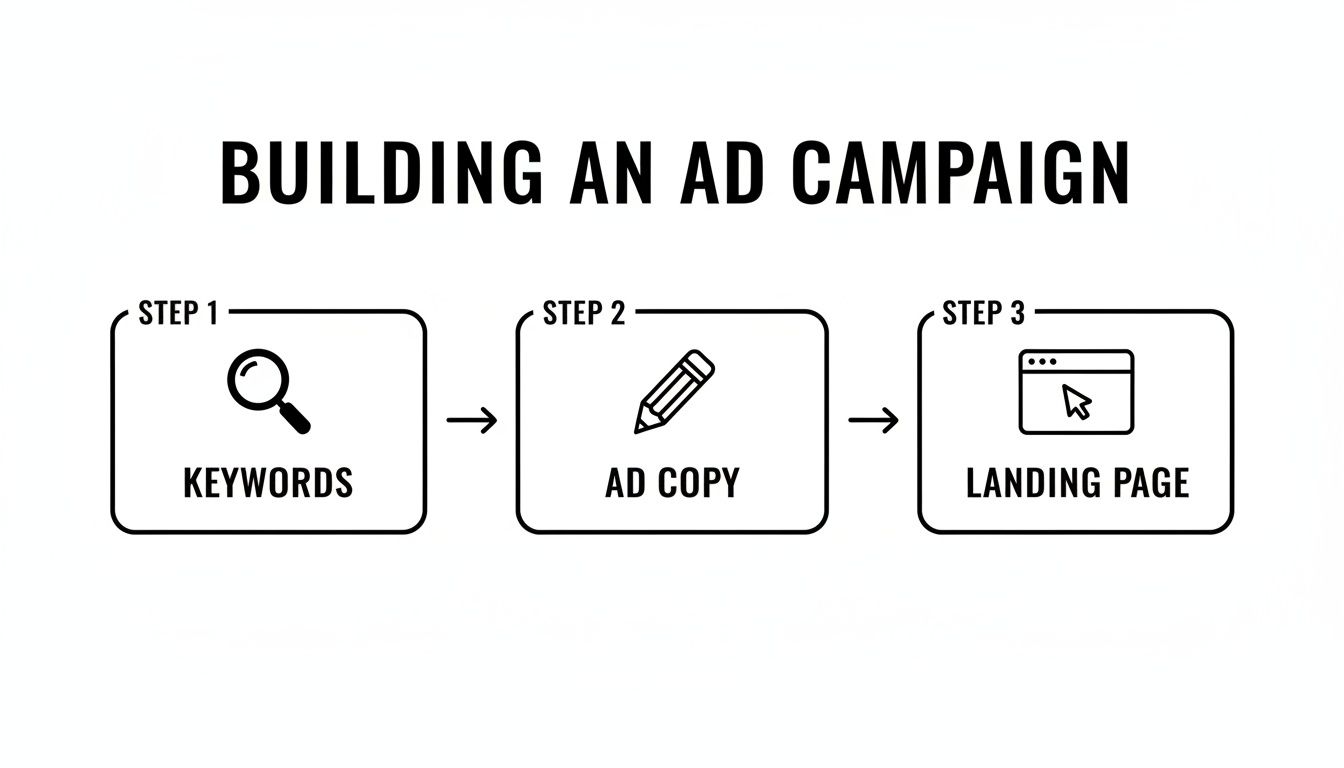
When your keywords, ad copy, and landing page are all perfectly aligned, you're not just getting clicks—you're getting customers.
Master Negative Keywords to Save a Fortune
If you take only one piece of advice from this guide, let it be this: get obsessed with negative keywords. These are the search terms you tell Google not to show your ads for. Think of them as the bouncer for your ad campaign, kicking out all the unqualified, budget-draining traffic before it even gets in the door.
Imagine you're a plumber who fixes leaky pipes. You don't want to waste a single cent on clicks from people searching for "plumbing school" or "plumbing jobs." By adding "school" and "jobs" to your negative keyword list, you instantly stop that bleeding.
I can't stress this enough: managing your negative keywords isn't a "set it and forget it" task. It’s an ongoing process. Making this a weekly habit can easily slash 20-30% of wasted spend from your budget in the first month alone.
Make a habit of digging into your search terms report weekly. This is where you'll find all the junk searches that are triggering your ads. If you want to speed this up, a tool like the Keywordme Chrome plugin can help you spot and eliminate these wasteful terms 10x faster than doing it by hand.
To keep things simple, here's a weekly checklist I recommend to all my clients to keep their campaigns lean and profitable.
Quick-Win Optimization Checklist
This simple routine doesn't take long, but the compound effect on your budget and results over time is massive.
Bring Back Lost Customers with Retargeting
Have you ever browsed for a pair of shoes online, decided against it, and then suddenly seen ads for those exact shoes following you around the internet? That's not a coincidence—it's retargeting, and it's one of the most powerful tools in your online advertising for small business playbook.
The concept is simple: you show specific ads to people who have already visited your website but left without buying anything. They’ve already raised their hand and shown interest, which makes them a much warmer lead than someone who’s never heard of you.
This isn't just a neat trick; it's incredibly effective. Heading into 2026, experts project that retargeting can boost conversion rates by a massive +70%. This is non-negotiable, especially when you consider that 57% of all online purchases happen on mobile and 88% of local searches start on a phone. You can find more stats that drive this point home in this great roundup on the impact of digital marketing.
Getting started is easier than you think. You just add a small snippet of code—often called a "pixel"—from your ad platform (like Google or Facebook) to your website. This builds an audience list of your past visitors, allowing you to run campaigns designed to pull them back in. It’s the perfect way to turn a "maybe later" into a definite "buy now."
Still Have Some Questions? Let's Clear Things Up
Got a few questions rattling around in your head? Good. That's a sign you're taking this seriously. Most small business owners I talk to have the same concerns when they're starting out.
Let's walk through the most common ones. No jargon, just straight talk.
So, How Much Should I Actually Spend on Ads?
This is the big one, isn't it? The honest answer is, "it depends," but that's not very helpful. So here’s a real-world starting point: aim for $20 to $50 per day.
That range is the sweet spot. It’s enough to get real data flowing in without you having to mortgage your house. The goal at the beginning isn't to get rich; it's to buy data. You're spending a little to learn a lot about what your customers are actually clicking on. Once you know what works, you can confidently ramp up your budget.
Which Ad Platform Is the Best Bet for a Beginner?
If you're a service business—a plumber, a consultant, a local shop—start with Google Ads. It’s a no-brainer. You're putting your business directly in front of people who are actively searching for the exact solution you offer. It's like setting up a shop right at the finish line of a race where everyone is looking for you.
Now, if you sell something that looks great in photos or videos—think clothing, home decor, unique food items—then Facebook and Instagram Ads are your playground. The visual nature of these platforms, combined with their incredible targeting, lets you find your perfect customer and build a real brand following.
If your budget is tight, pick one and own it. Don't try to be everywhere at once. Get really good at Google Ads or Facebook Ads. Once you've got a profitable system down, then you can think about expanding.
How Long Until I Actually See Results?
You'll see something happening almost right away—clicks, impressions, all that surface-level data will start trickling in within a day or two. But that's not the result you care about.
For the important stuff, like leads and sales, you need to give it time. Plan on letting your campaigns run for at least 30 to 90 days before making any huge decisions. This isn't a get-rich-quick scheme; it's a long-term strategy. The first month is all about learning and tweaking. Don't panic and pull the plug after three days of so-so results. Let the data tell you the full story.
Ready to stop guessing with your Google Ads? The Keywordme platform and Chrome plugin are built to help you find winning keywords, slash wasted ad spend, and optimize your campaigns way faster. Grab a free 7-day trial and see what it can do for you.
.svg)