
Localized Marketing Strategies: Your Step-by-Step Playbook
Localized Marketing Strategies: Your Step-by-Step Playbook


Localized pages capture 72% of brand engagement, but that lift only shows up when localization runs like an operating system, not a translation task. The teams that win treat localized marketing strategies as a workflow, with market selection, local research, creative adaptation, channel choice, and locale-level measurement all tied together.
Why Localized Marketing Strategies Move Revenue
Localized marketing strategies move revenue because they align the offer with how people in each market search, compare, and decide. The mistake many teams make is treating localization like a finishing touch. They launch the global campaign, then attach a translated landing page and expect the market to respond. That approach misses the point. Localization performs when it runs as an operating workflow, with market selection, local research, creative adaptation, channel choice, and locale-level measurement all connected before the first asset goes live.
The engagement signal is hard to ignore. Local content has been reported to drive 6x more engagement on social media when it speaks directly to local audiences, and localized pages captured 72% of brand engagement in one example set of metrics, both cited in the same industry summary on marketing localization statistics (Unbabel survey and related industry figures). Those gains are not cosmetic. They show that message-market fit changes how people interact with a brand, and that shift carries through to conversion quality and downstream revenue.
The five-step base layer
A sound localized marketing strategy starts with five decisions in order, not all at once:
- Identify priority regions and audiences.
- Research local behaviors and cultural context.
- Develop localized creative and messaging.
- Activate across locally relevant channels.
- Measure and optimize by locale.
Skip the first step and the rest turns into expensive guesswork. Choose the right markets first, and every later decision gets easier because the team is solving for real demand instead of vanity coverage.
Practical rule: if a market does not have a clear reason to exist in your plan, it should not get a budget yet.
That logic matters more now because localization-related spend is no longer niche. The location-based advertising market was valued at $128.12 billion in 2024 and was projected to grow at a 15.0% CAGR from 2025 to 2030, while the broader location-based marketing market was estimated at $101.85 billion in 2026 and forecast to reach $424.64 billion by 2035 at a 17.19% CAGR (market sizing summary). That scale says the same thing your dashboard does, localized execution has become a core growth system, and the budget decisions behind it deserve the same discipline as any other revenue channel.
For teams building practical infrastructure, solutions for local businesses is a useful reference point because it reinforces the same operating idea, local relevance only performs when the workflow supports it.
Planning and Researching Markets Before You Spend a Dollar
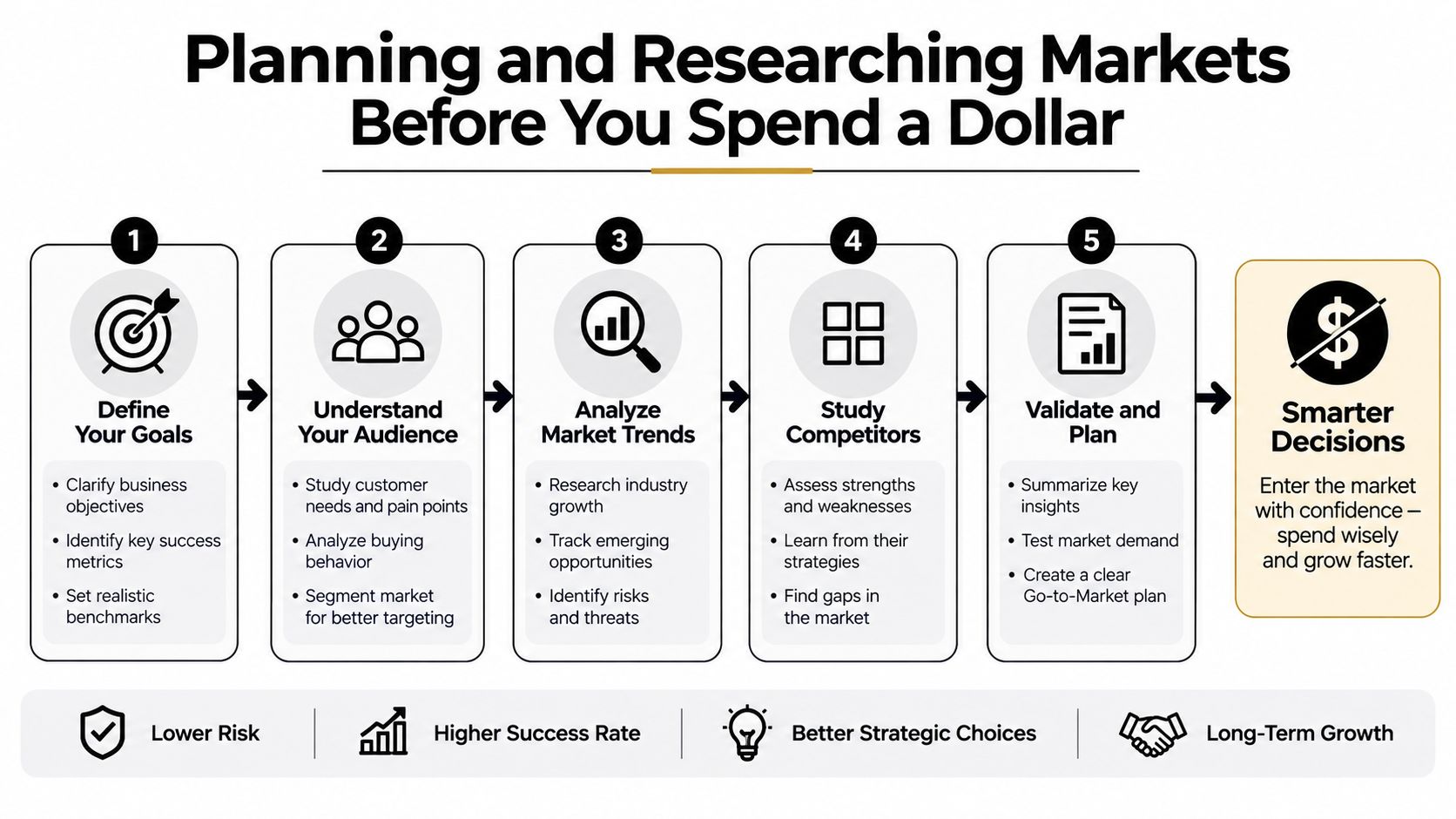
The quickest way to waste localization budget is to treat familiarity as proof of opportunity. Teams often start with the countries they know best, then defend the choice with convenience or internal politics. That approach reflects habit, not strategy.
Pick markets with evidence, not instinct
Amazon's localized marketing guidance puts the priority decision where it belongs, on regional demand signals and under-representation gaps (Amazon localized marketing strategy). The shortlist should come from evidence like search demand, competitor presence, category whitespace, and channel fit, not from whoever had the strongest opinion in the planning meeting.
A practical research pass usually looks like this:
- Search demand by locale. Look for recurring phrases, not just broad category keywords.
- Competitor saturation. Check whether local rivals already own the obvious entry points.
- Language patterns. Note how buyers describe the problem, not how your internal team names it.
- Channel dominance. Match the market to the platform people use.
- Compliance friction. Flag local legal or editorial constraints before creative starts.
A close look at how to find competitor websites helps here, because competitor mapping is often the fastest way to see how crowded a market really is, especially when you are comparing a home market against a new region.
Research behavior before you touch creative
Local behavior research is where assumptions get exposed. Search habits differ, buying cycles differ, and the same category can carry different decision triggers from one region to the next. Localized marketing strategies fail when teams localize words before they localize understanding.
Ask what would make a buyer in this market trust you enough to click.
The core failure mode is skipping research and then judging every market with a single global KPI. Amazon's guidance is explicit about using region-specific benchmarks rather than a universal scorecard, because aggregate performance can hide underperformance in an individual locale (Amazon localized marketing strategy).

Research should end with a simple output, a market brief that names the buyer, the channel, the language patterns, and the local proof points you will need. Without that, every downstream asset is built on a shaky premise.
Localized Keyword Strategies for Search and Paid Media
Keywords are where localized marketing strategies either become precise or fall apart. The same product can attract very different search terms in different markets, and if your ad groups don't reflect that, you end up paying for traffic that never had a chance to convert.
Build keyword sets around local intent
Localized keyword research starts with intent, not translation. A phrase that looks strong in a global report can be nearly useless in a specific market if it doesn't match how buyers search there. That's why the keyword list for one region shouldn't be copied and pasted into another.
Structure your work in this order:
- Collect local search terms from the market, not from a central glossary.
- Group terms by buyer intent and local wording.
- Map each group to one landing page and one offer.
- Exclude irrelevant queries with negative keywords.
- Review search term data and clean up the waste.
That structure matters because paid search punishes vagueness fast. If the ad group is too broad, spend leaks into junk queries. If it's too narrow, you miss variations that local buyers naturally use.
For a deeper tactical split between market scope and intent scope, the article on how to target local vs national keywords is a practical companion piece.
Match type discipline keeps local budgets honest
Match type choices should reflect how predictable the locale is. Exact match works when you know the phrasing is stable and high intent. Phrase match is more forgiving when local buyers use variants that still signal the same need. Broad match can work, but only with disciplined negative keyword coverage and tight monitoring.
Practical rule: if you can't explain why a search term belongs in that locale, it probably belongs in the negative list.
Keywordme fits into this part of the workflow as one tool for cleaning junk search terms, expanding ad groups with high-converting local keywords, and applying match types in one click. The point isn't the tool itself, it's the speed gain you get when repetitive account work stops blocking optimization.
Localized keyword strategy is not about stuffing city names into ads. It's about building a market-specific search structure that tells the algorithm, and the buyer, the same story.
Ad Copy and Creative That Resonate Locally
Localized ad creative starts with the language on the page, but the work goes well beyond translation. A message can be grammatically correct and still miss the market if the offer, tone, or visual cue does not match how buyers make decisions locally.
Compare literal translation with local relevance
A translated ad can be accurate and still underperform because it misses the local buying trigger. In one market, the hook might be speed. In another, it might be trust, status, convenience, or price clarity. Strong localized marketing strategies change the angle, not just the words.
That is the difference between a translated homepage and a market-specific landing page. A homepage is usually too broad to carry local intent, while a local page can mirror regional search terms, local proof, and the tone buyers expect. The strongest localized pages feel built for that market from the start.
The creative checklist is straightforward:
- Use local idioms carefully. If a phrase sounds forced, rewrite it.
- Adapt the offer framing. What persuades in one market may feel flat in another.
- Reflect local visuals. Images, symbols, and context should feel native.
- Respect buying cadence. Seasonal and cultural timing matters.
- Review tone with local eyes. Formality, humor, and directness do not travel evenly.
Ad copy examples is useful if you want to see how wording changes the job of an ad, not just its style.
Measure creative with the right lens
Smartling's guidance treats localization as an operational process rather than a copy task. Teams should measure localized conversion rates, engagement by region, regional pipeline growth, organic search traffic, content turnaround time, and translation-memory reuse (Smartling marketing localization). Those metrics make it easier to separate a message problem from a process problem.
If localized conversion rises but engagement stays weak, the message may be too late in the funnel. It is converting people who were already close, but it is not earning attention early enough. That points to a creative problem, not a reporting problem.
The test of localized ad copy is simple. Does the market feel seen before it feels sold to? If not, the translation is doing too much of the work and the strategy is doing too little.
For teams that need a tighter input on audience selection before creative is written, the demographic targeting guide is a useful companion.
Execution, Geo-Targeting, and Channel Selection by Region
Launch is where strategy meets friction. A campaign can have the right message and still miss the market if geo-targeting is loose or if the channel mix assumes every country behaves like the home market.

Geo-targeting needs a tighter setting than many teams apply
A country-level campaign is often too blunt. If buyer intent is city-specific, a national target can dilute relevance and blur the signal. Location setup should match the market shape, not just the map inside the ad platform.
The practical standard is straightforward. Target the places where the audience is, then structure the campaign around that geography. Keywordme's PPC guidance also points to using Google Ads location targeting set to “Presence: People in or regularly in your targeted locations” and reviewing the Geographic performance report to separate cities and regions by performance. That kind of location discipline keeps spend aligned with actual buyer presence.
Pick channels based on regional platform reality
Platform dominance is not universal. Facebook and TikTok are popular in the U.S. and Canada, VK works in Russia, LINE is big in Japan, and WeChat is the go-to platform in China (Lokalise marketing localization). If your channel plan ignores that reality, the campaign exports home-market habits instead of localizing.
A workable channel map usually starts with three questions:
- Where do buyers spend time?
- Which platform supports the message format you need?
- What proof does that channel require for trust?
For demographic framing, the demographic targeting guide is a useful reminder that audience structure should shape channel choice, not the other way around.
Don't ignore sparse or underserved markets
Localized marketing for rural or underserved audiences needs different assumptions. In low-density markets, neighborhood tactics matter less than trust signals, distribution, and proximity cues. A glossy metro playbook can fail there because the decision environment is different (rural and underserved markets guidance).
That is the part many guides miss. They explain which local tactics exist, but not how to adapt when there are few local signals to benchmark against. In those markets, you often have to measure more slowly, build trust harder, and expect channel performance to look unlike the urban norm.
Measuring Results and Optimizing Localized Campaigns
A single global dashboard makes localized marketing strategies look cleaner than they are. It hides weak regions inside stronger ones, and that creates false confidence right when precision matters most.

Measure by locale, not by average
Amazon's guidance on region-specific benchmarks points in the right direction because aggregate reporting can hide local failures. Every active locale needs its own dashboard, its own baseline, and its own definition of success, or you end up optimizing the wrong thing (Amazon localized marketing strategy).
The minimum measurement set should include:
- Localized conversion rate
- Engagement by region
- Organic search traffic by locale
- Content turnaround time
- Translation-memory reuse
Those metrics answer different questions. Conversion shows whether the offer closed. Engagement shows whether the message earned attention. Turnaround time shows whether the workflow is healthy. Reuse shows whether the system is getting smarter or just busier.
If one region improves and another stalls, do not celebrate the blended average. Find out which market moved.
Use tooling to shorten the learning loop
Optimization gets easier when repetitive account work is automated. That is where Keywordme can fit, because it helps teams clean up search terms, assign match types, and build negative keyword lists faster than manual spreadsheet workflows. The value is not only speed, it is the shorter path from local hypothesis to account change.
If localized conversion improves but engagement does not, the issue is usually early-funnel relevance. If engagement improves but conversion does not, the problem is usually landing page fit, offer alignment, or trust signals. The answer lives in locale-level data, not in aggregate reports.
Localized campaigns scale best when the system stays granular. Once the market-level view disappears, optimization shifts toward averages, and relevance drops with it.
Keywordme helps teams manage localized paid search without the manual churn that usually slows market expansion. If you are building localized marketing strategies and want a faster way to clean search terms, structure ad groups, and manage match types by market, visit Keywordme and see how it fits into your workflow.
.svg)