
How to improve marketing efficiency: Quick Wins for Faster Growth
How to improve marketing efficiency: Quick Wins for Faster Growth


If you want to make your marketing more efficient, you have to start by finding and fixing the hidden leaks in your funnel. We're talking about a deep-dive audit to uncover exactly where you're wasting time and money on things that just don't move the needle—like ad spend on keywords that never convert or manual tasks that a machine could do in seconds.
Find and Fix the Leaks in Your Marketing Funnel
Before you can build a slick, efficient marketing machine, you have to play detective for a bit. Too many teams jump straight to shiny new tools or complex strategies, hoping for a quick fix. But honestly, the fastest wins almost always come from stopping the bleeding.
Think of it like a leaky bucket. It makes zero sense to keep pouring more water in until you’ve patched the holes. This process, what I call a marketing efficiency audit, is about digging way deeper than surface-level stats like clicks or impressions. You need to get to the why behind your data to find the biggest drains on your resources.
Pinpointing Your Biggest Resource Drains
Your first mission is to find the specific activities that eat up the most resources but give you the least in return. These are your top-priority targets. Most of the time, these resource drains fall into a few usual-suspect categories:
- Wasted Ad Spend: This is the big one. It's the money you're blowing on irrelevant keywords, campaigns hitting the wrong audience, or ads with conversion rates so low they make you cringe.
- Manual Grunt Work: Think about all the hours your team spends on repetitive, low-impact tasks. Manually pulling reports, copying and pasting data between spreadsheets, or painstakingly managing negative keyword lists in Google Ads are classic examples.
- Underperforming Content: That blog post or video that took a ton of time and money to create but isn't attracting, engaging, or converting anyone? That's a major efficiency killer.
This simple three-step flow is a great way to visualize how to find and fix these leaks.
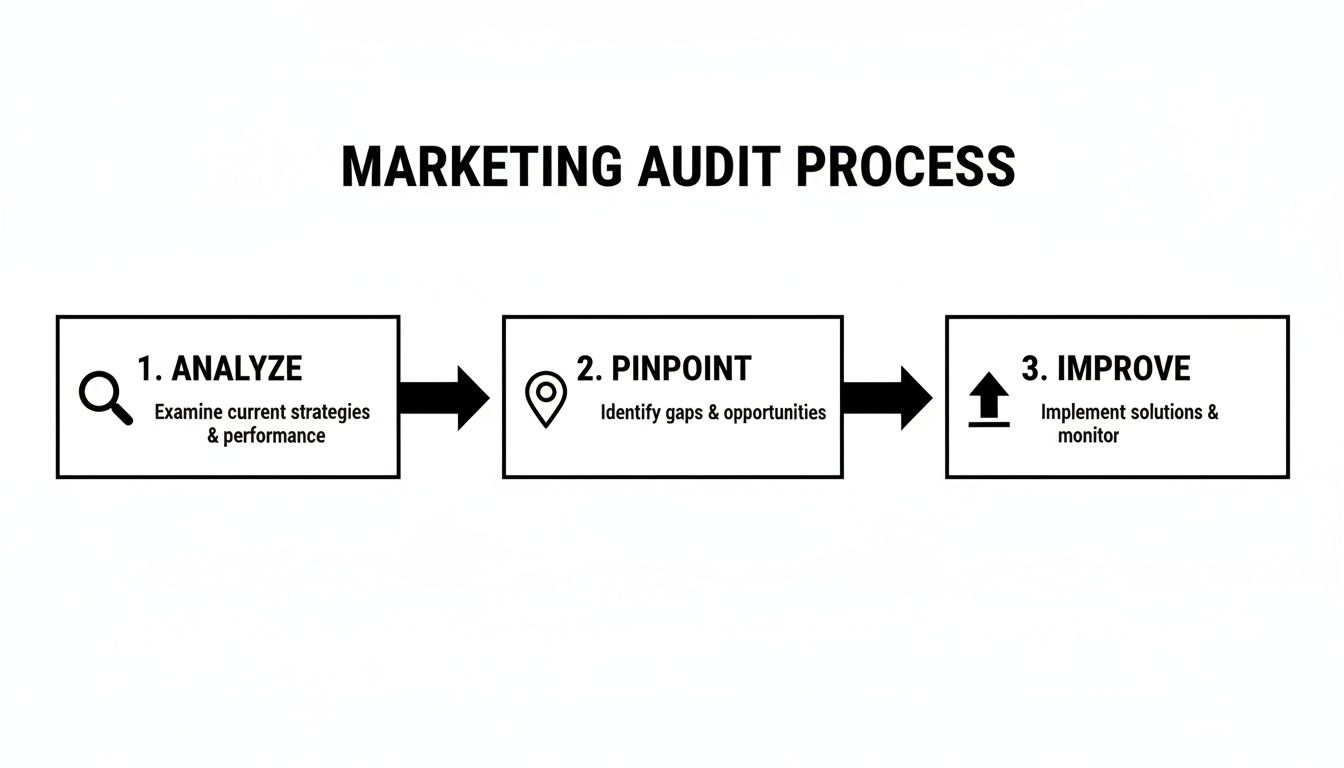
You analyze the data, pinpoint the specific problems, and then implement targeted improvements. It’s a straightforward, repeatable framework for getting more bang for your buck.
A Real-World Scenario in Action
Let’s get practical. Picture an e-commerce store running Google Ads for running shoes. At first glance, their overall sales look pretty good. But when they actually dig into their search term report, they uncover a massive leak.
It turns out that 30% of their ad budget is being spent on keywords like "free shoe repair" and "how to clean running shoes." Sure, these are related to their industry, but the people searching for them have zero intention of buying new shoes right now. Every single click is just money down the drain.
Once they spotted these non-buyer keywords, the fix was simple: add them to a negative keyword list. That one small action immediately plugged a huge financial leak, freeing up 30% of their budget. Now, they can redirect that cash to high-intent keywords like "buy trail running shoes" or "best marathon running shoes." This is a perfect example of how a quick audit can lead directly to a huge efficiency boost. For more on this, check out our complete guide to conversion rate optimization best practices.
Key Metrics to Scrutinize
To find your own leaks, you have to be looking at the right data. It’s easy to get lost in vanity metrics, so make sure you’re focused on the numbers that actually tie back to efficiency and ROI.
The goal isn't just to get more clicks or leads; it's to get them more profitably. Your audit should be laser-focused on metrics that reveal the true cost and return of your efforts.
Start by digging into these KPIs:
- Customer Acquisition Cost (CAC): How much are you actually paying to get a new customer from each specific channel or campaign?
- Return on Ad Spend (ROAS): For every dollar you put into advertising, how much revenue are you getting back out?
- Lead-to-Customer Conversion Rate: What percentage of your leads are actually turning into paying customers? A low number here often points to a disconnect between your marketing and sales efforts.
- Time Spent on Manual Tasks: This isn't a typical KPI you'll find in a dashboard, but estimating the hours your team spends on repetitive work can reveal incredible opportunities for automation.
When you have this data-backed starting point, you’re no longer guessing. Your audit will shine a bright light on the biggest opportunities, giving you a clear, focused roadmap for what to fix first.
Automate Your Way to Smarter Ad Campaigns

If you’ve audited your marketing funnel and found leaks, automation is the best way to patch those holes for good. It's probably the most powerful tool you have for boosting marketing efficiency, especially when you're dealing with the chaos of PPC advertising.
This isn't just about setting up a few email drips. We're talking about handing over the repetitive, soul-crushing tasks to technology so you can finally focus on what really matters: strategy and growth. Let's dig into how this plays out with something every PPC manager knows well—keyword management in Google Ads.
Escape the Search Term Report Grind
How many hours have you lost scrolling through endless search term reports? You're digging for gold, but mostly you're just sifting through junk—all those irrelevant queries that bleed your budget one pointless click at a time. The whole copy, paste, and manually add to negative keyword lists routine is as tedious as it is critical.
That manual grind is a massive efficiency bottleneck. It's slow, it’s easy to make mistakes, and frankly, it's a terrible use of a skilled marketer's brainpower. A tool like keywordme, for example, can turn this multi-hour chore into a one-click process, letting you stop wasted ad spend right at the source.
When you automate your negative keyword lists, you’re not just saving time. You’re sharpening your campaign’s targeting, making sure your ads only show up for people who are actually looking for what you sell. It’s all about letting technology handle the grunt work so you can step up your game.
The Power of Automated Keyword Management
True keyword automation is more than just blocking bad terms. It’s about building a smarter, more resilient campaign structure over time.
Here’s what that actually looks like:
- Intelligent Negative Keyword Building: Instead of you manually spotting "free," "jobs," or "DIY," an automated system can find these budget-draining terms across hundreds of search queries in an instant.
- Proactive Keyword Discovery: That same report hiding all the junk also has high-potential keywords buried in it. Automation can spot these winners and let you add them to the right ad groups with the right match type, all in one go.
- Consistent Match Type Application: Guessing between broad, phrase, and exact match types can get expensive. An automated workflow helps you apply a consistent strategy, optimizing for both reach and relevance without all the manual second-guessing.
I've seen campaign managers use keywordme to scan thousands of search terms in minutes, add hundreds of negative keywords, and simultaneously expand their ad groups with a dozen new high-intent keywords. That’s a task that would have easily burned an entire afternoon.
Let Data Drive Your Efficiency
This shift toward automation isn’t just a trend; it's backed by some serious performance gains. A staggering 70% of advertisers cite Google Ads as their highest ROI channel, and automation is how they unlock that potential.
Businesses using tools like Smart Bidding have seen their cost per acquisition (CPA) drop by as much as 30%. Automating your negative keyword lists fits right into this strategy, preventing the wasted spend on junk terms that can easily eat up 30% of a campaign's budget. This shift away from constant manual tweaks allows PPC specialists to speed up their workflows by up to 10x, freeing them to focus on high-level strategy and creative testing.
By automating the tactical, you free up the strategic. The goal is to stop being a campaign 'mechanic' and start being a campaign 'architect.'
Expanding Your Automated Toolkit
While keyword management is a huge win, this automation mindset can be applied all over your ad campaigns. With advertising now making its way into AI chatbots, understanding and using this guide to AI-Driven Marketing Campaigns with ChatGPT Ads can be another key part of your optimization strategy.
Look for other repetitive tasks you can offload to technology. A few easy wins include:
- Automated Reporting: Set up dashboards that automatically pull data from your ad platforms. This alone can save you hours of manual report-building every single week.
- Rule-Based Bidding: Create rules to automatically pause low-performing ads or keywords that drop below a certain ROAS threshold.
- Ad Copy Testing: Use responsive search ads and dynamic creative. Let the platform’s AI test different headline and description combos for you.
Embracing automation isn’t about replacing marketers. It’s about empowering them to operate at a higher level, make smarter decisions faster, and drive the kind of efficiency that leads to real growth.
Streamline Your Team's Marketing Workflows

Let's be honest—you can't just throw a bunch of fancy automation tools at a broken process and expect magic to happen. True efficiency comes from how your people and your technology work together. A clunky, disorganized workflow will always be a bottleneck, no matter how many shiny apps you're paying for.
To really see a jump in your team's output, you have to look at the human side of the equation. This is all about refining how your team operates, communicates, and gets things done day-to-day. The goal is a system so smooth and clear it becomes second nature.
Create Simple and Clear SOPs
The secret weapon for a seamless workflow? Standard Operating Procedures (SOPs). And I'm not talking about those hundred-page binders that just collect dust on a shelf. These should be quick, scannable, and genuinely useful guides for your most common tasks.
Think about the routine jobs your team tackles every week. Things like setting up a new PPC campaign, pulling a monthly analytics report, or even onboarding a new client. Documenting a clear, step-by-step process for these tasks crushes confusion and cuts down on those endless "just a quick question" emails and Slacks.
A great SOP doesn't just tell someone what to do; it shows them the most efficient way to do it. You're basically bottling up your team's best practices so that anyone can deliver great results, every single time.
This approach not only makes your team faster and more consistent but also massively speeds up training for new hires. You’re handing them a playbook for success from day one.
Standardize Your Key Processes
Once you've got your individual tasks down, zoom out to your larger workflows. How does your team really handle keyword research? What’s the official process for launching a new campaign from start to finish? Standardizing these core systems gets everyone rowing in the same direction.
For instance, plugging a tool like keywordme into your PPC workflow instantly creates a standard for how you manage keywords. Instead of every manager having their own messy spreadsheet or a "unique" method for finding negatives, everyone follows the same simple, one-click process. This creates incredible consistency and makes it a breeze to hand campaigns off between team members.
If you’re juggling multiple clients, you’ll find that good PPC management software for agencies can become the backbone for these standardized workflows, keeping everything in one organized place.
To see just how much of a difference this makes, let's look at the time spent on common Google Ads tasks.
Manual vs Automated PPC Workflow Comparison
The numbers don't lie. Adopting a standardized, tool-assisted workflow doesn't just shave off a few minutes here and there; it fundamentally changes how much your team can accomplish.
Use Checklists to Eliminate Errors
For multi-step processes like a campaign launch, simple checklists are your absolute best friend. They're a safety net, ensuring nothing critical gets missed when things get hectic. A solid checklist prevents a simple human error from derailing an entire launch.
Here’s a practical PPC launch checklist you can steal and adapt:
- [ ] Ad groups are tightly themed around specific keyword concepts.
- [ ] Naming conventions are consistent (please!).
- [ ] Budget and bidding strategy are set and double-checked.
- [ ] Initial negative keyword list has been applied.
- [ ] Location, device, and language targeting are correct.
- [ ] Match types are chosen strategically (no "all broad match" surprises).
- [ ] Ad copy is proofread for typos and grammar.
- [ ] Landing page URL is correct and the page actually loads.
- [ ] Conversion tracking is installed and has been tested.
This isn’t about micromanaging. It’s about giving your team a framework that empowers them to work confidently and independently. When you combine smart SOPs, standardized tools, and simple checklists, you eliminate the operational chaos that kills productivity and morale. You free up your team’s brainpower to focus on what really matters: strategy, creativity, and getting killer results.
Focus on Your High-Impact Marketing Activities
Let’s be honest. Not every marketing task on your to-do list is created equal. The real secret to a massive leap in efficiency isn't about working harder or longer hours; it’s about getting brutally honest about what actually moves the needle and then doing a lot more of that.
This is where the classic 80/20 rule comes into play. You might know it as the Pareto Principle, but for us marketers, it’s a lifesaver. It basically says that roughly 80% of your results will come from just 20% of your efforts. Your job—your mission, really—is to find that golden 20% and pour your energy into it.
It's all about pinpointing your best-performing campaigns, your most profitable keywords, or the blog posts that are true conversion machines. Once you know what they are, you can double down on your winners and finally start cutting the dead weight that's been slowing you down.
Pinpoint Your 20 Percent Winners
First things first, you have to go on a data-driven treasure hunt. This isn’t about what you feel is working; it's about digging into your analytics to see what the numbers are screaming at you.
Here are the key places I always look to find those top performers:
- Campaigns: Which ad campaigns consistently deliver the highest Return on Ad Spend (ROAS)? Forget about vanity metrics like clicks. I’m talking about the campaigns that generate actual sales or qualified leads.
- Keywords: Get cozy with your search term reports. You'll almost always find that a small handful of keywords is driving the vast majority of your conversions. Spot them, and give them the budget they deserve.
- Content: Check your website analytics. Which blog posts, landing pages, or videos have the highest engagement and, more importantly, the best conversion rates? Those are the topics your audience is begging you for.
- Channels: Is it Google Ads, LinkedIn, or your weekly email newsletter that brings in your best customers? Figure out where your most valuable audience hangs out and focus your firepower there.
The goal here is to shift your entire mindset from "What else can we possibly do?" to "What can we stop doing?" Being ruthless about cutting low-performing activities is just as crucial as scaling the successful ones.
Double Down and Reallocate Resources
Once you've identified your high-impact 20%, it's time to act. This isn't just a mental exercise. It requires a real, tangible shift in how you allocate your two most precious resources: time and money.
For instance, say you find that two of your ten Google Ads campaigns are generating 80% of your revenue. That’s a no-brainer. You should seriously consider pausing the other eight underperformers and funneling their entire budget into the two that are absolutely crushing it. This single move can dramatically boost your overall marketing efficiency overnight, without you spending a single extra dollar.
A Real-World Agency Scenario
I once saw this play out perfectly with a digital marketing agency I was advising. They were juggling twenty different clients, and the team was completely fried. They felt like they were constantly putting out fires, and morale was tanking.
We did an 80/20 analysis, and the results were shocking.
It turned out that just four of their clients (20%) were generating nearly 80% of the agency's total profit. The other sixteen clients, while paying their invoices, were incredibly high-maintenance, demanded a ton of manual work, and had razor-thin profit margins.
The agency made a tough call. Over the next quarter, they professionally and gracefully offboarded their sixteen low-impact clients. All their energy was refocused on giving incredible, proactive service to their top four accounts. The results were almost immediate: profitability soared, the team was suddenly less stressed and more focused, and they started getting amazing referrals from their happiest clients. That's the 80/20 rule in action—completely transforming a business just by focusing on what truly matters.
Measure What Matters for True Efficiency
You can't fix what you don't measure. It’s an old saying, but it’s true. The real trap, though, is getting lost in a sea of "vanity metrics." This is one of the biggest efficiency killers I see. Tracking impressions, likes, or even raw click numbers feels productive, but they often tell you next to nothing about what's actually moving the needle for the business.
Real efficiency isn't about being busy; it's about being effective. This means creating a lean, focused way to measure your work that ties every single marketing action back to a real business goal. It’s all about making smarter, faster decisions without getting buried in data that doesn't matter.
Ditching Vanity Metrics for Real KPIs
First things first: you have to draw a hard line between the metrics that make you feel good and the metrics that make you money. This is the critical difference that separates high-performing teams from those just spinning their wheels. An impression doesn’t pay the bills, and a social media like doesn't cover payroll.
Instead, you need to laser-focus on a handful of Key Performance Indicators (KPIs) that directly show your marketing’s financial health and its contribution to the bottom line. These are your real efficiency metrics.
Customer Acquisition Cost (CAC): This is the ultimate "How much did it cost us?" metric. It boils down all your marketing and sales spend to figure out what it costs to land one new customer. Your job is to constantly find ways to push this number down.
Return on Ad Spend (ROAS): A total non-negotiable for any paid advertising. For every single dollar you put into a campaign, how many dollars in revenue are you getting back? This tells you exactly which campaigns are profitable and which are just burning cash.
Customer Lifetime Value (LTV): This metric forces you to look beyond that first sale. It estimates the total revenue you can expect from a single customer over their entire relationship with your brand. A high LTV is a clear sign you’re not just acquiring customers, but the right customers.
LTV to CAC Ratio: This is where the magic really happens. A healthy ratio, typically 3:1 or higher, means you have a sustainable and profitable business model. It tells you that for every dollar you spend to get a customer, you're getting at least three dollars back over their lifetime.
To really nail this, it's crucial to understand how to measure marketing effectiveness by connecting your day-to-day activities to these big-picture business results. It helps everyone on the team see how their work impacts the company's financial success.
Building Your Efficiency Dashboard
You don’t need a hundred different charts to see what’s going on. A simple, clean dashboard that tracks your core efficiency KPIs is all you need to stay on course. Think of this dashboard as your single source of truth, giving you a quick, at-a-glance view of your marketing engine's health.
Your dashboard should answer one simple question: Are our marketing efforts getting more or less profitable over time? If you can’t answer that in 10 seconds, your dashboard is too complicated.
Here’s a simple template for what a lean dashboard should track.
Marketing Efficiency Dashboard Template
This kind of clear, concise view helps you spot trends, celebrate wins, and jump on problems before they spiral out of control. It turns data into something you can actually use—which is the whole point of measuring in the first place.
This is also where a tool like keywordme makes a direct, measurable impact. By automating the removal of junk search terms from your campaigns, you immediately slash wasted ad spend. This directly lowers your CAC and boosts your ROAS, making those key numbers on your dashboard look a whole lot healthier.
A Few Lingering Questions

It’s one thing to read about boosting marketing efficiency, but it’s another thing entirely to get your hands dirty and actually do it. Let’s tackle some of the most common questions I hear when teams start trying to put these ideas into practice.
How Long Does This Stuff Actually Take to Work?
This is the big one, right? And the honest, no-fluff answer is: it depends. But if you’re looking for a quick win, start with your paid ad campaigns.
Using a tool to automatically clean up wasted ad spend can improve your Return on Ad Spend (ROAS) in a matter of days. You’re essentially plugging leaks in your budget, and that impact shows up on your P&L almost immediately.
Bigger process changes, like overhauling team workflows or implementing new SOPs, will take longer. You might need a full quarter to really see a major difference in your team's overall output. The trick is to grab the low-hanging fruit first—like PPC cleanup—to build some momentum and prove the concept.
Can a Small Business Really Do This?
Heck yes. In fact, I'd argue it's even more critical for you. When you have a tight budget and a small team, you can't afford to waste a single dollar or hour.
The key is to resist the urge to do everything at once. Pick one high-impact area and go deep. For most small businesses I've seen, that's their Google Ads campaigns. A smart automation tool can give a solo marketer the power of a much larger team by handling the most soul-crushing, tedious tasks.
For small teams, the 80/20 rule isn't just a good idea—it's a survival guide. Find your single most profitable channel and optimize the heck out of it before you even think about expanding.
How Do I Convince My Boss to Pay for New Tools?
Frame the conversation around ROI, not features. Stop pitching a "new tool" and start presenting a solution to a specific, expensive problem. You have to draw a straight line from the tool's cost to either time savings, cost reduction, or revenue growth.
Get specific and use real numbers to build your case.
- Show the time saved: "We spend about 10 hours a month just managing negative keywords. At our team's blended rate, that's $500 in labor we're just throwing away."
- Show the money saved: "I'm confident we can cut our wasted ad spend by at least 15-20% with automation, which works out to over $1,000 back in our pocket each month."
- Show the bottom line: "This tool is $150 a month, but it will save us a combined $1,500 in time and ad spend. It literally pays for itself in the first week."
Even better, most modern tools offer a free trial. Use it. A trial lets you build an undeniable business case with your own data. It's tough for a manager to say no when you can prove the value before they ever pull out a credit card.
Ready to stop wasting time and money on manual keyword management? keywordme turns hours of tedious work into a one-click process, helping you boost your ROAS and scale your Google Ads campaigns faster than ever. Start your free 7-day trial and see the difference for yourself.
.svg)