
Best Social Media Ad Platforms: 2026 Guide
Best Social Media Ad Platforms: 2026 Guide


Where should you spend your social ad budget in 2026, and which platforms are just eating spend without giving you much back? That's the question most buyers get wrong. They chase the biggest names first, then wonder why reporting is messy, creative burns out, or the funnel looks good in-platform but weak everywhere else. Social media ad platforms have become a core part of the digital mix, with spending projected to reach $317.33 billion in 2026 and social ads forecast to account for 3 in every 10 dollars spent on digital advertising overall, according to Sprout Social's social media statistics roundup. A separate market estimate puts the category at USD 136.05 billion in 2025 and USD 302.41 billion by 2032, which is a useful reminder that this isn't a niche channel anymore, it's a serious budget line with real auction pressure Research and Markets.
For teams running performance media, the practical problem isn't whether social works. It's figuring out which platform fits the offer, the audience, the creative, and the measurement stack without making your paid search account harder to manage. If you're already balancing Google Ads, Meta, and a few experiments on the side, the safest move is to choose platforms that match your funnel stage and your operational bandwidth, not just the one with the loudest reputation. A strong starting point for startup teams is this startup social media strategy from Bazzly, but the payoff comes from picking the right ad system for the job, then tracking it with discipline across channels.
1. Meta Ads Facebook and Instagram
Meta is still the default choice for a lot of advertisers because it gives you scale, format variety, and enough automation to make performance work at serious volume. The platform sits on top of Facebook and Instagram, which means you can blend Feed, Reels, Stories, Marketplace, and Shops placements without rebuilding your whole campaign structure every time creative changes. For ecommerce, that flexibility matters, especially when you're running Dynamic Product Ads, Advantage+ shopping, or remarketing sequences that rely on first-party signals.
The biggest reason Meta keeps winning budget is simple. It's where the machine-learning stack is the most mature, and it's also where advertiser adoption is deepest. Ramp's June 2026 vendor data says Facebook Ads is used by 71% of organizations with a paid-ads vendor, ahead of Google Ads at 29%, LinkedIn Ads at 23%, and TikTok Ads at 12%. That doesn't automatically make Meta the best choice for every campaign, but it does mean your team will usually find the most battle-tested workflows there.
Where Meta works best
Meta tends to shine when the goal is full-funnel performance. It's a strong fit for remarketing, lookalike targeting, and catalog-driven commerce, and it usually gives media buyers enough inventory to test creative angles fast. It also tends to be the platform where creative fatigue shows up first if the account is underfunded or the message is too generic.
Practical rule: If your creative can't hold attention in the first second or two, Meta will expose that faster than your landing page will fix it.
The main trade-off is volatility. Small budgets can struggle because the system needs enough conversion signal to stabilize, and attribution can get noisy when privacy restrictions and signal loss distort reporting. If you want a clean, practical walkthrough on setting up Meta campaigns for both Facebook and Instagram, the Keywordme guide to advertising on Facebook and Instagram is a useful companion.
2. TikTok Ads
TikTok is built for attention first, then conversion second, which is exactly why a lot of performance teams underuse it. The platform rewards ads that feel native to the feed, not polished TV spots transplanted into vertical video. If your brand can produce short, fast-moving creative with a real human voice, TikTok can deliver efficient discovery, especially for younger and mid-age audiences.
What makes TikTok more interesting now is that it's moved beyond pure awareness. Search Ads bring keyword bids and match-type controls into the mix, which gives paid search teams a workflow that feels closer to PPC than classic social buying. That matters because it lets you test intent-driven queries without abandoning the creative energy that makes the platform work in the first place.
The budget and creative reality
TikTok does enforce minimum budgets at campaign and ad group levels, and that shapes how you test. Small experiments can get boxed in fast if you're trying to run too many variants with too little spend. On the creative side, you also need a steady pipeline of new assets, because “set it and forget it” doesn't work here.
Budgeting instinct: Don't judge TikTok on one polished ad and one week of delivery. Judge it on whether your team can produce enough creator-style variants to keep the learning loop alive.
If you need a practical reference on how the platform handles business-side execution, start with TikTok Ads itself, then sanity-check your creative volume against the account's pacing requirements. The strongest use cases are still Shop, lead gen, and test campaigns where you're willing to trade polish for volume and speed.
3. YouTube Ads via Google Ads
YouTube is usually the safest “social-adjacent” place to spend when you want reach plus a cleaner link to Google's measurement ecosystem. It isn't social in the same feed-first sense as TikTok or Meta, but it behaves like a social attention platform in practice because you're buying video influence in a highly visual environment. That makes it a good bridge between upper-funnel storytelling and downstream performance.
The biggest edge here is integration. You get audience layering, remarketing, and shared measurement with the broader Google Ads stack, which makes YouTube much easier to connect to search behavior than most standalone social platforms. That matters when paid media teams want to understand how video exposure influences later clicks, branded queries, and conversion paths in Google Ads.
When YouTube is the smarter buy
YouTube works best when your creative is strong enough to carry the message without social-native gimmicks. If the production looks thin, viewers will skip it, and the platform won't save you. It's also a better fit when you want to scale from awareness into performance through formats like Video Action and Demand Gen rather than treat video as a vanity channel.
The platform does have spend nuances. Some campaign types, including Demand Gen API, have daily minimums, and those floors can make tiny tests awkward if you're trying to validate too many audiences at once. If you want to estimate the planning side of the channel, Keywordme's guide to YouTube advertising costs is the more practical companion piece.
A strong YouTube account usually starts with audience logic from search and ends with creative that can hold attention for more than a scroll-stop.
For the direct platform entry point, use YouTube video ads in Google Ads. That's the right place to build if your broader PPC system already lives in Google.
4. LinkedIn Ads
LinkedIn is the cleanest answer when the brief is B2B and the target list is specific. It's not the cheapest platform, and it's rarely the widest, but it gives you professional filters that consumer networks can't match with the same precision. If you need job title, company, seniority, or firmographic targeting, LinkedIn is usually the first platform to test.
That precision is why the channel fits high-ACV lead generation, account-based marketing, and enterprise campaigns with long sales cycles. Native forms help reduce friction for gated content and demo capture, while conversation formats can support more complex offers that need multiple touches before conversion. It's also one of the few social media ad platforms where the audience definition itself is often the main asset.
The trade-off is cost and reach
LinkedIn's biggest weakness is obvious to anyone who has managed it for more than a week. Reach is smaller than the big consumer networks, and pricing is often heavier because you're bidding for professional attention in a premium context. That makes it a strong channel for qualified demand, but not usually the right place to chase broad upper-funnel volume.
Practical rule: Use LinkedIn when bad leads are more expensive than expensive clicks.
The platform also rewards discipline. If your offer is vague, the targeting won't rescue it. If your landing page feels too salesy, the audience will bounce fast. For a deeper walkthrough of how to structure campaigns for this environment, see Keywordme's LinkedIn Ads guide.
Start with LinkedIn Ads if your pipeline depends on reaching decision-makers, not just traffic.
5. X Ads formerly Twitter
X Ads is still one of the better platforms for real-time attention, even if it's not the most predictable place to scale every brand. It works best when timing matters, product launches, live events, breaking news, launches, or any campaign tied to conversation velocity. If you need to show up while a topic is hot, X gives you a useful lane that other platforms often dilute.
The format mix is straightforward, with in-feed video, image, carousel, and amplification options. The targeting is more about context and affinity than deep demographic nuance, so the key advantage comes from pairing sharp creative with timely topic selection. That makes X useful for brands that can react quickly and don't need months of audience education before a click happens.
Where X helps and where it hurts
The biggest plus is entry friction. X states there's no platform minimum spend, so test budgets are easier to launch than on channels that enforce stronger delivery floors. That said, low friction doesn't mean low effort. You still need good brand-suitability judgment and a creative process that can keep up with the speed of the feed.
If your message needs a quiet environment, X is probably the wrong room.
The honest limitation is consistency. Performance can swing based on vertical, topic, and timing, so this is usually a channel for teams that can monitor campaigns closely and make fast changes. If you want the direct platform access point, go to X Ads.
6. Snapchat Ads
Snapchat is one of the most useful platforms when your audience skews younger and your creative is built for the camera, not the boardroom. The platform's strengths are obvious. AR Lenses, Snap Ads, and story-style formats give you a native feel that works well for app installs, DTC promotions, and youth-focused campaigns. If the creative looks too polished or too corporate, it usually underperforms.
Snapchat also stays relevant because it gives you a relatively low-cost way to test against younger users without competing in the same crowded auction as every Meta-only buyer. The platform notes that you can spend as little as $5/day, though it recommends $20 to $50/day for stability and exploration. That's a useful signal for budget planning, because it tells you where the account may stall if you try to starve it.
Creative has to feel native
The best Snapchat ads look like content users would expect from a friend, a creator, or a brand that understands the app. That means vertical video, motion, and a clear offer. If the ad feels like a repurposed Facebook asset, the platform will usually punish it.
The platform also supports Pixel and Conversions API tracking plus ecommerce integrations, so it's more useful for performance than a lot of marketers assume. For a niche planning lens, the Data Hunters Agency Snapchat guide is a good adjunct, while the platform itself lives at Snapchat Advertising.
7. Pinterest Ads
Pinterest behaves less like a loud social feed and more like a planning engine with commercial intent. That's why it tends to work so well for home, beauty, fashion, food, and seasonal retail. People arrive there with an idea in mind, which changes the ad dynamic. You're not interrupting a conversation, you're inserting a product or concept into a search-and-save workflow.
That's also why Pinterest can be strong for ecommerce. Promoted Pins, Shopping Ads, product tagging, and catalog feeds all fit a user journey where discovery and intent are already blended together. If you sell visual products or lifestyle goods, the platform often gives you a better shot at mid-funnel and lower-funnel activity than a generic awareness channel would.
What to watch before you scale
Pinterest is not the right fit for every vertical. It rewards brands that can plan around seasonality and keep creative fresh enough to match browsing behavior. If your catalog is thin or your value proposition is abstract, performance can flatten out quickly.
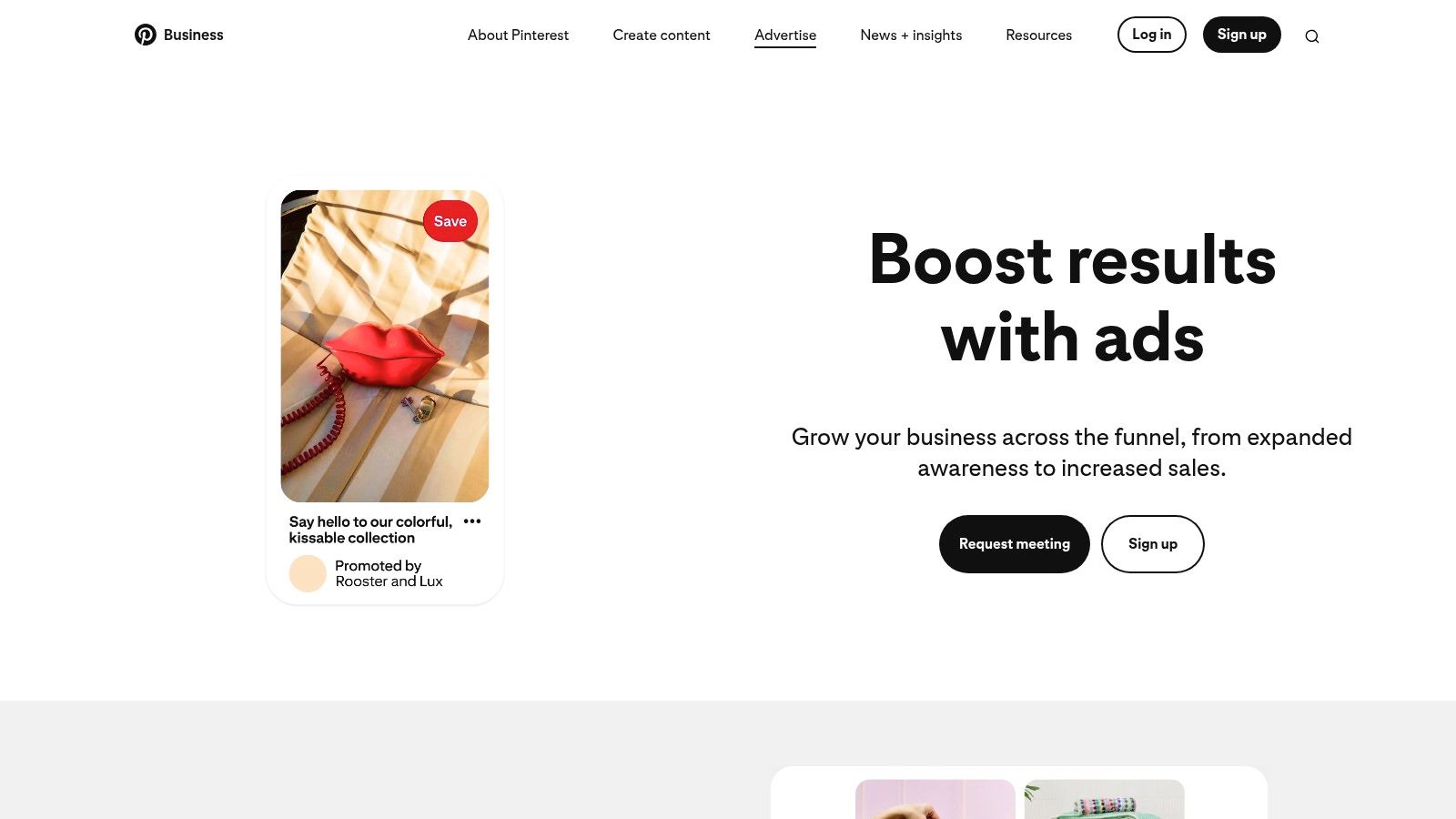
The platform works best when your product looks good in a feed and makes sense in a shopping mindset.
For the direct platform entry, use Pinterest Advertising. If you need a cost-oriented planning reference, AdRoll's social ad cost breakdown is a useful benchmarking read, but your creative and catalog quality will matter more than any generic average.
8. Reddit Ads
Reddit is one of the most overlooked social media ad platforms because it doesn't behave like a polished mass-market network. It behaves like a community network, and that changes the creative rules. If you know where your audience gathers, especially in niche B2B or technical spaces, Reddit can give you highly self-selected traffic that's much more useful than broad impressions.
The platform's real value is contextual fit. You can target by community, interest, and keyword-style placements, which means the ad can live near discussion that already signals intent. That makes Reddit useful not just for clicks, but for research, message testing, and retargeting later in the funnel.
Community rules matter more here
Reddit users will ignore you fast if the ad sounds generic or if the landing page doesn't match the tone of the subreddit. That's not a weakness, it's the price of access. Delivery can also get sensitive in smaller communities, so bid discipline matters more than many advertisers expect.
Practical rule: On Reddit, relevance beats polish, but only if the message feels like it belongs in the thread.
The platform also supports brand-suitability controls and negative placement options, which helps if you're trying to keep campaigns aligned with a narrow audience set. If you want the platform itself, go to Reddit Ads.
9. Quora Ads
Quora is one of the best places to buy intent without paying for a giant consumer audience. The environment is built around questions, which means users are often in research mode when they see your ad. That makes it especially useful for B2B, SaaS, and considered-purchase funnels where education is part of the sale.
Targeting by topic, question, audience, and keyword gives you a structure that feels familiar to paid search teams. That's a big advantage if you're trying to extend a PPC strategy into social-like inventory without losing control over message relevance. It also helps when you want to serve educational content before the first form fill.
Good fit for thoughtful offers
Quora works best when your creative sounds credible and informative. Pushy ads usually feel out of place, and broad consumer-style promos don't land as well as a direct answer to a real question. The platform also provides budget diagnostics and alerts when daily budgets are too low for delivery, which is helpful when a campaign doesn't seem to move.
For the direct platform access point, use Quora Business Ads. If your team thinks in search terms first, Quora can feel like a social extension of keyword strategy rather than a separate channel.
10. Nextdoor Ads
Nextdoor is the local-service platform on this list, and that matters for campaigns that depend on neighborhood relevance. Home services, real estate, and other trust-led offers often fit better here than on a national network that spreads budget across too many users. The audience is tied to households and local geography, so the platform makes sense when proximity matters more than raw scale.
The strongest use case is service-area marketing. Local businesses can build awareness and capture leads in the neighborhoods where the buying decision depends on location, familiarity, and trust. Creative needs to sound real, grounded, and helpful, not polished for its own sake.
For brands that need fresh creative at scale, an ai photoshoot for clothing brand can help produce the volume of assets local campaigns often need.
Local relevance beats broad reach
Nextdoor is not built for national-scale performance unless you are running broad geo targeting with tight control. It works better as a precise local layer inside a broader social mix, where the message can match the neighborhood and the offer can feel specific. Many local feeds also have less clutter than larger platforms, which gives a credible ad a better chance to stand out.
The platform says there is no strict platform-wide minimum spend, but it recommends approximately $100/day for scale and stability. That is a useful planning signal, because it shows where delivery tends to become steadier and easier to evaluate.
Use Nextdoor Ads if your business wins by being the local option people recognize and trust.
Top 10 Social Media Ad Platforms Comparison
| Platform | ✨Core features | 👥Best for | ★Quality/Scale | 🏆Value prop | 💰Budget notes |
|---|---|---|---|---|---|
| Meta Ads (Facebook + Instagram) | Feed/Reels/Stories/Marketplace, Dynamic product ads, Pixel & CAPI | 👥 DTC, retail, full-funnel & remarketing | ★★★★★ Massive reach & mature optimization | 🏆 Creative variety + lookalike scaling | 💰Auction; practical spend floor for learning |
| TikTok Ads | Search Ads w/ keywords/match-types, in-feed video, commerce & creative tools | 👥 Gen Z/younger, discovery-driven performance | ★★★★☆ High engagement; creative-driven | 🏆 Strong discovery + PPC-style testing | 💰Ad group guidance ~ $30/day (NA) |
| YouTube Ads (via Google Ads) | Multiple video formats, Google audience integration, shared measurement | 👥 Broad US reach; awareness → performance | ★★★★★ Deep measurement & scale | 🏆 Scales brand → performance with Google stack | 💰No universal min; some types ~$5/day |
| LinkedIn Ads | Job/company targeting, Lead Gen Forms, ABM & matched audiences | 👥 B2B, high-ACV lead gen & enterprise | ★★★★☆ Precise B2B targeting & lead quality | 🏆 Unmatched professional targeting for B2B | 💰Typical min ~$10/day; higher CPCs |
| X Ads (formerly Twitter) | In-feed video/image/carousel, keyword & follower lookalikes, conversation placements | 👥 Events, product launches, trend-driven brands | ★★★☆☆ Timely reach; variable performance | 🏆 Real-time engagement & low-barrier tests | 💰No platform-enforced minimum |
| Snapchat Ads | AR Lenses, Snap/Story/Collection Ads, pixel & ecommerce integrations | 👥 Gen Z & younger Millennials, app installs, DTC | ★★★★☆ Native, camera-first creative surfaces | 🏆 Engaging AR & mobile-native ad formats | 💰Min indicated $5/day; recommend $20–50/day |
| Pinterest Ads | Promoted Pins, Shopping Ads, catalog feeds, search-like targeting | 👥 Lifestyle & retail shoppers with purchase intent | ★★★★☆ High purchase-intent visual discovery | 🏆 Strong mid/low-funnel ecommerce performance | 💰Flexible; Performance+ uses averaged pacing |
| Reddit Ads | Community/interest/contextual placements, pixel/SDK support | 👥 Niche communities, passionate B2C/B2B segments | ★★★☆☆ Niche reach; discussion-driven lift | 🏆 High-intent, community-aligned targeting | 💰Auction; ad groups may overspend ~20% to deliver |
| Quora Ads | Topic/question/keyword targeting, lead forms, conversion tracking | 👥 B2B, SaaS, considered-purchase & educational content | ★★★☆☆ Intent-driven Q&A audiences | 🏆 Strong intent signals for expert/educational ads | 💰Flexible; budget diagnostics/alerts available |
| Nextdoor Ads | Neighborhood & household geo-targeting, local placements, lead gen | 👥 Local services, home improvement, real estate | ★★★☆☆ Hyperlocal relevance; smaller scale | 🏆 Neighborhood-level targeting for service-area businesses | 💰Recommend ~ $100/day for scale |
How to Choose Your Winner and Integrate Your Ads
The best social media ad platform doesn't exist. The best one is the one that matches your goal, your creative capacity, and your measurement maturity. If the brief is B2B lead generation, LinkedIn usually makes the most sense. If the offer is ecommerce and you need scale, Meta and Pinterest belong near the top of the list. If the campaign depends on fast-moving cultural relevance, X or TikTok may earn the test budget first. If the account is local, Nextdoor can punch above its weight. The mistake isn't choosing one platform. The mistake is choosing one platform for the wrong reason.
The right comparison is less about feature lists and more about operational fit. Meta brings the deepest automation and remarketing muscle, but signal loss can muddy results if tracking isn't clean. TikTok brings creative discovery and keyword-style search controls, but it asks for constant asset production. YouTube fits well when video needs to connect back into Google Ads and search behavior. Reddit and Quora reward specificity, which makes them valuable for niche or research-heavy offers. Snapchat and Nextdoor can be excellent, but only when the audience and geography line up tightly with the business model.
Measurement is where teams leave money on the table. The practitioner move in 2026 is to standardize UTMs, use server-side Conversions API where it makes sense, and compare social performance against what happens later in Google Ads and branded search. That matters more now because privacy changes keep distorting platform-reported performance, and recent practitioner guidance says standardized tracking is the way to reduce those losses Digital Applied. If you don't unify naming conventions, you'll never know whether a platform is weak or just badly measured.
The budget advantage comes from integration. Social can create demand, search can harvest it, and remarketing can close the loop. A paid media team that watches those handoffs closely will usually outperform a team that evaluates each channel in a silo. That's also why tools matter. Keywordme sits naturally in the Google Ads side of the workflow, where search-term cleanup, match-type management, and ad group expansion can help you keep the search layer tight while social feeds demand upstream traffic. If you're using paid social to fill the funnel, the search account has to be ready to catch it.
If you want to build a cleaner PPC system around social media ad platforms, visit Keywordme and see how it helps with Google Ads search-term cleanup, negative keyword handling, and keyword expansion. That's the kind of operational support that keeps paid search efficient while your social channels scale demand.
.svg)