
Advertise On Facebook And Instagram: Your 2026 Guide
Advertise On Facebook And Instagram: Your 2026 Guide


Your Google Ads account is probably in decent shape already. Search terms are cleaner, negatives are tighter, bidding is more predictable, and conversion tracking mostly tells a coherent story. Then growth slows down, branded search carries too much of the load, and every new gain gets more expensive.
That’s usually the point where teams start looking at Meta.
If you want to advertise on facebook and instagram, the good news is that your PPC instincts still matter. Offer-market fit, tracking discipline, landing page quality, audience segmentation, and ruthless testing all transfer well. What doesn’t transfer cleanly is intent. Search captures demand. Meta interrupts behavior and has to earn attention first.
That shift matters, because Meta can still be a major profit center when it’s handled properly. According to Search Logistics' Meta advertising statistics roundup, 70% of businesses achieve their highest ROI from Meta’s advertising platforms, with 40% identifying Facebook as their most profitable paid channel.
Your Next Growth Channel Beyond Search Ads
The first mistake Google Ads pros make on Meta is assuming the platforms should behave like a search campaign with extra targeting layers. They don’t. Search gives you explicit intent signals. Meta gives you audience context, creative advantage, and retargeting depth.
That’s why the mindset shift is so important. On Google, a keyword often does the heavy lifting. On Meta, the ad itself has to create the click.
What transfers well from Google Ads
Some skills carry over almost perfectly:
- Tracking discipline keeps bad decisions out of your account.
- Offer clarity still decides whether traffic converts.
- Funnel thinking helps you separate prospecting from retargeting.
- Testing habits matter just as much on Meta as they do in search.
The difference is where the advantage lies. In search, query intent and match types shape performance. In Meta, performance often rises or falls on audience inputs, creative fit, and how much clean conversion data the system receives.
Practical rule: Treat Meta as a demand creation engine that complements search, not a substitute for it.
If you’re expanding for the first time, it helps to look at a broader system rather than isolated setup tips. AdStellar AI has a useful full-funnel guide to Facebook Ads and Instagram that frames how both platforms support discovery, consideration, and conversion together.
Meta works best when you stop asking, “Which keyword triggered this?” and start asking, “Which message moved this audience one step closer?”
Laying the Foundation for Meta Ads Success
Meta punishes sloppy setup faster than most advertisers expect. If the account structure is messy or tracking is half-installed, you can still spend money, but you won’t know what worked.

Build the business layer first
Before you launch anything, set up the account as if multiple people will eventually touch it. In practice, that means:
- Create a Meta Business account.
- Add the correct Facebook Page.
- Connect the right Instagram profile.
- create or claim the ad account you’ll use.
- Confirm permissions before launch day.
This sounds basic, but a lot of wasted time comes from assets being owned by the wrong login or tied to an old employee’s profile. Google Ads has its access headaches too, but Meta gets especially ugly when ownership is fragmented.
Tracking is not optional
The single most important setup task is getting the Pixel installed correctly and verified. According to Uproas' Facebook ads statistics page, 70% of advertisers misconfigure the Facebook Pixel, which skews attribution and can halve ROAS.
That stat tracks with what many practitioners see in the wild. Events fire twice. purchases get counted as page views. lead forms never pass the right signal. Then the advertiser blames Meta for weak optimization when the platform is learning from junk data.
A clean setup usually includes:
- Pixel installation: Put it on the site and verify the right events fire.
- Event prioritization: Make sure your primary business outcome is clear.
- Conversions API: Pair server-side signals with browser-side tracking.
- Testing in Events Manager: Don’t trust a plugin blindly. Verify event flow.
If you need a deeper platform-specific reference point after setup, Keywordme’s coverage of Facebook Ads topics is a solid place to keep your terminology and workflow straight.
What a good setup actually looks like
A strong foundation is boring in the best way. The page is connected. The domain is verified. Events map to real business actions. UTMs are consistent. The ad account is cleanly named. Nothing breaks when a teammate logs out.
That’s the standard.
Bad Meta performance often starts as a tracking problem wearing a creative costume.
Common setup failures to catch early
Use this checklist before your first campaign goes live:
- Wrong Pixel selected: Confirm the ad account is optimizing against the active site’s Pixel, not a legacy asset.
- Broken event logic: Trigger your lead or purchase flow yourself and inspect what gets recorded.
- Missing page and profile links: Facebook and Instagram identities should both be available at the ad level.
- No CAPI connection: Browser-only tracking leaves more gaps than most advertisers expect.
- Unclear naming conventions: If you can’t read the account, you can’t diagnose it.
Most Meta headaches aren’t advanced. They’re foundational. Clean setup doesn’t feel glamorous, but it gives the algorithm something useful to work with and gives you reporting you can trust.
Architecting Your First Ad Campaign
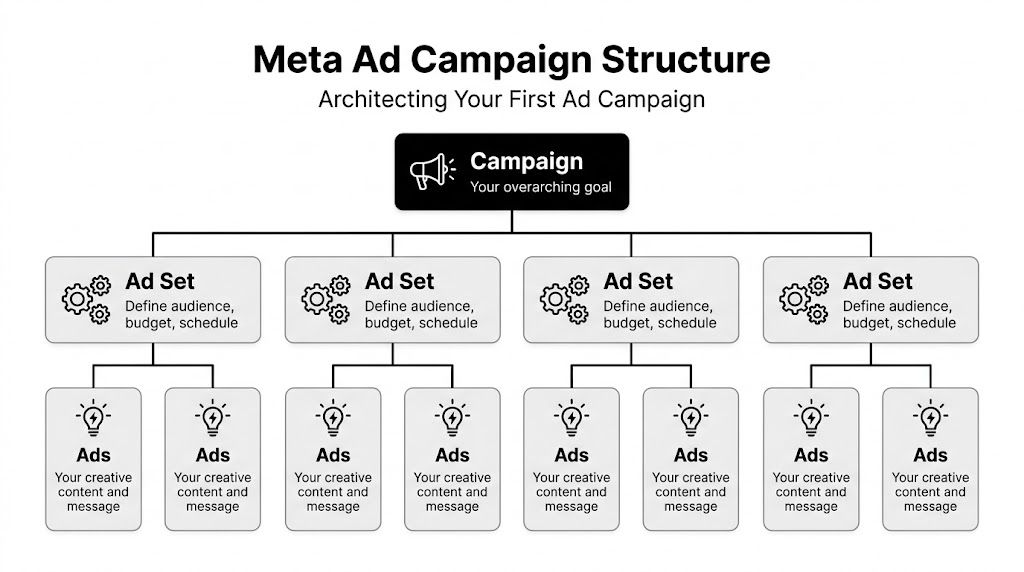
Meta’s structure is simple on paper and slippery in practice. You have a Campaign, one or more Ad Sets, and the Ads inside them. If you come from Google Ads, think of it as strategy at the top, delivery controls in the middle, and creative execution at the bottom.
Start with the objective, not the format
A lot of new Meta advertisers get distracted by placements and ad formats too early. The better starting point is the campaign objective because it shapes how Meta tries to find results.
For most performance-minded advertisers, the useful options are usually:
- Leads when the conversion happens through forms, calls, or inquiry actions
- Sales when you want Meta to optimize toward purchases or downstream revenue actions
- Traffic only when you have a clear reason to buy visits rather than business outcomes
- Awareness when reach matters more than immediate conversion efficiency
Google Ads pros often overuse traffic because it feels safer. On Meta, that can be a trap. Cheap clicks can look productive while producing weak intent and worse follow-through.
Think in funnel stages
The cleanest way to structure your first account is by audience temperature.
| Funnel stage | Meta objective fit | Typical message angle |
|---|---|---|
| Cold prospecting | Leads or Sales | Problem aware, benefit-first, pattern interrupt |
| Warm retargeting | Leads or Sales | Proof, objections, urgency, trust signals |
| Existing customers | Sales | Upsell, cross-sell, renewal, repeat use |
Meta starts to feel less like search and more like paid media strategy. You’re not just matching queries. You’re sequencing messages.
Ad set decisions carry more weight than many search marketers expect
The ad set level controls the audience, placements, schedule, and in some cases where budget pressure shows up first. That makes it the primary delivery engine of the account.
Keep your first build restrained. Don’t create ten audiences just because the interface allows it. Consolidation gives Meta stronger signals and makes it easier to see what’s different.
A practical first build might look like this:
- Campaign: Sales
- Ad Set 1: Broad prospecting
- Ad Set 2: Customer list or site visitor retargeting
- Ad Set 3: Lookalike or adjacent audience test
- Ads: A small set of clearly different creative angles
Budget control is a trade-off, not a religion
Google advertisers love control, so many start with ad set budgets because they want to force delivery. That can be smart when you’re isolating tests. But it also limits Meta’s ability to shift spend toward stronger ad sets.
Use campaign-level budget control when:
- you trust the conversion signal
- ad sets are close in purpose
- you want Meta to lean into winners
Use ad set-level budgets when:
- you’re validating new audiences
- you need hard spend floors
- you want cleaner side-by-side testing
If you need a quick refresher on creative formats before building ads, AdCrafty has a useful overview of Facebook ad types that helps map format choices to campaign goals.
The key is not building the biggest structure. It’s building the smallest structure that still lets you learn.
Finding Your Audience and Crafting Your Message
Search targeting starts with what people type. Meta targeting starts with who people are, what they’ve done, and what kind of creative gets them to care. That’s a different game.
If you want to advertise on facebook and instagram profitably, audience selection and message fit have to work together. Great targeting with bland creative stalls. Great creative with the wrong audience burns money.
The three audience buckets that matter
For most accounts, audience strategy falls into three practical groups.
Core audiences
These are Meta’s built-in targeting options. Interests, demographics, location, job-related signals, behaviors, and other broad descriptors live here.
Core audiences are useful when:
- you’re entering a market without much first-party data
- you need early directional learning
- your product solves a clear problem for identifiable groups
They’re less useful when advertisers stack too many filters and create an audience that looks precise but is brittle.
Custom audiences
Many serious advertisers gain a significant advantage through audiences such as site visitors, customer lists, video viewers, lead form openers, and engaged users.
Custom audiences tend to work because they’re based on real interaction rather than inferred affinity. If you already know someone visited your pricing page or started a form, your messaging can be much tighter.
Lookalike audiences
Lookalikes sit between prospecting and first-party data. You give Meta a seed audience, then ask it to find similar people.
They’re especially useful when your source list is strong. A lookalike built from low-quality leads usually produces more low-quality leads. Garbage in still applies.
Your best audience often isn't the most detailed one. It's the one built from the cleanest underlying signal.
Creative does more targeting than many advertisers admit
This is the part search marketers often underestimate. On Meta, the image, video, hook, headline, and first line of copy help decide who pays attention.
For B2B and SaaS in particular, generic “streamline your workflow” messaging usually underperforms. Specific pain points, stronger contrast, and a clear next step tend to carry more weight. Meta users aren’t searching for your solution at that moment, so your ad has to make the problem feel immediate.
A few examples of stronger angles:
- Operational pain: Call out the manual process people already hate.
- Lost revenue: Frame the cost of inaction in plain language.
- Time savings: Show what gets easier or faster after the switch.
- Proof and specificity: Use product visuals, interface context, or use-case language.
If you need help sharpening the copy side, these ad copy examples are useful for studying hook structure and CTA clarity.
Reels, Stories, and feed creative are not interchangeable
One of the fastest ways to waste spend is forcing one asset into every placement. Platform-native adaptation still matters.
According to America Amplified’s cited roundup on Reels usage and engagement, boosted Reels with trending audio can yield 2.5x more engagement than static image boosts, and Reels drove 35% of Instagram ad impressions in major markets in the latter half of 2025.
That doesn’t mean every account should shove budget into Reels. It does mean short-form vertical creative deserves serious testing, especially if your current assets look like resized display ads.
Quick-Reference Creative Specs 2026
| Placement | Aspect Ratio | Recommended Resolution |
|---|---|---|
| Facebook Feed | 1:1 or 4:5 | 1080 x 1080 or 1080 x 1350 |
| Instagram Feed | 1:1 or 4:5 | 1080 x 1080 or 1080 x 1350 |
| Stories | 9:16 | 1080 x 1920 |
| Reels | 9:16 | 1080 x 1920 |
Message by audience temperature
Many campaigns finally click here.
- Cold traffic: Lead with the problem, a sharp hook, and one clear benefit.
- Warm traffic: Address objections. Show proof. Reduce friction.
- Hot traffic: Ask for the conversion directly. Keep the path simple.
For a SaaS product, cold creative might call out wasted manual work. Warm creative might show the interface and explain the workflow. Hot creative might focus on trial signup, implementation simplicity, or a direct comparison against the current process.
Creative rules that usually help
- Front-load the hook: The opening line has one job. Earn the next second.
- Show the product early: Especially for software, vague brand videos often lose to clear interface shots.
- Use one message per ad: If the ad tries to sell every benefit, none of them land.
- Match landing page language: The ad promise and page headline should feel connected.
Meta rewards advertisers who can connect audience signal with creative relevance. Search marketers who embrace that shift usually adapt faster than they expect.
Managing Placements Budgets and Launch
Launch settings are where a lot of decent campaigns get subtly sabotaged. The two biggest choices are where your ads can appear and how tightly you control spend on day one.
Automatic placements versus manual placements
Meta strongly nudges advertisers toward Advantage+ placements for a reason. Broad placement access gives the system more inventory and more opportunities to find lower-cost outcomes.
Used well, that can help. Used lazily, it can spread weak creative into places where it doesn’t belong.
A practical approach:
| Approach | Best use case | Main risk |
|---|---|---|
| Automatic placements | New campaigns with adaptable creative and solid tracking | Spend drifts into placements your assets weren’t built for |
| Manual placements | Tight tests, niche audiences, or known placement winners | You limit learning and cut off potentially efficient inventory |
A cited benchmark from the earlier setup source notes that Facebook Feed typically gets 60% of the budget share, while Instagram receives about 40% of the budget and 20% of impressions when automatic placements are enabled. The point isn’t to memorize those numbers. It’s to remember that Meta won’t distribute spend evenly just because you checked every box.
Budget settings that keep early tests sane
Your first budget should be large enough to generate signal and small enough that bad assumptions don’t get expensive. That balance matters more than any rigid “best” number.
Two budget models matter most:
- Daily budget: Better when you want steady pacing and frequent adjustments.
- Lifetime budget: Better when timing matters and you need firmer date control.
For most new advertisers, daily budgets are easier to manage. They give you cleaner operational control while you’re still diagnosing creative fit and audience quality.
A pre-launch checklist worth using
Before you hit publish, confirm the basics manually.
- Destination check: Open the landing page on mobile and desktop.
- Identity check: Make sure the correct Facebook Page and Instagram account are selected.
- Tracking check: Confirm the right conversion event is attached.
- Creative check: Review crop behavior in feed, Stories, and Reels.
- Copy check: Look for cut-off text, broken punctuation, and mismatched CTAs.
Meta can optimize delivery. It can't rescue a weak landing page or a mismatched offer.
Manual placements aren’t “advanced” and automatic placements aren’t “beginner.” They’re just different trade-offs. Start broad when the creative is flexible. Get narrower when the data tells you a specific environment or audience deserves isolation.
Optimizing and Scaling Your Ad Performance
Launch day tells you almost nothing by itself. The true edge comes from how you respond once the account starts producing signal.

One of the more useful reminders for experienced PPC managers is that Meta optimization is less about “micro-fixing” and more about deciding which variable deserves the blame. Was it the audience, the offer, the placement, the creative adaptation, or the conversion signal?
That diagnostic habit matters because automation helps, but it doesn’t absolve you from judgment. According to the cited analysis behind this finding, Meta’s Advantage+ placements increased average ROAS by 17% in late 2025, yet 42% of campaigns also saw higher wasted spend on low-conversion placements like Instagram Stories due to poor creative adaptation in a separate analysis of campaign performance discussed in this YouTube source on Advantage+ placement trade-offs.
The metrics that deserve your attention
Most Meta accounts become easier to manage when you narrow your dashboard to a few business-relevant fields:
- Cost per result: Your first directional read on efficiency
- ROAS: Useful when revenue tracking is trustworthy
- CTR: A creative relevance signal, not a success metric by itself
- Conversion rate on-site: Tells you whether the ad promise matches the landing page
- Frequency and trend direction: Helpful for spotting fatigue
Google Ads pros sometimes over-focus on click metrics because that’s where many search optimizations begin. On Meta, a decent CTR can coexist with bad business outcomes if the wrong people clicked or the landing page didn’t carry the message forward.
How to make optimization decisions without thrashing the account
Use staged decisions rather than constant edits.
When performance is weak
Look for the failure point first.
- Low click-through and weak engagement: Usually a creative or hook problem.
- Solid clicks but poor conversion quality: Often an audience or offer issue.
- Good early results that fade: Creative fatigue or placement mismatch is a likely suspect.
- Erratic reporting: Recheck event integrity before making structural changes.
If you’re rebuilding retargeting flows or need examples for sequencing audiences after the click, this set of remarketing ads examples is a useful reference.
If the ad wins the click but loses the visit, fix the message handoff before blaming the platform.
How to scale without wrecking a winner
Scaling Meta campaigns is where many advertisers get impatient. They see a profitable ad set, double the budget, and then wonder why efficiency falls apart.
Safer scaling usually looks like this:
- Duplicate a winner into a controlled test if you want to trial a new audience or placement mix.
- Expand through adjacent creatives instead of relying on one exhausted ad.
- Broaden carefully once the current audience stops delivering efficient reach.
- Separate prospecting from retargeting so one doesn’t hide the weakness of the other.
This is also a good place to use platform-native features selectively. Advantage+ can help when the account has strong signals and enough creative variety. It tends to disappoint when advertisers expect automation to compensate for bad assets.
Here’s a walkthrough that’s worth watching if you want a practical view of Meta campaign optimization decisions in motion:
The common mistakes worth avoiding
- Editing too often: Meta needs stability to learn.
- Testing too many variables at once: You lose attribution inside your own process.
- Ignoring placement fit: A feed creative isn’t automatically a Stories creative.
- Confusing activity with progress: More clicks don’t always mean better traffic.
- Letting one hero ad carry the account: Fatigue catches up.
Optimization on Meta rewards calm operators. The best accounts usually aren’t the busiest. They’re the ones where someone knows which signal matters, which signal is noise, and when to leave a stable system alone.
Your Path from Novice to Pro
If you’ve spent years in Google Ads, Meta doesn’t require you to relearn performance marketing from scratch. It asks you to shift where you look for advantage.
The durable skills are the same. Tight tracking. Clear offers. Strong landing pages. Consistent testing. Clean segmentation. What changes is the order of operations. On search, intent arrives first. On Meta, attention comes first, then interest, then conversion.
That’s why the strongest Meta advertisers rarely obsess over one trick. They build a reliable system. The account is set up cleanly. The campaign structure is restrained. Audiences are chosen with purpose. Creative matches audience temperature. Placements are monitored instead of blindly trusted. Winners scale through disciplined iteration, not panic edits.
A lot of advertisers make Meta harder than it has to be. They overbuild, over-target, over-edit, and under-test creative. The simpler approach usually works better. Start controlled. Learn fast. Keep the variables understandable. Expand only after you know what the account is responding to.
If you want to advertise on facebook and instagram well, think like a performance marketer but operate like a media buyer. That mix is where the results usually show up.
Frequently Asked Questions
Is Facebook or Instagram better for B2B advertisers
It depends on the audience, the offer, and the creative format. Many B2B advertisers assume Facebook will always be stronger because it feels more utility-driven, but Instagram can still work when the message is visual, direct, and built for interruption-based browsing. Test both unless you already have a clear reason not to.
Should I start with prospecting or retargeting
Start with both if your site already has enough warm traffic to justify retargeting. Retargeting often converts more easily because the audience already knows you. Prospecting matters because it keeps the funnel filled. Running only retargeting usually caps growth.
How long should I wait before making changes
Wait long enough to get meaningful signal, but not so long that obvious failure drains budget. If the ad clearly isn’t earning attention, fix the creative. If clicks are coming but conversions aren’t, inspect the offer, audience, and landing page before rebuilding the whole campaign.
Do I need separate creatives for placements
Usually, yes. A square feed image can technically serve in multiple places, but “technically works” and “performs well” are very different standards. Stories and Reels usually need vertical-first thinking.
Can I use the same landing pages from Google Ads
Sometimes. High-intent search pages often assume the visitor already knows what they want. Meta traffic usually needs more context, stronger proof, and a smoother narrative from ad to page. In many accounts, the landing page needs at least some adaptation.
What’s the biggest beginner mistake on Meta
Launching before the foundation is stable. Weak tracking, confused campaign objectives, generic creative, and sloppy placement adaptation create problems that look like optimization issues later. Most of those losses were avoidable before launch.
If you already live in Google Ads and want cleaner search term workflows, faster keyword expansion, and less wasted spend from manual cleanup, Keywordme is worth a look. It’s built for PPC teams that want to move faster without turning account maintenance into a weekly grind.
.svg)