
LinkedIn Ads B2B: Generate High-Quality Leads in 2026
LinkedIn Ads B2B: Generate High-Quality Leads in 2026


You’re probably in one of two spots right now.
Either you’ve already run linkedin ads b2b campaigns and felt the sting of expensive clicks, vague attribution, and leads that looked decent in Campaign Manager but didn’t turn into pipeline. Or you’re about to launch, and you’re trying to avoid paying premium media costs just to learn basic lessons the hard way.
LinkedIn can absolutely work for B2B. It also punishes sloppy strategy faster than almost any other paid channel. The platform earns its place because it dominates B2B social lead generation, producing 80% of all B2B social media leads with a visitor-to-lead conversion rate that’s nearly three times higher than other social platforms, according to LinkedIn marketing statistics from Ligo Social. But those headline numbers don’t save bad campaigns.
The campaigns that win usually look boring from the outside. Tight audience. Sharp offer. No bloated targeting. Strong exclusions. Landing page that matches the ad. Clear handoff into Google Ads and CRM reporting. The campaigns that lose tend to do the opposite. They go broad, say too much, chase vanity engagement, and pretend paid social should close the whole deal by itself.
Your Strategic Foundation Before Spending a Dime
A familiar failure pattern starts before launch. The team has creative drafts, a landing page, and a budget. What they do not have is agreement on what LinkedIn is supposed to accomplish in the funnel, how it will support Google Ads, or what outcome would justify the spend.
Failed LinkedIn campaigns often fail before the first impression.
That happens because LinkedIn is expensive enough to punish fuzzy strategy fast. If the campaign goal, audience logic, offer, and follow-up path are still loose, Campaign Manager will gladly spend money while teaching you nothing useful.
Treat LinkedIn as the channel that shapes demand
For B2B teams already comfortable with PPC, the cleaner model is to give each channel a job:
- LinkedIn gets your message in front of the right buyers before they search
- Google Ads captures active intent once those buyers start looking
- Your CRM and pipeline reporting show whether the combination produced revenue
That cross-channel view matters more than platform tactics. Mastering LinkedIn B2B Marketing makes the same point from a broader B2B angle. LinkedIn performs best inside a system, not as a standalone experiment run in isolation from search and sales.
If you want a solid setup reference before building the cross-channel workflow, this guide to paid advertising on LinkedIn covers the mechanics well.
One practical rule has held up across a lot of accounts I have seen. If LinkedIn ads talk about one pain point and Google search ads talk about another, conversion rates usually suffer somewhere downstream. Buyers feel that disconnect on the landing page, in the form fill, or on the sales call.
Pick one business outcome per campaign
Vague goals like “more awareness” lead to wasted spend. So do “more leads” targets with no qualification standard behind them.
A campaign needs one job.
Good campaign goals are specific enough to shape targeting, creative, landing page copy, and follow-up:
- Book demos from a defined ICP
- Generate qualified content downloads from target accounts
- Warm up problem-aware buyers before branded and non-brand search campaigns
- Re-engage high-intent visitors with a narrower offer
Trying to force one campaign to educate cold buyers, collect leads, and drive pipeline in the same motion usually ends with weak performance on all three.
Here is the simpler way to frame it:
| Campaign goal | What success looks like | What usually breaks |
|---|---|---|
| Awareness | Target accounts engage, return later, and show stronger branded or direct traffic | Teams judge it only on immediate form fills |
| Consideration | Prospects consume the asset, visit deeper pages, and enter retargeting pools | The offer jumps to a sales ask too early |
| Conversion | Demo requests, lead forms, or other hand-raiser actions from the right personas | The audience is too cold for the CTA |
Define the win before launch
Before spending anything, write down five things and get sign-off from both marketing and sales.
- Primary conversion: the one action that counts
- Lead qualification rule: who sales wants
- Audience hypothesis: which companies and roles should respond
- Message hypothesis: which pain point or promise earns attention
- Follow-up path: what happens after the click and after the form
This sounds basic. It is also where a lot of B2B teams get sloppy.
If the form routes every submission to sales, sales will reject half the leads. If the thank-you page goes nowhere, you lose momentum. If the offer is a generic ebook for a six-figure product, the CRM fills up with names that never had buying intent.
Build LinkedIn messaging from search behavior
Google Ads is one of the best inputs for LinkedIn strategy because search queries reveal how buyers describe the problem when intent is already high. That language is usually more useful than internal positioning copy.
Look for patterns such as:
- recurring pain phrases
- comparison intent
- problem-aware searches
- industry-specific wording
- objections hidden inside the query itself
Use those patterns to shape LinkedIn hooks, headlines, and landing page copy. Search gives you the vocabulary of demand. LinkedIn gives you a way to introduce that message earlier, before the prospect opens a comparison tab or starts pricing vendors.
That is the strategic foundation. Clear role for the channel. Clear outcome. Clear handoff into search, CRM, and sales. Without that, linkedin ads b2b turns into an expensive lesson instead of a repeatable growth program.
Mastering Audience Targeting on LinkedIn
A LinkedIn campaign can look perfect in Campaign Manager and still fail for a simple reason. It reached people with the right titles at companies that were never going to buy, or it reached decent accounts through people with no influence on the deal. That is usually a targeting problem, not a platform problem.
LinkedIn earns its keep on audience quality. If you build audiences from a real ICP and connect them to the rest of your demand gen system, the higher CPMs can make sense. If you treat targeting like a pile of filters, you pay premium rates for noise.
If your ICP is still fuzzy, this breakdown of a B2B Ideal Customer Profile (ICP) is worth reviewing before you touch Campaign Manager.
Start with the hierarchy, not the filters
A common pitfall is starting with random targeting options. The better method is to build the audience in layers, in the same order sales would qualify an account.
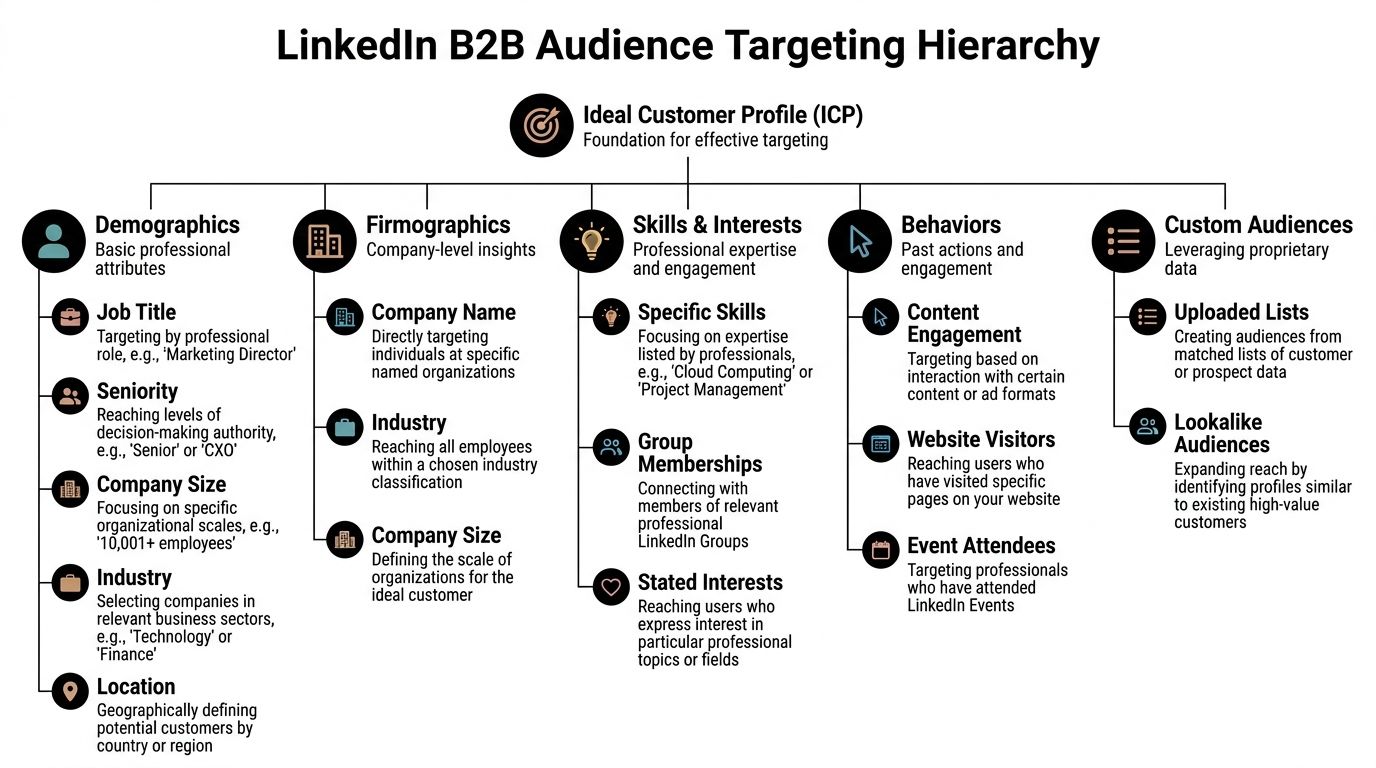
Use this order:
- Company fit
- Persona fit
- Behavior and matched audience signals
- Exclusions
That sequence matters. Starting with job titles often pulls in the right function at weak-fit companies. Starting with company filters alone leaves you paying for employees who will never touch the buying process.
Layer one is company targeting
This is the firmographic screen. The question is simple. Are these companies worth any budget at all?
The filters that usually matter most are:
- Industry: Keep this tighter than your TAM slide suggests.
- Company size: Match it to average contract value, sales motion, and onboarding reality.
- Company name: Best for account-based programs and expansion plays.
- Geography: Align it with actual sales coverage and service delivery.
- Revenue or growth signals: Use them if they reflect buying capacity in your category.
Overexpanding firmographic targeting is a common mistake. Teams add every adjacent industry, every borderline company size, and every region that might convert someday. Lead volume goes up. Lead quality usually drops faster.
A cleaner setup looks like this: target the industries you already close well, the company sizes your sales team can work efficiently, and the regions you can actively support. Leave the "maybe later" segments for a separate test, not your core campaign.
Layer two is persona targeting
Once the account set is clean, narrow to the people who can move a deal forward.
LinkedIn is strong here because it lets you combine role signals in ways other paid social platforms cannot. The trick is choosing attributes that reflect buying influence, not just professional identity.
Use combinations like:
- Job function plus seniority when titles vary by company
- Specific job titles when the naming is consistent
- Member skills when the niche is technical or emerging
- Years of experience or related traits when they sharpen the buyer profile
Good persona targeting sounds like "VPs of Marketing, Demand Gen Directors, and Marketing Operations leaders at mid-market SaaS companies."
Weak persona targeting sounds like "marketing, sales, and growth professionals."
Broad persona sets create a hidden problem. The audience gets bigger, but the ad has to become vague enough to speak to everyone. Response rates suffer because nobody feels the message was written for them.
Layer three is matched audiences
Matched Audiences are where LinkedIn starts behaving more like a serious B2B revenue channel and less like a rented social feed.
This is the layer that connects LinkedIn with the rest of your engine. CRM lists, account lists, and site behavior should not live in separate silos. If you already run search, demand capture and paid social should inform each other. Teams that already know the mechanics of PPC for lead generation usually get faster results here because they are used to building campaigns around intent tiers instead of channel silos.
The three audience types I use most are:
| Audience type | Best use | Common mistake |
|---|---|---|
| Contact list uploads | ABM, customer expansion, event follow-up | Uploading weakly segmented lists |
| Company list uploads | Named-account campaigns | Including accounts with no buying fit |
| Website retargeting | Re-engaging warm traffic | Serving the same message to every visitor |
Website retargeting deserves more thought than it usually gets. A pricing-page visitor, a webinar attendee, and a blog reader should not see the same ad. Segment by behavior and recency, then change the ask accordingly.
Exclusions are where a lot of wasted spend gets removed
Exclusions are not cleanup. They are part of the targeting strategy.
At minimum, decide whether to exclude:
- Students and interns
- Job seekers if they are irrelevant to the offer
- Existing customers
- Competitors
- Departments outside the buying group
- Very junior roles
- Locations you cannot serve
Google Ads can improve this layer too. Search campaigns show which queries produce real pipeline, which segments bounce, and which pain points attract low-intent traffic. Use that information to tighten LinkedIn audiences, suppress weak-fit segments, and tailor retargeting paths. Search tells you where intent already exists. LinkedIn lets you reach similar buyers earlier, before they start comparing vendors.
Match the audience to the offer temperature
Audience quality and offer quality have to line up. Good targeting cannot rescue the wrong ask.
A simple framework:
- Cold account list: Educational content, category point of view, problem framing
- Warm site visitors: Buyer guides, case studies, use cases, proof-based messaging
- High-intent retargeting: Demo requests, consultations, or direct-response offers
I have seen plenty of LinkedIn campaigns fail because the targeting was fine and the CTA was wildly premature. Asking a cold audience to book a sales call often produces expensive clicks and very little else. Asking the same audience to engage with a sharp, relevant point of view can build the pool that later converts through branded search, retargeting, or sales outreach.
That is also where the Google Ads connection matters. LinkedIn introduces demand and qualifies interest by account and role. Google captures the follow-up behavior when buyers start researching solutions on their own terms. Build audiences with that handoff in mind, and the channel starts working like part of a full-funnel B2B machine instead of an isolated campaign.
Crafting Campaigns and Ads That Convert
The platform can find the right people. That doesn’t mean those people will care.
Most weak LinkedIn ads fail for one of three reasons. The objective is misaligned with the funnel stage, the creative looks like corporate wallpaper, or the copy tries to say six things at once. Usually all three.
Choose the objective that matches buyer temperature
Campaign objective settings matter because they influence delivery. If you pick the wrong one, you train the system toward the wrong behavior.
A practical way to choose:
- Awareness objectives work when the audience is cold and the ask is light.
- Consideration objectives fit content offers, page visits, and engagement campaigns.
- Conversion objectives make sense when you already have enough intent, proof, and tracking in place.
The mistake I see a lot is running conversion campaigns against cold audiences with an unproven message. That setup often burns budget quickly and gives the team the false impression that LinkedIn doesn’t work.
Run the ad your buyer is ready for, not the ad your sales team wishes they were ready for.
The ad format should fit the job
A format is not a strategy. It’s a container for the message. Different containers work better for different moments.
Here’s the simplest cheat sheet I’d use.
LinkedIn Ad Format Cheat Sheet
| Ad Format | Best For | Pro Tip |
|---|---|---|
| Single Image Ads | Clear offers, direct problem-solution messaging, retargeting | Keep one message per ad. If the visual needs a paragraph to explain it, start over. |
| Video Ads | Explaining a pain point, building familiarity, showing a human face | Open with the problem fast. Don’t spend the first few seconds on branding fluff. |
| Carousel Ads | Breaking down frameworks, comparisons, or multi-step ideas | Only use carousel if each card carries its own weight. Weak cards kill momentum. |
| Document Ads | Checklists, guides, and educational assets for mid-funnel audiences | Make the first few pages useful on their own so the asset feels worth the click or form fill. |
If your team also runs search and wants a stronger lead generation framework across channels, this piece on PPC for lead generation pairs well with the same conversion logic.
What tends to work in the feed
LinkedIn users are still people. They ignore bland, overpolished ads just like they do everywhere else.
What usually performs better:
- Specific pain points: Speak to a real operational problem.
- Clear audience signal: Let the right person know the ad is for them.
- Plain language: Skip buzzwords and inflated claims.
- Tight visual concept: One idea, not a collage of ideas.
- Useful CTA: Give them a reason to act now, even if they’re not ready to buy.
A good LinkedIn ad often reads more like a sharp internal memo than a brand campaign. It gets to the point quickly and sounds like someone who understands the problem.
What wastes money fast
A few patterns show up in underperforming campaigns over and over:
- Generic thought-leadership fluff
- Stock-photo creative with abstract headlines
- Long copy that hides the value
- Offer-message mismatch
- Landing pages that restart the conversation instead of continuing it
One of the worst habits is using broad “transform your business” language. That kind of copy sounds important and converts poorly. Specificity does the heavy lifting.
Write the ad like a practitioner, not a committee
The best copy usually has three parts:
- Call out the problem
- Frame the consequence
- Offer the next useful step
For example, if you’re targeting RevOps leaders, don’t say your platform “unifies GTM excellence.” Say what breaks, who feels the pain, and what changes after they act.
A simple structure that holds up well:
- problem statement
- proof or credibility cue
- offer
- direct CTA
That’s enough for most campaigns. More words do not automatically create more persuasion.
Budgeting Bidding and Measuring What Matters
LinkedIn gets expensive when teams confuse activity with traction.
The platform can justify its costs, but only if you’re measuring the right outcomes and not panicking over every high click price. Based on 2025 data, LinkedIn Ads deliver an average B2B ROAS of 113%, with average CPC at $5.39 and CTR at 0.62%, and some B2B SaaS firms saw 2.46x revenue ROI in Q4, according to Electro IQ’s LinkedIn advertising statistics.
Those numbers matter for one reason. They tell you not to judge LinkedIn by cheap-click standards. It’s a B2B platform with expensive inventory and, when the setup is sound, stronger downstream economics.
Pick a bidding approach that matches your maturity
LinkedIn’s bidding options can look more complex than they really are.
In plain English:
- Maximum delivery is the easiest starting point. You let the platform spend toward the objective.
- Target cost makes more sense once you understand what an acceptable outcome looks like.
- Manual bidding is for advertisers who already know the auction dynamics and want tighter control.
For most accounts, I’d start simpler than you think. A lot of teams jump to manual bidding because it feels more disciplined. In reality, they often don’t yet have the signal quality to make manual control an advantage.
Budget for learning, not just lead capture
New campaigns need enough room to generate signal. If you starve them, you won’t learn whether the audience, message, or offer works.
A cleaner budgeting mindset:
- use one budget bucket for testing
- separate proven campaigns from experiments
- don’t mix cold prospecting and retargeting in the same reporting logic
- expect audience quality to matter more than raw click volume
If your finance team only wants a single blended number, push back. Blended reporting hides the difference between demand creation and demand capture.
The Insight Tag is not optional
If the Insight Tag isn’t installed properly, your measurement is compromised from day one.
That means you lose useful retargeting audiences, conversion visibility, and any chance of making optimization decisions with confidence. This is one of those basics that experienced teams still mess up because the launch checklist gets rushed.
Check these before spending:
- Tag installed on every relevant page
- Conversions defined clearly
- Thank-you pages or event rules set correctly
- UTMs aligned with your analytics setup
- CRM fields mapped so leads can be traced later
For anyone trying to get cleaner finance conversations around paid media performance, this explainer on the return on ad spend formula is useful background.
Measure business events, not platform vanity
The useful conversion points are usually not the top-line metrics the ad platform wants you to celebrate.
Track actions that reflect buying intent, such as:
| What to track | Why it matters |
|---|---|
| Demo requests | Strong hand-raiser signal |
| Qualified lead form fills | Better than raw lead volume |
| High-intent page visits | Helpful leading indicator |
| Content downloads from target accounts | Useful for mid-funnel evaluation |
| CRM-stage progression | Best signal that the campaign is creating real opportunities |
Here’s a good sanity check. If the campaign has strong platform engagement but weak downstream movement, the issue is usually one of these: wrong offer, weak landing page, bad qualification, or poor follow-up.
A short walkthrough can help if the team is struggling with reporting setup:
Don’t benchmark LinkedIn like Google Search
Search traffic arrives with declared intent. LinkedIn traffic often doesn’t. That difference affects everything from CTR expectations to conversion lag.
If you compare a LinkedIn campaign directly against bottom-funnel branded search, LinkedIn will often look worse in-platform and better in the actual buying journey than impatient reporting suggests. That’s why measurement has to connect back to CRM outcomes, not just front-end clicks.
The Optimization Routine for Scaling Your ROI
Most of the significant gains in linkedin ads b2b happen after launch.
Not from heroic overhauls. From boring, steady cleanup. Better creative. Sharper exclusions. More disciplined testing. Stronger audience-message match. The teams that scale profitably usually have a routine. The teams that stall keep making random changes and calling it optimization.
The hidden lever most advertisers ignore
LinkedIn has an internal Ad Relevance Score that isn’t visible in Campaign Manager, but it still affects auction outcomes. According to Aimers’ LinkedIn Ads benchmark analysis, improving creative quality and targeting precision can reduce CPC by 20–40% at the same bid level.
That’s a big deal because it changes how you should think about creative. Creative is not just branding work. It’s a cost-control lever.
If an ad gets ignored, you don’t just lose attention. You often pay more for the same audience.
Better creative doesn’t only lift response. It can make the same audience cheaper to reach.
A weekly routine that actually holds up
Every week, review the account in this order:
- Check spend pacing
- Look for outlier CPC and CTR by campaign
- Review frequency and creative fatigue
- Compare landing page behavior across audiences
- Inspect lead quality in CRM
- Pause obvious losers
- Queue fresh variations
The order matters. If you start by obsessing over CTR before checking whether the campaign is even hitting the right audience and budget pacing, you can make the wrong fix.
A practical weekly checklist:
- Audience drift: Are clicks coming from the people you wanted?
- Creative fatigue: Has one ad clearly stopped pulling its weight?
- Offer friction: Are people clicking but failing to convert?
- Lead quality: Are titles, companies, and notes from sales still acceptable?
- Retargeting freshness: Are repeat visitors seeing a relevant next step?
What to test first
Not all tests are equal.
Start with the variables most likely to change economics:
| Test priority | What to change | Why it matters |
|---|---|---|
| First | Hook and headline | This changes scroll-stop rate fastest |
| Second | Audience definition | Fixes wasted reach and poor fit |
| Third | Offer angle | Improves click-to-conversion efficiency |
| Fourth | Visual treatment | Helps relevance and engagement |
| Fifth | Landing page path | Converts attention into action |
A lot of advertisers test tiny copy tweaks too early. That’s fine once the campaign is stable. It’s not where the biggest gains usually come from.
Know when to kill, keep, or scale
Use a simple decision framework.
Kill an ad when it’s clearly mismatched to the audience, drawing weak engagement, or producing poor traffic quality with no signs of downstream value.
Keep an ad running when the front-end signals are average but CRM quality is strong. LinkedIn often looks better in sales feedback than in shallow dashboard reads.
Scale an ad when three things are true:
- the audience fit is solid
- lead or pipeline quality is holding
- performance stays stable as spend increases
The mistake is scaling off cheap vanity metrics. A campaign that gets lots of clicks from the wrong people is not a winner. It’s a distraction.
Monthly cleanup separates serious teams from casual ones
Each month, step back from daily fluctuations and look at account structure.
Review:
- overlapping audiences
- underused retargeting segments
- duplicate messaging across campaigns
- creative themes that repeatedly win
- conversion lag between click and pipeline movement
That last point matters more in B2B than many teams admit. Some ads create response now. Others create recognition that shows up later through direct traffic, branded search, or sales outreach. The account gets better when you can tell which is which.
Your Playbook Summary and Common Questions
The simplest version of the playbook looks like this.
Start with a tight business goal. Build audiences from company fit, persona fit, and matched data. Align the offer to buyer temperature. Choose a format that fits the message. Track meaningful conversions. Then optimize every week with more discipline than drama.
That’s what tends to separate profitable linkedin ads b2b programs from expensive experiments. Not one clever hack. Just solid mechanics repeated consistently.
The short version worth remembering
If I had to compress the whole thing into a working checklist, it would be this:
- Nail the ICP before launch
- Use Google search intent to sharpen LinkedIn messaging
- Keep audiences tight and exclusions ruthless
- Match CTA strength to audience warmth
- Install tracking before spending
- Optimize creative like it affects cost, because it does
- Judge campaigns with CRM reality, not platform ego metrics
Most LinkedIn waste comes from one of two things. Bad audience definition or asking for too much from cold traffic.
Common questions marketers ask after launch
Can small budgets still work on LinkedIn
Yes, but the playbook changes.
For businesses with budgets under $5K/month, a contrarian setup often works better. Data from 2025 shows SMBs can see 2.5x ROI by starting with short video awareness ads capped at $1K, using tight exclusions, and then remarketing with simple single-image ads, according to Odd Angles Media’s comparison of Reddit and LinkedIn for B2B.
That approach makes sense because smaller budgets usually can’t support broad testing across too many audiences and formats. You need a narrow learning loop. Short video for top-of-funnel attention. Then simple retargeting to convert the people who engaged.
What usually does not work on a small budget is pretending you’re an enterprise advertiser. Too many campaigns, too many segments, too many offers.
How long should you let a campaign run before judging it
Long enough to collect signal. Not so long that obvious losers drain the budget.
In practice, judge on two levels:
- Early read: Is the right audience engaging at all?
- Business read: Is traffic quality turning into meaningful downstream action?
If the campaign is getting the wrong clicks, weak engagement, or obvious mismatch feedback from sales, don’t wait just to feel patient. Fix it. But if the audience fit is solid and the buying cycle is slow, don’t kill a campaign because it didn’t force instant revenue from cold traffic.
What should you do if the campaign gets impressions but no clicks
Usually one of four issues is causing that:
- the hook is too generic
- the audience is too broad
- the creative blends into the feed
- the offer is too early or too weak
Start by rewriting the first line and headline. Make the pain point sharper. Then check whether the audience is specific enough to recognize themselves in the message. If the ad still feels like it could apply to everyone, it usually lands with no one.
Also check the visual. A lot of LinkedIn creative looks like internal sales deck filler. That style tends to disappear in the feed.
What if leads look fine in-platform but sales hates them
Trust sales feedback, then investigate carefully.
That usually points to one of these problems:
- targeting is too loose
- the lead magnet is attracting curiosity, not buying intent
- the form is too easy
- follow-up is weak or delayed
The right fix depends on where the mismatch starts. Don’t respond by only tightening the form. Sometimes the form isn’t the issue. The message attracted the wrong person in the first place.
Is LinkedIn better for demand gen or lead gen
Both can work. The mistake is forcing one motion into the other.
If the audience is cold and the solution requires trust, use LinkedIn to build familiarity and educate. If the audience already knows the category and your offer is tightly matched, lead gen can work well. Most strong programs blend the two instead of arguing about them.
Keywordme helps PPC teams turn messy search term data into cleaner campaign decisions, which is exactly what makes LinkedIn and Google work better together. If you want a faster way to mine intent signals, build negative keyword lists, and tighten the search side of your full-funnel B2B machine, take a look at Keywordme.
.svg)