
Preventing Click Fraud: A Guide to Stop Wasted Ad Spend
Preventing Click Fraud: A Guide to Stop Wasted Ad Spend


Feel like your ad budget just seems to evaporate? You're pouring money into Google Ads, the click numbers look great, but actual sales and leads aren't budging. It’s a classic story, and the quiet culprit is often click fraud.
This isn't just a small leak in your marketing spend; it's a direct hit to your ROI.

Click fraud is a massive, industry-wide problem. We're talking about projected global losses hitting an eye-watering $133 billion by 2026. On average, about 11.5% of clicks in Google Ads campaigns are invalid. That means nearly one out of every nine clicks you pay for is completely useless, generated by a bot or a bad actor. For anyone running campaigns at scale, that adds up to a huge amount of wasted cash if left unchecked.
The first step in fighting back is knowing who you're up against.
The Main Suspects Behind Invalid Clicks
So, who's actually doing all this clicking? It’s not just one type of offender. The sources are surprisingly varied, and each requires a slightly different approach to combat.
- Malicious Competitors: It’s an old trick, but it still happens. A competitor repeatedly clicks your ads to drain your daily budget, knocking you out of the auction so their ads can show up instead.
- Organized Click Farms: These are real operations, often based in other countries, where low-paid workers are hired to do nothing but manually click on ads all day.
- Sophisticated Botnets: This is the high-tech version. Networks of infected computers run automated scripts that are designed to mimic real human behavior, making them tricky for standard filters to detect.
- Publisher Fraud: Sometimes the problem comes from within the Google Display Network. Website owners might click the ads on their own sites to fraudulently boost their ad revenue.
Knowing these players helps you understand the different footprints they leave behind in your data. If you notice your Google Ads budget is depleting faster than usual, for instance, it's a clear signal to start digging deeper.
The real danger of click fraud isn't just the money you lose today. It's the skewed data that leads to bad decisions tomorrow. When your analytics are polluted with fake engagement, you end up optimizing for bots instead of real customers.
Early Warning Signs of a Click Fraud Problem
You don’t need to be a data wizard to spot the signs of click fraud. It often leaves obvious clues in your campaign metrics if you know where to look. The trick is to identify patterns that just don't make sense for a legitimate user.
This table breaks down the most common symptoms that should have you immediately on alert.
Think of these as the early tremors before the earthquake. Catching them early allows you to put defensive measures in place before your budget is completely drained. Now, let's get into the practical steps you can take to stop it.
Your First Line of Defense Against Invalid Clicks
So, you're ready to stop lighting your ad budget on fire. The great news is you don't need to shell out for expensive third-party software right out of the gate. Google Ads actually gives you a pretty decent set of tools to build your initial fortifications. Think of them as the basic locks on your doors and windows—they won't stop a professional thief, but they'll keep out most of the riff-raff.
Taking back control really just means being proactive inside your own account. If you keep a close eye on a few key areas, you can shut down the most obvious sources of junk clicks before they really start to bleed you dry.
Start with IP Exclusions
One of the most satisfying ways to deal with a known problem is to just block it outright. If you spot repeated, worthless clicks coming from the same IP address, you can toss it onto an exclusion list. This tells Google Ads, "Hey, don't show my ads to this person anymore." It's incredibly effective against a vindictive competitor or a simple bot that isn't sophisticated enough to cycle through different IPs.
To find these culprits, you'll have to do a little digging in your server logs. You're looking for patterns that just don't feel right:
- Rapid-fire clicks from a single IP in a ridiculously short amount of time.
- An IP that clicks your ads multiple times but never, ever converts.
- Clicks from IPs in countries or regions you don't even target.
Once you have your list of shady IPs, adding them to Google Ads is simple. This one cleanup task can make an immediate difference by cutting off a direct drain on your budget.
Master Placement and Network Exclusions
If you’re running ads on the Google Display Network or with its search partners, you’re essentially trusting hundreds or thousands of other websites to send you good traffic. The hard truth? Not all of them will. Some sites are notorious for generating garbage traffic, either from terrible layouts that trick people into clicking or, in worse cases, from outright fraud.
Your placement report is your best weapon here. Get in the habit of reviewing it regularly and asking some tough questions:
- Which websites or apps are sending me tons of traffic but zero conversions?
- Are there placements with a crazy-high click-through rate (CTR) but also a bounce rate that's through the roof?
- Do any of the URLs just look spammy or low-quality? Trust your gut.
When you find a site that’s just a black hole for your money, add it to your placement exclusion list. You're basically telling Google, "Thanks, but I'm good. Don't show my ads here again." Be ruthless. This is how you ensure your ads are only appearing on properties that drive actual business.
Don’t be afraid to cut placements aggressively. A website that sends 100 clicks and zero conversions isn't an "opportunity"—it's a liability. Protecting your budget means pruning these dead ends without hesitation.
Clean Up Your Search Terms Relentlessly
This is, hands down, the most powerful tactic you have, and it’s where a tool like Keywordme becomes a total game-changer. Your search terms report is a direct look into your customer's mind—it shows you exactly what they typed into Google before clicking your ad. It's a goldmine for finding irrelevant traffic that acts just like click fraud.
Think about it: someone searching for "free marketing templates" isn't a malicious bot, but their click on your "marketing agency services" ad is just as much of a waste. This kind of mismatched intent is a huge budget killer.
By constantly reviewing your search terms, you can build a powerful negative keyword list that filters this junk out before it even has a chance to cost you money. The faster you negate these terms, the more of your budget is protected for clicks that count. This is where the manual grind can really slow you down, but a dedicated tool makes it almost effortless.
For example, with Keywordme, you can zip through thousands of search terms in minutes, spot the irrelevant ones, and add them to your negative lists with a single click. This isn't just about optimization; it's a fundamental strategy for starving click fraud at the source. To really get a handle on this, check out our complete guide on finding and using negative keywords effectively. Keeping your search terms squeaky clean closes the door on a massive chunk of low-quality traffic before you ever pay for it.
Putting Your Click Fraud Protection on Autopilot
Let's be honest: nobody can monitor an ad account 24/7. Trying to do so is a fast track to burnout. To really get a handle on click fraud and scale your efforts, you have to bring in some automation. This is how you build a defense system that works around the clock, freeing you up to focus on strategy instead of constantly putting out fires.
The whole point is to create a system that acts on your behalf, flagging or stopping suspicious activity the moment it happens.
Using Google Ads Automated Rules
Right inside your Google Ads account, you have the ability to set up automated rules. Think of them as simple "if-this-then-that" commands that keep an eye on your campaigns. While they can't catch everything, they're a fantastic first line of defense against obvious problems.
For example, you could create a rule that automatically pauses a campaign if its click-through rate (CTR) suddenly skyrockets overnight but conversions stay flat. That’s a classic sign of a bot attack, and a simple rule can stop the bleeding before you’ve even had your morning coffee.
Here are a couple of practical rules you can set up today:
- High CTR, No Conversions: Have Google Ads send you an email alert if an ad group's CTR jumps above a certain threshold (say, 20%) but has zero conversions. This lets you investigate manually without letting a junk campaign run wild.
- Rapid Budget Burn: Set a rule to pause any campaign that burns through more than 75% of its daily budget before noon. Sure, this can happen on a really good day, but more often than not, it's a sign of fraudulent clicks draining your funds way too quickly.
Think of these rules as your automated sentinels, watching for patterns that just don't add up.
Exploring Third-Party Detection Tools
While Google's built-in features are a solid start, sophisticated fraud often requires a more specialized solution. This is where third-party click fraud detection tools come into play. These platforms are built for one purpose: to identify and block invalid traffic in real-time.
They typically work by adding a small tracking script to your website that analyzes every single click coming from your ads. This script gathers data points like the IP address, device fingerprint, user behavior on the page, and the time between clicks. Using this mountain of data, their algorithms can tell the difference between a real customer and a bot with pretty stunning accuracy.
When a fraudulent source is identified, the best tools will automatically add the offending IP address to your Google Ads exclusion list. This blocks them from ever seeing or clicking your ads again. It becomes a closed-loop system that’s constantly learning and getting smarter.
This process shows how a multi-layered defense really works, from manual blocks to automated keyword cleanup.
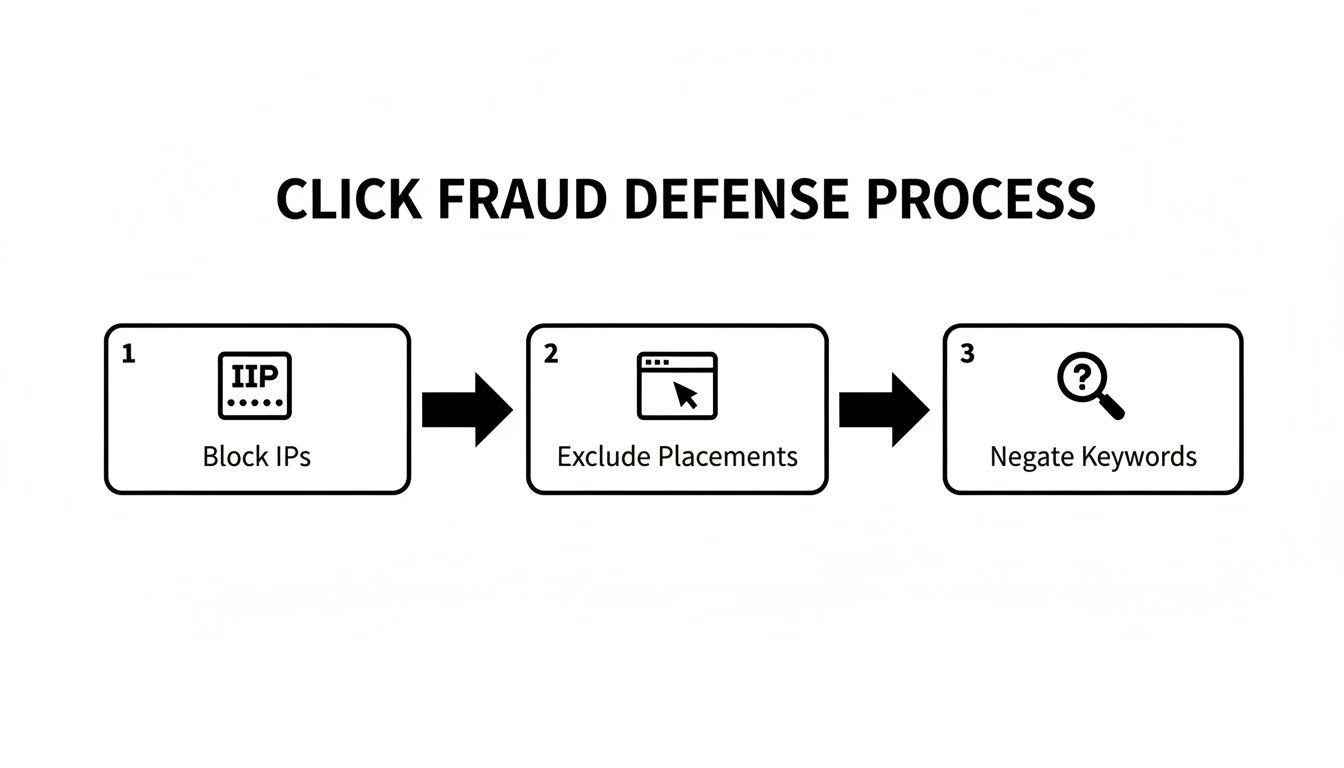
As the visual shows, a strong strategy isn't just about blocking bad actors (IPs and placements) but also about filtering out bad intent by negating junk keywords.
What to Look for in a Detection Tool
Not all click fraud tools are created equal. When you're shopping around, here are the features that actually matter:
- Real-Time Blocking: The system needs to identify and block a bad IP instantly. Waiting for a daily report is too little, too late. The damage is already done.
- Customizable Rules: You need to be in the driver's seat. Look for a tool that lets you set your own thresholds for what counts as suspicious, like how many clicks from a single IP in an hour is too many.
- Detailed Reporting: The tool has to give you clear insights into why a click was flagged. This helps you understand the specific threats you're up against and proves the tool is worth its salt.
The real magic of an automated system is its ability to analyze patterns at a scale no human ever could. It can spot the subtle connections between thousands of clicks across dozens of campaigns to identify a coordinated botnet attack that would just look like random noise to you or me.
The unfortunate reality is that a huge chunk of clicks simply aren't legitimate. In paid search, an alarming 14% to 22% of clicks are typically invalid, with bots responsible for about 24% of all fraudulent activity. Industries like fintech and eCommerce get hit especially hard during their peak seasons. You can dig deeper into these ad fraud trends from recent industry reports. This makes having an automated, real-time defense an essential part of any serious campaign.
Uncovering Industry Hotspots Where Click Fraud Thrives
When you're trying to stop click fraud, the first thing to realize is that not all industries are created equal. The risk isn't spread evenly. Far from it. Certain sectors are basically magnets for fraudsters, and the reason is almost always the same: sky-high cost-per-click (CPC).
Think about it from a fraudster's perspective. They can spend all day clicking on a local bakery's ads for a dollar a pop, or they can target a personal injury lawyer where a single click might be worth $100. The choice is a no-brainer. If you're in an industry with expensive keywords, you've got a massive target painted on your back.
The High-Risk Verticals
So, where are the fraudsters lurking? Over the years, I've seen the same handful of industries get hit the hardest, time and time again. These are the verticals where the budgets are huge and the competition is absolutely brutal.
If your business falls into one of these categories, you can't afford to be passive. You have to be on high alert.
- Finance and Insurance: Keywords like "car insurance quotes" or "mortgage refinance" can have some of the highest CPCs out there, making this sector a goldmine.
- Legal Services: From "personal injury lawyer" to "divorce attorney," legal terms are notoriously expensive. That high cost is exactly what attracts so much fraudulent activity.
- Home Services: We're talking plumbers, electricians, and HVAC companies. A single good lead can be worth thousands, so competitors and click farms are always looking to sabotage campaigns.
- Addiction and Rehab Services: This is another space with extremely high-cost keywords, making it a lucrative target for anyone trying to burn through a competitor's budget.
The finance and insurance sectors get hit particularly hard. We're seeing an average invalid traffic rate of 10.12% in this space. One fraudulent click isn't just a minor annoyance; it can cost hundreds of dollars, completely blowing up your customer acquisition costs.
Click Fraud Risk by Industry
It's one thing to talk about high-risk industries, but seeing the data laid out can really drive the point home. The difference in invalid traffic rates between a high-stakes vertical like legal services and a lower-cost one like e-commerce is staggering.
This table makes it clear: if you're in a high-CPC industry, you are actively being targeted. Understanding the specific tactics used against your vertical is the first step in building a solid defense.
Why Are These Industries So Vulnerable?
It’s not just about the high CPCs, though that's a huge part of it. The business model itself can make certain industries more vulnerable. Many of these high-risk sectors are all about lead generation, where one phone call or form fill can be incredibly valuable. This creates a cutthroat environment where competitors might turn to shady tactics to get ahead.
You also see a lot of affiliate programs in these spaces. To really get why this is a problem, it helps to understand the basics of what is affiliate marketing. Some less-than-honest affiliates will use bots to rack up fake clicks on their own links, hoping to collect commissions on traffic that was never real in the first place. This is especially common with insurance and financial product comparison sites.
The higher your CPC, the bigger the target on your back. Fraudsters follow the money, and industries with expensive keywords are where they can do the most damage in the shortest amount of time.
Knowing your industry's risk profile is step one. If you're operating in one of these hotspots, you can't just set your campaigns and forget them. You need a proactive strategy built specifically to fight the threats you're facing every single day.
How to Build a Sustainable Monitoring and Reporting Routine
Fighting click fraud isn't a "set it and forget it" task. Think of it more like routine maintenance on a high-performance engine. You can't just check the oil once a year and expect everything to run smoothly. This is an ongoing discipline, a simple but consistent process that keeps your account healthy and your budget flowing to real, potential customers.
A solid monitoring and reporting workflow is your best long-term insurance policy against wasted ad spend. It’s what separates advertisers who are always putting out fires from those who consistently get a great return on their investment.
Your Account Health Checklist
The key to staying on top of all this without getting buried in data is a simple, repeatable checklist. I like to break it down into daily, weekly, and monthly tasks. This way, you can catch weird stuff early before it drains your budget.
The Daily Health Check (5-10 Minutes)
This is your quick morning coffee scan to make sure nothing is on fire.
- Check Daily Spend: Did your budget evaporate before 10 AM? A campaign that burns through its entire daily budget in a couple of hours is a massive red flag.
- Glance at Core Metrics: Look for any sudden, wild spikes in clicks or impressions that don't come with a corresponding lift in conversions. You’re looking for things that just don’t add up.
The Weekly Deep Dive (30-60 Minutes)
Alright, time to roll up your sleeves and look for patterns.
- Dive into Search Term Reports: This is your most important job of the week, period. Get into the search terms report and see what people actually typed to trigger your ads. Are the queries relevant? Are you seeing patterns of junk? A tool like Keywordme makes this a breeze, helping you quickly spot and kill off those irrelevant terms that are just eating your cash.
- Analyze Placement Reports: If you're running Display or Performance Max, you have to check where your ads are showing up. Be ruthless here. Cut any site placements that have high clicks but zero conversions.
- Check Geographic Data: I once saw a local Miami plumbing company getting tons of clicks from Southeast Asia. Check your geographic reports. If you're seeing clicks from locations that make absolutely no sense for your business, exclude them immediately.
The Monthly Strategy Review (1-2 Hours)
Now you get to zoom out and look at the bigger picture.
- Assess Your Invalid Click Rate: Find the "Invalid clicks" column in your Google Ads account. Is that percentage trending up? Google catches some of the obvious stuff, but a rising rate is a clear signal that you need to be more aggressive with your own defenses.
- Review Blocked IPs: Take a look at your IP exclusion list. How fast is it growing? Are you starting to see patterns from certain internet service providers (ISPs) or regions?
- Evaluate Your Tools: If you're using a third-party click fraud tool, review its reports. Is it actually helping? Are the IPs it's blocking stabilizing your metrics and improving performance?
Building a Case for Invalid Click Credits
Even with the best defenses in place, some junk clicks will inevitably get through. The good news? You can ask Google for a refund on clicks they might have missed. The bad news? You can’t just ask nicely. You need to show up with proof.
The moment you think you've been hit by a click fraud attack, start documenting everything.
Think of yourself as a detective building a case file. Google needs more than a hunch—they need dates, numbers, and clear patterns that prove the traffic was illegitimate. The more detailed your evidence, the better your chances of getting that money back.
Here’s the kind of evidence you should start gathering:
- Dates of the Attack: Pinpoint the exact date range when the suspicious activity spiked.
- Campaigns & Ad Groups Affected: Don't just say "my account." Be specific about which campaigns were targeted.
- Suspicious IP Addresses: If you have access to server logs, pull a list of the IPs you identified, complete with click timestamps.
- Click Pattern Data: Explain the anomaly with hard numbers. For example: "We saw a 300% increase in clicks from X location between these dates, with a 0% conversion rate and a 98% bounce rate."
- Supporting Logs: If you have web server logs showing the rapid-fire clicks from the same source, they are your smoking gun. Include them.
Once you have your evidence compiled, you can submit a request through Google Ads support. Be clear, concise, and professional. Having a consistent reporting routine makes gathering this evidence way easier when you're under pressure. For more ideas on what to include, our guide on crafting a great pay-per-click reporting strategy can give you a solid starting point.
This whole process—from the quick daily checks to requesting refunds—is about creating a sustainable system. It’s how you shift from constantly reacting to problems to proactively preventing click fraud, ensuring every dollar you spend has a real shot at growing your business.
Your Top Click Fraud Questions, Answered
Even when you've got a solid plan, click fraud can leave you with some nagging questions. It’s a messy topic with a lot of moving parts, so let's tackle some of the most common ones I hear from clients. My goal is to give you straightforward answers so you can manage your campaigns with a lot more confidence.
Think of this as your go-to reference when those little uncertainties creep in. Once you get these core concepts down, you can get back to focusing on what actually matters: driving real results.
Doesn't Google Already Protect Me From This Stuff?
Yes, but only to a certain extent. Google has its own system for filtering out what it calls "invalid clicks," and it's decent at catching the low-hanging fruit—things like accidental double-clicks or really basic bot traffic. The problem is, you should think of it as a generic, one-size-fits-all safety net, not a security system built to protect your business.
The hard truth is that more sophisticated bots, sneaky competitors, and organized click farms have gotten very good at slipping through those general defenses. Their tactics are always changing to look more and more like genuine human behavior. This is exactly why you can't just set it and forget it. You need your own proactive strategy, layering manual checks with automated rules, and for high-stakes campaigns, even bringing in third-party tools.
Google provides a good baseline of protection, but it’s your own focused effort that will actually shield your ad budget from the more clever threats. Relying only on Google is like leaving your front door unlocked just because your neighborhood has a gate.
Is It Possible to Get Rid of Click Fraud Completely?
Let's be real: no. Trying to eliminate 100% of click fraud is an impossible game of whack-a-mole. New threats and shady tactics pop up all the time. The real goal isn't total elimination—it's aggressive reduction and smart mitigation.
Your job is to make your ad account an unprofitable, frustrating target for anyone trying to waste your money. By consistently blocking bad IPs, cleaning up your placements, and using the other strategies in this guide, you can shrink the impact of fraud until it's barely a blip on your financial radar.
A successful strategy is one that minimizes waste so effectively that the fraudsters just give up and move on to an easier target. It's all about making sure the lion's share of your ad spend is reaching actual human beings who might want to buy from you.
What’s the Difference Between Low-Quality Traffic and Click Fraud?
This is a fantastic and crucial question. They both feel the same on your credit card statement because they both waste money, but their intent is worlds apart. Nailing this distinction is key to figuring out how to fight back.
Here’s a simple way to think about it:
- Low-Quality Traffic: This comes from real people who just aren't a good fit for your offer. Maybe they're students doing research, people looking for jobs, or someone who just misunderstood your ad. It’s a wasted click, for sure, but there’s no malice behind it.
- Click Fraud: This is all about deliberate, malicious intent. It’s activity designed purely to drain your budget. This is the nasty stuff—automated bots, click farms, and even competitors trying to knock you out of the auction for the day.
While both problems hit your bottom line, you deal with them very differently. You handle low-quality traffic with tighter ad copy, better audience targeting, and a killer negative keyword list. You fight click fraud with more aggressive tactics like IP blocking, geographic exclusions, and specialized detection software.
Cleaning up both junk search terms and fraudulent clicks is non-negotiable for a healthy Google Ads account. Keywordme was built specifically to speed this up, helping you find and negate irrelevant search terms in a fraction of the time it would take to do it by hand. Stop burning money on junk and start focusing your budget on clicks that actually convert. Start your free 7-day trial of Keywordme today.
.svg)