
PPC Ads Facebook Guide for 2026 Campaigns
PPC Ads Facebook Guide for 2026 Campaigns


You've opened Meta Ads Manager, chosen “traffic,” uploaded a decent image, and set a budget. Then the first results arrive, and the obvious question appears: Are Facebook ads too expensive now? The honest answer is that there isn't one Facebook PPC price. Costs depend on what you're asking Meta to find, where the person sits in your funnel, and whether your creative gives them a reason to stop scrolling.
This guide builds a practical mental model for PPC ads on Facebook. You'll learn how the auction works, why traffic and lead campaigns shouldn't share the same benchmark, how campaign structure affects optimization, and why creative testing has become a more reliable lever than endless audience micro-targeting.
Why Facebook PPC Still Deserves Your Budget
A first-time advertiser often treats Facebook like a vending machine. Put money in, select an audience, and expect leads or sales to come out. Meta Ads Manager quickly proves that the platform is more like a live marketplace, where advertisers compete for attention and the system decides which ad offers the strongest overall value.
That competition is real. Meta's worldwide advertising revenue reached $196.2 billion in 2025, a scale that shows how central its advertising ecosystem has become to media buying, as reported in Statista's Facebook marketing overview. A large marketplace can offer reach, but it also gives advertisers plenty of opportunities to waste money if they optimize for the wrong result.
Facebook's global ad reach is around 2.28 billion users, representing roughly 74.3% of monthly active users, while one industry summary reports about 8 million active advertisers across Meta platforms in its Facebook ads statistics report. Those figures explain both sides of the experience. You can reach a huge audience, but you're also entering a crowded auction with many other businesses.
The useful mindset: Facebook PPC isn't expensive or cheap in isolation. It's expensive or cheap relative to the action you want and the value of that action.
A traffic campaign may buy inexpensive visits. A lead campaign may pay more because Meta is looking for people likely to submit information. A sales campaign may cost more again because the system is trying to identify users who are likely to complete a deeper conversion. Comparing those campaigns with one flat “average CPC” creates bad decisions.
Facebook also shouldn't be judged as a direct replacement for Google Search. A practical Facebook Ads versus Google Ads comparison helps clarify the difference. Search ads meet an existing query, while Facebook ads interrupt a browsing session and create demand through the message, visual, offer, and audience context.
That makes Facebook a strong tool for discovery, retargeting, lead generation, and demand creation. It also means your ad has to earn attention before it can earn a click.
What PPC Ads on Facebook Actually Are
Pay-per-click means you pay for a defined interaction, usually a click, rather than paying only for the space where an ad appears. An everyday analogy is a billboard beside a shop. You're paying for people to enter the shop, not merely for drivers to pass the sign.
Facebook's version is more flexible than that analogy suggests. You can optimize for traffic, leads, sales, reach, video views, or other actions. The platform then tries to show your ad to people it believes are most likely to complete the selected action. In other words, “PPC” on Facebook usually means paying according to the campaign outcome you've chosen, not paying one universal rate for every click.
Facebook demand differs from search demand
Google Search generally captures intent. Someone types a problem, product, or service into a search engine, and the ad answers that active request. Facebook users may be thinking about family updates, entertainment, or news when your ad appears, so your creative has to connect the offer to a problem or desire they already recognize.
That distinction affects the entire funnel:
- Awareness: Introduce a problem, category, or brand to people who may not be actively shopping.
- Consideration: Give interested users a reason to visit, watch, compare, or engage.
- Conversion: Ask a warmer prospect to submit a lead form, purchase, book, or sign up.
The campaign objective tells Meta which type of person to prioritize. If you choose traffic, the system looks for people likely to click. That doesn't automatically mean those users will become leads. If you choose lead generation, Meta has a different job, and the auction may seek users with stronger conversion signals.
The auction happens around each opportunity
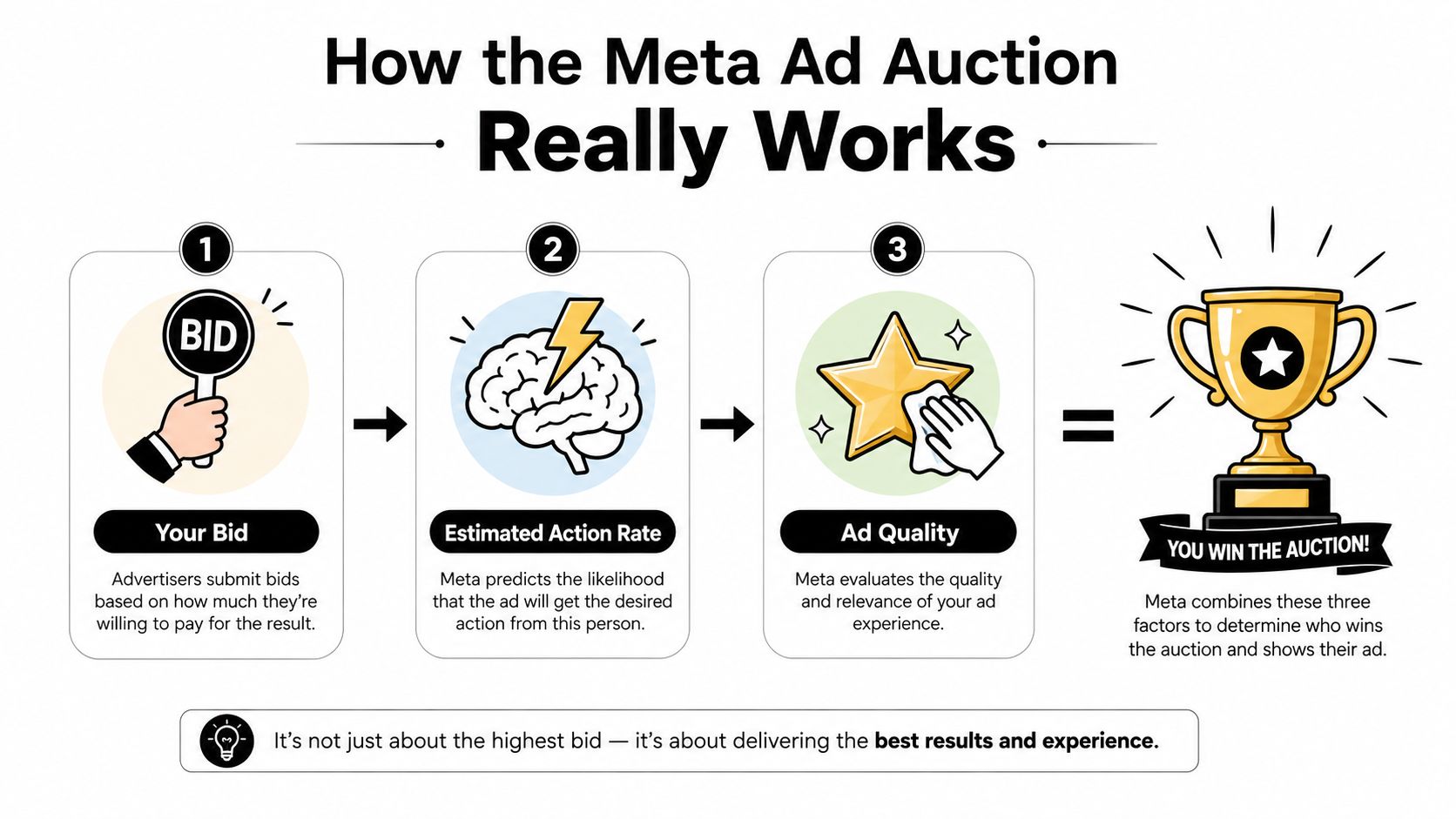
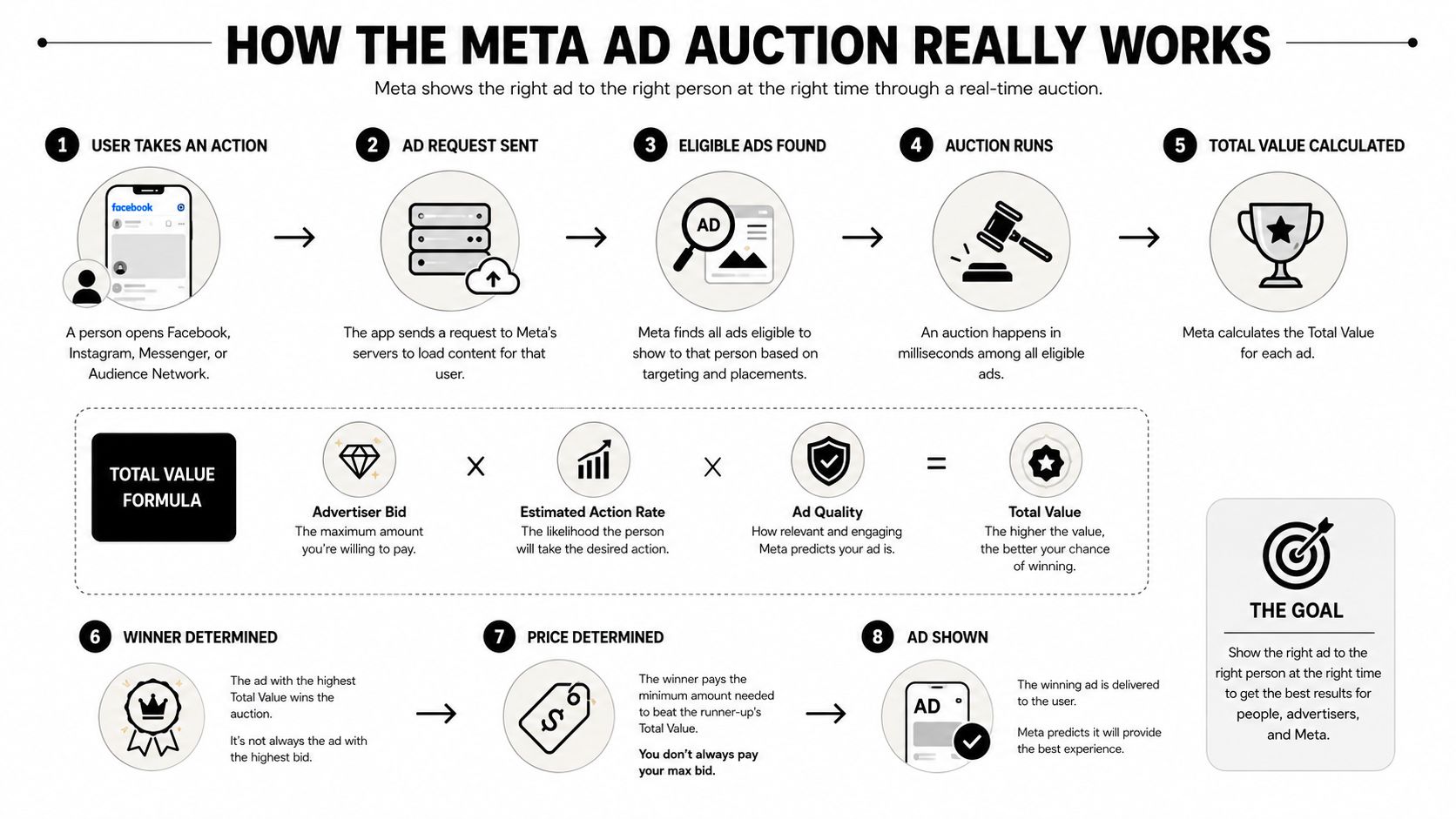
Facebook doesn't sell a fixed slot to the advertiser with the biggest budget. Each eligible ad competes in an auction, and Meta evaluates the bid, the predicted likelihood of the desired action, and the ad's quality. The winning ad is the one with the strongest total value for that opportunity, not necessarily the one with the highest bid.
This is why two advertisers can target similar people and see very different results. One may have a clearer offer, stronger first frame, and better landing-page experience. Another may bid aggressively but give users little reason to respond.
Plain-English definition: Facebook PPC is an auction-based system that uses your objective to find likely responders, then charges according to the result and delivery conditions.
How the Meta Ad Auction Really Works
The auction becomes easier to understand if you treat it like a job interview. Salary matters, but a candidate's fit and the quality of their work matter too. Meta's commonly described value equation has three parts: advertiser bid, estimated action rate, and ad quality, as explained in this Meta ad auction guide.
Your bid sets the commercial signal
Your bid tells Meta how aggressively you're willing to compete for the chosen outcome. Depending on the setup, you may use a lowest-cost approach, a cost cap, or a bid cap.
These controls don't guarantee that your ad will win. They help manage how Meta pursues results and how tightly you want to constrain the auction. A lower-cost strategy generally gives the system more freedom to find opportunities, while caps can add control when your economics require stricter limits. Tight controls can also make delivery harder if the system can't find enough opportunities within those limits.
Estimated action rate predicts behavior
Meta estimates how likely a person is to complete the action connected to your objective. For a traffic campaign, that might mean clicking. For a lead campaign, it might mean submitting a form. The prediction draws on engagement and conversion likelihood signals, so your historical data, event setup, audience context, and creative response all matter.
A strong estimated action rate can help an ad compete even when another advertiser offers a larger bid. If users consistently ignore your ad, Meta receives a weak signal that the ad is unlikely to create the intended outcome.
Ad quality changes delivery efficiency
Ad quality reflects how people respond to and experience the ad. Clear messaging, relevant visuals, a credible offer, and a landing page that matches the promise can support stronger delivery. Poor creative can attract negative feedback, generate weak engagement, or create a frustrating post-click experience.
The important point is that quality isn't limited to the image itself. An attractive ad that sends people to a slow, confusing, or mismatched page can still struggle. Creative and landing-page quality can affect delivery efficiency even when you hold the bid constant.
Practical rule: Before raising the bid, ask whether the ad gives Meta strong evidence that users will take the action you selected.
This framework also explains why bid changes alone rarely solve weak performance. If the estimated action rate and quality remain poor, paying more may buy additional exposure without fixing the conversion problem.
Choosing Campaign Objectives and Structures
Campaign architecture gives Meta a clear job. At the top level, you choose the campaign objective. Inside the campaign, ad sets handle audience, placement, budget, and delivery settings. Ads contain the creative, copy, destination, and call to action.
Think of the structure as a funnel:
- Top of funnel: Reach or traffic for introducing an offer and creating visits.
- Middle of funnel: Lead generation for collecting contact details or qualifying interest.
- Bottom of funnel: Sales for driving purchases or other high-value conversions.
The most common beginner mistake is choosing traffic because clicks feel easy to understand, then wondering why those visitors don't become leads. Meta is doing what it was asked to do. If your real business goal is a completed form, optimize toward leads when you have the measurement and volume to support it.
Here's a practical comparison using benchmark reporting from Adamigo's 2026 Meta ads benchmarks:
| Objective | Typical CTR | Typical CPC | Best Funnel Stage |
|---|---|---|---|
| Traffic | 1.71% | $0.70 | Awareness and consideration |
| Lead generation | 2.59% | $1.92 | Consideration |
| Sales | 1.38% | $1.38 | Conversion |
These values are directional benchmarks, not promises. They show why a lead campaign can look “worse” on CPC while being better aligned with the business outcome. The same account may produce inexpensive traffic and comparatively costly leads because Meta is optimizing for different user behavior.
Manual control or Advantage+
Manual structures make sense when you need to separate audiences, placements, geographies, or funnel stages for a clear business reason. They can also help when you're diagnosing delivery and want cleaner comparisons.
Advantage+ workflows make sense when you have reliable conversion tracking, enough creative variety, and a willingness to let Meta explore broader delivery. The shift toward automation means advertisers increasingly need to supply strong inputs rather than micromanage every audience detail.
Use Facebook ads targeting options to understand the available controls, but don't confuse more targeting fields with better targeting. A narrow audience can restrict delivery, while broad delivery paired with relevant creative may give the system more room to find likely responders.
Creative That Carries the Campaign
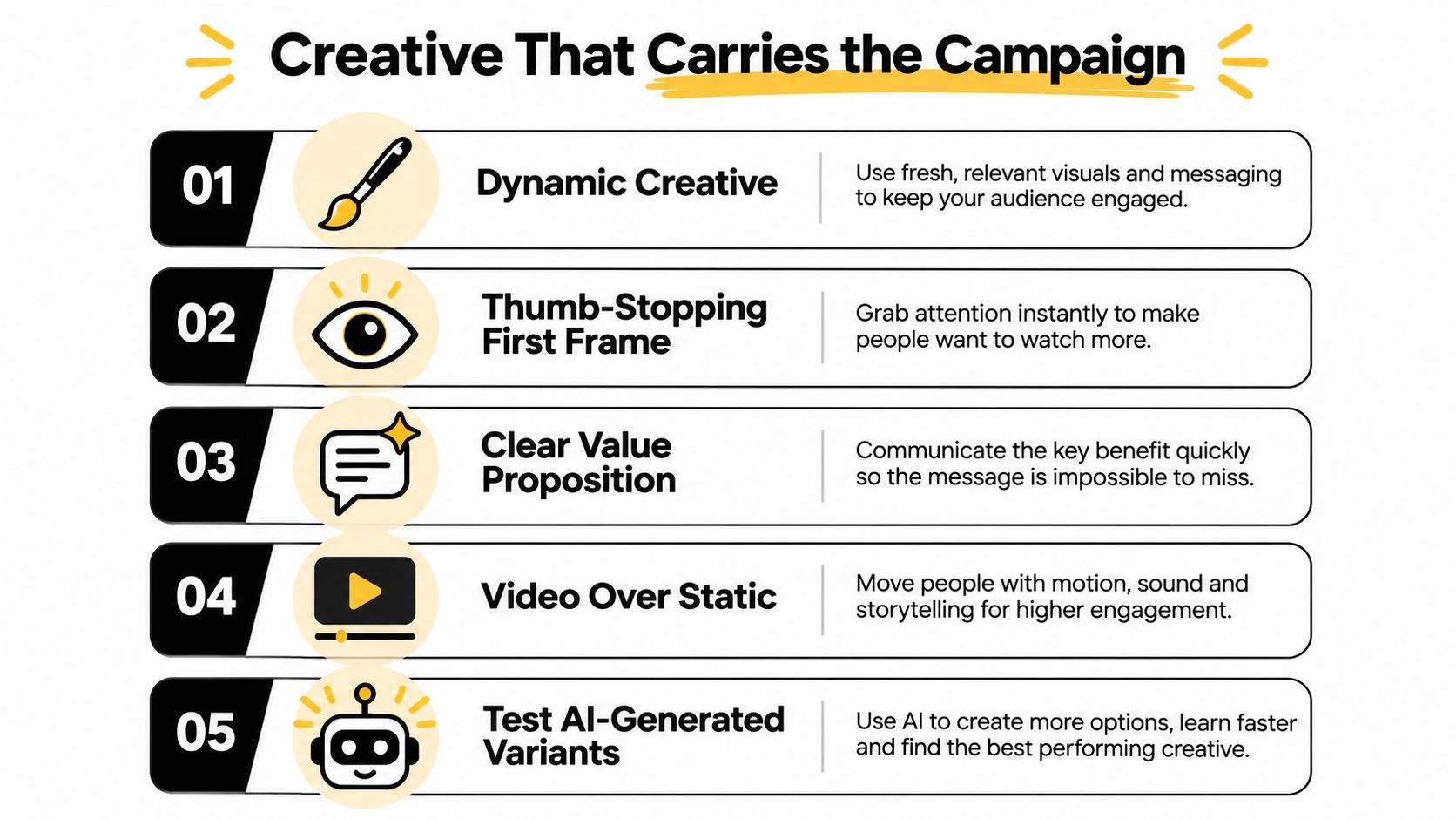
Targeting used to dominate Facebook PPC conversations. In 2026, that advice is incomplete. Meta's automation, Advantage+ workflows, and AI-assisted creative tools have shifted more responsibility toward the quality and variety of the ads you provide.
One industry discussion cites AppsFlyer reporting that 70% to 80% of Meta ad performance stems from creative strength, as referenced in this Reddit discussion about Meta ads updates. Treat that figure as an industry-reported directional claim, not a guarantee for your account. The strategic lesson is more durable: creative gives the system multiple ways to match different people, placements, and moments.
Build a portfolio, not one “perfect” ad
A useful creative portfolio may include a founder explanation, a customer problem, a product demonstration, a comparison, and a direct offer. Each version should change a meaningful variable, such as the opening message, visual angle, proof, or call to action.
Short-form video deserves a place in that mix because it can demonstrate a product or explain a service quickly. If producing variations is the bottleneck, a tool such as the Hooked Facebook video generator can help teams create starting points for short-form concepts.
Make the first moment do real work
People decide whether to continue before they've processed your full offer. Open with the customer's problem, a visible product result, a strong question, or a specific situation. Don't hide the value proposition beneath brand history.
Copy length also needs practical discipline. For Facebook feed placements, guidance commonly centers on about 125 characters of primary text before the “See More” cutoff, with headlines generally around 27 to 40 characters, depending on placement, as outlined in Meta ad copy specifications. These are format guidelines, not universal performance rules, so test concise and expanded versions.
Image text needs nuance. Meta stopped penalizing ads for higher amounts of text in images during auctions and delivery on September 7, 2020, but it still recommended minimizing image text because ads with less than 20% text tended to perform better, according to the cited update discussion. Use text when it clarifies the offer, not because the design has empty space to fill.
Creative test question: What single idea should a distracted user understand before deciding whether to keep watching?
Measuring and Optimizing Performance
The better question isn't “What's a good Facebook ads CPC?” It's “What's good for this objective, this funnel stage, and this conversion value?”
Published benchmark data reports an overall Facebook ads CPC of about $1.14, an average CTR of about 0.90%, and an average lead-generation conversion rate of 9.21%, as summarized by Stackmatix's Facebook ads cost guide. The same source reports conversion-campaign CPM at about $14.68, compared with about $7.19 for reach campaigns. That gap illustrates a basic trade-off: optimizing for downstream actions can make delivery more expensive because Meta is competing for users it predicts are more likely to convert.
Diagnose the whole path
A click is only the beginning. Check whether the landing page loads correctly, whether the offer matches the ad, whether the form works, and whether your sales team follows up. A campaign can show an acceptable CPC while losing money after the click.
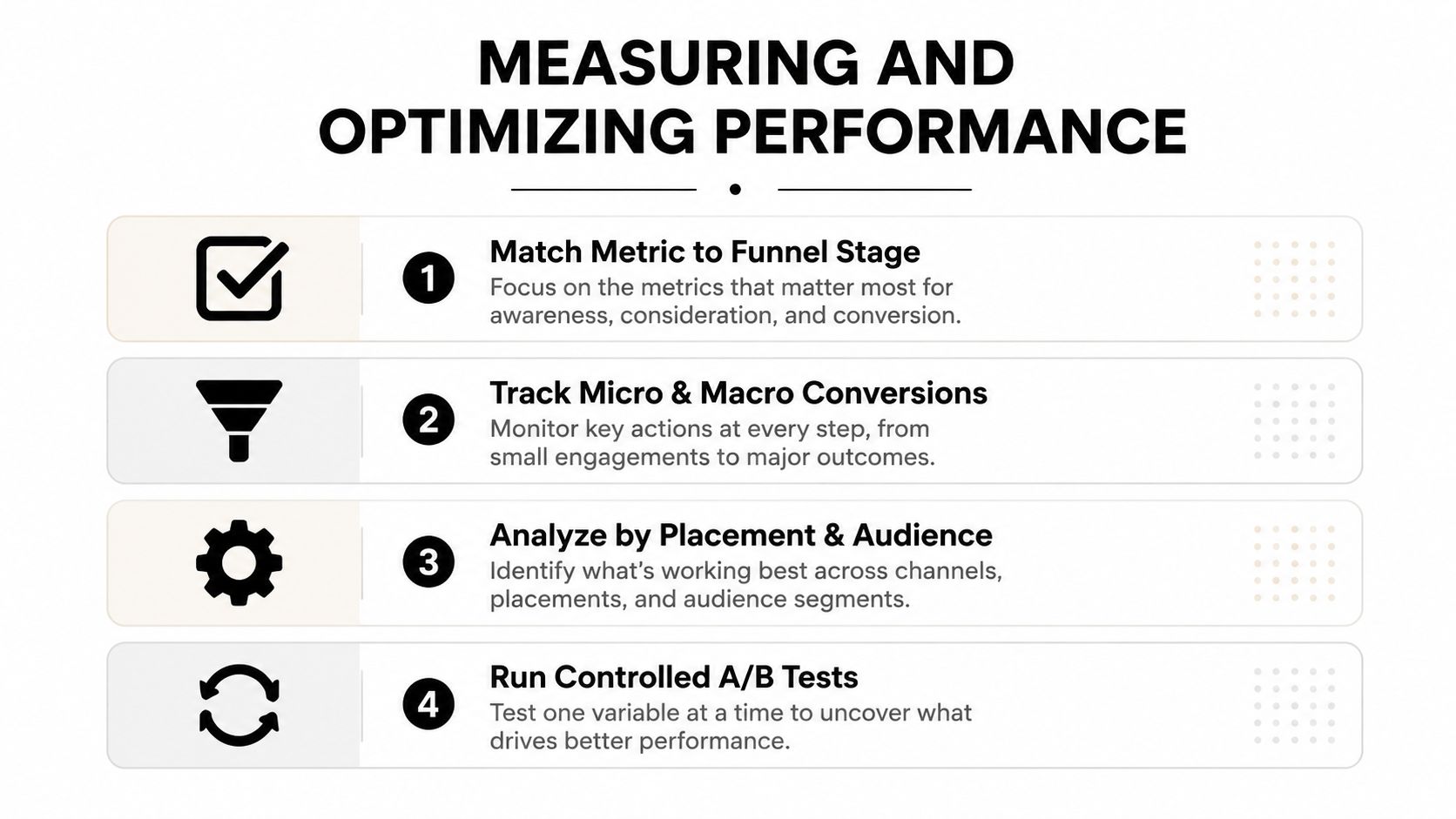
Use a simple diagnostic sequence:
- Match the metric to the objective. Judge traffic campaigns on qualified visits, lead campaigns on valid leads, and sales campaigns on profitable conversions.
- Separate micro and macro conversions. Video views, landing-page visits, and form starts can reveal friction before the final conversion.
- Break down delivery. Compare placements, audiences, devices, and creative versions rather than averaging the entire campaign.
- Refresh the weakest link. Replace tired creative, repair the landing page, or adjust the audience only when the evidence points there.
Clean waste before you scale
Wasted spend often hides inside irrelevant traffic, weak placements, poor-quality leads, or conversion events that don't reflect revenue. Review the terms and actions that enter the wider paid-media workflow, then remove patterns that repeatedly fail your qualification criteria.
For broader account-management context, this Facebook ads scaling strategy offers a useful reference for thinking about controlled growth. Scaling should follow evidence from the conversion path, not just rising impressions or clicks.
You'll also want a clear view of what Meta charges and when. The Facebook advertising charges guide can help you keep billing mechanics separate from performance analysis, so you don't mistake a payment setting for an optimization insight.
Your First Facebook PPC Campaign Plan
Start with one business outcome. Choose traffic when qualified visits are the immediate goal, leads when a completed inquiry matters, or sales when your tracking can reliably identify purchases.
Then prepare a small creative portfolio before launch:
- Choose three to five variations: Change the hook, visual, proof, or offer angle so the results teach you something.
- Keep the structure readable: Separate campaigns only when the objectives or funnel stages differ.
- Set a modest daily budget: Give the system room to learn without making early mistakes expensive.
- Schedule a 72-hour review: Check delivery, broken links, conversion tracking, and obvious waste before making major edits.
- Record the decision: Note what changed, why it changed, and which metric should improve.
Avoid touching every setting as soon as the first numbers appear. Facebook PPC rewards a steady cycle of launch, observation, diagnosis, and creative iteration. For organic content that supports your paid activity, Donivo's tips for scheduling can help you plan publishing around campaign themes without turning your workflow into a daily scramble.
Keywordme can support the paid-search side of that broader process by helping marketers review search terms, build negative keyword lists, assign match types, and handle campaign expansion in a Chrome-based workflow. That work won't replace Facebook creative testing, but it can reduce waste across accounts where search data informs broader acquisition decisions.
Keywordme helps you organize keyword research, clean up junk search terms, build negative keyword lists, and apply match types without repetitive copy-and-paste work. Visit Keywordme to start the seven-day free trial and bring a faster search-term cleanup process into your PPC workflow.
.svg)