
Facebook Ads vs Google Adwords: 2026 Showdown
Facebook Ads vs Google Adwords: 2026 Showdown


You're probably staring at the same question a lot of advertisers hit when a fresh budget lands on the table. Do you put the money into Facebook Ads, Google AdWords, or split it across both and hope attribution doesn't turn into a mess three weeks later?
If the budget is $10k, this isn't a theoretical debate. It's a resource allocation problem. One platform can generate demand cheaply. The other can capture people who are already close to buying. The hard part is that both can look good in-platform while only one is driving profitable growth.
That's why most facebook ads vs google adwords articles feel incomplete. They compare features, show a few benchmark numbers, and stop right before the messy part. Real accounts don't live in clean platform silos. Buyers see a social ad, leave, search later, click a branded term, and convert on a different device. If you don't account for that, your reporting gets sloppy fast.
A practical starting point is this. Google usually wins when the offer already has clear search demand. Facebook usually wins when the market needs education, repetition, or a visual hook before people care enough to search.
Here's the quick comparison before we dig in.
| Criterion | Google Ads | Facebook Ads |
|---|---|---|
| Core strength | Captures existing demand | Creates and shapes demand |
| User mindset | Active search intent | Passive browsing and discovery |
| Typical CPC | Higher | Lower |
| Best use case | High-intent leads and purchases | Awareness, creative testing, retargeting |
| Primary targeting | Keywords, search queries, intent signals | Demographics, interests, behaviors |
| Creative environment | Search, Shopping, YouTube, Display | Feed, Stories, Reels, carousel, video |
| Common reporting trap | Over-crediting branded and bottom-funnel terms | Over-crediting view-through and light-intent leads |
Paid Search vs Paid Social A Fundamental Choice
The cleanest way to think about facebook ads vs google adwords is this. Google is paid search. Facebook is paid social. They solve different problems.
Google captures demand that already exists. Someone searches for a product, service, problem, or comparison. Your ad appears because the query signals intent. That's why Google clicks cost more. According to Shopify's comparison of Google Ads and Facebook Ads, Facebook Ads average between $0.62 to $1.72 CPC, while Google Ads average $2.69 to $5.26 CPC. That price gap reflects user intent, not platform generosity.
Facebook works the other way around. People aren't usually searching for a solution when they open the app. They're scrolling. Your ad has to interrupt, attract attention, and create interest before the click even matters.

Think demand capture versus demand creation
A lot of wasted spend comes from mixing these roles up.
If you run Google Ads for a product nobody is actively searching for, you can build a technically solid campaign and still get weak volume. If you run Facebook Ads for a boring but high-intent service and expect instant bottom-funnel efficiency, you can end up paying for attention without enough qualified action.
Practical rule: Use Google when buyers already know what they want. Use Facebook when they need a reason to care first.
That distinction shapes everything else, from offer structure to landing page design.
Google behaves like spear fishing. You're targeting a specific moment. Facebook behaves more like casting a net. You reach more people cheaply, but most of them won't be ready yet. That's not a flaw. It's the job.
What I'd do with a fresh $10k budget
I'd start by asking one question. Is there existing search demand for this offer?
If the answer is yes, I'd bias spend toward Google first because it lets you intercept commercial intent faster. If the answer is no, I'd lean harder into Facebook because creative, audience testing, and message-market fit matter more before search volume can do much work.
A few examples:
- Local legal service: Google first. People search when the need is urgent.
- New skincare brand: Facebook first. Buyers often need repeated exposure and strong creative.
- B2B software with category awareness: Usually both, but not with equal expectations.
- Niche service nobody knows to search for: Facebook or another discovery channel before scaling search.
This is the strategic fork in the road. Get this part wrong and every later decision gets harder.
Head-to-Head Platform Capabilities
The platform debate gets clearer when you compare how each system operates. Not slogans. Not dashboard screenshots. The mechanics.
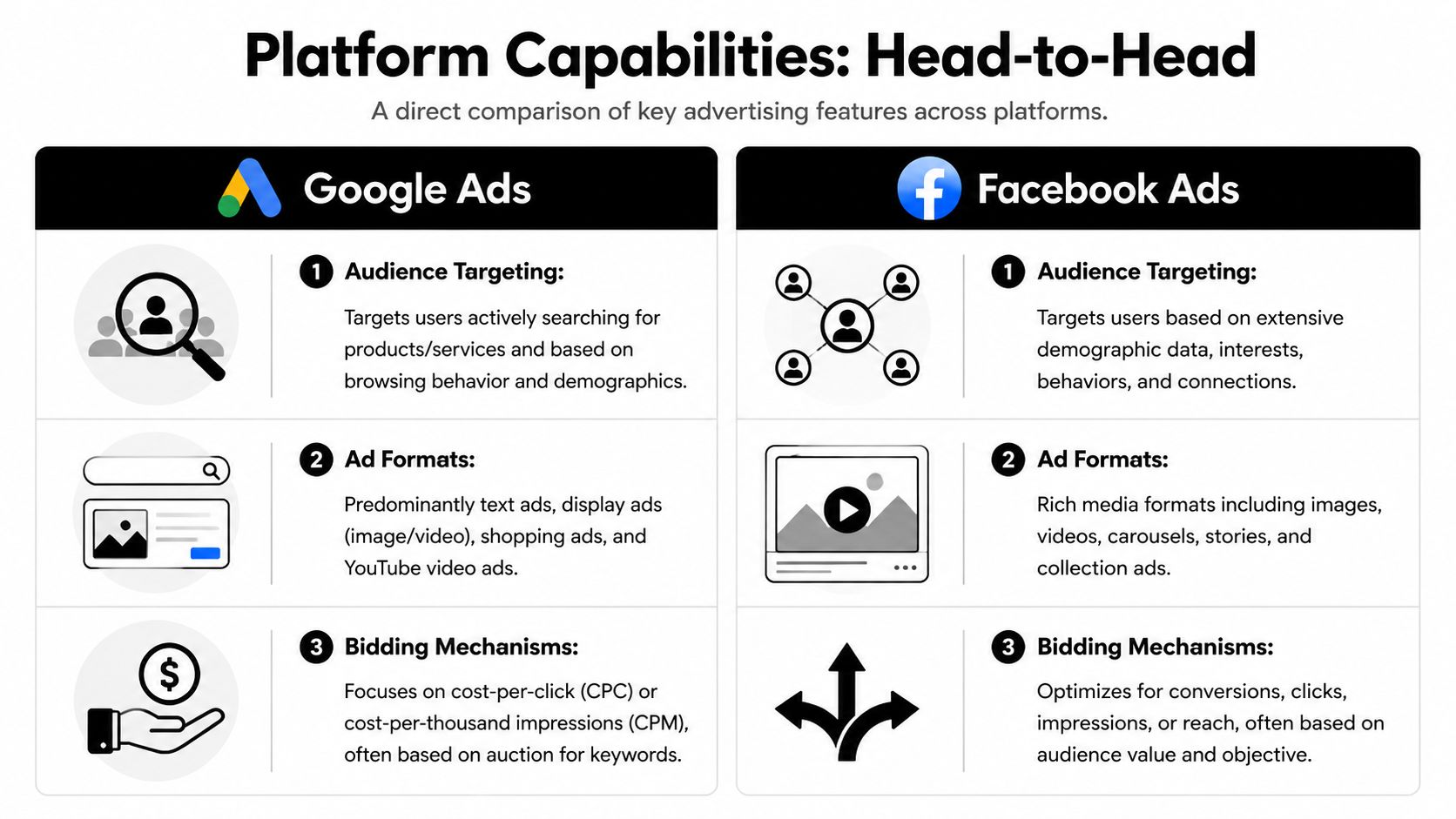
Google Ads vs Facebook Ads Feature Comparison
| Criterion | Google Ads | Facebook Ads |
|---|---|---|
| Audience targeting | Keywords, search intent, audience signals, remarketing | Demographics, interests, behaviors, lookalikes, remarketing |
| Ad formats | Text ads, Shopping, Display, YouTube | Image, video, carousel, Stories, Reels, collection |
| Bidding style | Auction-based with intent and conversion signals | Objective-based delivery optimized by audience response |
| Best creative type | Direct response, offer clarity, product relevance | Visual storytelling, hooks, thumb-stop creative |
| Best campaign role | Mid and bottom funnel | Top and mid funnel |
Audience targeting works differently
Google targeting starts with the query. That means the user tells you what they want, or at least what they're investigating. That's a huge advantage for products and services with clear intent.
Facebook targeting starts with the person. You choose audiences based on demographics, interests, behaviors, and platform data. That's powerful for discovery, but it also means your ad has to do more work because intent is weaker at the moment of impression.
The biggest targeting difference is simple. Google targets what people want right now. Facebook targets who people are and what they might care about.
This is why search terms matter so much on Google. Tight match type control, negative keywords, and query mining improve efficiency because they refine intent. On Facebook, the advantage stems more from creative angle, audience quality, and event optimization.
If you're running Meta and need execution help, a specialist in professional Facebook campaign management can be useful when your issue is audience structure and creative testing rather than search term quality.
For advertisers trying to improve paid social setup internally, Keywordme has a useful primer on advertising on Facebook and Instagram.
Ad formats match the environment
Google ad formats are built around utility. Search ads answer a query. Shopping ads help product comparison. YouTube can widen the net, but the core system still revolves around intent-led placements.
Facebook ad formats are built for interruption and persuasion. Image ads, video, carousel, Stories, and collection ads all give you more room to sell a narrative, show a product in use, or present a problem-solution angle.
That doesn't mean one is better. It means the creative standard is different.
- Google Ads: The message has to be relevant fast. Searchers want clarity.
- Facebook Ads: The opening seconds matter most. If the ad doesn't stop the scroll, nothing after that counts.
- Shopping and catalog-led campaigns: Strong on Google when users are already comparing options.
- Video and lifestyle creative: Often stronger on Facebook when the offer needs emotional context.
Bidding and optimization are not the same game
Many advertisers flatten the comparison too much. Both platforms automate. They do not automate toward the same signals.
According to Stackmatix's breakdown of Google Ads vs Facebook Ads, Google's Smart Bidding uses real-time, auction-level signals like device, intent, and conversion value. Meta's system, by contrast, prioritizes engagement more naturally for upper-funnel goals and can dilute downstream revenue signals without strict conversion tracking.
That difference matters in live accounts.
Critical difference: Google's automation tends to reward tight conversion paths. Meta's automation tends to reward ads that generate strong platform response unless you feed it cleaner conversion data.
In practice, that means Google often becomes more predictable when you have:
- Clear conversion actions
- Strong search term control
- High-intent landing pages
- Enough history for Smart Bidding to learn
Facebook becomes more effective when you have:
- A strong creative testing system
- Clear event prioritization
- Solid post-click tracking
- A nurturing plan after the first click
If your offer is already being searched, Google's structure usually feels more controllable. If your offer needs education, Facebook often gives you more room to shape demand.
Analyzing Cost Conversions and ROI
Cheap clicks don't mean cheap customers. That's the trap.
Facebook often looks attractive at the top of the funnel because the CPC is lower. For broad reach and creative testing, that matters. But if your goal is revenue, you can't stop at click price. You need to look at intent, conversion quality, and what happens after the first purchase.
Why Google clicks often cost more and still win
According to Elyspace's 2025 benchmark comparison, Google Search Ads achieve an average conversion rate of 4.40%, while Facebook's e-commerce average sits at 2-3%. The same source says Google Ads deliver 20-30% more ROI for high-intent searches over a 6-month period.
That lines up with what many practitioners see in mature accounts. Search traffic converts better when the user already has a problem, a category in mind, or buying intent.
The click is expensive because the moment is valuable.
What actually changes the math
If I'm reviewing a $10k budget, I don't ask which platform is cheaper. I ask which platform is more likely to produce profitable actions in this business model.
Use this simple lens:
- Search-heavy business: Google usually deserves more of the spend.
- Impulse-friendly visual product: Facebook can open the market faster.
- Long sales cycle: Facebook may start the journey, but Google often closes it.
- Weak landing page and weak offer: Both platforms will underperform, just in different ways.
A quick way to pressure test assumptions is with a tool like this lead generation ROI calculator, especially when clients fixate on CPC and ignore close rate or repeat purchase value.
You should also understand what spend levels can realistically support Google learning and query coverage. This guide on how much Google Ads costs is useful when you're modeling whether your budget can sustain a serious search campaign.
Don't ignore the time horizon
Facebook can make early numbers look better in some setups because it's great at generating initial engagement and lower-cost traffic. That's helpful when you need audience data, creative learning, or retargeting pools.
Google often looks better over time when the business depends on qualified leads, repeat purchase behavior, or strong buying intent.
Here's a useful walkthrough if you want a broader take on the trade-offs in campaign economics.
If a buyer searches with intent, you're not paying just for a click. You're paying to intercept a decision already in motion.
That's why ROI conversations get distorted when teams compare low-cost social traffic against bottom-funnel search traffic as if they're equal assets. They aren't.
Mapping Platforms to Your Marketing Funnel
The better question isn't which platform is better. It's where each platform belongs in the buying journey.
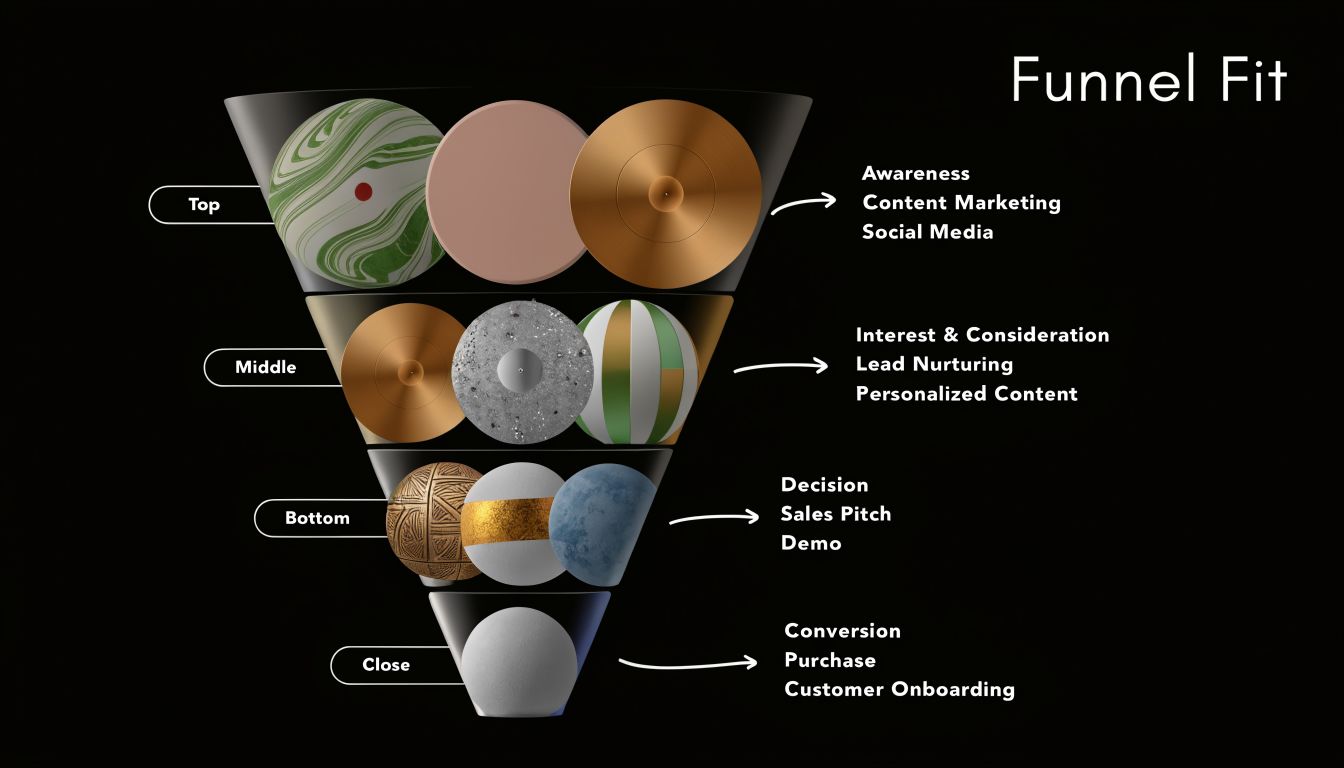
Top of funnel awareness
Facebook is usually stronger here because it can reach people before they start searching. It has the scale and creative flexibility to introduce a product, frame a problem, or seed a category.
According to MarTech's benchmark summary, Google Search conversion rates average 4.4-7.5% because the traffic is high intent, while Meta can show higher headline lead form conversion rates around 9% but often with lower-intent visitors who need more nurturing.
That makes Facebook well suited for:
- Product discovery
- Founder-led storytelling
- Visual demos
- Cold audience education
- Lead magnets that warm up future demand
For a deeper read on how intent differs across ad environments, this breakdown of search ads vs display ads helps frame the same funnel logic from another angle.
Middle of funnel consideration
The platforms begin overlapping at this point.
Facebook retargeting works well when someone has visited the site, watched content, or engaged with an earlier ad. You can reintroduce proof, show customer outcomes, or answer objections with a different creative angle.
Google becomes stronger when the same person starts comparing solutions. Search terms at this stage often reveal sharper intent. Brand searches, competitor searches, and category-plus-feature searches become more meaningful than broad discovery traffic.
A person who watched your Facebook video is interested. A person who later searches for your solution by name is moving closer to action.
For e-commerce, this often means Facebook creates the first touch and Google catches branded or product-specific follow-up searches. For B2B, Facebook might generate awareness around a problem, while Google captures demo intent later.
Bottom of funnel conversion
Google usually owns this stage when demand already exists.
Search is built for moments like:
- “best payroll software for small business”
- “emergency plumber near me”
- “crm pricing”
- “buy trail running shoes online”
Those are decision-shaped queries. That's very different from someone scrolling through social content after work.
For local service businesses, strong bottom-funnel Google campaigns can carry most of the account. For visually led consumer brands, Facebook may still drive direct purchases, but Google often becomes the cleaner closer once the brand is known.
The key is not forcing Facebook to behave like search, or forcing Google to create demand that doesn't exist yet.
Building a Winning Dual-Channel Strategy
The smartest setup for many accounts isn't Facebook or Google. It's Facebook first touch plus Google capture, with reporting disciplined enough to keep both platforms honest.
The simple comparison breaks down at this point. A buyer sees a Facebook ad on Monday, ignores it, searches the brand on Thursday, clicks a Google ad, and converts on Friday. Google claims the conversion. Facebook claims influence. The client asks which platform deserves the budget increase.
That's not a reporting glitch. That's normal buyer behavior.
The hidden cost is attribution
According to Wicked Reports' discussion of Facebook Ads vs Google Ads, the major gap in most comparisons is attribution complexity. The problem isn't just running both platforms. It's proving the incremental lift when one creates awareness and the other captures the final action.
If you don't plan for that, you'll make bad budget decisions.
A practical operating model for $10k
If I'm advising a client with a fresh $10k and both platforms are viable, I'd use a staged approach instead of splitting funds evenly on day one.
Fund Facebook to test hooks and audience response
Use it to learn which messages get attention, what offer framing lands, and which segments engage.Use Google to capture the intent that already exists
Build around non-junk queries, clear ad groups, and landing pages that match the search.Separate prospecting from retargeting
Don't let warm audiences make cold traffic look profitable.Watch branded search carefully
A rise in brand search after social spend often signals that Facebook is assisting, even if Google gets last-click credit.Judge channels by role, not vanity
Facebook should be evaluated on qualified traffic and assisted demand creation. Google should be judged on efficient capture of buying intent.
If you run both platforms, don't ask which one “won” the conversion. Ask what role each one played and whether the combined system lowers acquisition cost or improves revenue quality.
Where tooling matters
This is also where keyword discipline stops being a minor optimization and becomes budget protection. If Facebook creates interest and pushes people into search later, your Google account has to be clean enough to capture that demand efficiently.
One option is Keywordme, which works inside Google Ads to clean search terms, build keyword groups, apply match types, and manage negative keywords without the usual manual copy-paste routine. In a dual-channel setup, that matters because wasted search spend can erase the advantage you created upstream on paid social.
The winning strategy isn't “be everywhere.” It's making sure each platform does the job it's built for.
FAQ Your Google vs Facebook Ads Questions Answered
Which platform should a beginner start with
Start with Google Ads if people already search for what you sell. Start with Facebook Ads if your product needs demonstration, education, or strong creative to generate interest.
If you're a local service business, search is usually easier to justify first. If you're launching a visually driven product with weak search demand, Facebook often gives you faster feedback.
How would you split a fresh $10k budget
It depends on demand maturity.
If search demand already exists, I'd usually put more budget into Google first and reserve the rest for Facebook retargeting or creative testing. If the market needs warming up, I'd flip that logic and use Facebook to shape demand before expecting search to scale.
The mistake is forcing an even split before you know how buyers move.
Is Facebook cheaper than Google
At the click level, often yes. But lower CPC doesn't automatically mean lower acquisition cost or better ROI. Cheap traffic that doesn't convert cleanly can waste money fast.
Can I use only one platform
Yes.
Use only Google if your business wins on urgent, high-intent searches and your sales path is direct. Use only Facebook if your offer is discovery-led and search demand is limited. Most established brands eventually benefit from both, but not always at the same spend level.
Which platform is harder to master
They're hard in different ways.
Google punishes weak account structure, loose match types, and poor landing page alignment. Facebook punishes stale creative, weak hooks, and sloppy tracking. Search feels more mechanical. Paid social feels more fluid.
What's the biggest mistake in facebook ads vs google adwords decisions
Comparing platform dashboards without understanding the customer journey. Last-click reporting can make Google look like the hero and Facebook look wasteful, even when Facebook created the demand in the first place.
If you're putting real budget behind Google and want tighter control over search terms, match types, and negative keywords, Keywordme is worth a look. It's built for the unglamorous part of PPC that affects ROI more than most advertisers want to admit: keeping your Google Ads account clean enough to turn intent into profitable conversions.
.svg)