
Onboarding New Team Members: Step-by-Step Playbook
Onboarding New Team Members: Step-by-Step Playbook


Only 12% of employees believe their organization has a good onboarding process, while 55% of businesses don't check whether onboarding works. Effective onboarding new team members means closing the readiness gap between completing administrative tasks and confidently doing the job.
That distinction matters in marketing operations, where a new hire may need to understand campaign structure, reporting standards, approval workflows, client context, and team norms before they can make useful decisions. A completed form proves compliance. It doesn't prove readiness.
The strongest onboarding programs treat the first several months as a productivity acceleration system. They prepare access before Day 1, clarify responsibilities immediately, create supervised practice, schedule deliberate feedback, and measure whether people can perform essential work without constant rescue. Gallup notes that onboarding may span the first 30, 90, 150, or even more than 365 days, depending on the role and industry, so a single orientation session was never a realistic finish line. Gallup's guidance on effective onboarding supports that extended view.
Why Traditional Onboarding Misses the Mark
A widely cited onboarding baseline says the average new hire is expected to complete 54 onboarding activities, yet only 12% of employees say their organization has a good onboarding process. Worse, 55% of businesses reportedly don't check whether onboarding is working at all. G2's onboarding statistics show the problem clearly: organizations often create plenty of activity without creating enough capability.

Activity isn't the same as readiness
A checklist can tell you that someone signed the handbook, watched a security video, joined Slack, and received a laptop. It can't tell you whether they know which campaign data to trust, when to escalate an issue, or how to explain a performance change to a client.
The traditional approach compresses too much into orientation. New hires sit through policy presentations, complete forms, meet a stream of colleagues, and receive a large collection of documents. By the end of the day, they may know more facts about the company but still have no clear answer to a practical question: What should I be able to do this week?
The same G2 findings report that 43% of workers say onboarding lasts more than a day, while 25% of companies include no employee training in onboarding. Those figures help explain why the process feels complete to administrators but unfinished to the person expected to produce work.
Practical rule: Measure what a new hire can do, not only what a new hire has received.
Replace the paperwork finish line
Paperwork still matters. Access controls, employment documentation, and policy acknowledgments protect the business and reduce avoidable delays. The mistake is allowing those tasks to define the entire experience.
A productivity-led process connects every administrative step to a work outcome:
- System access: The new hire can enter the tools required for assigned work.
- Role clarity: The manager explains responsibilities, decision rights, priorities, and boundaries.
- Practice: The new hire observes, performs, and reviews real tasks.
- Feedback: Someone identifies confusion before it becomes a repeated error.
- Measurement: The team tracks progress through meaningful milestones.
That shift changes the manager's job. Instead of asking whether onboarding is finished, ask whether the person can complete the next important responsibility with appropriate support. If the answer is no, another presentation won't necessarily help. A clearer example, supervised task, or manager conversation probably will.
Pre-boarding Checklist for Smooth Arrival
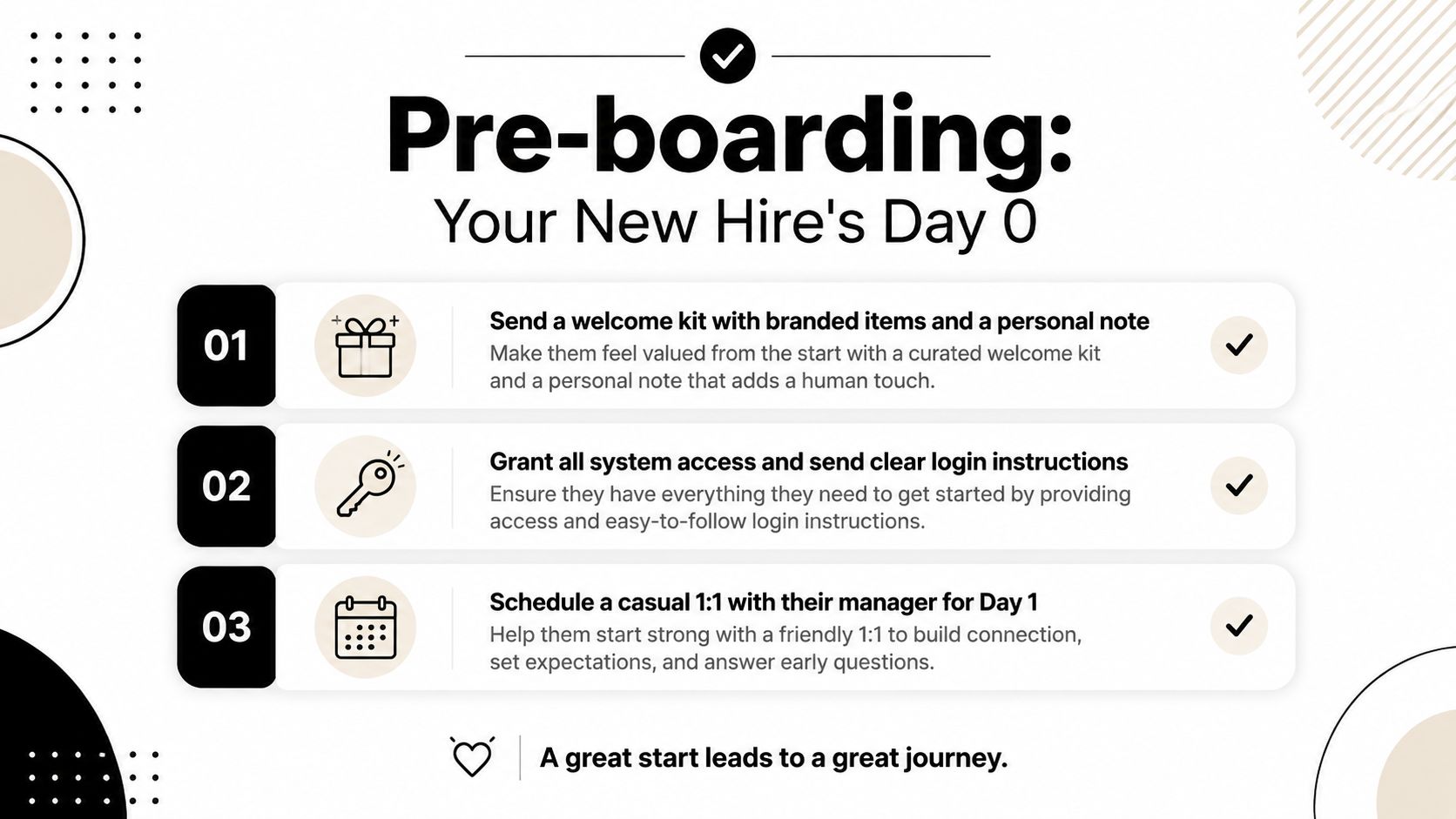
Pre-boarding starts after the offer is accepted and before the first working day. The aim isn't to fill the new hire's calendar early. It's to remove friction so their first meaningful interaction with the team isn't a password reset or a search for missing equipment.
Industry benchmarking reports that 65% of employees receive some preboarding, while other findings show that many organizations still compress onboarding into a short window and 55% don't measure onboarding effectiveness. AIHR's onboarding statistics and benchmarks support a practical conclusion: preparation before Day 1 creates space for learning and connection once the person arrives.
Complete the operational setup
Assign one owner for the pre-boarding checklist, then give each task a clear deadline and backup owner. The manager should confirm the role requirements, while IT or operations handles provisioning and equipment.
- Confirm the welcome details: Send the start time, location or video link, dress expectations, working hours, lunch plan, and contact person for arrival questions.
- Provision essential access: Prepare email, communication channels, project management tools, analytics platforms, documentation, and role-specific applications. Send login instructions through an approved secure process.
- Prepare the workspace: Set up the desk, monitor, headset, laptop, software, and basic supplies. For remote hires, confirm equipment delivery and explain how to get technical help.
- Load the first learning path: Organize the documents, recorded training, examples, and initial exercises in the order the new hire should use them. A folder full of unranked links isn't a learning path.
- Invite the right meetings: Add only the recurring meetings that help the person understand work, decisions, and relationships. Don't fill the first week with calls that have no context.
- Assign a buddy: Choose someone approachable who understands the team's informal workflows. SHRM recommends that the buddy connect before the first day to answer practical questions and reduce uncertainty. SHRM's onboarding guidance describes onboarding as a staged process that can include orientation, foundation building, and mentoring.
For complex organizations with multiple systems, locations, or compliance requirements, a structured onboarding checklist for complex environments can help managers separate universal tasks from role-specific ones.
Document the repeatable path
Document the process while it's fresh. Record who owns each task, where the relevant template lives, what access is required, and what the new hire should produce. Teams can use this process documentation guide to make the workflow easier to repeat and update.
The best pre-boarding checklist ends with a simple test: can the new hire access the tools, find the first assignment, identify their manager and buddy, and understand what will happen on Day 1? If not, the process still has a readiness gap.
Day One Agenda Focused on Expectations
Day One shouldn't be a parade of forms, generic presentations, and forced socializing. SHRM recommends focusing the first day on setting expectations and introducing objectives, so the new hire leaves with clear job duties and responsibilities. SHRM's first-day onboarding guide puts role clarity ahead of administrative volume.
Build the day around useful outputs
A practical agenda should move from orientation to context to action. The exact timing can vary, but each block should answer a question the new hire will face in the work.
- Welcome and working agreement: The manager explains how the team communicates, makes decisions, handles deadlines, and raises concerns. The new hire should know when to use chat, email, meetings, or a task system.
- Role and objectives: Review the job's core responsibilities, current priorities, decision rights, and early success criteria. Show how the role connects to team and company goals.
- Tool setup with purpose: Confirm access by using the tools in a realistic workflow. A marketing operations hire might open a reporting workspace, locate campaign documentation, and trace a task from request to approval.
- Team context: Introduce the people the new hire will work with and explain why each relationship matters. Avoid listing names without explaining responsibilities.
- Buddy conversation: Let the buddy cover practical questions that a manager may overlook, including team norms, recurring routines, and where to find reliable answers.
- First task: Assign a small, bounded task that produces evidence of understanding. The task might involve annotating a campaign brief, reviewing a reporting template, or documenting questions about an existing workflow.
- End-of-day check-in: Ask what makes sense, what remains unclear, and what the new hire expects to accomplish next. Capture the answers instead of relying on memory.
Protect attention
Don't confuse a full calendar with a thoughtful welcome. New hires need quiet time to read, test access, and process unfamiliar information. Schedule fewer meetings, provide written context before each one, and make the manager accountable for removing contradictions between documents and actual practice.
Permission errors can derail the technical portion of Day One, especially when a role touches client data or advertising accounts. A documented approach to user permission management helps teams grant the right access without treating security as an afterthought.
The new hire doesn't need to master the organization in one day. They do need to understand what they own, how success is judged, where to ask for help, and what they will do next.
30-60-90 Day Plans That Actually Work
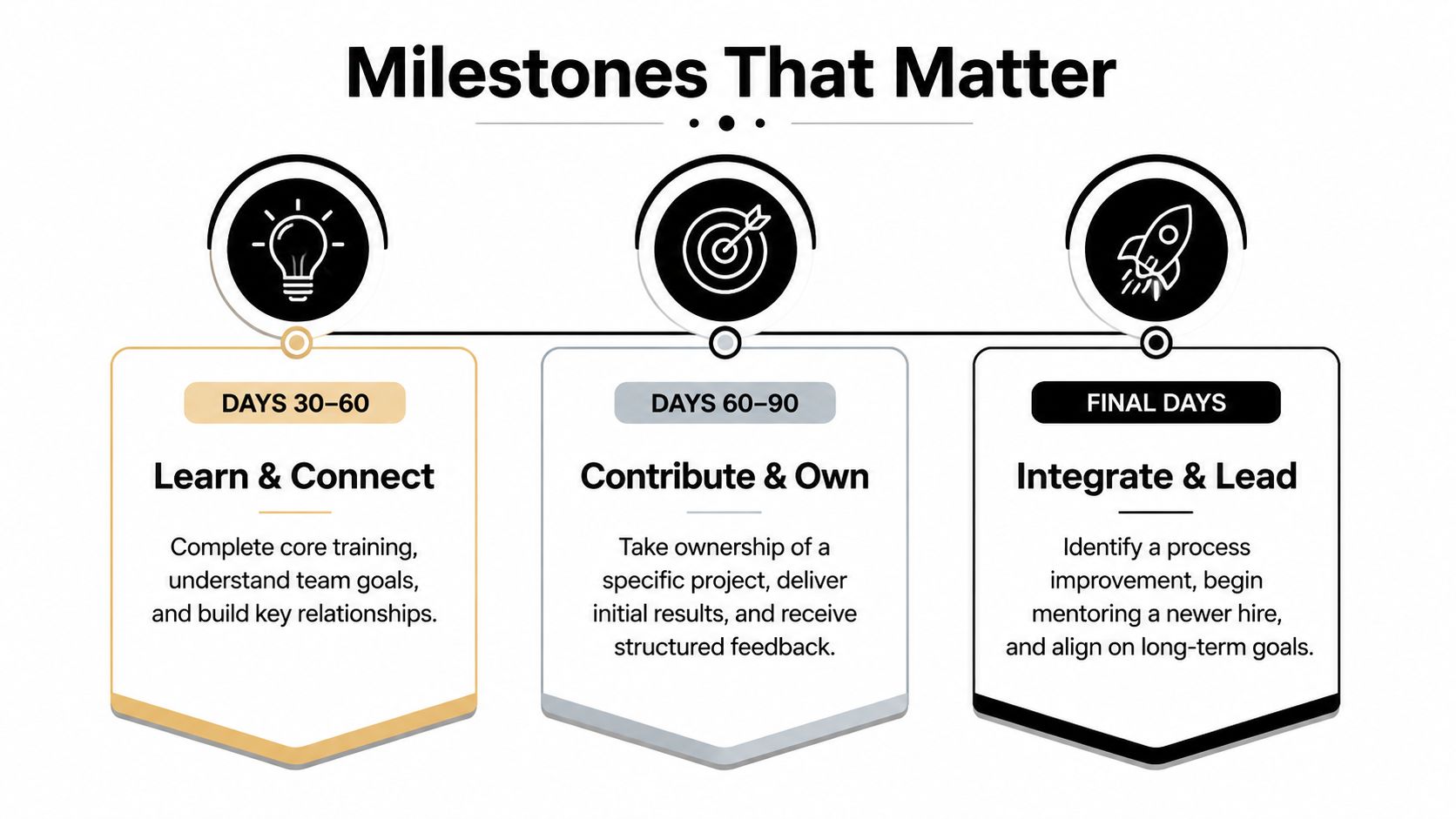
A 30-60-90 day plan works when it describes observable progress rather than a collection of training topics. The plan should show how the new hire moves from understanding the environment to contributing independently, with the manager checking progress in 30-day increments during the first 90 days. SHRM recommends using the Day 90 meeting to support follow-up quarterly review and development planning. SHRM's 90-day onboarding guidance gives the cadence a practical anchor.
Days 1 through 30
The first milestone is orientation through supervised practice. The new hire should learn the team's priorities, meet key collaborators, understand the core systems, and complete carefully scoped work with review.
For a PPC specialist, that could mean auditing a small set of search terms, identifying questions in an account structure, and explaining the reasoning behind proposed changes. For an agency account manager, it might mean reviewing a client brief, joining a status call, and drafting a follow-up for manager feedback.
The 30-day conversation should test understanding:
- Can the new hire explain the team's goals?
- Can they identify the owner of each major decision?
- Can they complete a recurring task using the documented process?
- Do they know which questions require escalation?
- Which training or relationship is still missing?
Days 31 through 60
The second milestone should introduce controlled ownership. Assign a defined project or recurring responsibility with a clear quality standard, deadline, and review point. The manager should reduce step-by-step instruction while staying available for decisions that carry risk.
The 60-day review should focus on patterns. Is the new hire applying feedback? Are they finding information independently? Do they communicate blockers early? A person who completes tasks quickly but repeatedly misses context may need stronger role framing, not more software training.
Days 61 through 90
By Day 90, the new hire should own a meaningful slice of work and explain the choices behind it. The manager can review results, stakeholder feedback, operational habits, and development priorities. The conversation should produce a forward-looking plan, not merely a pass or fail judgment.
This cadence matters because 24% of employees leave within their first 90 days, and poor onboarding can account for 12% to 15% of first-year turnover, according to the systematic review and associated industry findings in this onboarding research synthesis. The same source reports that 70% of new hires decide in the first month whether the role is a fit. Early check-ins give managers a chance to correct confusion while correction is still possible.
Adapting Onboarding for Remote and Hybrid Teams
Remote onboarding can look complete while still feeling disconnected. Recent coverage reported that 76% of new hires felt welcomed, yet nearly one in three said their onboarding lacked human interaction. The Learning Guild's coverage of belonging during onboarding highlights the difference between receiving a welcome message and building genuine connection.

Compare the experience, not just the tools
An office-based hire can overhear how colleagues discuss priorities, notice who answers particular questions, and learn informal norms through repeated contact. A remote hire needs those signals made explicit. Hybrid teams face a different challenge: employees may attend the same meetings but receive unequal access to informal conversations depending on how often they're physically present.
Use the same work expectations across locations, but change the connection mechanisms:
- Remote: Schedule short video conversations with the manager, buddy, close collaborators, and key partners. Pair each meeting with a purpose and suggested questions.
- Hybrid: Create meetings and documentation that work equally well for people in the room and people joining online. Don't let important decisions happen only in hallway conversations.
- In-office: Use spontaneous interaction as a supplement, not the entire onboarding strategy. New hires still need written norms, defined milestones, and deliberate feedback.
- Distributed agency: Explain client communication standards, time-zone expectations, handoff rules, and where final decisions are recorded.
A buddy system works remotely when the buddy has a real responsibility rather than a ceremonial title. The buddy can invite the new hire to observe a workflow, explain an unfamiliar acronym, and check in after the first client-facing or cross-functional interaction.
This short video can help managers think through the human side of virtual onboarding:
For teams managing employment logistics across locations, guidance on how PEOs simplify hybrid onboarding offers useful context on coordinating operational requirements while managers focus on connection, role clarity, and practical work.
The standard should be simple: a remote or hybrid hire should know who to contact, where decisions live, how the team collaborates, and how they belong to the work. A welcome emoji can't provide all of that.
Measuring Success and Troubleshooting Gaps
A process that isn't measured becomes a collection of opinions. Yet 55% of businesses reportedly don't check whether onboarding works, according to G2's onboarding research. Measurement doesn't require a complicated people analytics stack. It requires clear definitions of progress and consistent questions at the moments when managers can still act.
Track evidence of capability
Use a small scorecard built around readiness:
- Time to productive contribution: Record when the new hire completes a defined role task to the expected standard without step-by-step intervention. Define the task before the person starts.
- Readiness score: Ask the new hire and manager to rate confidence against specific responsibilities, then compare the answers. A general question such as “How's onboarding going?” produces less useful information.
- Milestone completion: Track whether the learning path, supervised exercises, ownership assignments, and review conversations happened on schedule.
- Early retention: Review whether people remain through the early employment period, then compare outcomes with onboarding quality and manager participation.
- Feedback themes: Tag recurring issues as access, role clarity, training, social connection, workload, or process design.
APQC's 2025 survey work examines onboarding through timelines, learning methods, delivery methods, effectiveness, and satisfaction. Other 2025 to 2026 summaries report that only 29% of new employees feel fully prepared after onboarding, which points to a readiness problem rather than a checklist problem. APQC's onboarding experience resource provides a useful framework for evaluating the experience from the employee's perspective.
Diagnose before adding content
If readiness is low, don't automatically assign another course. Ask where the failure occurs:
- Role clarity gap: The person can't prioritize or explain decision boundaries. Rewrite objectives and show examples of good work.
- Manager support gap: Check-ins are irregular or feedback is vague. Put recurring meetings on the calendar and review actual outputs.
- Process gap: The documented workflow conflicts with reality. Ask an experienced operator to update the process and identify exceptions.
- Connection gap: The new hire knows the tools but not the people or context. Add purposeful conversations and supervised collaboration.
The best measurement loop connects feedback to a change in the process. If the same question appears across several hires, update the checklist, learning path, or manager guide instead of asking every new employee to solve the same problem alone.
Turning Onboarding Into a Retention Strategy
Onboarding earns strategic status when leaders connect it to workforce stability and output. Organizations with strong employee onboarding can increase retention by 82%, while 69% of workers who feel properly onboarded are likely to stay with a company for at least three years, according to reported employee onboarding benchmarks. These figures don't mean onboarding can prevent every departure. They show why the early experience deserves more attention than a one-day compliance handoff.
Design for the full ramp
A consistent process creates a shared operating standard. Managers know what to explain, buddies know how to support, new hires know what progress looks like, and operations teams can identify where delays occur.
The productivity case is also substantial. Broader industry findings report that when companies use a consistent onboarding process, productivity can rise by an average of 54%. The same onboarding benchmark source connects consistency with faster integration and stronger workforce stability.
That consistency doesn't require identical onboarding for every role. A PPC specialist, designer, sales representative, and operations analyst need different practice tasks. They do need the same underlying architecture:
- Prepare access and context before arrival.
- Set expectations and objectives on Day One.
- Use role-specific practice instead of passive information delivery.
- Review progress in 30-day increments through the first 90 days.
- Measure readiness, contribution, connection, and retention.
- Update the process when evidence shows a recurring gap.
The connection to improving team productivity is direct. Teams lose time when experienced employees repeatedly answer avoidable questions, repair preventable errors, or reconstruct undocumented workflows. A readiness-focused onboarding system transfers knowledge deliberately, protects manager capacity, and helps new people contribute without pretending they can operate independently before they understand the environment.
Onboarding new team members isn't a welcome event with a longer calendar invite. It's the operating system for early performance. Treat it as a measurable process, give managers ownership, and keep supporting the person until they can produce reliable work with appropriate independence.
Keywordme helps marketing teams standardize recurring PPC workflows, including keyword research, search-term cleanup, negative keyword handling, match-type assignment, and campaign expansion from real search data. Visit Keywordme to see how your team can turn documented processes into faster, more consistent execution for new and experienced operators alike.
.svg)