
Modified Broad Match: What It Was & How to Adapt
Modified Broad Match: What It Was & How to Adapt


SEO Title: Modified Broad Match and How to Adapt
Meta Description: Modified broad match is gone. Learn what it did, what Google changed, and how to adapt your match type strategy with sharper control today.
You can usually tell who managed Google Ads before 2021 by the way they talk about query control. They remember turning plain keyword lists into something usable with a quick find-and-replace, dropping in plus signs, and getting a cleaner balance between reach and relevance than broad match ever gave them.
If you're still feeling the aftereffects of that change, you're not imagining it. A lot of accounts lost a very specific control lever when Google folded modified broad match into phrase match. The interface got simpler. The work did not.
That matters because the current match type system still makes more sense when you understand what modified broad match was solving in the first place. It wasn't just a formatting trick. It was a practical way to tell Google, "expand a little, but keep these words in the conversation."
Remembering the Days of Modified Broad Match
There was a stretch when account builds felt almost mechanical in a good way. You'd take a seed list, split the obvious intents, then build out modified broad match versions to catch the searches that exact and phrase would miss without opening the floodgates.
That workflow became second nature because it worked. Modified Broad Match gave PPC managers a middle lane. It wasn't as tight as exact. It wasn't as loose as broad. It let you scale coverage while still forcing the query to contain the terms that mattered.
Google ultimately retired the format, but the role it played is still useful to remember. Before its retirement, BMM had been a core Google Ads match type for years, and Google retired it in July 2021 after first introducing it in 2009, folding the functionality into updated phrase match to simplify the match type system.
Why people leaned on it so hard
The appeal wasn't nostalgia. It was operational control.
- Reach without full chaos meant you could expand beyond exact or old phrase while still keeping the core query anchored.
- Fast build speed mattered for agencies and in-house teams with big accounts. The plus-sign method was easy to scale in Ads Editor.
- Intent filtering was its key value. You could insist on must-have words and let the rest stay flexible.
Before retirement, BMM could reach up to 30% more searches than exact or phrase match while staying more predictable than standard broad match. In some campaigns, it also drove 20 to 40% more impressions than phrase match while keeping Quality Score stable because those required words still had to appear in the query.
Practical rule: If a match type helps you grow reach without losing the core intent term, it becomes part of your account structure, not just your keyword list.
That old discipline still matters now. Even though the syntax is gone in Google Ads, the mindset behind it is still the best way to judge modern phrase and broad match. If you don't understand the gap BMM filled, the current system can feel random when it isn't. It's just less explicit.
How Modified Broad Match Used to Work
The day-to-day use case was straightforward. A PPC manager could build a keyword that stayed flexible without giving Google full freedom to reinterpret the search.
The plus sign did the heavy lifting
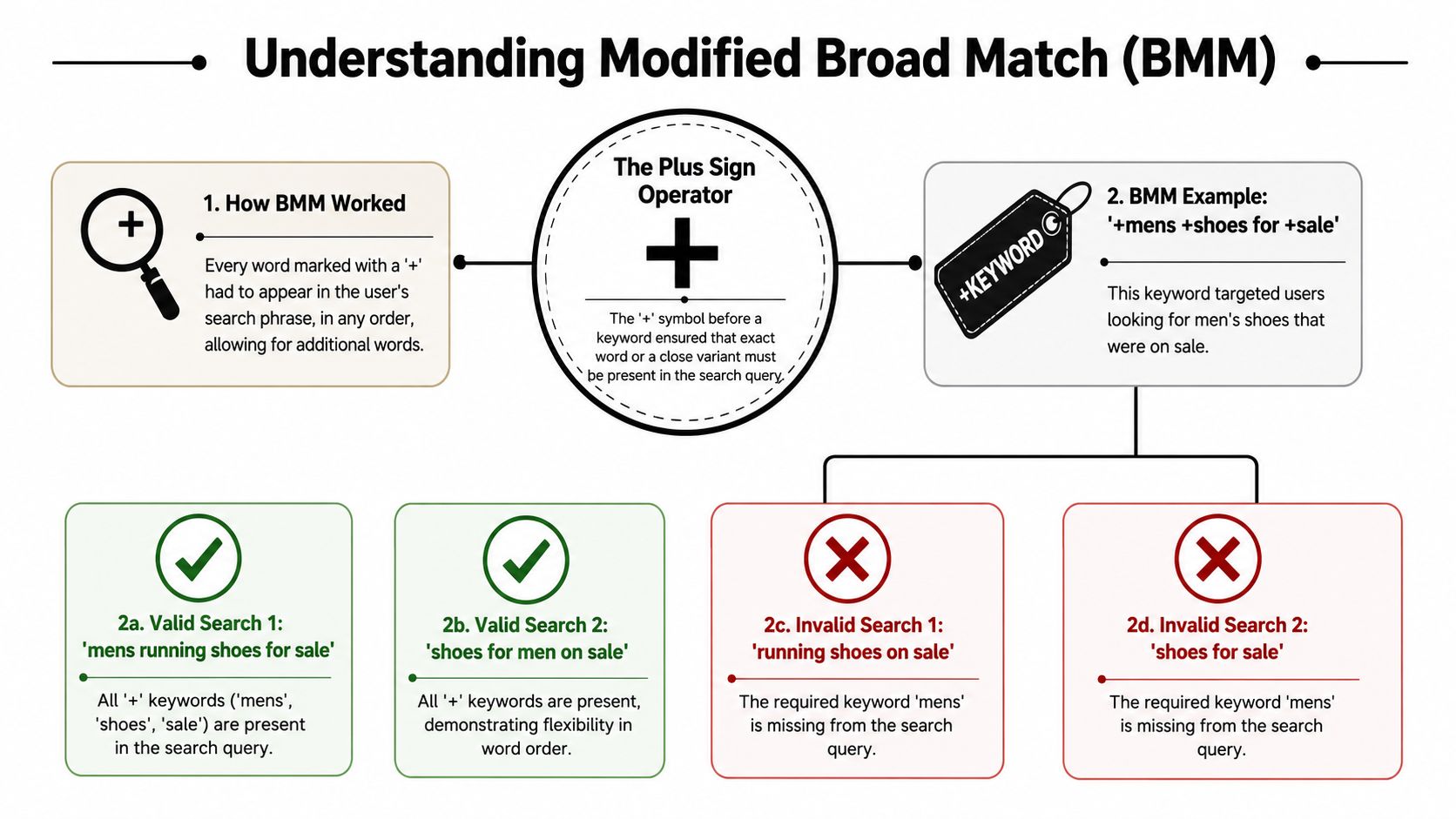
With modified broad match, you placed a plus sign (+) in front of the words that had to remain in play. If the keyword was +floor +plumbing, Google could vary the query structure, add extra terms, and allow close variants, but it still had to match both core ideas. A search like "floor plumbing services" could qualify. "Basement plumbing" could not, because one required term was missing, as explained in WordStream's breakdown of modified broad match.
That was the whole value proposition. You could keep the intent anchor while giving the system room to find longer, messier, real-world searches.
| Keyword | What had to appear | What could vary |
|---|---|---|
| +floor +plumbing | floor, plumbing, or close variants | word order, extra words |
| +mens +shoes for +sale | mens, shoes, sale, or close variants | filler words like "for" and query structure |
| +emergency electrician | emergency and electrician | location terms, service modifiers |
This mattered in large accounts. Teams could build fast in Ads Editor, push coverage wider than exact match, and still know which terms were doing the filtering.
What BMM actually controlled
BMM sat in the middle. It was more open than exact or the old version of phrase match, but much tighter than standard broad match.
The important limitation was what it would not do. Modified broad match did not force Google to jump to loosely related concepts or free-associate around intent. It matched the required words and their close variants, such as plurals, misspellings, and stems. That gave advertisers a cleaner way to test coverage without opening the door as wide as broad match.
For practitioners, this is the part that often gets lost in the history lesson. BMM was not popular because of the plus sign itself. It was popular because the syntax made control visible. You could look at a keyword and know which terms were protected.
BMM gave advertisers a middle layer of control that current match types handle less explicitly.
Why the mechanics mattered
The mechanics shaped account structure.
If a service category had one term that could not be dropped, BMM let you enforce it. If a local modifier or product qualifier mattered, you could choose whether to require it or leave it open. That made search term reviews faster because the keyword already expressed your intent threshold.
It also created a strategic layer that is harder to recreate now. Broad was for exploration. Exact was for precision. BMM covered the space in between, where you wanted growth but still needed a clear boundary.
That missing middle ground is why many experienced Google Ads managers still talk about BMM in practical terms, not nostalgic ones.
The Big Switch Why Google Retired BMM
A lot of advertisers felt the change first in search term reviews, not in the announcement. A keyword that used to hold a tighter line started matching on broader meaning, and suddenly the old account structure made less sense.

The timeline that changed account management
Google started phasing out modified broad match in early 2021 and stopped allowing new BMM keywords later that year. By that point, the platform had already redirected advertisers toward updated phrase match behavior.
What mattered in practice was the underlying rewrite. Legacy BMM keywords could remain visible in accounts for a time, but they no longer enforced the same query rules. The syntax looked familiar. The matching logic did not.
For teams that had built campaigns around required terms, that was a real operational change, not a naming update.
Why Google made the change
Google framed the retirement as simplification, and there was some truth in that. The old distinction between phrase and BMM had become harder to explain once close variants, automation, and intent interpretation started doing more of the work.
But simplification was only part of it. The larger shift was philosophical. Google wanted fewer advertiser-set rules and more machine-led matching based on meaning.
That trade-off benefits accounts with thin data, limited management time, or broad service categories. It creates problems in the places experienced PPC managers worry about most: expensive queries, regulated categories, local intent, and offers where one missing qualifier can turn a good click into wasted spend. If you want a clear breakdown of how that trade-off compares today, this guide on broad match vs phrase match is a useful reference.
The same pattern has played out since the old Google AdWords era. Google keeps reducing manual syntax and asking advertisers to guide the system with signals, exclusions, audiences, and conversion data instead.
What advertisers actually lost
The main loss was not the plus sign. It was a visible control layer between exact and broad.
With BMM gone, advertisers lost the ability to signal, at the keyword level, which words had to stay in play. That made intent mapping less explicit and forced more of the filtering work into negatives, campaign design, and query audits. It also made historical performance harder to interpret during migration, because old keyword labels no longer described old behavior.
That is the strategic void BMM left behind. The replacement is not a new operator. It is a different operating model.
Strong accounts now compensate with tighter search term review habits, stricter negative keyword systems, cleaner match type separation, and better use of automation inputs. The advertisers who adjusted fastest were not the ones complaining about the retired syntax. They were the ones who rebuilt control using process and tools instead of punctuation.
Navigating the New World of Phrase and Broad Match
You open a search terms report after a migration and the old labels stop helping. A keyword that used to act like a controlled discovery term now overlaps with phrase match in ways that are harder to predict. Another keyword loses coverage you expected to keep. That is the actual post-BMM adjustment. The syntax changed, but the bigger shift was operational.
Match Type Behavior Comparison Before and After 2021
| Match Type | Example Keyword | Will Match Search For... | Will NOT Match Search For... |
|---|---|---|---|
| Old Phrase Match | "moving services nyc to boston" | close phrasing with similar order | searches that break core phrase order too aggressively |
| Modified Broad Match | +moving +services +nyc +boston | searches containing the required terms in flexible order, with extra words allowed | searches missing required modified terms |
| New Phrase Match | "moving services nyc to boston" | searches that preserve the meaning of the keyword with more flexibility than old phrase | searches Google sees as outside the phrase meaning |
The table is clean. Live account behavior is not.
What changed in practice is the layer of intent control between strict phrasing and open exploration. BMM used to give advertisers a practical way to say, "keep these words involved, but allow variation around them." New phrase match does not replace that one-for-one. It uses meaning more aggressively, which can help discovery in one ad group and create overlap or ambiguity in another.
That is why migrated keywords often felt inconsistent across accounts. The same update could expand reach for one advertiser and tighten it for another, depending on query mix, account structure, and how much Smart Bidding was already shaping traffic.
What to check in live accounts
Start with the search terms, not the keyword names. I treat migrated phrase keywords as new traffic sources until the reports prove otherwise.
A few checks surface problems fast:
- Find overlapping intent where old BMM traffic now collides with phrase or broad coverage in the same account.
- Group queries by meaning instead of reviewing one keyword at a time. That exposes where Google's interpretation drifted from your original build.
- Check ad group boundaries for spillover. Tightly segmented structures often start bleeding once phrase match interprets meaning more loosely.
- Compare pre- and post-migration query themes if you have historical data. The goal is not nostalgia. It is spotting where profitable intent disappeared or junk traffic slipped in.
This is also where newer tooling matters. Manual syntax used to carry more of the control burden. Now the gap gets filled by better query analysis, tighter negatives, and cleaner reporting workflows.
If you want a practical comparison of current match behavior, this guide on broad match vs phrase match is a useful reference. For broader context on how match strategy evolved from the Google AdWords era, that history still helps explain why older account structures break under current matching rules.
Evaluate migrated keywords by the search terms they attract now. That is the only reliable way to judge whether the account still reflects your intent.
Modern Optimization Strategies Post BMM
You feel the loss of BMM most on the day a once-stable campaign starts matching to queries you never would have allowed before. The old fix was obvious. Tighten the modifier pattern, push changes in bulk, move on. That option is gone, so post-BMM optimization depends on a tighter operating system.
The goal now is to replace syntax control with a repeatable decision process. Match type still matters, but it matters less than how fast you can identify drift, cut waste, and promote useful search terms into cleaner coverage.
Build a tighter post-BMM control loop
A workable structure for most accounts looks like this:
- Launch with phrase match when intent boundaries are clear and query precision matters.
- Add broad match only where conversion tracking is clean, bidding signals are stable, and the account can afford testing.
- Review search terms on a schedule that matches spend and volatility.
- Add negatives quickly, before bad themes spread across ad groups or campaigns.
- Split out proven queries into exact or dedicated phrase coverage when they deserve their own bids, ads, or landing pages.
That process fills the void BMM left behind. It is less elegant than the old plus sign, but it gives you a clearer framework for deciding where automation can help and where it still needs limits.
Negatives now carry more of the control burden
BMM used to enforce a level of intent discipline inside the keyword itself. Phrase match no longer does that job in the same way, and broad match pushes even more responsibility into account management.
That changes the role of negatives. They are not just cleanup after launch. They are part of targeting.
A few rules hold up in live accounts:
- Block bad themes early. If a query is clearly informational, job-seeking, support-related, or irrelevant to the offer, exclude it before it burns more budget.
- Use the right negative level. Shared and campaign negatives handle account-wide waste. Ad group negatives protect tighter segmentation and reduce internal overlap.
- Separate winners from noise. Queries with strong commercial intent should not stay buried inside broad or loose phrase traffic if they can support their own structure.
If your negative process is inconsistent, this guide on how to add negative keywords in Google Ads gives a clean framework to standardize it.
Broad match still has a place
Broad match works best under specific conditions. Reliable conversion tracking, enough conversion volume for Smart Bidding to learn, and offers without too many ambiguous interpretations all improve the odds.
It struggles in smaller accounts, long sales cycles, messy tracking setups, and categories where one word can point to several very different intents. Legal, SaaS, healthcare, education, and local services run into this often. In those cases, broad can expand faster than your review process can contain it.
The practical approach is selective trust. Use broad match where the machine has enough context to make good decisions. Use phrase match where intent protection matters more than reach. Use negatives and search term promotion to rebuild the precision BMM used to provide with syntax alone.
That is the primary adjustment after BMM. The match types are simpler on paper, but the management job is more strategic, and the teams that adapt fastest are the ones using better review habits, clearer query classification, and tooling that shortens the gap between discovery and action.
Streamline Your Post-BMM Workflow with Keywordme
The operational headache after BMM wasn't philosophical. It was manual.
You used to take a clean keyword list, bulk-apply modifiers, upload, and move on. The plus sign made expansion fast. In fact, PPC specialists could bulk-add thousands of keywords with a simple text replacement in Ads Editor in under 15 seconds, and that efficiency disappeared when BMM went away.
Now the same level of control takes more touches. You have to review raw search terms, sort winners from noise, decide which should become phrase or exact, and turn irrelevant queries into negatives without drowning in formatting work.
Where the workflow breaks
Teams often don't struggle because they don't know what to do. They struggle because doing it at scale is tedious.
- Search term triage gets slow when every promising query needs manual cleanup.
- Negative building becomes repetitive when you keep copying and pasting unwanted terms into shared lists.
- Match type assignment turns clunky when you're trying to move fast inside live campaigns.
That gap is exactly where tools earn their keep.
What actually helps in practice
Keywordme fits the post-BMM workflow because it handles the parts that became slower after Google removed the modifier-based shortcut. Instead of forcing more spreadsheet work, it lets teams work directly from search term data and move faster on the decisions that matter.
A practical setup usually looks like this:
- Pull real search term data, then separate expansion candidates from obvious waste.
- Apply match types in one click so strong queries can become new exact, phrase, or broad keywords without another formatting roundtrip.
- Build negatives in bulk so bad traffic gets blocked before it drains more budget.
- Expand ad groups from proven queries instead of guessing from static keyword research alone.
If your account cleanup still depends on exports and manual formatting, that old friction compounds fast. A tool like Keywordme closes the gap left by BMM's retirement by making query control operational again.
For deeper list-building workflows, Keywordme also has a practical resource on using a Google Ads keyword list builder.
Keyword control didn't disappear when modified broad match did. It just got pushed downstream into search term review, negatives, and faster keyword decisions. If you want a cleaner way to handle that workload, try Keywordme and turn messy post-BMM optimization into a workflow you can actually keep up with.
.svg)