
Broad Match vs Phrase Match: The 2026 Definitive Guide
Broad Match vs Phrase Match: The 2026 Definitive Guide


SEO Title: Broad Match vs Phrase Match Guide
Meta Description: Broad match vs phrase match explained for Google Ads managers who want tighter control, cleaner traffic, and better ROI without wasting spend.
You open the search terms report expecting the usual cleanup. A few harmless mismatches. Maybe one oddball query from broad match.
Instead, you find clicks from searches that have almost nothing to do with what you sell. The ads got traffic, sure. But the traffic wasn't qualified, the budget disappeared faster than expected, and now you're trying to explain why leads got worse even though volume went up.
That moment is usually where the broad match vs phrase match debate stops being academic.
In real accounts, match type is one of the fastest ways to improve or wreck efficiency. It affects who sees your ads, how much irrelevant traffic slips through, how quickly you discover new queries, and how much cleanup work you create for yourself later. The frustrating part is that Google's updates made this less straightforward than it used to be. Phrase match isn't as tight as many people still assume. Broad match isn't always the disaster people fear.
The useful question isn't which one is "better" in the abstract. It's which one gives you the right mix of reach, control, and learning for the campaign you're running right now.
Cost of Choosing the Wrong Match Type
A junior PPC manager once asked why a campaign with solid click volume still felt broken. The answer was in the search terms report.
The account was driving traffic for a service business with a narrow offer. One ad group leaned too heavily on broad match. On paper, it looked promising. Impressions were healthy, clicks were coming in, and CPCs didn't look alarming. But the query list told a different story. Searches were adjacent, vague, and often informational when the campaign needed buyers.
That pattern is common. Broad match can fill the top of the funnel fast, but if the account lacks strong negatives, clean conversion signals, or enough oversight, spend starts leaking into curiosity clicks. You pay for attention that never had much chance of turning into revenue.
Phrase match causes a different kind of problem. Teams often trust it too much. They assume phrase means "safe," then stop checking search terms closely. Because phrase has become more flexible, that confidence can get expensive too. The traffic is usually better than broad, but not automatically clean.
What wasted spend looks like
It's rarely one dramatic mistake. It's usually a stack of small ones.
- Loose keyword intent: A keyword sounds right, but Google matches it to searches with a different meaning.
- Weak negative lists: The campaign keeps paying for the same irrelevant patterns.
- Wrong funnel fit: Broad gets used in a bottom-funnel campaign, or phrase gets used where discovery matters more.
- False confidence in phrase: Managers stop auditing because the match type feels controlled.
Most wasted spend doesn't come from one bad keyword. It comes from using the wrong match type for the job, then leaving it unchecked.
ROI gets hit in two places
The first hit is obvious. You pay for clicks that shouldn't have happened.
The second hit is worse. Bad traffic pollutes the data. Smart Bidding learns from weaker signals, ad copy gets judged by the wrong audience, and search term reports become harder to work through. Once that happens, optimization gets slower.
Broad match vs phrase match matters because it shapes the quality of every decision that follows. If the match type is off, almost every metric after that gets harder to trust.
Understanding Broad and Phrase Match Fundamentals
A lot of the confusion starts here. Advertisers still talk about broad and phrase as if the gap between them is obvious, but Google's AI-driven matching has narrowed that gap. The labels still matter. They just do not give you the clean level of control they used to.
Broad and phrase shape how much freedom Google has to interpret intent. That difference is important to note.
| Match type | Reach | Control | Query quality | Best use |
|---|---|---|---|---|
| Broad match | Widest | Lowest | More mixed | Discovery, scale, awareness |
| Phrase match | Moderate | Better | Usually stronger | Qualified traffic, tighter targeting |
How broad match behaves
Broad match gives Google the most room to connect your keyword to related searches, synonyms, and inferred intent. That flexibility is useful when the account needs to find new query patterns or when Smart Bidding has enough clean conversion data to separate strong traffic from weak traffic.
It also creates work.
A broad keyword like digital advertising can pull in searches that are directionally related but commercially off target. Some will be worth keeping. Some will drain budget for weeks if nobody is reviewing search terms and adding negatives. Broad match performs best in accounts that have active query mining, solid conversion tracking, and a clear plan for cutting waste fast.
How phrase match behaves
Phrase match gives Google less room, but not nearly as little as many advertisers assume. The old mental model, where phrase meant a fairly tight version of the keyword with a few close variations, no longer holds up in many accounts.
Today, phrase is better understood as controlled flexibility. It usually keeps traffic closer to the core intent than broad, which makes it easier to manage budget and judge lead quality. But phrase can still expand into searches that preserve meaning loosely enough to surprise you, especially in categories with mixed intent.
That is why phrase often works well for advertisers who already know the themes they want, but still need coverage beyond exact match lists.
What advertisers get wrong now
The biggest mistake is treating phrase as a safety setting and broad as a pure research setting. That used to be closer to reality. It is not a reliable operating model now.
Broad can produce efficient traffic if bidding, negatives, and conversion signals are strong. Phrase can waste money if the keyword theme itself is too vague or the account stops checking search term quality. The practical question is not which label sounds safer. The practical question is how much ambiguity your campaign can afford.
If you want a refresher on how Google defines the full set of options, this guide to Google Ads keyword match types is a useful baseline.
A better mental model
Use match types as levels of supervision, not fixed intent buckets.
- Choose broad match when you want to discover new searches and you have the systems to review terms, add negatives, and feed bidding clean conversion data.
- Choose phrase match when you want tighter intent alignment but still need reach beyond exact match.
- Choose either one carefully when the keyword has multiple meanings, because Google's interpretation can widen faster than expected.
That is the part many guides miss. The line between broad and phrase has blurred, so control now comes less from the label itself and more from the setup around it. Search term reviews, negative keyword discipline, audience signals, and bidding strategy decide whether either match type pays off.
A Head-to-Head Breakdown Broad Match vs Phrase Match
Two advertisers can bid on the same keyword theme, use the same ads, and get very different results based on match type alone. One gets useful search term data and profitable conversions. The other gets a pile of loosely related clicks that drain budget before noon.
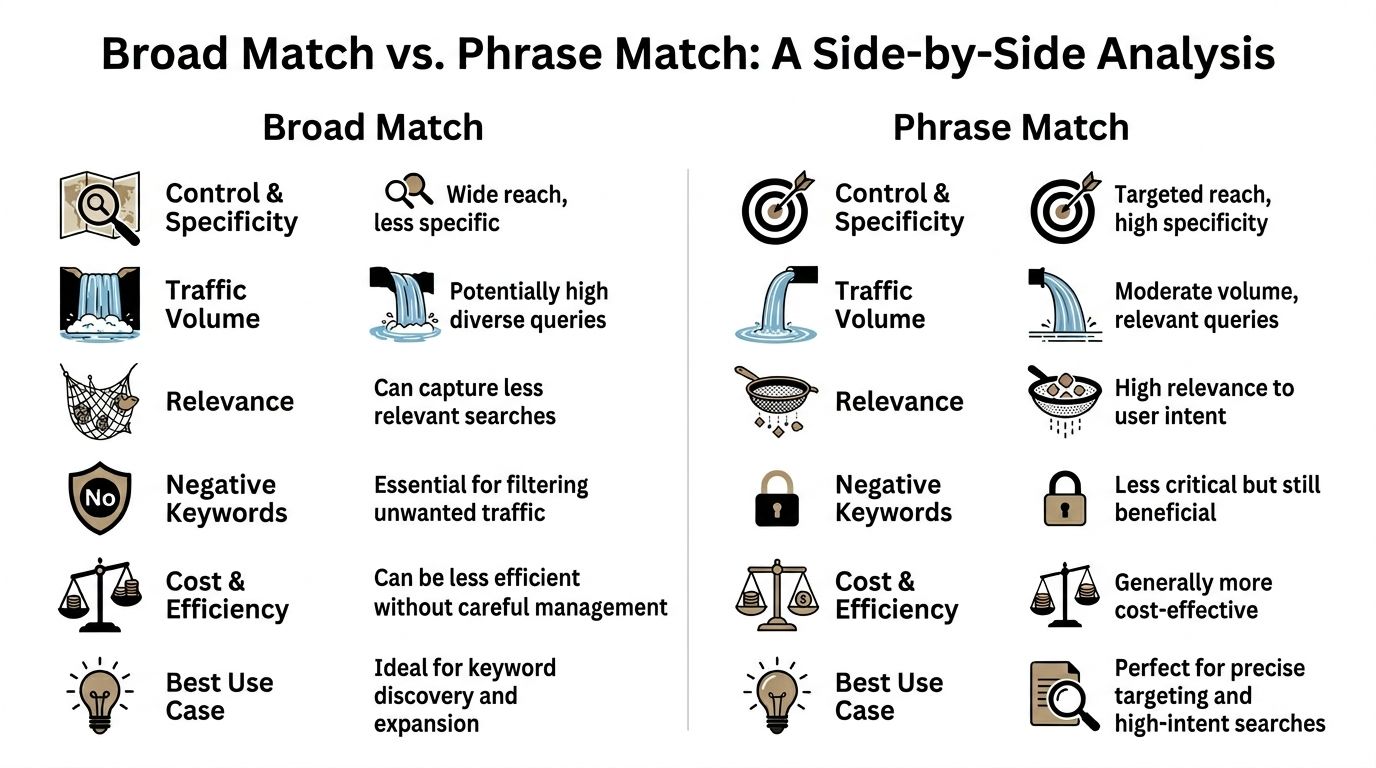
That is why broad match vs phrase match deserves a side by side comparison based on account behavior, not old assumptions about "safe" and "risky" traffic.
Reach and query expansion
Broad match still gives Google the most room to expand beyond your literal keyword. It reaches related searches, alternate wording, and adjacent intent faster than phrase. That makes it useful when coverage matters and you need to find demand you have not mapped yet.
Phrase match casts a narrower net. It still reaches beyond the exact wording, but it usually stays closer to the commercial meaning you intended. In practice, that means lower volume than broad, but often fewer obviously off target queries.
Here is the practical difference:
| Criteria | Broad match | Phrase match |
|---|---|---|
| Reach | Widest coverage | More limited coverage |
| Query discovery | Strongest | Useful, but narrower |
| Intent consistency | Less predictable | More consistent |
| Search term review load | Heavier | Lighter |
The trade-off is simple. Broad gives you more chances to find winners. Phrase gives you fewer chances to pay for irrelevant curiosity clicks.
Control over intent
Control is where the old advice starts to break down.
Broad match can perform well if the account already has strong conversion tracking, enough signal volume, a disciplined negative list, and a bidding strategy that can tell a valuable search from a bad one. Without that support, broad often expands into queries that are related on paper but weak commercially.
Phrase match usually holds closer to the keyword theme, which makes it easier to keep spend pointed at a narrower slice of intent. That matters in accounts where a bad click is expensive, such as local services, high CPL lead gen, legal, SaaS with niche use cases, or B2B categories with multiple meanings.
A useful rule in live accounts is this. The less room you have for ambiguity, the more phrase earns its place.
CPC and actual efficiency
Broad often attracts people because the click price can look cheaper. That part is real. The mistake is stopping the analysis there.
Cheap clicks are only useful if they turn into qualified leads, revenue, or at least meaningful conversion signals. Broad can lower CPC while raising wasted spend if the extra traffic is loose, early stage, or irrelevant. Phrase often runs with tighter traffic quality, which can make the effective cost per qualified conversion more stable even if CPC is not the lowest in the ad group.
That is the part junior PPC managers tend to learn the hard way. Lower CPC is not a win if sales rejects the leads.
Search term quality and learning value
Broad is still the stronger research tool, but only if someone is reviewing what it brings in.
It can surface new modifiers, customer language, product use cases, and adjacent themes that deserve their own ad groups or exact match builds later. That makes broad valuable in expansion campaigns and mature accounts that want fresh query data.
Phrase can also generate useful discoveries. It just does it with more restraint. If you want a closer look at why phrase behaves less rigidly now, this breakdown of how phrase match changed in recent Google Ads updates is a useful reference.
Broad teaches you faster. Phrase teaches you with fewer distractions.
Cleanup burden and budget risk
ROI gets decided here.
Broad match creates more review work. Search terms need checking. Negatives need adding. Query themes need splitting out before they keep spending under the wrong keyword bucket. If that workflow is weak, broad becomes expensive quickly, especially in accounts with limited budgets or mixed intent keywords.
Phrase match still needs maintenance, but the cleanup job is usually smaller. That makes it easier to manage for lean teams or accounts where one bad week of search term drift can throw off the whole month.
Where each match type tends to earn its keep
Broad match usually works best when:
- You need query discovery fast
- The account has reliable conversion tracking
- Smart bidding has enough data to work with
- Someone is reviewing search terms consistently
- The budget can tolerate testing and some waste
Phrase match usually works best when:
- The keyword theme is commercially specific
- Budget control matters more than max reach
- Lead quality matters more than click volume
- The team wants useful scale without opening the door too wide
- The account has already learned which themes deserve tighter supervision
Broad and phrase are no longer clean opposites. The line between them has blurred, especially once Google's systems start matching on intent instead of wording alone. The practical way to compare them is by asking three questions. How much ambiguity can this campaign afford, how fast do we need new query data, and how much cleanup work can the team handle?
How the 2021 Update Blurred the Lines
The reason this topic confuses so many advertisers now is simple. The old mental model broke.
In 2021, Google expanded phrase match to absorb broad match modifier traffic. That change made phrase more flexible and more intent-driven. It also made phrase less predictable than many advertisers were used to. A useful summary from Click's analysis of phrase and broad match close variants notes that phrase match now overlaps more with broad match's machine learning-driven matching, while still offering better control and higher conversion rates.
Why phrase started feeling looser
Before this shift, many managers treated phrase match as a reliable boundary. The phrase had to stay close, the order mattered more rigidly, and the traffic pattern was easier to anticipate.
After the update, phrase started matching based more on meaning and intent. That improved flexibility. It also introduced more edge cases where a query technically fit Google's interpretation but didn't fit the advertiser's commercial goal.
That's the source of the "broad-lite" feeling people talk about. Phrase didn't become broad match. But it moved closer to it.
What changed in practice
A few real-world effects showed up after the update:
- More overlap between match types: Broad and phrase can now compete for similar query space.
- Less comfort from old naming: "Phrase" sounds stricter than it behaves.
- More dependence on negatives: You can't rely on phrase alone to hold the line.
- More importance on query review: Search term reports matter even when you're not using broad.
Google also prioritizes identical phrase matches over broad for the same query, which helps with ad rank and spend allocation in overlap situations, as explained in that same Click breakdown of the 2021 phrase match change.
Why junior managers get tripped up here
They inherit old advice.
A lot of account structures were built around assumptions that made sense years ago. Phrase was treated as the safe middle lane. Broad match modifier handled controlled expansion. Then broad match modifier disappeared into phrase, and many advertisers didn't update their operating habits.
If you're still managing phrase match like it's the old version, you're probably underestimating how much irrelevant traffic can sneak in.
That doesn't mean phrase stopped being useful. It means phrase now needs active supervision. The blurring lines aren't a reason to panic. They're a reason to stop relying on labels and start relying on actual query behavior.
Strategic Playbook When to Use Each Match Type
The best match type depends less on theory and more on campaign context. Budget size, funnel stage, sales cycle, and signal quality all matter.
A broad match keyword in the right campaign can be smart. The same keyword in the wrong campaign can burn money for weeks.
Use broad when learning matters more than precision
Broad works best when the account needs to explore.
That usually includes new launches, large category campaigns, and high-volume B2C programs where the goal is to surface demand patterns quickly. Broad can also work when Smart Bidding has enough solid conversion feedback to make decent decisions.
Broad is a strong choice when:
- You're entering a new market: You don't yet know the full scope of queries.
- The offer has broad consumer demand: There are many valid ways people search.
- You can review search terms often: Broad without maintenance is where problems start.
- Your goal is expansion: You're intentionally trading some precision for coverage.
What doesn't work is using broad on a fragile budget with no cleanup routine. That's when lower CPCs become a trap.
Use phrase when every click needs to count
Phrase is usually the better default for campaigns that need disciplined traffic quality.
If you're running lead gen, selling a high-consideration service, or managing a campaign where irrelevant searches are expensive, phrase gives you a better balance. You still get reach beyond exact match, but with more guardrails than broad.
Phrase is usually the better fit when:
- Budget is tight: You can't tolerate much waste.
- Intent matters a lot: Search quality beats search volume.
- The sales cycle is longer: A poor lead isn't just a bad click. It wastes sales time too.
- You need cleaner reporting: Phrase usually makes search term analysis easier.
The hidden risk inside phrase campaigns
Phrase isn't self-policing anymore.
That's where many managers get caught. According to Karooya's review of phrase match vs broad match, Google's data showed a 3-4% lift in clicks for phrase match after post-2019 expansions, but some advertisers reported 20-30% more irrelevant triggers, and unmonitored phrase campaigns can face up to 15% higher wasted spend. That's why phrase shouldn't be treated like "set it and forget it."
Match type by campaign scenario
| Scenario | Better starting point | Why |
|---|---|---|
| New product launch | Broad match | Fast discovery and query expansion |
| Tight-budget lead gen | Phrase match | Better control over relevance |
| Large B2C growth push | Broad match | Maximum reach and learning |
| Niche B2B service | Phrase match | Stronger intent alignment |
| Search term mining project | Broad match | Finds adjacent demand faster |
| Mid-funnel demand capture | Phrase match | Balanced control and volume |
What keeps either strategy profitable
The answer is negative keyword discipline.
If a junior manager asks what separates profitable broad campaigns from sloppy ones, that's usually it. And it matters for phrase too. If you want a practical primer, this guide to negative keywords is worth bookmarking because it explains the filtering side many advertisers skip.
The second requirement is routine. Match type decisions only stay smart when someone keeps checking whether the traffic still matches the plan.
For broader expansion workflows, this resource on broad match keywords is also useful if you're trying to decide how aggressively to scale.
The right match type is the one that matches your campaign objective and your management capacity. If you can't maintain broad, don't use it just because Google wants more automation. If you need more reach and your phrase campaign is tapped out, don't cling to phrase out of habit.
Optimize Your Campaigns Instantly with Keywordme
Manual keyword work is where good strategy goes to die.
Many teams know what they should do. Review search terms. move strong queries into the right match type. add negatives. clean duplicates. The problem is volume. Once an account gets large, the copy-and-paste work slows everything down.
Start with the search terms report
The fastest wins usually come from query cleanup.
Open the report and sort for obvious mismatch patterns. Not just random one-offs. Look for repeated themes: research intent when you need commercial intent, job seekers when you need buyers, free-seekers when you sell premium services, or adjacent services you don't offer.
A practical workflow looks like this:
- Pull recent search terms: Start with the campaigns spending enough to matter.
- Group bad queries by pattern: One-off cleanup helps, but repeated themes save more money.
- Separate false positives from expansion ideas: Some "odd" queries belong in negatives. Others belong in new ad groups.
- Decide if the root issue is the keyword or the match type: Sometimes the keyword itself is fine. The match type is what's wrong.
Bulk-change match types instead of patching one by one
Teams waste hours manually in this situation.
If an ad group is too loose, you may need to shift a cluster of broad keywords into phrase. If a campaign is boxed in and no longer discovering new demand, you may want to test selected phrase terms in broad. Doing that one keyword at a time gets old fast.
Keywordme is built for this kind of cleanup and reassignment. You can bulk-apply exact, phrase, or broad in one click, which is much closer to how real account work happens than hand-formatting keywords in spreadsheets.
Build negatives from real query patterns
Most negative keyword lists are incomplete because teams build them reactively.
A better method is to mine recurring low-intent patterns and turn them into durable exclusions. That's where tools matter. Keywordme helps turn junk search terms into usable negative keyword lists without the usual formatting mess. It also makes it easier to spot which terms should be blocked at the ad group level and which belong at the campaign level.
That matters because broad match vs phrase match usually isn't solved by changing match type alone. You regain control by combining the right match type with the right exclusions.
A quick demo helps make that workflow easier to picture:
Use speed to improve judgment
The true value of automation isn't convenience. It's decision quality.
When the mechanical work gets faster, you can spend more time on the part that needs a PPC manager's brain:
- Which search terms deserve promotion into their own ad groups
- Which broad keywords are worth keeping
- Which phrase keywords have become too loose
- Which negatives are overblocking useful traffic
- Which campaigns need tighter funnel segmentation
Keywordme is useful because it removes the slowest parts of keyword management. It helps agencies, freelancers, and in-house teams move from "I know this account needs cleanup" to "the cleanup is done."
Where it fits in a normal workflow
Use it after your weekly search term review. Use it when restructuring ad groups. Use it after a broad match test starts surfacing themes worth isolating. Use it when phrase traffic starts drifting and the account needs tighter control.
The point isn't to automate thinking. The point is to automate the repetitive actions that prevent good thinking from happening often enough.
A Simple Framework for Testing Match Types
If you're stuck between broad and phrase, don't argue about it in theory. Test them.
Most accounts are too context-dependent for one universal answer. The cleaner approach is to run a controlled experiment and let the account tell you what it prefers.
Set up a fair test
The easiest version is a campaign experiment with closely matched conditions.
Keep the budget, geo targeting, ad copy, landing pages, and bidding approach as similar as possible. The major variable should be the match type. If one version uses broad and the other uses phrase, you want everything else stable enough that the difference in traffic quality means something.
A simple setup:
- Control: Existing campaign with phrase match
- Variant: Duplicate campaign using broad match for the same core themes
- Traffic split: Use an even split so each side gets comparable exposure
- Keyword set: Keep the intent cluster aligned, not random
- Negative strategy: Apply the same baseline exclusions to both sides
Watch the right KPIs
Don't judge the test on one metric.
Broad may look attractive on CPC or raw volume. Phrase may look stronger on conversion quality. You need a fuller view of what the account is buying.
Monitor these together:
| KPI | Why it matters |
|---|---|
| CTR | Shows how well the queries and ads align |
| Conversion rate | Indicates traffic quality |
| CPA | Tells you what efficiency looks like |
| ROAS | Best for revenue-driven accounts |
| Search term quality | Catches relevance issues metrics can hide |
If you're in lead gen, don't stop at form fills. Check lead quality if you can. Broad can sometimes drive cheaper conversions that sales teams hate. Phrase can sometimes drive fewer but cleaner leads.
Don't call it too early
A lot of PPC tests fail because someone declares a winner after a few days.
Wait until both variants have enough data to be representative for your account. That doesn't mean waiting forever. It means resisting the urge to react to early noise. If you're unsure how to think about that threshold, this explainer on testing statistical significance is a useful non-hype reference.
A match type test is only useful if the traffic conditions are comparable and the judgment standard is clear before launch.
What usually counts as a win
The winner isn't always the one with the better top-line metric.
Phrase wins if it brings cleaner query intent, stronger conversion quality, and more stable efficiency. Broad wins if it expands reach profitably and surfaces new themes worth promoting. Sometimes both win. One becomes the scaling layer, and the other becomes the control layer.
That outcome is common in mature accounts. Broad handles discovery. Phrase handles disciplined capture. Exact absorbs the strongest proven terms. That's often a better structure than trying to force one match type to do everything.
A practical review cadence
Use a simple review rhythm during the test:
- Early check: Make sure nothing is clearly broken.
- Midpoint review: Compare query themes, not just metrics.
- Final review: Judge cost, quality, and scalability together.
- Post-test action: Promote winners, cut waste, and update negatives immediately.
That last step matters. A test without implementation is just expensive curiosity.
If you're tired of doing all this keyword cleanup by hand, Keywordme makes the practical work faster. You can review junk search terms, apply broad or phrase in bulk, build negative lists, and tighten campaign structure without the usual spreadsheet grind.
.svg)