
PPC for Lead Generation: A Practical Guide to High-Quality Leads
PPC for Lead Generation: A Practical Guide to High-Quality Leads


Let's get straight to it: you need leads, and you need them yesterday. This is exactly where PPC for lead generation becomes your best friend. While organic strategies are great, they take time to gain traction. Paid search, on the other hand, puts you right in front of people who are actively hunting for what you sell, giving you visibility almost instantly.
Why PPC Is Your Secret Weapon for Immediate Leads
When the sales pipeline is looking a little sparse, waiting around for SEO to work its magic can be agonizing. Pay-per-click advertising cuts right through that waiting period, opening a direct channel to potential customers the very second they start searching.
It’s not just about being fast; it’s about being smart.
PPC lets you target your audience with a level of precision that would take months, if not years, to build organically. You can zero in on people based on their location, demographics, interests, and—most crucially—the exact phrases they’re typing into Google. This means your budget is spent reaching people who are already raising their hands.
If you're looking for a broader overview of how paid ads work, this guide to PPC Advertising is a great starting point.
The Strategic Edge of Paid Search
Beyond just getting clicks, a good PPC campaign is a powerful feedback machine for your entire marketing plan. Here’s where you get that immediate advantage:
- Test Offers in Real-Time: Got a new service or a limited-time promotion? You can spin up a campaign in a few hours and get immediate data on whether your message is hitting the mark.
- Mine for Invaluable Data: PPC campaigns are a treasure trove of insights. You’ll quickly discover which keywords actually lead to conversions, what ad copy gets people to click, and how they interact with your landing pages. This data makes all of your marketing smarter.
- Get Instant Visibility: A brand-new business can show up right next to industry giants on the first page of Google from day one. That kind of immediate presence is huge for building brand awareness and credibility right from the start.
The real power of PPC is control. You control the budget, the audience, and the message, letting you tune your lead generation machine with incredible precision.
Think of it as the ultimate market research tool. You get to figure out exactly what your customers are looking for and give it to them at the perfect time. To get a better handle on the fundamentals, you might want to check out our guide that helps explain pay-per-click advertising in simple terms.
Laying the Groundwork for a Winning Campaign
Let's be real: diving into Google Ads without a solid plan is the fastest way to burn through your marketing budget. I’ve seen it happen too many times. A successful PPC for lead generation campaign isn’t built on luck—it’s built on a strong, strategic foundation. This blueprint is what separates the campaigns that pull in quality leads day after day from the ones that just fizzle out.
Before you write a single ad, you need to get laser-focused on who you're trying to reach. What does your ideal customer struggle with? What keeps them up at night? And just as important, what does a "good lead" actually look like for your business? Is it a form submission? A guide download? A direct phone call? Nailing this down first will guide every single decision you make from here on out.
This whole process boils down to visibility, targeting, and using your data to make smarter moves.
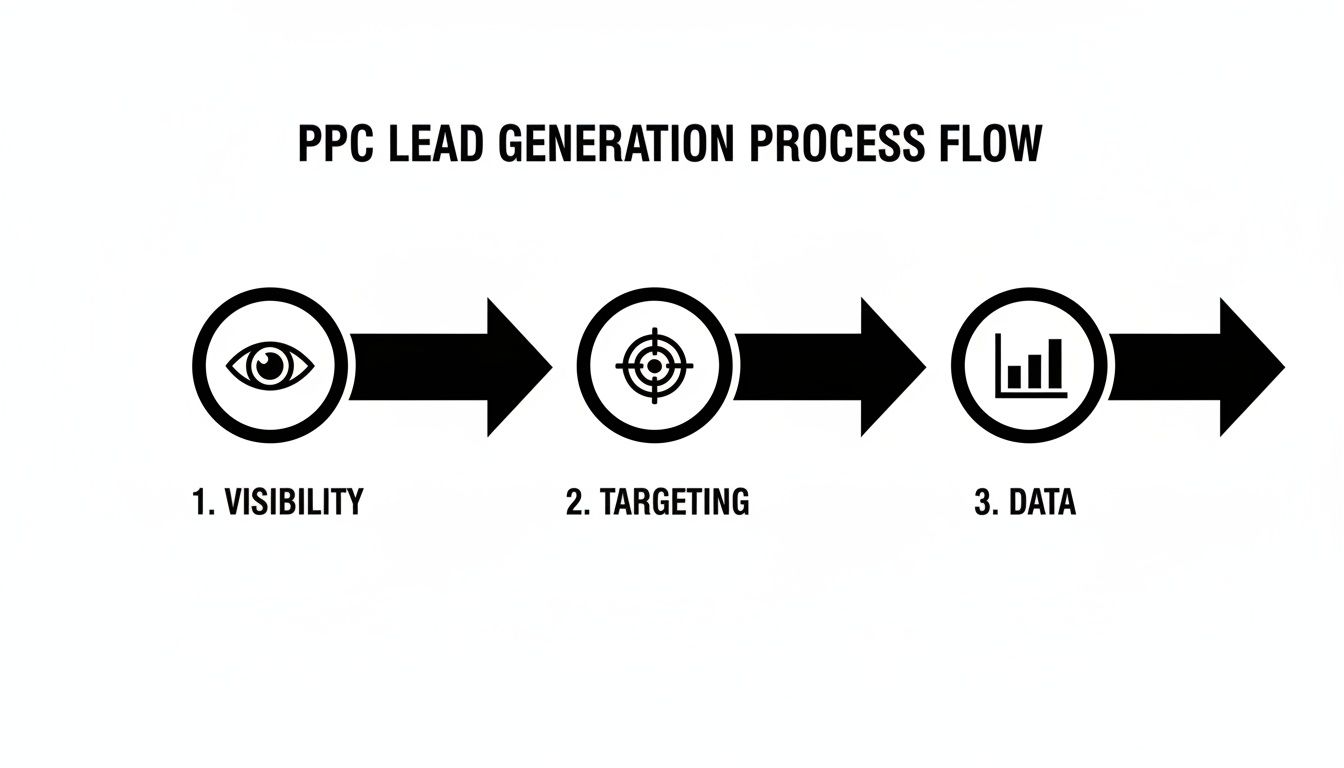
As you can see, getting seen is just the beginning. The real magic happens when you dial in your targeting and let the data tell you what's working.
Mastering Keyword Research and Intent
Once you know your audience, it's time to step into their shoes and figure out what they’re typing into that search bar. Keyword research isn't about grabbing the most obvious, high-volume terms. It's about finding the specific phrases that scream "I'm ready to buy."
Think about the massive difference between someone searching for "what is a roofer" versus "emergency roof repair near me." The first is just research. The second is a hot lead with a serious problem that needs solving right now. Focusing on these high-intent, long-tail keywords puts your ads in front of people who are looking for exactly what you offer.
A well-structured PPC campaign is built on a foundation of targeted keywords that align perfectly with user intent. Getting this right means you spend your money on clicks that are far more likely to convert into actual business.
And the numbers don't lie. PPC is a beast when it comes to driving action. The average click-through rate (CTR) on Google Ads is a solid 6.66%, and PPC traffic is known to convert 50% better than organic visitors. Plus, with 46% of all clicks going to the top three ad spots, it’s clear where the action is. You can dig into more of these PPC statistics on Shopify.com if you're curious.
Structuring Your Campaign for Success
How you organize your campaigns is just as critical as the keywords you pick. A messy, disorganized structure is a recipe for poor performance and a massive headache when it comes time to optimize. You need a logical hierarchy that reflects your business.
Here’s a simple, effective structure I always recommend:
- Campaigns: Think high-level. Group these by product lines, service categories, or even different geographic locations you serve.
- Ad Groups: Get more specific here. Inside each campaign, create tightly themed ad groups around clusters of related keywords. For a "Digital Marketing" campaign, you might have ad groups like "SEO Services," "PPC Management," and "Content Marketing Agency."
- Keywords & Ads: This is where the magic happens. Each ad group should have a small, curated list of keywords and ads written specifically for those terms. The ad for "PPC Management" should sound very different from the ad for "SEO Services."
This kind of granular structure makes your ads hyper-relevant to what someone is searching for. That relevance boosts your Quality Score, which in turn lowers your ad costs and, most importantly, brings in much better leads.
Creating Ads and Landing Pages People Actually Respond To
Getting the click is a great start, but it's the conversion that pays the bills. This is where the magic of PPC for lead generation really happens—you're building an irresistible path from a search query right to a "thank you" page.
It all begins with your ad. You need to write copy that grabs a searcher's attention because it speaks directly to their problem. Ditch the generic headlines. Your ad needs a strong hook, a clear benefit, and a call-to-action that makes clicking feel like the only logical next step. Think of it as your first handshake; it better be a confident one.
From Click to Conversion: The Landing Page
Once you've earned that click, the user arrives on your digital doorstep. Your landing page has one job and one job only: turn that visitor into a lead. The message on the page has to be a direct continuation of the promise you made in the ad. If there's any disconnect, you've already lost them.
A high-converting landing page isn’t some dark art. It’s built on a few core elements that build trust and gently guide the user to take action.
- A Crystal-Clear Value Prop: They should know what you offer and why it matters within three seconds. No jargon, just straight-up benefits.
- Benefit-Focused Messaging: Don't just list features. Tell them how those features will solve their specific problem and make their life easier.
- Social Proof: Testimonials, reviews, and case studies are absolute gold. They prove that real people have trusted you and gotten real results.
- A Frictionless Form: Only ask for what you absolutely need. The more fields you add, the more leads you lose. It's that simple.
Building a Seamless User Experience
The journey from your ad to your landing page needs to feel like a single, cohesive experience. The visuals, the language, the offer—it all has to line up perfectly. This consistency is what builds the trust required for someone to hand over their contact details. To really get this right, take a look at our guide on conversion rate optimization best practices.
The core principle is simple: make it easy for people to say yes. Remove every possible obstacle standing between their problem and your solution.
The numbers don't lie. We know that PPC traffic tends to convert 50% better than organic traffic, and a huge reason for that is sending users to dedicated, optimized landing pages. With Google Ads clocking an average conversion rate of 7.52%, a polished landing page is your ticket to getting your piece of the pie. You can dig into more powerful PPC statistics on WebFX.com.
At the end of the day, a killer ad and landing page combo is what turns a simple click into a valuable lead for your business.
Optimizing for Quality, Not Just Clicks
So, you’ve launched your campaign. Pop the champagne, right? Well, not quite. The launch is a huge step, but the real magic—the part where you turn a decent campaign into a lead-generating machine—is just getting started.
This is where the obsessive tinkering and data-driven decisions come into play. It's how you go from just getting clicks to consistently pulling in high-quality leads that actually turn into business.
The first place you need to live and breathe is your search term report. This isn't just a spreadsheet; it's a direct look into your customer's mind. It shows you the raw, unfiltered queries people are actually typing to find you. It's a goldmine for spotting what's working and, more importantly, where your budget is quietly leaking away.
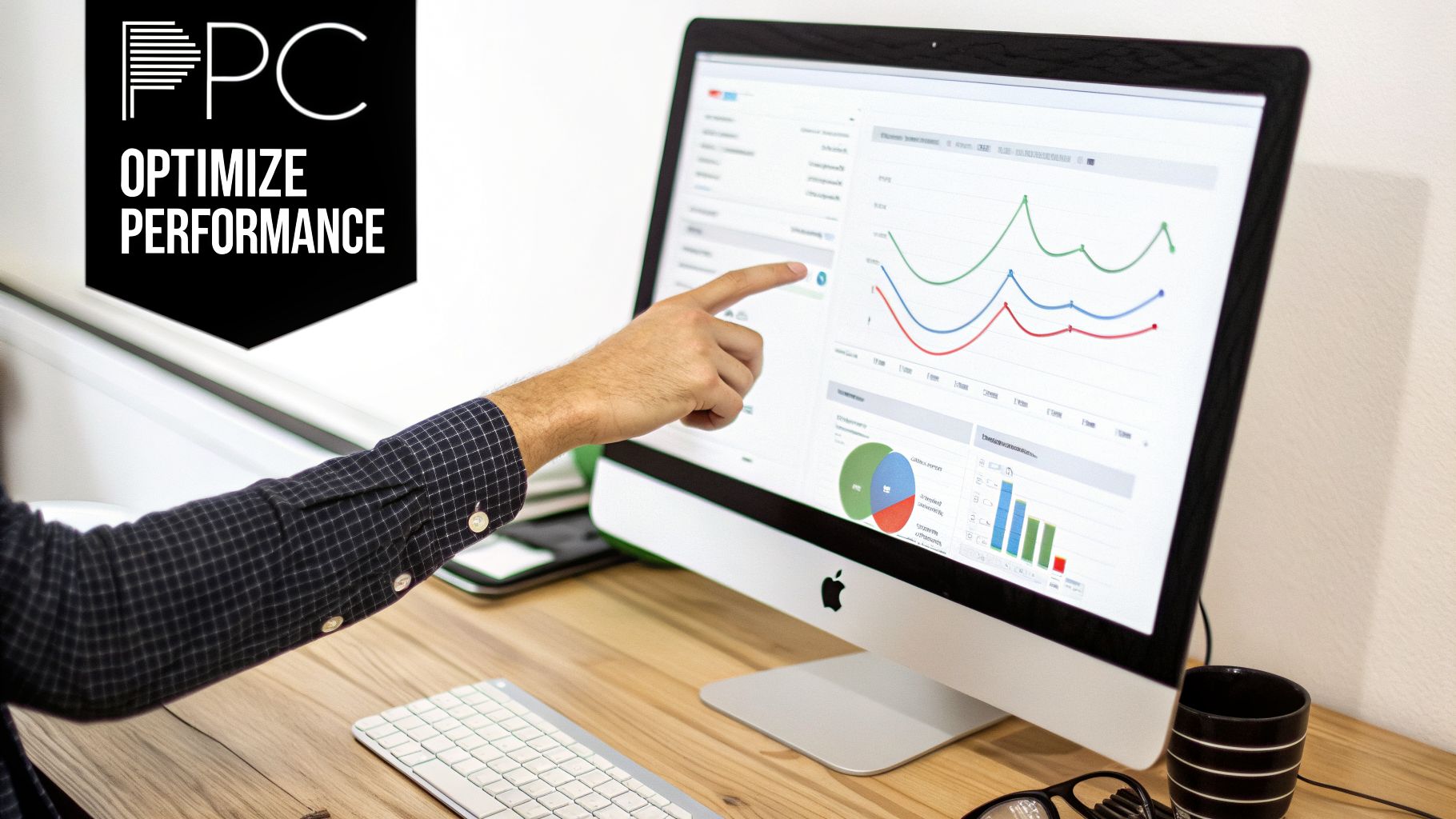
Trim the Fat and Protect Your Budget
Your primary mission in the search term report is to hunt down and eliminate irrelevant search queries. Think about it: if you sell "luxury dog beds," you absolutely do not want to pay for a click from someone searching for "cheap dog toys." Every single one of those clicks is cash down the drain.
By adding terms like "cheap" and "toys" to your negative keyword list, you’re telling Google, "Don't show my ads for this junk anymore."
This simple act of campaign hygiene is one of the most powerful things you can do to boost your ROI. The more garbage you block, the more your ad spend is focused on the people who are genuinely looking for what you offer. This is where a tool like keywordme becomes a lifesaver, automating the tedious process of finding and negating irrelevant terms to keep your campaigns lean and mean.
The goal isn't just to spend your budget; it's to invest it wisely. Proactive negative keyword management ensures your ad spend is laser-focused on terms that drive valuable leads, not just empty clicks.
Test, Tweak, and Track Your Way to the Top
Once you've plugged the budget leaks, it's time to pour fuel on the fire. This means you need to get comfortable with constant testing and optimization. Never, ever assume your first ad or landing page is the best it can be. There's always room for improvement.
Here are the key areas to obsess over:
- A/B Test Your Ad Copy: You should always have at least two ad variations running in every single ad group. Pit different headlines against each other. Test a new call-to-action. Try highlighting a different benefit. Once a clear winner emerges, pause the loser and immediately create a new challenger to take on your reigning champion.
- Be Smart with Your Bids: Not all keywords are created equal. Find your heavy hitters—the ones driving the most conversions at the best cost—and don't be afraid to bump up their bids to get more visibility. At the same time, dial back the bids on keywords that are just eating up your budget without delivering results.
- Watch the Metrics that Matter: Clicks and impressions look nice on a report, but they don't pay the bills. The number you need to be laser-focused on is your Cost Per Lead (CPL). This tells you exactly how much it costs to get a new lead in the door, giving you the clarity to make smart decisions about your budget and overall strategy.
Understanding your costs is everything. Looking at the bigger picture, the average CPL on Google Ads is around $70.11. But that figure can go wild depending on your industry—we're talking $982 for higher education and $649 for legal services. And don't forget what happens after the click; companies that excel at nurturing their leads generate 50% more sales-ready leads at a 33% lower cost. If you want to dive deeper, you can explore more lead generation insights on Snov.io.
Scaling Your Campaigns Without Torching Your Budget
So, you've hit a sweet spot. Your PPC for lead generation campaigns are humming along, the leads are consistent, and your cost per lead (CPL) is right where you want it. The natural instinct is to just throw more money at it, right? Pump up the budget and let the good times roll.
Not so fast. Scaling a campaign isn't just about increasing your spend.
Pouring more money into a leaky bucket just means you lose money faster. Smart scaling is about increasing your lead volume while keeping that CPL stable—or even lowering it. This takes a bit of strategy, not just a bigger budget. The first step is to figure out what’s already working for you.
Think of your best campaigns as a treasure map. They show you exactly which keywords, ads, and audiences are hitting the mark. These are your proven winners, and they're the foundation for your next move.
Dig Into Your Data to Find Growth Pockets
Your search term report is the single best place to find expansion opportunities. You’ve been using it to find negative keywords, but now it’s time to flip the script and use it for growth. Hunt for those search queries that are driving conversions but aren't yet in your keyword list as an exact or phrase match.
Found a search term that's converted a few times? That's a huge signal. The market is literally telling you what it wants. This is the perfect chance to build a brand new, super-focused ad group around that theme.
Smart scaling isn’t about just spending more; it’s about investing in what's already proven to work. Use your own performance data to guide every decision and expand with confidence, not just hope.
This surgical approach lets you write incredibly specific ads and tailor landing pages directly to that searcher's intent. The result? Almost always a higher conversion rate and a better Quality Score. The keywordme tool was built for this exact task—helping you spot these golden nuggets and build out campaigns without all the manual grunt work.
Expanding Beyond Your Current Playground
Once you feel like you've squeezed all the juice out of the Search Network, it's time to explore other channels. Where you go next really depends on your business.
- Google Display Network: This is fantastic for building brand awareness and getting in front of people earlier in their journey. You can use it to retarget people who have visited your site or go after audiences based on their online habits and interests.
- Social Media Platforms: For B2B lead gen, channels like LinkedIn or even Facebook can be goldmines. Their targeting is incredible—you can zero in on people by their job title, the size of their company, or the industry they work in.
As your account gets bigger, staying organized is non-negotiable. Use logical campaign structures and stick to a consistent naming convention. A tidy account is so much easier to manage, optimize, and scale. If you want to dive deeper into managing your spend as you grow, check out our guide on how to set effective Google Ads budgets.
At the end of the day, scaling your PPC efforts is all about building on your wins. You systematically find what works, clone that success into new areas, and carefully widen your reach. It’s this disciplined process that lets you grow your lead volume without your budget spiraling out of control.
Common Questions About PPC for Lead Generation
Even with a solid plan, it's natural to have some questions rattling around in your head. When you're putting real money on the line to get real results, you want to be sure you're moving in the right direction. Let's dig into some of the most common questions I hear about running PPC for lead generation campaigns.
Think of this as your personal FAQ for when you need a straight answer, no fluff.
What Is a Realistic Starting Budget?
This is the big one, isn't it? The honest, if slightly annoying, answer is: it depends. But a "good" budget isn't about a magic number; it's about having enough cash to buy the data you need to make smart decisions. A budget of $10 a day just isn't going to cut it.
A much better starting point is a budget that can get you at least 10-20 clicks per day. So, if your average cost-per-click (CPC) is around $5, you should be looking at a daily budget of at least $50-$100. This gets enough people through the door to start seeing what's actually working and what's a dud.
You don't need a massive enterprise-level budget to get started, but you do need enough to buy data. Think of your initial ad spend as an investment in learning what your audience actually responds to.
When Will I Start Seeing Results?
Another classic question, and it really has two parts. You'll start seeing traffic and data almost immediately—we're talking within hours of your campaign going live. Clicks, impressions, and all those juicy search terms will start rolling in right away.
But seeing consistent, high-quality leads? That takes a bit more patience. It usually takes a few weeks, maybe a month, to get enough performance data to really start optimizing properly. In that initial phase, you'll be busy adding negative keywords, tweaking your ad copy, and adjusting bids. Don't panic if the first week feels a bit messy; that's all part of the game.
Why Is My Ad Quality Score So Low?
A low Quality Score is basically Google's way of telling you there's a disconnect between your keywords, your ads, and your landing page. Google’s number one job is to give users the most relevant results, and if you're not helping them do that, they'll penalize you for it.
Here are the usual culprits behind a poor score:
- Ad Relevance: Does your ad copy actually match the keywords in the ad group? If someone searches for "emergency plumbing services," your ad headline better say something similar, not just a generic "Local Plumber."
- Landing Page Experience: When someone clicks your ad, does the landing page feel like the next logical step? The page needs to load fast, be easy to use, and, most importantly, be super relevant to what they just searched for.
- Expected Click-Through Rate (CTR): Google is pretty good at predicting whether people will click your ad. Compelling ad copy with a strong call-to-action will naturally improve your CTR, which gives your Quality Score a nice boost.
Nailing these three things is the fastest way to improve your score. When you do, you'll often see your ad costs go down and your ad positions go up. It's a total win-win.
Ready to stop wasting time on manual keyword cleanup and start scaling your campaigns with confidence? keywordme automates the tedious parts of PPC management, from building negative lists to expanding your best-performing ad groups. See how much faster you can optimize your campaigns with a free trial at keywordme.io.
.svg)