
Unlocking Your Return on Ad Spend Formula for Smarter Campaigns
Unlocking Your Return on Ad Spend Formula for Smarter Campaigns


Let's cut to the chase. The simple return on ad spend formula is: Total Revenue from Ads ÷ Total Ad Spend = ROAS.
That’s it. This calculation shows you exactly how much money you’re making for every single dollar you spend on advertising. It’s the clearest, most direct way to know if your ads are actually working.
Why the ROAS Formula Is Your Most Important Metric
Think of Return on Ad Spend (ROAS) as the financial report card for your ad campaigns. It completely ignores vanity metrics like clicks and impressions and gets right to the heart of what matters: "Is my ad budget actually making me money?"
Without this clarity, you're just gambling. You're pouring cash into campaigns, hoping something sticks, without knowing if you're fueling real growth or just setting your budget on fire.
Getting a firm grip on ROAS is what separates the pros from the amateurs. It’s the difference between guessing and making sharp, data-backed decisions that grow your business. When you know your ROAS, you can:
- Spot Your Winners (and Losers): Instantly see which campaigns are hitting it out of the park and which ones are duds that need to be fixed or shut down.
- Allocate Your Budget Like a Pro: Confidently move your money into the channels and strategies that deliver the best returns. No more guesswork.
- Justify Your Ad Spend: Show stakeholders—or yourself—cold, hard proof that your marketing is directly contributing to the bottom line.
Breaking Down the Formula
The beauty of the ROAS formula is its simplicity. It only has two key ingredients. But be warned: for this to work, you absolutely must have a solid system for proper Google Ads conversion tracking to make sure your revenue numbers are spot-on.
Here’s a quick look at what goes into the calculation.
ROAS Formula at a Glance
This table breaks down the core components of the ROAS formula and what each element represents for quick reference.
With the example values above, your ROAS would be $10,000 ÷ $2,000 = 5. That means you're making $5 for every $1 you spend. Not bad at all.
The ROAS formula cuts through all the noise. It’s not about how many people saw your ad; it’s about how many of the right people saw it and then actually bought something. It's your North Star for profitable growth.
How to Calculate ROAS with Real-World Examples
Alright, let's stop talking theory and get our hands dirty with some real numbers. The best way to understand the return on ad spend formula is to see it in action, and once you get it, you'll start making much smarter decisions with your ad budget.
The math itself is refreshingly simple. You just take the total revenue your ads brought in and divide it by what you spent to run them. That’s it. The number you get tells you exactly how many dollars you made for every single dollar you put in.
This quick diagram breaks it down perfectly.
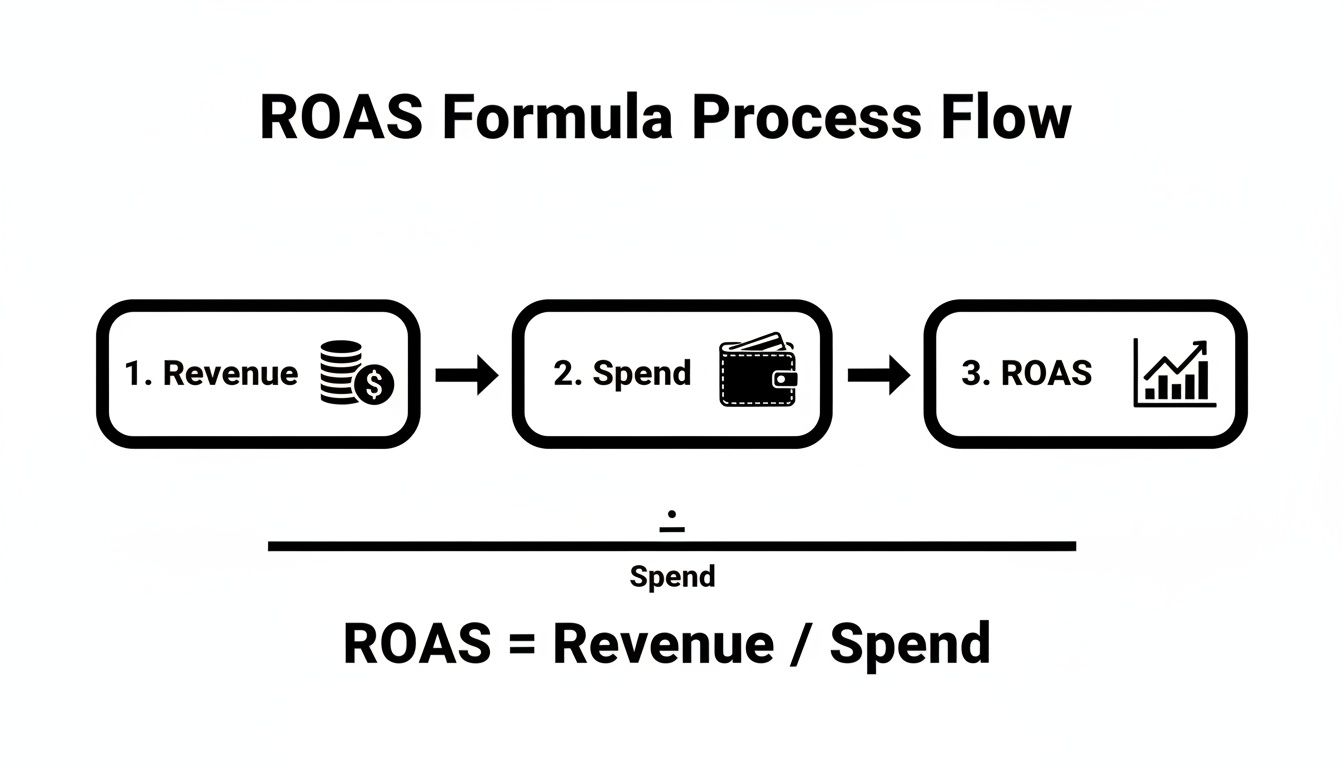
It’s just a two-step process of division that cuts through all the campaign noise to give you a single, powerful performance metric.
Putting the ROAS Formula into Action
Let’s say you run an e-commerce shop and you're launching a new line of products. You decide to test the waters with two different campaigns—one on Google Ads and one on social media—to see which one gives you more bang for your buck.
Here’s what your campaign data looks like:
- Google Ads Campaign: You put $20,000 into search and shopping ads. Those ads brought in $120,000 in sales.
- Social Media Campaign: You spent $10,000 on ads across your social channels. That effort generated $30,000 in revenue.
Now, let's plug these numbers into the formula and find out which campaign was the real winner.
Comparing Campaign Performance
Time for some quick math.
Google Ads ROAS Calculation:
- Formula: $120,000 (Revenue) ÷ $20,000 (Ad Spend)
- Result: 6
Social Media ROAS Calculation:
- Formula: $30,000 (Revenue) ÷ $10,000 (Ad Spend)
- Result: 3
- Profit Margins: This is the big one. If your business has a juicy 50% profit margin, a 3:1 ROAS might feel fantastic. But if your margin is a much tighter 20%, that same 3:1 ROAS could actually be losing you money once you factor in the cost of your products, shipping, and overhead.
- Industry and Competition: In a cutthroat market, you’re paying more for every click. That might mean you have to stomach a lower ROAS, at least initially, just to get your foot in the door and grab some market share.
- Business Stage: Are you a brand-new startup? You might be thrilled with a 2:1 ROAS if your main goal is just to get your name out there and acquire customers as fast as possible. An established company, on the other hand, is probably more focused on the bottom line and will be shooting for a much higher ROAS, maybe 5:1 or even more.
- First-Click: Gives all the glory to the very first touchpoint. This is great for understanding what drives initial awareness.
- Last-Click: Credits only the final touchpoint before the sale, focusing on what seals the deal.
- Multi-Touch: Spreads the credit across multiple touchpoints, painting a much more realistic picture of the customer's journey.
- Broad Match: Use this one carefully, almost like a research tool to discover new search terms. But you have to watch it like a hawk.
- Phrase Match: This is often the sweet spot. It gives you a good mix of reach and control, catching relevant searches without straying too far off track.
- Exact Match: Now we're talking. This is your high-intent sniper rifle, targeting users who are searching for exactly what you sell. This is where your highest conversion rates—and best ROAS—usually live.
- Instantly Spot Irrelevant Keywords: Our system automatically flags the junk terms that are quietly eating away at your budget.
- Add Negatives with a Single Click: Forget copying and pasting. You can zap irrelevant terms and add them to your negative keyword lists instantly, plugging the leaks in your ad spend for good.
- Wrong Audience: You're putting your ads in front of people who just aren't interested.
- Weak Creative: Your ad copy and visuals aren't grabbing attention or persuading anyone to click.
- Leaky Landing Page: You're getting the clicks, but your landing page is failing to close the deal.
The results couldn't be clearer. Your Google Ads campaign delivered a 6:1 ROAS—for every $1 you spent, you got $6 back. Meanwhile, your social media ads produced a 3:1 ROAS, bringing in just $3 for every $1 spent.
This kind of direct comparison is why ROAS is so critical. With marketing teams spending roughly 14% of company budgets in 2023, there's zero room for waste. This simple formula gives you the confidence to double down on what’s working and pull back on what isn’t. If you want to dive deeper into the latest trends, check out the research on marketing investment from Fivetran.
By comparing the ROAS of different channels, you move from guesswork to strategic budget allocation. And while ROAS is laser-focused on revenue, it’s not the only metric you should track. To get a fuller view of your performance, take a look at our guide on how to calculate cost per acquisition to see how efficiently you're winning new customers.
What Is a Good ROAS and What Should You Aim For?
Okay, so you've crunched the numbers using the return on ad spend formula, and you have a result. Now what? That number is pretty useless without some context. Is it good, bad, or just… meh?
Figuring this out is where the real strategy kicks in. The honest truth is, there’s no magic number for a "good" ROAS that applies to every business out there. What's fantastic for a software company with huge margins could be a total disaster for an e-commerce store selling low-margin goods.
That said, there is a widely accepted benchmark that gives you a solid place to start.
The 4-to-1 Rule of Thumb
Talk to enough advertisers, and you'll inevitably hear about the 4:1 ROAS. This simply means you’re earning $4 in revenue for every $1 you spend on ads. It's often held up as the gold standard because, for a lot of businesses, it hits that sweet spot between driving growth and actually being profitable after you account for all your other costs.
This isn't just some random number someone pulled out of a hat. The 4:1 benchmark has become a crucial dividing line between campaigns that are making money and those that are just spinning their wheels. Research from years back showed a 4:1 ratio was the average for CPG brands, and that standard has stuck around. A 4:1 ROAS is often a strong signal that your ads aren't just paying for themselves—they're actively fueling your business. If you want to dig deeper into this, you can explore detailed insights on ROAS benchmarks from Channelsight.
But remember, even this trusted benchmark isn't a one-size-fits-all solution.
Why Your Perfect ROAS Is Unique to You
A "good" ROAS is completely tied to your business model, your profit margins, and what you’re trying to achieve. It’s a number you have to define for your specific situation.
Think about these factors:
A good ROAS isn’t about hitting some arbitrary industry number. It's about finding the number that supports your specific business goals, whether that’s aggressive growth, maximizing profit, or simply breaking even to acquire a new customer.
To put this into perspective, let's look at how ROAS expectations can vary wildly depending on the type of business you're running.
ROAS Benchmarks by Industry and Goal
A comparative look at typical ROAS targets across different industries and business models to help you set realistic expectations.
Setting a ROAS target without considering your industry and business model is like sailing without a map. What's a fantastic journey for one ship could lead another straight into the rocks. Use these benchmarks as a starting point, but always circle back to your own numbers.
Common ROAS Mistakes and How to Avoid Them
The return on ad spend formula seems simple enough on the surface, but it's surprisingly easy to get a number that's telling you a lie. A few common pitfalls can completely skew your calculations, leading you to make confident—but totally wrong—decisions about where your money goes. Let’s pull back the curtain on these frequent mistakes so you can steer clear of them.

Knowing what these traps are is the first step to making sure your data is giving you the whole, unvarnished truth about how your campaigns are really doing.
Mistake 1: Confusing ROAS with ROI
This one is, by far, the most common and dangerous mistake in the book. While they sound alike, ROAS and ROI (Return on Investment) measure two completely different things. ROAS is all about gross revenue versus ad spend. ROI, on the other hand, cares about actual profit.
A high ROAS can easily mask a campaign that's quietly losing money. Picture this: you're hitting a 3:1 ROAS, making $3 for every $1 you spend on ads. Sounds great, right? But what if your profit margin is only 25%? That $3 in revenue only translates to $0.75 in profit. You've actually lost $0.25 for every dollar you spent. Ouch.
To dodge this bullet, always calculate your break-even ROAS. You need to know the absolute minimum return required to cover not just the ad spend, but also your cost of goods sold (COGS) and other business expenses.
Mistake 2: Using a Flawed Attribution Model
So, which ad gets the credit for a sale? It's a tricky question. A customer might see a Facebook ad on Monday, click a Google ad the following week, and finally make a purchase through an email link on Friday. If you’re using a simplistic "last-click" attribution model, you’re giving 100% of the credit to that email. Suddenly, your other channels look like they're doing nothing.
This narrow view can trick you into cutting the budget for top-of-funnel campaigns that are critical for introducing new people to your brand in the first place.
The key is to pick an attribution model that actually reflects the messy, complex way your customers find and buy from you.
Mistake 3: Ignoring Customer Lifetime Value
Finally, a classic case of shortsightedness is focusing only on the ROAS from a customer's very first purchase. Some of your most important campaigns aren't about getting one sale; they're about acquiring customers who will come back and buy from you again and again.
A campaign might start with a seemingly mediocre ROAS of 2:1. But what if that campaign is a magnet for customers with a high lifetime value (CLV)—people who make several more purchases over the next year? Its true, long-term ROAS could be closer to 10:1. Don't sacrifice long-term profitability for a quick win on paper.
Let's Get Your ROAS Pointing Up: Real-World Tactics That Work
Okay, so you know how to calculate your ROAS. That’s step one. But the real magic happens when you start making that number climb. It's time to roll up your sleeves and apply some proven strategies that will get you more bang for your ad buck. These aren't just theories; they're the battle-tested tactics we use to squeeze every last drop of revenue from an ad budget.

The fastest path to a better ROAS is to simply stop lighting money on fire. First, we plug the leaks by cutting out clicks that were never going to convert anyway. Then, we get smart about refining our campaigns to attract the right kind of traffic—the people who are actually looking to buy what you're selling.
Plug the Leaks with Negative Keywords
Think of negative keywords as the bouncers for your ad campaign. Their job is to stand at the door and politely (or not so politely) turn away all the irrelevant search traffic that has zero chance of ever converting.
Every time someone looking for "free templates" or "DIY instructions" clicks on your ad for a premium software tool, you've just wasted money. Aggressively building and maintaining your negative keyword lists isn't just a good idea; it's absolutely essential. It’s the single fastest way to immediately boost your ROAS.
Get a Grip on Your Keyword Match Types
Keywords aren't all the same, and the way you target them can make or break your ROAS. Just letting broad match run wild is like opening the floodgates to a sea of low-quality traffic that will sink your performance.
By shifting your budget toward tighter match types for your most important keywords, you take back control. You get to be picky about who sees your ads, which means you spend more of your money on people who are actually ready to convert.
Nail Your Ad Copy and Landing Pages
Once you've stopped the bleeding from junk clicks, it's time to work on turning more of the good clicks into customers. Your ad copy is your first impression; it has to be compelling enough to get them to click. But your landing page? That's where you seal the deal.
Boosting your conversion rate is a direct line to a better ROAS. For instance, a solid Amazon CRO Strategy is all about making sure the traffic you drive actually turns into sales. The same logic applies to any platform.
If your ad promises a solution to one problem and the landing page talks about something else, you're just paying for bounces. The journey from ad to page needs to feel like a smooth, logical next step. For a deeper dive, check out our guide on conversion rate optimization best practices to get even more tips.
How Keywordme Supercharges Your ROAS Optimization
Let's be honest, trying to manually juggle all of these optimization tactics is a fast track to burnout. It's a never-ending grind of messy spreadsheets and data deep-dives that keeps you stuck in the weeds instead of focusing on big-picture strategy.
This is exactly where Keywordme flips the script. We built our platform to automate the most time-consuming (and frankly, annoying) tasks that boost your ROAS. Instead of spending hours hunting through search term reports, you can spot problems and act on them in minutes.
One-Click Cleanup to Stop Wasting Money
The quickest path to a better return on ad spend? Simple: stop wasting money on clicks that will never turn into customers. That’s precisely what Keywordme's one-click search term cleanup was designed for.
This isn't just about tidying up your account; it's about making every dollar work harder. For example, Keywordme helps you sharpen your targeting for advanced paid search strategies, which directly pumps up your ROAS by funneling your budget toward high-intent traffic.
From Data Overload to Strategic Action
Beyond just cleaning up the mess, Keywordme helps you uncover the hidden growth opportunities already sitting in your account data. You can easily sift through real search terms to find new, high-converting keywords—without ever having to build another pivot table.
By taking the grunt work off your plate, Keywordme frees you up to focus on the strategic moves that actually grow the business. You'll spend less time on tedious tasks and more time on what really matters.
ROAS FAQs: Your Burning Questions Answered
Once you get the hang of the basics, you'll inevitably run into some trickier, real-world scenarios. Let's walk through a few of the most common questions that pop up, so you can handle your ROAS calculations like a seasoned pro.
What Does a 'Bad' ROAS Really Mean?
A "bad" ROAS isn't just a low number. It's any number that falls below your break-even point. If your product has a 25% profit margin, a 3:1 ROAS might look okay on the surface, but you're actually losing money on every single sale. Think of it as a red flag.
When you see a ROAS like that, it's a clear signal that something in your strategy is broken. It usually points to one of a few culprits:
Don't just see a bad ROAS as a failure. See it as a diagnostic tool. It tells you exactly where you need to start investigating to plug the holes in your funnel and stop burning through your ad budget.
Should ROAS Ever Take a Backseat to CPA?
Believe it or not, yes. While ROAS is the undisputed champ for measuring pure profitability, there are times when Cost Per Acquisition (CPA) is the more important metric. This is especially true when your main goal is aggressive growth.
Imagine you're a startup trying to carve out your slice of the market. You might be perfectly happy to break even—or even take a small loss—on that first sale just to get a new customer. In that scenario, you're focused on keeping your CPA manageable, not maximizing immediate ROAS.
This approach only makes sense if you have a rock-solid plan to make money on the back end, banking on a high Customer Lifetime Value (CLV). Here, you're playing the long game, betting that future purchases will more than make up for the initial acquisition cost.
Industry analysis often pins the average ROAS somewhere between 200% to 400%, but this is all over the map depending on the platform. For example, the average ROAS on Facebook Ads can be around 400%, while a well-tuned retargeting campaign might hit 600% because it’s targeting people who already know you. For a deeper dive, check out the latest return on ad spend analysis.
How Do You Approach ROAS for Long Sales Cycles?
This is a classic head-scratcher for businesses with long sales cycles, like a B2B company selling high-ticket software. Looking at last month's ad spend versus last month's revenue is completely useless.
The trick is to match your attribution window to your typical sales cycle. If it usually takes 90 days from the first click to a signed contract, then you need to measure your ROAS over a 90-day period.
Doing this gives you a far more honest look at how your ads are actually performing. It shows you how that initial ad spend is influencing deals that close weeks or even months down the line. Most importantly, it stops you from mistakenly shutting down top-of-funnel campaigns that are quietly filling your pipeline with future customers.
Ready to stop wasting ad spend and dramatically improve your ROAS? Keywordme automates the most tedious optimization tasks, from cleaning up junk search terms to finding new high-converting keywords in a single click. Start making smarter, faster decisions with your Google Ads budget. Start your 7-day free trial of Keywordme today!
.svg)