
How to Increase ROAS: Proven Tactics That Actually Work
How to Increase ROAS: Proven Tactics That Actually Work


Most advice about how to increase ROAS starts with bids, budgets, and ad copy. That's often the wrong starting point. A campaign can report an excellent return while paying for customers who would have converted without the ad, or while generating revenue from products that barely produce profit after fulfillment, returns, and other variable costs.
The practical order is different. First, establish whether the reported return is incremental. Then calculate what profitable revenue is worth to your business. Only after that should you tighten search terms, improve Quality Score, choose match types, and automate bidding. That sequence keeps a polished dashboard from becoming an expensive distraction.
Why Your Reported ROAS Might Be Lying to You
A reported ROAS number answers a narrow question: how much conversion value the platform assigned to advertising compared with spend. It doesn't necessarily answer the business question that matters most, which is whether the advertising created additional demand.
That distinction is especially important for branded search. A user who already knows your company may search for your name, click the paid result, and purchase. Google Ads can credit the sale to the campaign, even though the customer may have bought through an organic result or another owned channel. The dashboard looks efficient, but the ad may have contributed little.
Recent incrementality testing across 225 DTC geo-based tests found a median incremental ROAS of just 0.70x for branded search, below breakeven in that dataset (Improvado's PPC ROAS analysis). That doesn't mean every branded campaign is unprofitable. It does mean platform-reported ROAS shouldn't be treated as proof of incremental value.
Reported efficiency versus additional demand
A geo-based test compares markets where advertising continues with comparable markets where the campaign is held back. The difference in total outcomes, including paid and organic sales, offers a stronger view of causal impact than the conversions claimed by one platform.
A basic process looks like this:
- Choose comparable geographic areas. Match them on historical sales, demand, customer mix, and media exposure.
- Keep the test isolated. Change the selected campaign in the test markets while keeping other major marketing conditions as consistent as possible.
- Compare total business outcomes. Look at revenue or conversions across all channels, not only the ad platform's reported conversions.
- Calculate incremental ROAS. Divide the additional conversion value associated with the advertising by the campaign cost.
| Campaign Type | Reported ROAS | Incremental ROAS | Incrementality % |
|---|---|---|---|
| Branded search | Not supplied | 0.70x median in the cited tests | Not supplied |
| Non-brand search | Account-specific | Account-specific | Account-specific |
| Prospecting | Account-specific | Account-specific | Account-specific |
The table deliberately leaves unsupported fields blank. Your own test should replace platform assumptions with measured results.
Practical rule: If a campaign targets people who already know you, test whether it captures demand or creates it before scaling it.
Incrementality testing is most valuable when branded spend is substantial, channel reports disagree, or leadership is making budget decisions from highly attributed bottom-funnel results. Last-click ROAS can remain a useful operating proxy for smaller accounts or campaigns where a formal test isn't practical, but label it as attributed ROAS.
For a broader measurement framework, Stimulead's guide for marketing teams provides useful context on evaluating marketing effectiveness beyond a single platform metric. You can also review cross-channel attribution before comparing campaigns that use different attribution logic.
Setting Profit-Based ROAS Targets That Make Sense
A revenue-based target can look precise while hiding the economics underneath. If two products generate the same sales value but carry different costs, they shouldn't necessarily receive the same bidding target.
The basic breakeven formula is:
Breakeven ROAS = 1 ÷ contribution margin
Contribution margin is more useful than gross margin for advertising decisions because it can account for variable costs such as product cost, payment processing, fulfillment, shipping, and expected returns. A business should calculate that margin at the product, campaign, or market level whenever those costs vary materially.
The verified examples provide a useful contrast. A 30% margin implies a 3.33x breakeven ROAS, while a 70% margin implies a 1.43x breakeven ROAS (benchmark guidance on Google Ads economics). Those are floors, not growth targets.
Build the target from contribution, not optimism
A practical target adds the profit you want after advertising to the amount required to cover variable costs. In simplified form:
Profit-adjusted target ROAS = 1 ÷ (contribution margin × allowable cost factor)
The exact allowable cost factor depends on your profit objective and financial model. Don't force one account target across products with different contribution margins. Separate high-margin and low-margin product groups, then pass accurate conversion values to bidding systems.
| Business Model | Gross Margin | Contribution Margin | Breakeven ROAS | Target ROAS with 20% Profit |
|---|---|---|---|---|
| High-margin SaaS subscription | Not supplied | Business-specific | Business-specific | Business-specific |
| Mid-margin DTC product | Not supplied | After shipping, returns, and processing | Business-specific | Business-specific |
| Low-margin marketplace reseller | Not supplied | After platform and fulfillment costs | Business-specific | Business-specific |
The table uses qualitative fields because the available evidence doesn't provide verified margin figures for those three models. The calculation itself is still actionable. A subscription company might value a new customer using expected lifetime contribution, while a reseller may need to bid on immediate contribution after marketplace costs.
A common mistake is to raise Target ROAS whenever revenue grows slowly. That can suppress profitable volume if the target exceeds what the campaign can realistically achieve. Google defines Target ROAS as the average conversion value desired for each dollar spent, and warns that setting the target too high can prevent a strategy from spending its full budget (Google's Target ROAS documentation).
Use recent account history as the starting point rather than copying a benchmark. Google's Shopping guidance recommends reviewing average conversion value divided by cost from the last four weeks before choosing a target (Google's Shopping bidding guidance).
Finance check: A campaign can improve revenue ROAS while making less money if product mix shifts toward lower-margin items.
Customer lifetime value belongs in the model when repeat purchases are genuine, measurable, and appropriately discounted for time and retention risk. Keywordme's customer lifetime value guide can sit alongside your contribution-margin model, while resources on video ROI for marketers can help teams evaluate production and distribution costs that revenue-only reporting often ignores.
Cutting Wasted Spend with Smarter Negative Keywords
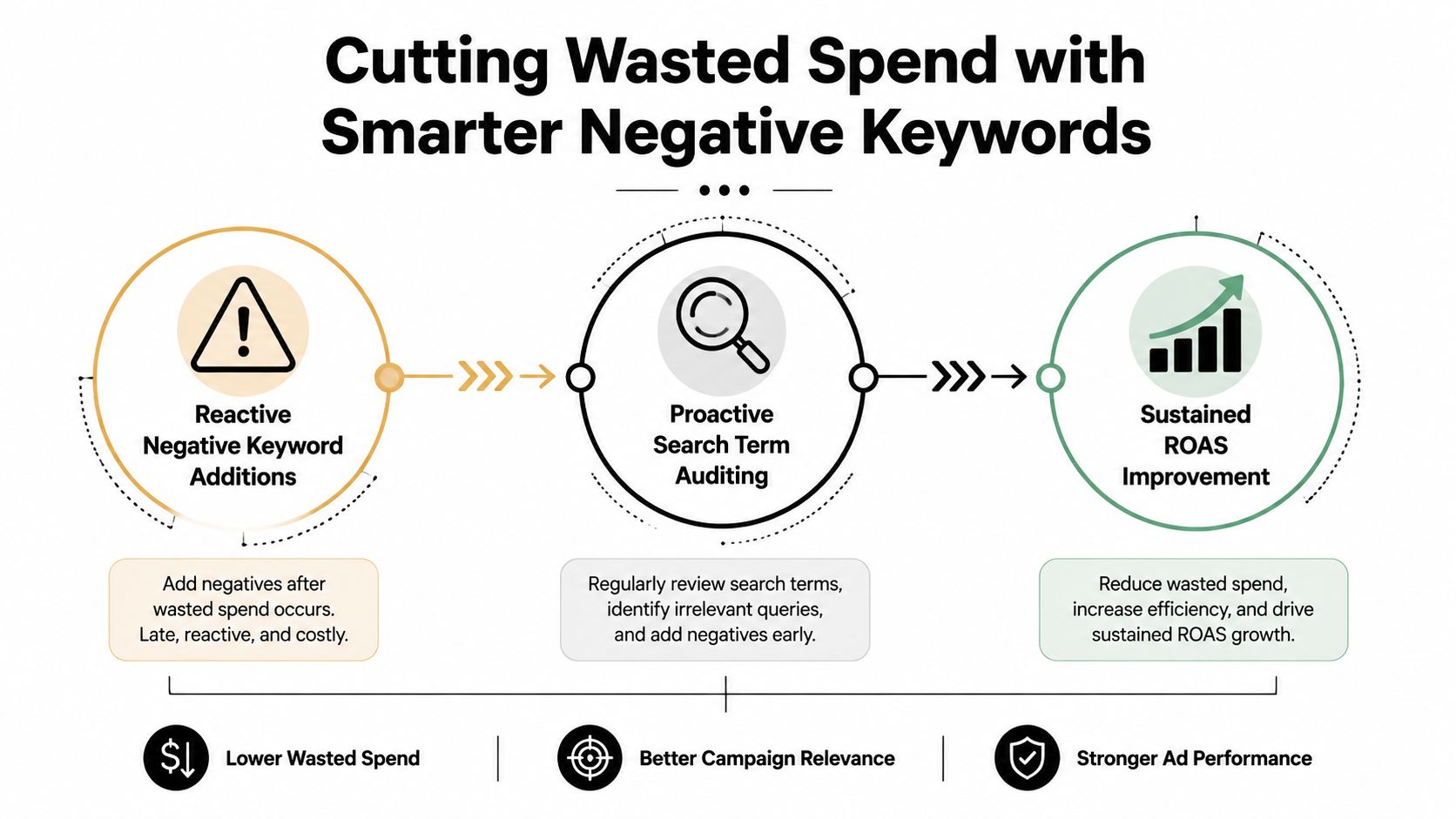
Negative keywords control relevance. They stop ads from serving against intent the offer cannot satisfy, but they do not automatically improve profit. A query can look inefficient while still introducing valuable customers, so exclusions need both performance and margin context.
The stronger workflow starts with the search-term report, not a complaint about one query. Export the data, tokenize queries into 1-grams, 2-grams, and 3-grams, then sort recurring patterns by cost, conversions, conversion value, or cost per conversion. Repeated patterns reveal waste that single-query reviews often miss.
A safer pruning workflow
Use a recent search-term window. Independent PPC guidance recommends reviewing the last 30 days and prioritizing queries with 5 or more clicks and zero conversions as likely waste drivers (WebFX's Google Ads benchmarks guide). Treat those thresholds as review signals, not automatic deletion rules. The right decision also depends on conversion value, margin, and whether the query reflects an audience you still want to test.
- Export the report. Include search term, campaign, ad group, cost, clicks, conversions, and conversion value.
- Normalize the text. Lowercase terms and separate words into n-gram groups.
- Flag repeated waste. Find patterns with meaningful spend and no conversions, or results materially below the account's own baseline.
- Check intent manually. A weak query may still represent a valuable long-tail variation or a profitable product category.
- Apply the narrowest exclusion. Use exact negatives for one clear query, phrase negatives for a recurring phrase, and broader exclusions only when unwanted intent is unambiguous.
- Record the reason. Note the date, campaign scope, and rationale so another operator can reverse the change if performance shifts.
Google's Search terms report lets you select an irrelevant query and choose Add as negative keyword to prevent future matching (Google's negative keyword instructions). For the setup details and shared-list workflow, see this guide to adding negative keywords.
Modifiers such as free, jobs, and salary may belong on a shared list when they clearly conflict with the offer. Competitor terms need a separate review. Some signal research intent, while others generate costly traffic with little conversion value. One failed query does not justify blocking an entire concept.
Shared negative keyword lists apply consistent exclusions across campaigns. Campaign-level negatives handle exceptions. Keywordme can scan search terms for junk, add high-intent terms as positive keywords, apply match types, and build negative keyword lists without repetitive formatting and copy-and-paste work.
Over-pruning remains the main risk. An n-gram found in weak queries may also appear in profitable variants. Exclude clear waste first, then expand only after checking conversion value, intent, and the campaign's profit-adjusted target.
Fixing Quality Score to Lower Your Cost Per Click
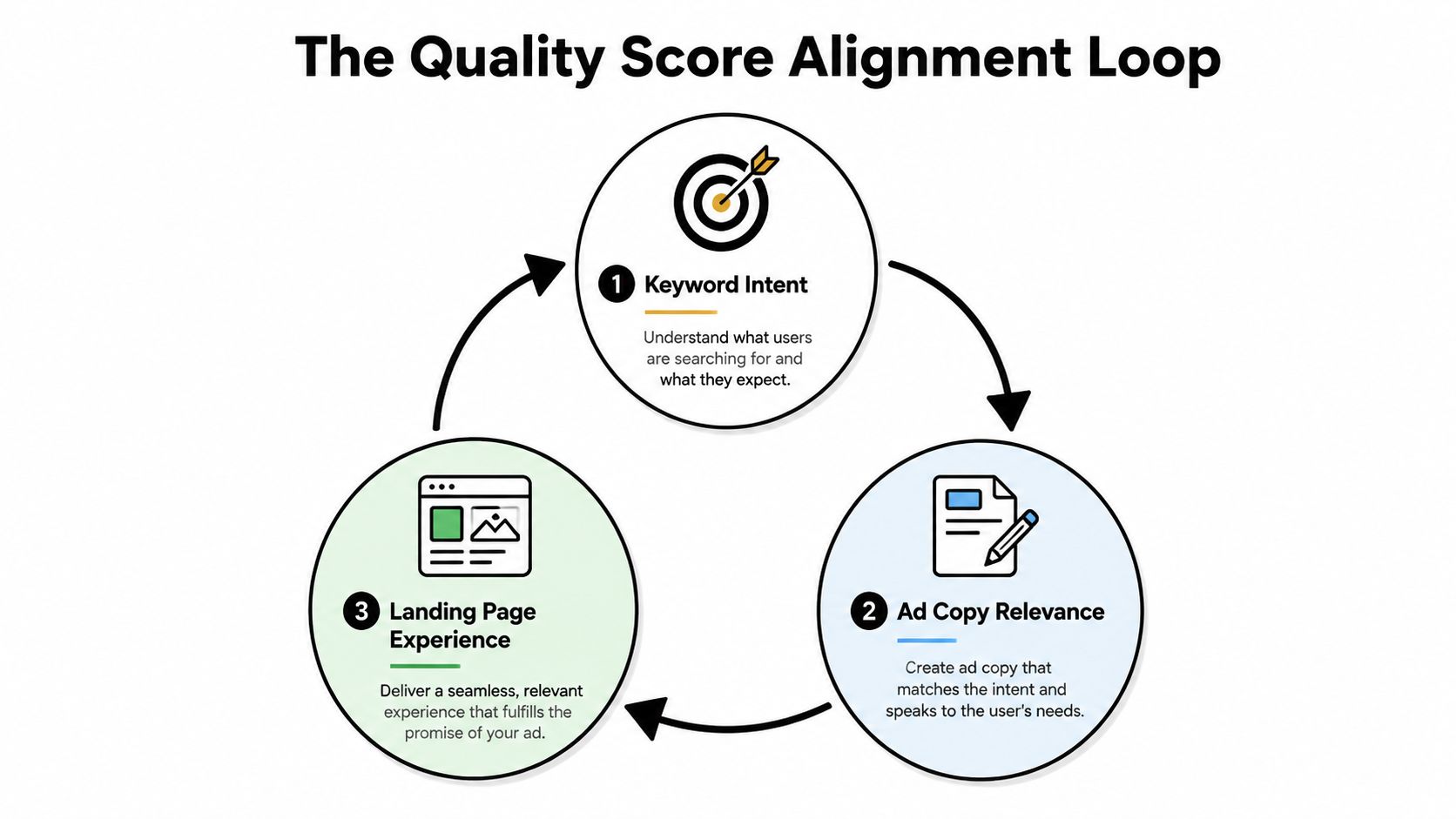
Quality Score is a 1–10 keyword-level diagnostic built from expected click-through rate, ad relevance, and landing page experience, according to Google's explanation of the metric (Google Ads Quality Score guidance). It isn't a business KPI, and chasing the number alone can waste time.
The useful question is simpler: which part of the keyword-to-ad-to-page chain is weakest?
Find the bottleneck
Export Quality Score and its component ratings. Group related keywords by intent, then identify whether the problem sits in expected CTR, ad relevance, or landing page experience.
- Expected CTR: Align ad language with the actual search intent and the terms people use.
- Ad relevance: Make the headline and description answer the query's specific need rather than describing the entire business.
- Landing page experience: Match the page headline, offer, and call to action to the promise made in the ad.
A keyword about pricing shouldn't land on a generic brand page. A search for a specific service shouldn't force the visitor to search through a broad product catalog. Message mismatch creates friction before the visitor has a chance to evaluate the offer.
The number diagnoses the problem. The alignment work fixes it.
Improve one component at a time and watch the commercial metrics that follow, such as CPC, conversion rate, and conversion value. A higher Quality Score may improve ad rank efficiency and lower CPC for a comparable position, but a higher score with poor intent or weak economics isn't a win.
The three-part loop is practical:
- Keyword intent: Define what the searcher wants now.
- Ad copy relevance: Reflect that intent in the promise and wording.
- Landing page experience: Deliver the promised answer without forcing a detour.
Don't rewrite every ad because one keyword has a low score. Segment first. A tightly related cluster can share a landing page and testing plan, while a different intent needs separate messaging.
Choosing the Right Match Types for Higher Conversions
Match types determine how tightly Google connects a keyword to a user's query. The choice isn't just about volume. It controls the balance between intent, discovery, and cleanup effort.
A 2026 benchmark found that exact match represented 55% of keywords, produced 27% of impressions, and generated 40% of conversions. The same dataset implied conversion-per-impression efficiency of 1.48 for exact match versus 0.76 for broad match, with exact match also delivering the highest ROAS among major match types (Keyword and match type benchmark).
| Match Type | Avg ROAS | Volume Potential | Negative Keyword Effort | Best Use Case |
|---|---|---|---|---|
| Exact | Highest in the cited benchmark | More limited | Lower when tightly structured | High-intent, high-value themes |
| Phrase | Not supplied | Moderate expansion | Moderate | Adjacent intent around proven themes |
| Broad | Lower efficiency in the cited benchmark | Broadest discovery | High | Discovery with strong tracking and controls |
Exact match is usually the profit anchor when CPCs are high or margins are tight. Phrase match can expand a proven theme without opening the entire query universe. Broad match can uncover demand, but it needs disciplined search-term auditing and reliable conversion values.
Use match types as budget layers
Don't run exact, phrase, and broad versions of the same keyword with identical budgets and no role definition. Give each layer a job:
- Exact campaigns capture proven, high-intent queries and protect budget.
- Phrase campaigns test close variants that may deserve promotion.
- Broad campaigns discover new language and audiences for review.
When a broad-match query converts consistently, add it as an exact keyword in a controlled campaign. Then review overlap, bids, search terms, and negative lists so the new exact theme receives the budget you intended.
Broad match isn't automatically bad. It becomes expensive when advertisers use it to compensate for weak tracking, poor conversion values, or missing negatives. Exact match isn't automatically sufficient either. It can produce an attractive return while limiting reach to a narrow pocket of existing demand.
The trade-off is operational. More control requires more structure and review. More discovery requires stronger hygiene. Choose the mix based on margin, search volume, conversion reliability, and your capacity to inspect what the system matched.
When to Switch to Target ROAS Bidding
Target ROAS is a control system, not a cure for weak measurement. It bids toward the conversion value you provide, so inaccurate revenue, missing offline outcomes, or inconsistent attribution can push spend toward sales that look efficient but produce little contribution profit. Switching before those inputs are dependable gives the system less useful evidence.
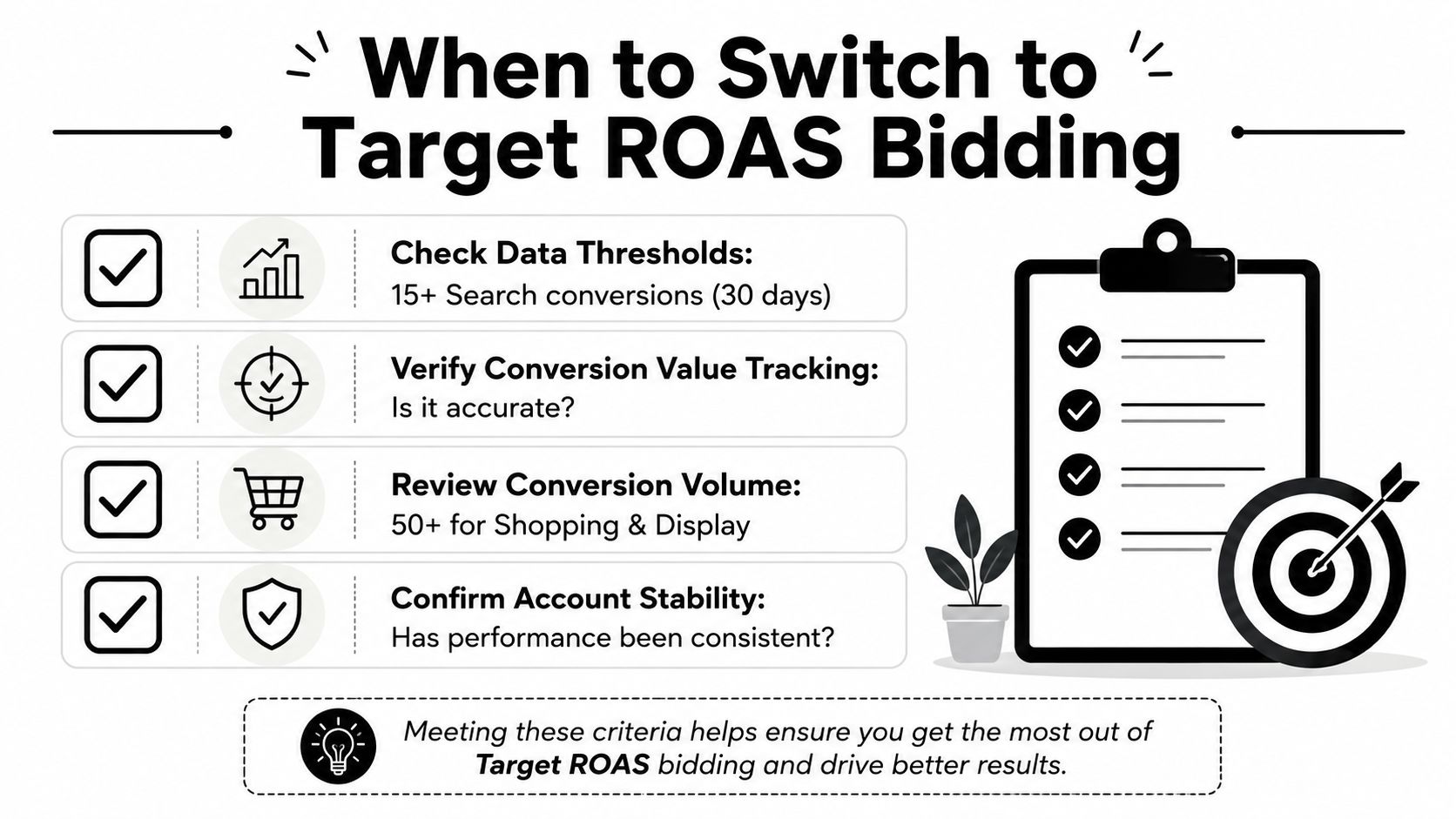
Google's value-based bidding guidance gives Demand Gen advertisers a concrete eligibility example: 50 conversions with value in the last 35 days and 10 conversions with value in the previous 7 days (Google's value-based bidding requirements). Thresholds vary by campaign type, so use the applicable requirement instead of treating one benchmark as universal.
Make the transition deliberately
Before changing the strategy, verify:
- Conversion tracking: Purchase or lead values reflect actual business value.
- Recent signal: The campaign has enough recent value-based conversion data for its campaign type.
- Stable structure: Major budget, targeting, creative, and landing-page changes are not happening at the same time.
- Clean inputs: Tracking gaps and obvious search-term waste have been addressed.
- Profit-based target: The starting target reflects recent value per cost and acceptable margin, not a rival campaign's headline result.
Set the initial target close to recent actual performance. An aggressive target can reduce delivery, especially when the campaign has limited eligible traffic or uneven conversion volume. If delivery drops after the switch, lower the target cautiously and inspect eligibility, budget, conversion values, and attribution before rebuilding the campaign.
Treat the early period as a learning phase. Do not react to a short reporting window or change the target repeatedly. Account for conversion lag, compare complete cohorts, and monitor spend, conversion value, delivery, and profit together. A rising ROAS can still hide weaker incremental sales or a shift toward low-margin products.
If product margins vary sharply, pass margin-aware values or separate campaigns by economics where the account structure supports it. Revenue-based bidding can meet its target while contribution profit deteriorates, so the bid strategy should answer to the business margin, not only the percentage shown in the dashboard.
Building a Weekly ROAS Optimization Routine
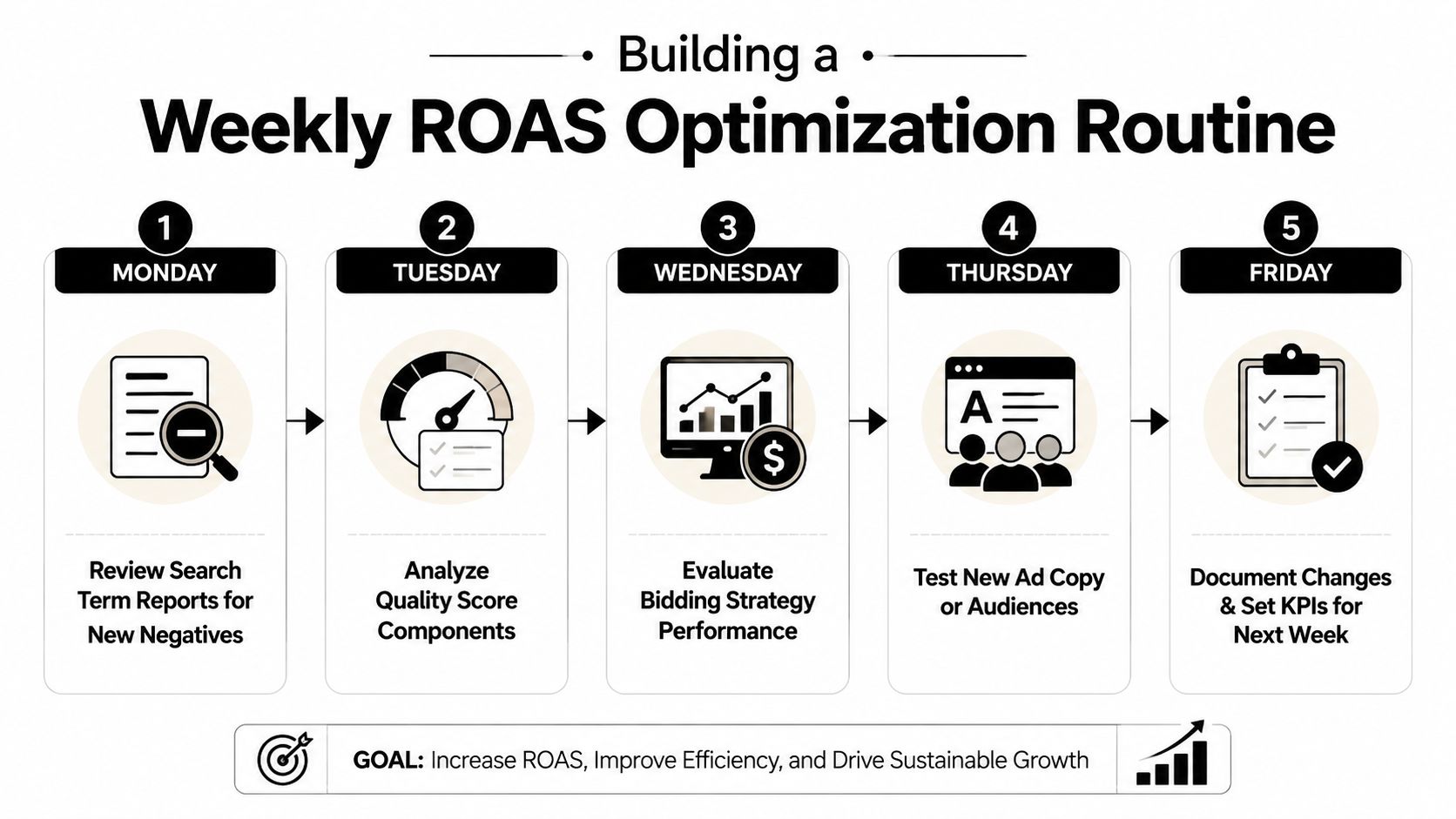
ROAS improves through controlled repetition, not frantic daily edits. A weekly routine should protect the highest-impact checks first, then create space for testing.
Use the week as a decision system
Monday is for search-term control. Review new queries, apply clear negatives, and promote valuable converting terms into the right match-type layer. Start with waste that is obvious and repeated, not speculative exclusions.
Tuesday belongs to Quality Score diagnosis. Review component ratings in underperforming clusters. Rewrite the weakest link, then check whether the ad and landing page make the same promise.
Wednesday is for bid strategy health. Confirm conversion values are arriving, inspect delivery, and compare actual performance with the profit-based target. If the campaign lacks sufficient signal, don't expect Target ROAS to rescue it.
Thursday should create learning. Test a focused ad message, landing page variation, or audience refinement. Change one meaningful variable and write down the hypothesis before launch.
Friday closes the loop. Record what changed, why it changed, and what result would justify keeping or reversing it. This record prevents the account from cycling through the same ideas without learning.
A simple priority order helps when time is limited:
- Stop clear waste.
- Repair tracking and conversion values.
- Protect profitable search themes.
- Fix keyword, ad, and page alignment.
- Test expansion only after the controls are sound.
Teams preparing for scaling company marketing budgets should document these decisions before increasing spend. Scaling a clean process is different from scaling an account that merely reports attractive attribution.
The best routine is boring enough to repeat and specific enough to produce a decision. Review the same fields, apply explicit criteria, and give each change a documented hypothesis. Consistency beats intensity because it preserves the connection between an edit and its commercial result.
Keywordme helps PPC teams turn this routine into a faster Google Ads workflow by scanning search terms for junk, applying negative keyword lists, and promoting high-intent terms with match types in one place. Visit Keywordme to start a seven-day free trial and spend less time formatting keywords, so you can spend more time improving profitable ROAS.
.svg)