
Customer Lifetime Value: A Practical Guide to Smart Ad Spend
Customer Lifetime Value: A Practical Guide to Smart Ad Spend


The report looks fine until finance asks the one question that matters, are these customers worth more than the money we just spent to get them? That's where a lot of PPC accounts fall apart. A campaign can look efficient on paper, yet still drain margin if it keeps buying cheap first orders that never turn into repeat business.
Customer lifetime value is the missing lens. It tells you whether your Google Ads work is creating durable profit or just generating a prettier dashboard.
Why CPA Alone Misleads PPC Budget Reviews
A lot of marketers open Google Ads, sort by cost per acquisition, and feel relief when the number drops. I've sat through those budget reviews. The problem is that a low CPA doesn't tell you whether those customers stick, buy again, or vanish after the first order.
That gap gets expensive fast when acquisition keeps getting pricier. One benchmark source says customer acquisition costs have risen over time, which explains why short-term conversion reporting can be so misleading for growth planning. The same source says only a minority of companies can accurately measure CLV, even though most say it matters, so many teams are still judging paid media with incomplete information. Customer lifetime value statistics and benchmarks
A clean-looking campaign can still be the wrong campaign.
Practical rule: If a keyword or audience looks profitable only because you're measuring the first order, you're not seeing the full picture. You're seeing the entry fee.
That's why CLV matters in paid search. It ties acquisition, retention, and margin into one number that exposes whether you're scaling a real customer base or just buying transactions. Once you start reading your account through that lens, the “winning” ad groups often change.
What Customer Lifetime Value Actually Means
Customer lifetime value is not total revenue. It's the present value of all future profits a customer relationship is expected to generate, after accounting for the costs of attracting, selling, and servicing that customer. That definition matters because revenue-only thinking can make unprofitable customers look valuable on a spreadsheet. Marketing definition of customer lifetime value
Why profit, not revenue, is the right lens
If two customers each spend the same amount, the one with the heavier support burden or thinner margin can be worth far less. That's why rigorous CLV models discount future margin contributions over time instead of just adding up sales. It's also why CLV feels closer to discounted cash flow than to a simple ecommerce revenue report. CLV as present value of future profits
For a PPC strategist, that distinction changes bidding decisions. A first-time buyer who never returns may deserve a lower bid ceiling than a smaller initial buyer who reliably renews or repurchases. The platform never tells you that unless you feed it better value signals.
The three mechanics behind most CLV math
Most practical formulas still reduce to three moving parts, average purchase value, purchase frequency, and customer lifespan. Wharton describes CLV as customer value × average customer lifespan, while other practical models express the same idea as average revenue or purchase value multiplied by lifespan and adjusted for total costs to serve. Wharton on why customer lifetime value matters
That's enough structure to work across ecommerce, subscriptions, and service businesses. The inputs change, but the logic doesn't.
The CLV Formulas You Can Use Today
A marketer does not need an actuarial model to make better budget calls. A usable CLV estimate just needs to stay consistent enough to compare audiences, channels, and campaigns without flattering weak traffic.
Three formulas that show up in real dashboards
Simple lifetime value model.
CLV can be expressed as customer value times customer lifespan, which is the fastest way to get a directional number. It works best for businesses with repeat purchases and messy data, because it gives you a workable baseline without overbuilding the model. Wharton on why customer lifetime value matters
Recurring revenue model.
For subscription or SaaS businesses, a common benchmark formula is CLV = (ARPA × Gross Margin) ÷ Churn Rate. That matters because lifetime value moves inversely with churn, so even a small retention improvement can raise expected account value in a way straight revenue reporting will miss. SaaS customer lifetime value formula
Predictive cohort model.
If you have enough history, cohort behavior can forecast future value more accurately than a flat average. BCG notes that stronger CLV work increasingly relies on machine-learning-based forecasting and that backtesting matters, because the test is whether the model predicts historical periods well enough to trust it going forward. BCG on CLV limitations and tactical optimization
A PPC team cares about this because the formula changes bidding logic. If a first-time buyer tends to disappear after one order, that customer should not justify the same bid ceiling as a smaller initial buyer who renews or repurchases.
A quick retail example
Take a mid-sized ecommerce store. If customers usually buy twice, stay active for a predictable period, and carry stable margin, the simple model is close enough to separate low-value and high-value buyers. If churn becomes the main leak, the recurring model becomes more useful because it makes retention the variable that moves the number.
| Formula | Best For | Data Required | Weakness |
|---|---|---|---|
| Customer value × lifespan | Fast baseline comparisons | Average purchase value, frequency, lifespan | Can ignore margin and churn |
| (ARPA × Gross Margin) ÷ Churn Rate | Subscription and recurring revenue | ARPA, gross margin, churn | Less useful when buying is irregular |
| Predictive cohort model | Mature data teams | Historical cohorts, margins, retention patterns | Harder to maintain and validate |
If you are comparing acquisition vs retention growth KPIs, this is the right place to start. The math does not need to be fancy, but it does need to separate one-off demand from compounding customer value.
The test is whether the number changes media decisions. If CLV does not affect audience bids, negative keyword calls, or how you split prospecting from remarketing, it is just a reporting ornament.
Gathering the Right Data Before You Calculate
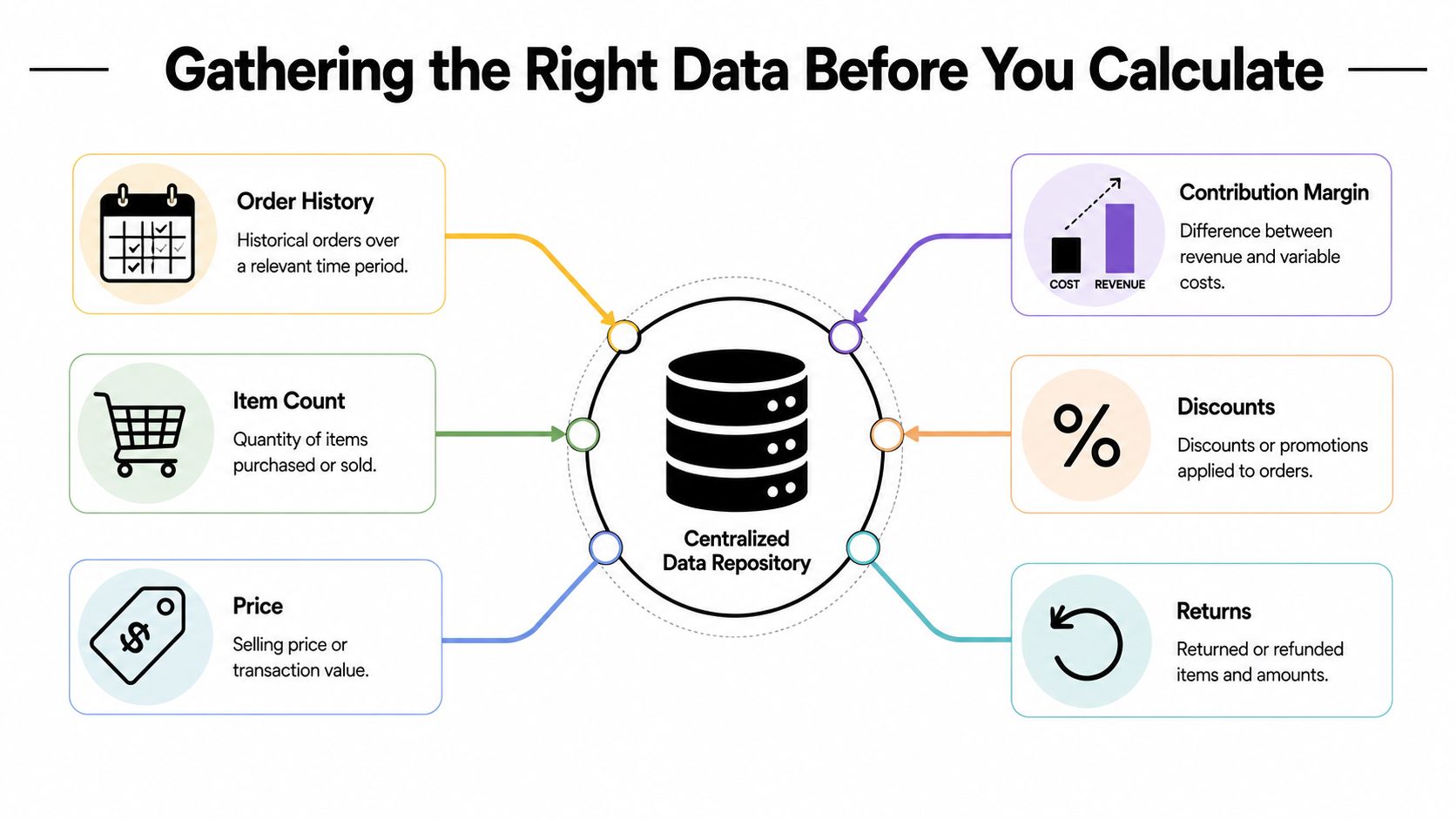
A CLV model breaks the second the inputs are sloppy. Revenue history alone won't cut it, because you need to know what customers bought, what those orders contributed, and what got returned or discounted out of the basket. INWT's minimum data list is straightforward, order history plus item counts, prices, contribution margins, discounts, and return information. INWT CLV white paper
Build the spreadsheet around the business, not the other way around
Start with one row per customer and add a few columns that make the future easier to calculate.
- Order history: Date of first order, latest order, and repeat order count.
- Item count: Units bought per order, which helps spot low-ticket high-frequency customers.
- Price: Gross revenue by order, before you mistake volume for value.
- Contribution margin: The money left after direct costs, which is the part finance cares about.
- Discounts: Needed to avoid overrating bargain-driven buyers.
- Returns: Critical for ecommerce, because returned sales inflate CLV if you ignore them.
A practical layout also needs customer cohort, repeat-purchase window, and churn flag. Those fields let you sort buyers into comparable groups instead of averaging everyone together and calling it insight.
Good data hygiene beats clever modeling. If your customer file is full of stale records, missing margin data, or blended cohorts, your CLV number will feel precise while still being wrong.
Keep the input chain connected
If you're also fixing paid media attribution, the tracking layer matters. A clean CLV spreadsheet only gets better when conversion data is consistent, so it's worth checking your setup against a proper Google Ads conversion tracking workflow.
Turning CLV Into KPIs You Can Act On
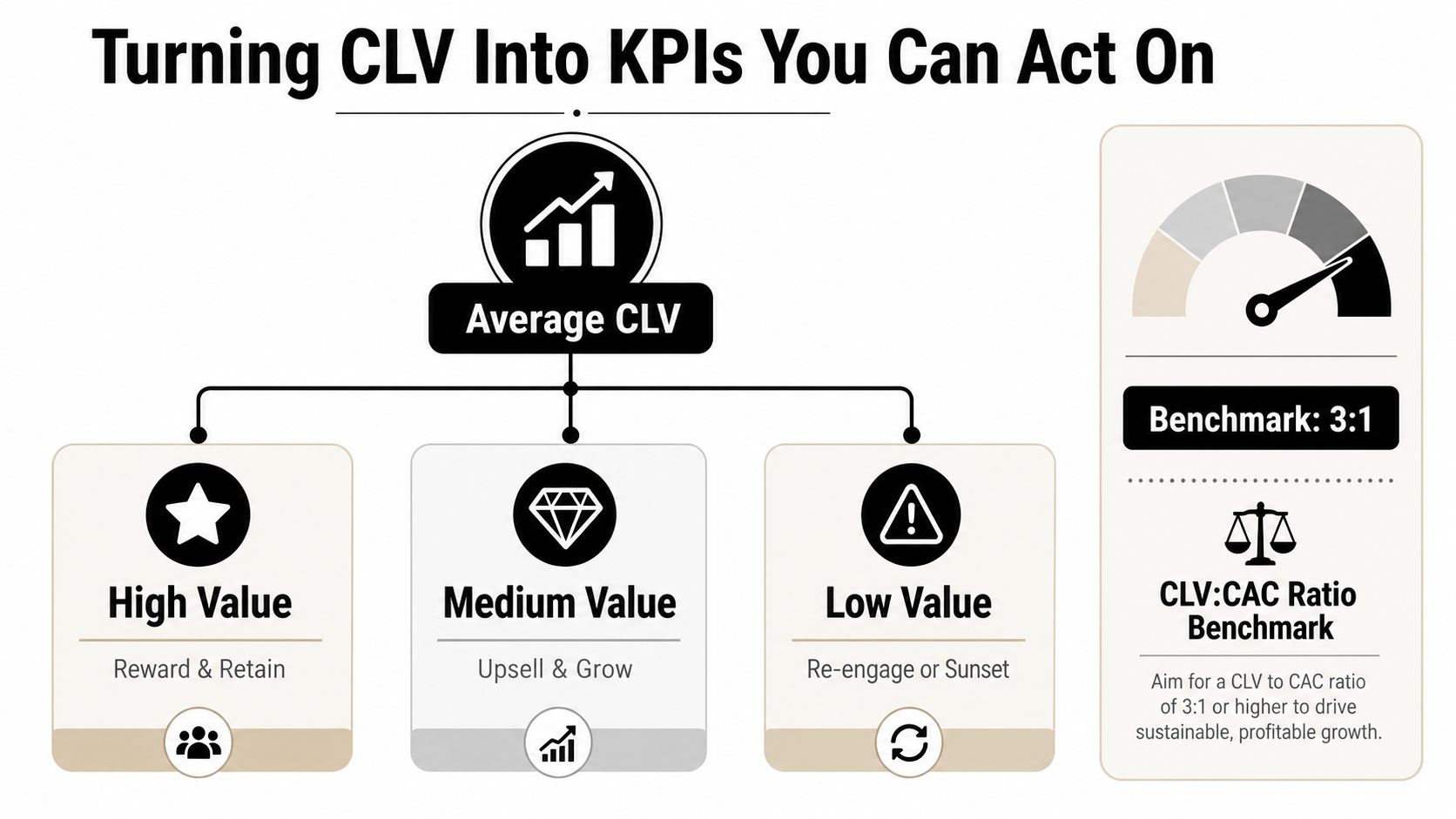
A CLV figure sitting in a report does nothing by itself. The value comes from the decisions it changes. In budget reviews, I use CLV to split customers into groups that deserve different levels of bid pressure, retention spend, and exclusion.
Use tiers, not averages
High-value customers deserve retention and expansion work. Medium-value customers need nudges that increase frequency or basket size. Low-value customers often need re-engagement, tighter acquisition filters, or a deliberate choice to stop spending on them.
The line that matters most is the CLV:CAC ratio. A healthy benchmark is 3:1, meaning the lifetime value of a customer should be about three times the cost of acquiring that customer. If you're below 1:1, acquisition is burning cash instead of building value. If you want a clean way to sanity-check that math against spend, this ROAS formula guide helps connect the value side to the return side.
The KPIs that deserve dashboard space
Repeat purchase rate shows whether the first order is setting up a second sale or just looking good in a one-off report.
Revenue per cohort tells you whether newer groups are improving or only appearing healthy because the volume is high.
Loyalty program lift matters too, because loyalty members can show stronger CLV than non-members, which is one reason membership mechanics deserve a real business case. For teams evaluating software support for these programs, BonusQR loyalty card software is a useful example of how digital loyalty mechanics can be operationalized without building everything from scratch.
A lot of teams still do not know their own CLV with confidence. That is partly a measurement problem, but it is also a prioritization problem, because teams that cannot measure lifetime value cleanly usually overinvest in short-term conversion volume and miss the customers worth protecting.
Practical Ways to Increase CLV
The fastest way to raise CLV is usually not a bigger acquisition budget. It is keeping the right customers longer and getting them to buy again without training them to wait for a coupon. Retention, upsell, and pricing work usually beat raw prospecting on both cost and effort.
What tends to move the number most
Retention programs come first because they protect the value you already paid to acquire. Upsell and cross-sell flows come next because they raise the value of existing demand without starting a new customer relationship from scratch. Pricing and packaging matter after that, since even small structural changes can improve long-term value without adding media spend.
A loyalty program is often the cleanest lever when repeat behavior is already present. As noted earlier, loyalty members can show meaningfully stronger CLV than non-members, which is why membership mechanics deserve a real business case instead of a generic brand polish. Customer lifetime value statistics and benchmarks
For teams evaluating software support for these programs, BonusQR loyalty card software is a useful example of how digital loyalty mechanics can be put into practice without building everything from scratch.
Don't ignore hidden value
Salesforce's CLV guidance points to something many marketers leave out, customer value is not just revenue. Referrals, product feedback, and implementation effort can all change the economics of a customer relationship, especially in service-heavy or B2B models. Salesforce on customer lifetime value
That matters because a customer who buys modestly but sends qualified referrals may be worth more than a higher-spend account that creates friction at every touchpoint. If you only measure purchase value, you keep funding the wrong retention plays.
My bias in budget reviews is simple. If a retention lever can lift repeat behavior, it usually deserves a look before another prospecting push gets approved.
Using CLV to Optimize Google Ads and PPC Campaigns
CLV stops being a finance concept and starts changing actual spend. If high-value customers behave differently from low-value customers, then your Google Ads account should treat them differently too. Otherwise, you're bidding the same way on traffic that won't behave the same way after the click.
Where CLV changes PPC decisions
Bid harder for high-LTV audiences. Customer Match lists, remarketing pools, and past purchasers with strong lifetime value deserve more aggressive treatment than generic prospecting. If the value signal is stronger, the platform has a better reason to spend into those auctions.
Suppress weak search intent. Low-LTV terms aren't always bad because they convert slowly. Sometimes they're bad because they attract bargain hunters, one-and-done buyers, or support-heavy customers who never pay back the acquisition cost. Negative keywords are a blunt but useful way to stop repeating that mistake.
Adjust targets by tier. A single campaign-wide target ROAS assumes all revenue is equal. It isn't. High-LTV segments can justify different thresholds than low-LTV traffic, especially once you've got enough conversion history to separate them cleanly.
If you want a practical framework for doing that, this is also where value-based bidding becomes relevant. The point isn't to inflate bids everywhere, it's to teach the platform what real quality looks like.
Make the bidding algorithm learn from lifetime outcomes
Google Ads can only optimize around the values you pass back to it. If it sees first-purchase revenue, it'll optimize for first-purchase revenue. If it sees better downstream value, it has a shot at learning what the better customer looks like.
That's why offline conversion values matter. Pass back post-sale data where you can, then compare campaign performance by customer tier rather than by headline CPA alone. The result is less guesswork and fewer budget meetings built around vanity efficiency.
A tight 30-day test plan usually starts with three moves, bid adjustments for known high-LTV audiences, negative keyword cleanup for low-value queries, and value-based conversion imports so the account stops optimizing to the wrong finish line.
Common CLV Mistakes and a Quarterly Review Framework
Most CLV work does not fail because the formula is too hard. It fails because teams treat one number as permanent, then keep making Google Ads and budget decisions after customer behavior has already shifted. That is how accounts end up bidding hard on traffic that looks efficient on paper, while the actual payback never shows up.
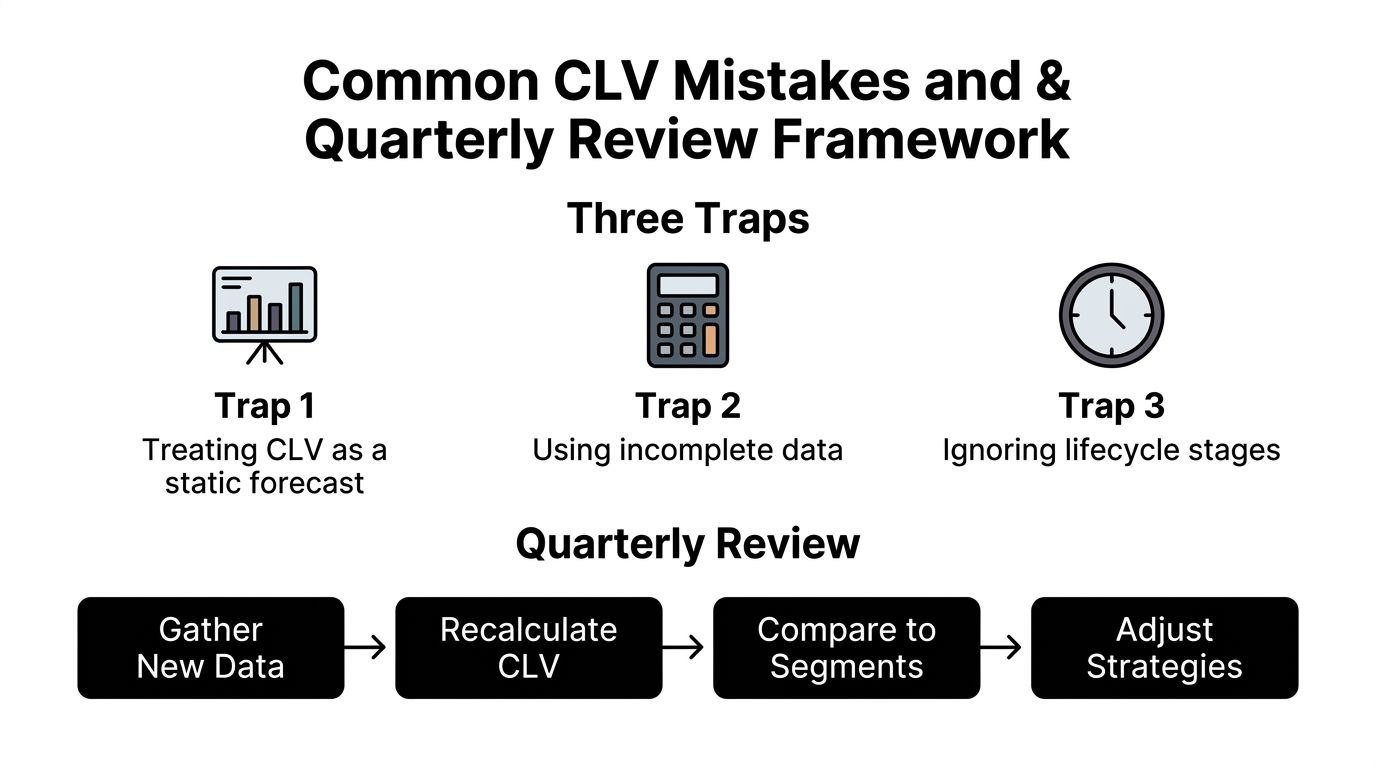
Three traps that keep showing up
The first trap is treating CLV as a fixed forecast instead of a lifecycle model. CLV changes as customers move through onboarding, repeat purchase, retention, and reactivation, so the number you use for audience bids or segment targets has to reflect the stage you are buying into.
The second trap is using incomplete data, which sends you straight back to the revenue-only mistake. If you ignore margin, discounts, refunds, or support load, the CLV number can make weak traffic look stronger than it is. The third trap is running experiments without causal controls, then giving credit to the wrong campaign when the result moves. That is how teams keep funding ads, audiences, or offers that seemed to help but were not responsible for the lift.
A simple quarterly review rhythm
- Gather new data: Pull the latest orders, margin updates, discounts, returns, and any post-sale signals that changed customer value.
- Recalculate CLV: Refresh the model with current behavior, not last quarter's assumptions.
- Compare to segments: Check whether high, medium, and low tiers still behave the way you expect them to.
- Adjust strategies: Change bids, retention actions, audience exclusions, or reactivation offers based on the new reading.
The point of the review is to keep the spreadsheet honest, then use it to make sharper budget calls. If a segment's CLV has softened, the bid cap should usually soften with it. If a high-value cohort keeps converting profitably, that is the group that deserves more room.
A practical warning from BCG on CLV limitations and tactical optimization, CLV is most useful when teams avoid treating it as a single score for every decision. In PPC, that means using it to separate bid strategy, audience targeting, and negative keyword cleanup, instead of letting one blended metric drive the whole account.
Keywordme helps PPC teams clean up search terms, build smarter negative keyword lists, and turn value signals into better Google Ads decisions without the usual spreadsheet drag. If you are trying to make your budget follow customer lifetime value instead of shallow CPA wins, visit Keywordme and see how much faster your campaign cleanup can get.
.svg)