
Mastering Cross Channel Attribution for True ROI
Mastering Cross Channel Attribution for True ROI


Let's get one thing straight: Cross-channel attribution is simply the art of figuring out which marketing channels actually work together to land a sale. It’s about moving past the outdated idea of giving 100% of the credit to the very last ad someone clicked. Instead, we're looking at the whole customer journey—from the first blog post they stumbled upon to the final retargeting ad that finally got them to convert.
Why Your Last-Click Data Is Lying to You
Think about a soccer game. The striker who kicks the ball into the net gets all the glory, right? Their name flashes on the scoreboard, the crowd chants their name. But what about the midfielder who threaded a perfect pass through the defense? Or the defender who won the ball back and started the entire play?
If you only gave credit to the goal-scorer, you'd have a ridiculously warped view of how the team won. You'd probably end up benching the very players who set up the winning moments.
That’s exactly what's happening when you rely solely on a last-click attribution model. Sure, it’s simple and easy to track, but it's also dangerously misleading. This model hands all the credit for a conversion to the final touchpoint a customer had before they pulled out their credit card.
The Incomplete Picture of Last-Click
When you're stuck in a last-click world, your Google Ads reports might scream that one search campaign is an absolute rockstar, while your efforts on Facebook look like you're just burning cash.
But what if that "rockstar" search ad was just the final, logical step for a customer who was already warmed up by:
- An awesome video they watched on Facebook last week.
- A genuinely helpful blog post they found through an organic search two weeks ago.
- An email newsletter that kept your brand from being forgotten.
Ignoring these earlier touchpoints is just like ignoring the assists in our soccer game. You inevitably end up overvaluing your bottom-of-the-funnel channels (like brand search) while killing the budget for the top- and mid-funnel activities that build awareness and actually nurture people toward that final click.
This tunnel vision leads to terrible budget decisions. You pour money into what looks like it's working (the final click) and starve the very channels that are creating real demand in the first place.
The Real Cost of Misattribution
The damage goes way beyond just a skewed budget. When you lean on last-click data, you're making major strategic calls based on a fraction of the story. You have no real insight into the customer's path or how your marketing channels are supposed to work together.
You might not see how a simple brand impression vs. a click on a display ad actually plants a seed that leads to a high-value search conversion days later. This blindness keeps you from seeing the complete picture, and frankly, it puts a ceiling on your growth.
That's why embracing cross-channel attribution isn't just a "nice-to-have" anymore; it's essential. It’s about finally acknowledging that every touchpoint plays a part and giving credit where credit is truly due.
Alright, you've realized that last-click is giving you a skewed picture of what’s actually working. Good. That’s the first big step. Now, let’s find a better map.
This is where attribution models come into play. Think of them as different lenses you can look through to see the same customer journey. Each lens highlights a different part of the story, and the trick is picking the right one for what you’re trying to achieve.
There's no single "perfect" model that works for everyone. The best one for you depends entirely on your business goals. A model that's great for a big brand awareness campaign is probably the wrong choice for a team laser-focused on hitting quarterly sales targets.
First, the Simple Stuff: Single-Touchpoint Models
The most basic models give 100% of the credit for a conversion to a single moment in time. They're easy to wrap your head around, but just like last-click, they only tell a fraction of the story.
- Last-Click Attribution: We’ve talked about this one. All credit goes to the final touchpoint. It’s useful if you absolutely need to know what closes the deal, but it ignores every single thing that brought the customer to that final click.
- First-Click Attribution: This is the polar opposite. It gives all the credit to the very first channel a customer ever engaged with. If your main goal is to fill the top of your funnel and measure what’s bringing new people into your world, this is a solid choice.
This chart really boils down the fundamental choice you have to make: do you want to credit one single moment, or do you need to understand the entire journey?
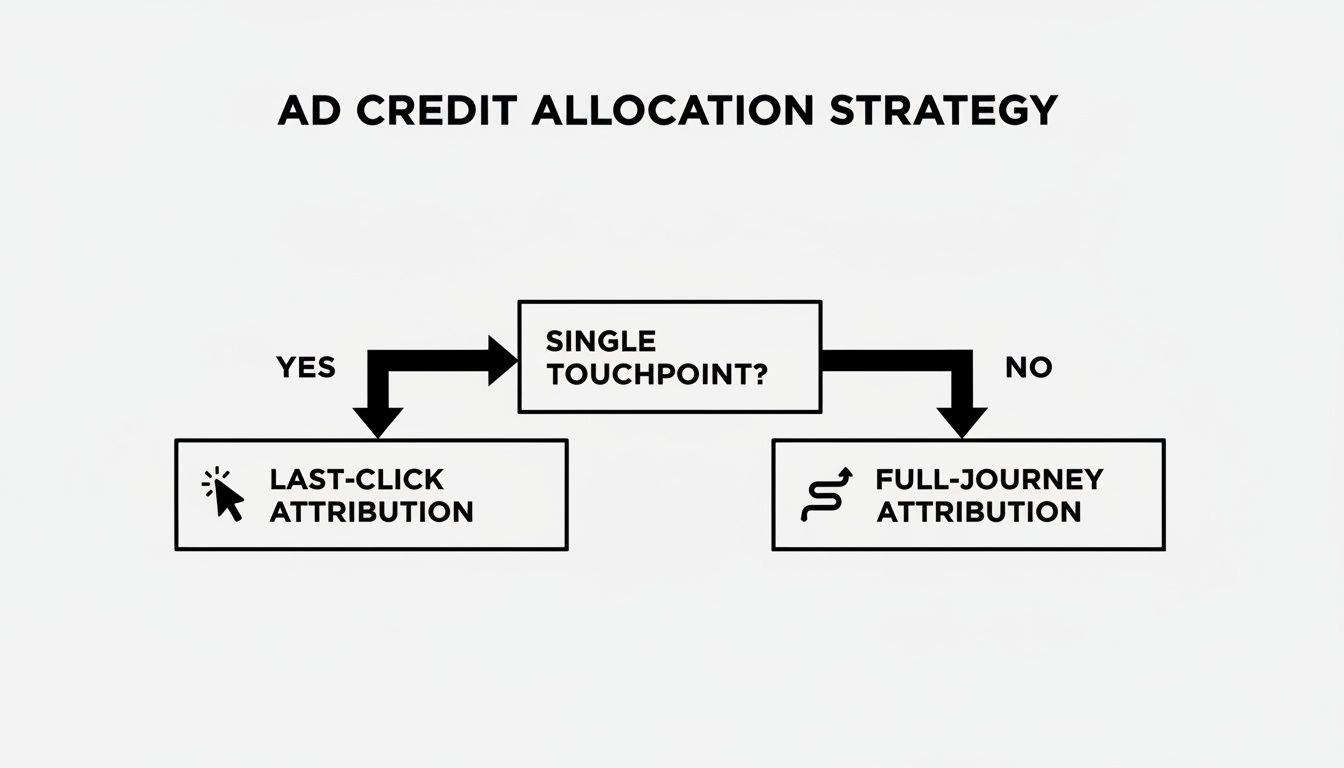
As you can see, last-click is all about that final action. But to really get what's going on, you have to look at the whole messy, complex path that led a customer to you.
Getting Smarter: The Multi-Touch Models
This is where true cross-channel attribution starts to get interesting. Instead of crowning a single winner, multi-touch models spread the credit across several interactions. This gives you a much more balanced and realistic view of what’s driving results.
And trust me, this is where the industry is heading. The global market for Marketing Attribution Software was valued at a whopping USD 4.74 billion in 2024 and is on track to more than double to USD 10.10 billion by 2030. Even more telling, the multi-source attribution segment—the kind that uses AI to weigh touchpoints—already commands over 48% of the market. It’s a clear signal that the days of simple models are numbered.
To help you navigate this, here's a quick cheat sheet comparing the most common models.
Attribution Model Comparison Cheat Sheet
This table should give you a good starting point for conversations with your team about which model makes the most sense for your specific campaigns.
Key Takeaway: Multi-touch models are how you finally prove the synergy between your channels. They show how that "fluffy" social media campaign actually teed up a bunch of conversions for your "hard-hitting" paid search ads.
The Gold Standard: Data-Driven Attribution
If you have the data for it, data-driven attribution is the holy grail. Instead of following a pre-set rule (like "give 40% to the first click"), this model uses machine learning to sift through all your conversion paths. It compares the journeys of people who converted against those who didn't and figures out which touchpoints actually moved the needle.
What’s so powerful about this is that the model is custom-built for your business. It might learn that for your audience, an email click followed by a YouTube ad view is an incredibly effective combo that deserves a ton of credit. The more data you feed it, the smarter it gets, giving you a living, breathing map of your marketing performance.
Of course, knowing which channels get credit is only half the battle. You have to connect those insights to your bidding strategy. For a deeper dive on that, check out our guide on Value-Based Bidding to see how it all comes together.
2. Building a Rock-Solid Data Foundation
If your attribution model is the brain, then clean, reliable data is the lifeblood that keeps it alive. You can have the most sophisticated data-driven model in the world, but if you’re feeding it garbage, you’re going to get garbage insights. This is where the less glamorous, technical work becomes absolutely critical.
Think of it like building a house. You wouldn't start framing walls before pouring a solid concrete foundation, right? Trying to do cross-channel attribution without a solid data structure is just as risky—the whole thing will eventually come crashing down.
The Tools of the Trade
Your journey to clean data starts with getting your tracking centralized and standardized. This means it’s time to stop manually pasting dozens of different tracking scripts all over your website. Your new best friend here is a tag management system.
A tool like Google Tag Manager (GTM) acts as a central hub for all your marketing and analytics tags—your Google Analytics tag, Meta Pixel, you name it. It lets you manage everything from one place, which ensures consistency and seriously cuts down on the chance of human error.

This centralized dashboard is your command center. It's how you make sure every user interaction is captured correctly, which is the absolute first step toward getting attribution right.
But just having the tools isn't enough. You need a system. That's where UTM parameters become non-negotiable.
Your Data Integrity Checklist
UTM parameters are those little tags you add to a URL to tell your analytics platform exactly where a user came from. Without them, you’re flying blind. To keep your data clean, every single campaign you run needs a consistent UTM strategy.
Your cross-channel attribution model is only as smart as the data it’s analyzing. Inconsistent or missing UTMs are the number one killer of accurate reporting and the main reason ad spend gets wasted.
Here’s a quick checklist to keep your data clean and ready for analysis:
- Standardize Naming Conventions: Decide on a single format for
utm_source,utm_medium, andutm_campaignand stick to it religiously. Is it "facebook" or "Facebook"? "cpc" or "paid-search"? These tiny differences create separate, fragmented line items in your reports and fracture your data. - Use a UTM Builder: Don’t let your team create them from scratch every time. Use a shared spreadsheet or a dedicated tool to enforce the rules. This simple step prevents typos and keeps everyone on the same page.
- Tag Every Single URL: This means everything—social media posts, email links, QR codes, affiliate links. If it drives traffic, it needs a tag. This kind of diligence is what makes effective Google Ads conversion tracking possible.
For an even clearer picture, you might also want to pull in data from other sources. For instance, using competitor price tracking tools can give you valuable market context that helps explain why certain campaigns are performing better than others.
Ultimately, building this foundation takes discipline. But once you have these practices locked in, you can finally apply an attribution model and actually trust the story it tells you.
Finding Attribution Insights in Your Favorite Platforms
Okay, you've done the foundational work. Your UTMs are clean, your tags are firing, and the data pipeline is solid. Now for the fun part: actually using it. Theory is one thing, but it’s time to get our hands dirty and pull some real, actionable insights from the platforms you live in every day.
This is where the idea of cross-channel attribution stops being an abstract concept and starts being a practical tool. We're going beyond talking about conversion paths and are now going to pinpoint the exact reports that show you the messy, zigzagging journeys your customers actually take.
Let's dive in.
Uncovering Paths in Google Analytics 4
Thankfully, Google Analytics 4 (GA4) puts attribution front and center, a welcome change from its last-click-obsessed predecessor. The trick is just knowing where to look.
Your home base for this is the Advertising section in the left-hand navigation. Once you're there, two reports are absolute goldmines:
- Model Comparison: This is your "what if" machine. It lets you see, side-by-side, how conversion credit gets reassigned when you switch from a basic Last Click model to something more intelligent, like the AI-powered Data-Driven model. It’s a fantastic way to visually grasp how much credit your early, awareness-building channels have been missing out on.
- Conversion Paths: Ever wonder what the most common journey looks like? This report lays it out for you. You might find that organic search is the handshake, social media is the first date, and a branded paid search ad is what finally closes the deal.
Here’s a snapshot of what you'll find in the GA4 advertising workspace.
This view gives you a much richer story of how different channels work together over time—a story that a simple last-click report could never tell.
Attribution Within Google Ads
While GA4 provides the big-picture view, Google Ads has its own powerful attribution reporting built right in, zeroing in on your ad performance. You can find it by navigating to Tools and Settings > Measurement > Attribution.
Here, you can actually change the attribution model for your conversion actions. Applying a model like Time Decay or Data-Driven directly influences how conversions are counted in your campaign tables. This is huge, because it feeds richer, more accurate data into your smart bidding strategies, helping you align your budget with how customers really behave.
How Meta Handles Attribution
Meta (think Facebook and Instagram) is its own little world. It’s fantastic at tracking a user’s journey across its own apps, but connecting that activity to what’s happening on Google Search or your blog can be a real headache.
Meta's default setting is usually a 7-day click or 1-day view model. In plain English, it takes credit for a sale if someone clicked your ad in the last week or just saw it in the last 24 hours before converting. This generous window often means both Meta and Google claim the same conversion, which is one of the classic challenges in true cross-channel attribution.
The goal isn't just to pull reports from each platform; it's to understand their built-in biases. Every platform is designed to make itself look good. Your job is to use a more neutral referee—like GA4 or a dedicated third-party tool—as your single source of truth.
Stitching It All Together with Your CRM
For any business with a considered purchase or a long sales cycle, your CRM is the ultimate arbiter of truth. By piping your marketing data into your CRM, you can finally connect all those clicks and impressions to what really matters: closed deals.
This process, sometimes called "data stitching," creates a complete customer story that no single ad platform can offer. It answers the million-dollar questions, like, "Which campaigns brought in the leads that our sales team actually closed?" This is peak attribution, tying marketing spend directly to revenue. It’s no surprise that the global Cross-Channel Advertisement Software market is projected to hit a staggering USD 10,200 million by 2025. You can read the full research on this market's growth to see just how critical these integrated solutions are becoming.
Common Attribution Pitfalls and How to Sidestep Them
Diving into cross-channel attribution feels like a massive step forward, but the path is full of potential traps. Even the smartest teams can make mistakes that warp their data and lead to some seriously bad decisions. Let's talk about the most common blunders I've seen and, more importantly, how you can avoid them.
One of the biggest mistakes is getting stuck in a digital-only mindset. In a world dominated by screens, it’s all too easy to give all the credit to online channels like search ads and social media campaigns. But what about all the real-world stuff? A customer might tune into a webinar, drive past a billboard, or hear a podcast ad—all powerful touchpoints that often get left out of the picture simply because they're harder to track.
When you ignore these offline signals, you create a massive blind spot. You end up undervaluing the channels that build real brand loyalty long before someone ever clicks on an ad.
Overcoming Digital Bias and Pesky Data Gaps
This digital bias is a huge problem. One analysis of over 1,000 ad accounts found that a whopping 68% of multi-touch attribution models gave digital channels more than 30% too much credit. This led to budgets being poured into last-click search ads while high-impact channels like email (which actually had a 261% ROI) and webinars (213% ROI) were starved of funds. You can read more about these attribution reporting findings to get a sense of just how deep this problem runs.
So how do you fix this? You have to bridge the gap between your online and offline data. Here are a few practical ways to get started:
- Custom Promo Codes: Create unique discount codes for your offline channels (like "PODCAST20") to directly tie sales back to where they came from.
- Dedicated Landing Pages: Use simple, memorable URLs for print ads, event banners, or direct mail. Think
yourbrand.com/event. - "How Did You Hear About Us?" Surveys: It sounds old-school, but just asking customers at checkout can uncover gold. You'll be surprised what your tracking misses.
Another major headache is the constantly shifting privacy landscape. Things like Apple’s iOS updates have made pixel-based tracking way less reliable than it used to be. If you're only looking at the data inside Meta's or Google's platforms, you're getting a siloed, biased view of the world. Each platform is designed to take as much credit as it can, which leads to double-counting conversions and a very messy picture.
Think of your attribution model as a hypothesis, not a rulebook. It's something you need to constantly poke, prod, and validate against real-world results. If the data just doesn't feel right, it probably isn't.
Is Your Model Lying? Check it with Incrementality Testing
So, how do you know if your model is telling you the truth or just what you want to hear? The answer is incrementality testing. This is your strategic gut-check.
Put simply, incrementality testing means you turn off your ads in a specific, controlled area (a "holdout group") and see what happens. You then compare its performance to a similar area where the ads are still running. The difference in sales or leads between the two groups reveals the true lift your ads are providing—the conversions that wouldn't have happened without them.
For example, you could pause all your Facebook ads in California for a week but leave them running everywhere else. If sales in California dip by 10% compared to a similar state like Texas, you now have solid proof of your ads' real-world impact.
This is how you cut through the noise. It helps you measure the actual causal effect of your marketing spend, ensuring your entire attribution strategy is built on a foundation of truth, not just convenient numbers.
Turning Attribution Insights into Action with Keywordme
So, your fancy new attribution model just dropped a bombshell. It’s telling you that a specific group of long-tail keywords are absolute conversion machines, but only after a customer sees one of your social media ads first. You’ve got the insight—now what? This is that critical moment where data needs to become action, and honestly, it’s where a lot of teams get stuck.

Knowing what works is only half the battle. The other, and arguably more important, half is actually doing something with that knowledge quickly and efficiently. Think of your cross channel attribution report as the treasure map—you still need a fast ship and a good shovel to dig up the gold.
Bridging the Gap Between Insight and Execution
This is exactly where a dedicated PPC management tool becomes your secret weapon. Once you’ve figured out your most valuable conversion paths and the keywords that play a starring role, a platform like Keywordme lets you act on that intel right away, without getting lost in spreadsheet hell for hours.
Let's say your report flags keywords like "eco-friendly running shoes for marathon training" as a high-value closer for people who already watched your Instagram video ad. Perfect. You can jump straight into Keywordme to give those campaigns a serious boost.
The whole point is to close the loop between analysis and optimization, turning what you’ve learned from attribution into real, measurable ROI.
Putting Your Data to Work
A solid keyword management tool lets you translate complicated data into simple, decisive actions. Instead of manually slogging through dozens of ad groups, you can make the entire process a breeze.
Here’s how you can turn those insights into action:
- Rapid Keyword Expansion: Grab those newly discovered high-performing keywords from your report and instantly beef up your target ad groups with them.
- Precise Match Type Application: Apply exact or phrase match types to zero in on high-intent searchers who are ready to buy, just like your data showed.
- Strategic Negative Keyword Building: Did the report reveal that certain broad terms are great for a first touch but just burn cash later on? Add them to your negative keyword lists with a single click and stop wasting money.
At the end of the day, effective cross channel attribution isn't about making pretty reports that collect dust in a folder. It’s about taking the 'what' from your data and having a powerful tool to execute the 'how'—saving you hours of manual work and making sure your ad spend is laser-focused on what actually drives results.
Got Questions About Attribution? We've Got Answers.
Even when you think you've got a handle on it, cross-channel attribution can throw some curveballs. Let's dig into a few common questions that pop up once marketers start getting serious about their data.
What Is the Biggest Challenge in Cross-Channel Attribution?
Hands down, the single biggest headache is data integration and accuracy. We're all trying to piece together a customer's journey as they bounce between their phone, laptop, social media, and maybe even an in-store visit. With privacy rules getting stricter, this has only gotten harder.
You end up with a fragmented puzzle. The data is there, but it's in a dozen different places, making a single, clear view of the customer path feel almost impossible. The only way through it is with a disciplined mix of solid tagging (get religious about your UTMs!), server-side tracking, and sometimes pulling in your CRM data to finally connect all the dots.
How Often Should I Review My Attribution Model?
There isn’t a one-size-fits-all answer here, but a good rhythm is to revisit your attribution model quarterly or any time you make a big strategic shift.
For example, if you just launched a huge new channel (hello, TikTok ads) or moved a massive chunk of your budget around, that's your cue to pop the hood and re-evaluate. You have to make sure the model is still making sense in this new reality. Think of it as a quick health check every 3-6 months to keep your strategy honest.
Your attribution model isn't a "set it and forget it" tool. Treat it like a living document that needs to adapt as your marketing and your customers' habits change.
Can Small Businesses Actually Use Cross-Channel Attribution?
Absolutely. It might sound like a complex beast reserved for giant companies with bottomless budgets, but small businesses can get incredible value right out of the box with tools like Google Analytics 4.
GA4's default data-driven model is a massive upgrade from the old last-click world. For small teams, the key is to nail the fundamentals:
- Be a stickler for UTM tagging on every single campaign link. No exceptions.
- Set up your conversion goals properly in your analytics platform.
- Get comfortable with the "Conversion paths" reports to actually see how your channels are playing together.
Even this simple setup gives you a much richer story than last-click ever could, providing a real competitive advantage without needing a huge investment.
Ready to turn those attribution insights into action that actually drives ROI? Keywordme is the perfect next step. It lets you take the high-performing keywords you've just uncovered and use them to immediately optimize your Google Ads campaigns. You can expand ad groups, nail down your match types, and build out powerful negative keyword lists in minutes, not hours. Ditch the spreadsheets and start making moves with confidence. Start your free trial of Keywordme today and finally close the gap between data and results.
.svg)