
Benefits of PPC That Justify the Spend
Benefits of PPC That Justify the Spend


Google's conservative planning math puts advertiser value at about twice Google Ads spend, so a $10,000 test lines up with roughly $20,000 in value rather than $10,000 in traffic for its own sake. That's not a promise for your account. It's an anchor you can test against your own margins, close rate, and lead quality. The Benefits of PPC are measurable intent and control, but in 2025 and 2026 that control only holds when someone governs search terms and checks platform conversions against business results. If you're sitting in a budget meeting asking what a dollar buys, that's the honest starting point.
Benefits of PPC at a Glance
The Google economic impact FAQ describes a methodology developed by economist Hal Varian that estimates advertisers receive between 2 and 2.3 times their total Google Ads expenditure in value, with Google using the conservative lower bound of 2 times. That estimate comes from observed cost-per-click activity across a large sample of advertisers and assumes advertisers seek to maximize profits. So $10,000 in spend maps to about $20,000 in advertiser value under that framework. Your result can land well below or above it. Industry, targeting, conversion rate, margins, and campaign execution move the number, and a bad landing page can erase the advantage fast.
Five benefits and what proves them
| Benefit | What you actually get | Proof point |
|---|---|---|
| Intent traffic | Ads on searches that already show commercial intent, beside organic results | About 5.3 organic clicks per paid click, so PPC complements SEO |
| Measurability | Impressions, clicks, cost, and conversions you can read and change quickly | The search terms report shows the real queries behind each click |
| Targeting | Query, location, device, time, and audience context in each auction | Ad Rank uses bid plus ad quality and search context |
| Speed to market | A live test this week instead of waiting on organic rankings | Budgets and bids can move as results come in |
| ROI | A planning anchor for value versus spend | About 2 times spend in Google's conservative estimate, 2024 CTR 6.42%, 2023 CPL $53.52 |
The intent row matters because paid search doesn't have to replace your organic presence. The same Google FAQ cites users clicking organic results about 5.3 times for every paid click, rounded to a conservative 5 to 1 ratio. Think of PPC as an extra commercial slot on a page where most clicks still go unpaid. You gain another chance to reach someone who just typed what they want, while SEO keeps doing its slower work underneath.
Planning rule: Treat the 2x figure as a hypothesis for a test budget, never as a forecast you can bank.
Measurability, targeting, and speed are the practical reasons teams reach for PPC before other channels. You can see impressions, clicks, cost, and conversions this week, then change the query, location, device, or time targeting that isn't earning its keep. You don't wait months for a ranking to move before learning whether an offer lands. Keep that 2x anchor in front of you as you read on, and watch what pushes a real account toward it or away from it.
How a Pay Per Click Auction Works
Pay per click means exactly what it says. You pay when someone clicks your ad, not when it merely shows. The diagram below shows the four steps that repeat for every eligible search and partner placement.
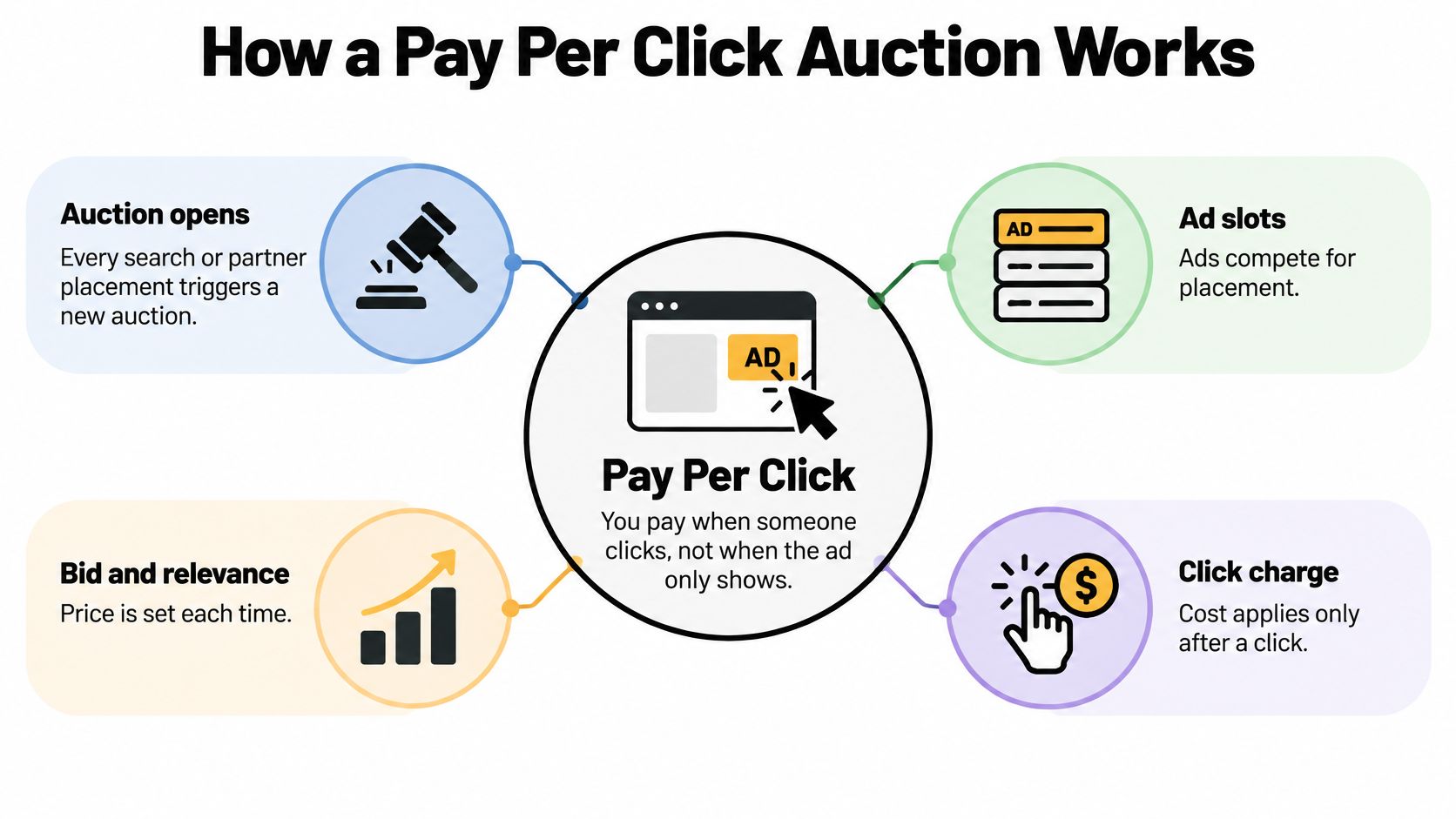
The Google Ads auction guide explains that Google runs an auction every time an eligible ad space becomes available on search results pages and across other Google partner placements, deciding which ads appear and in what order. Your maximum cost per click bid is the most you're willing to pay for a click. The friendlier part is that Google generally charges only the amount needed to retain your position and qualify for formats such as sitelinks. Your actual bill often sits under your bid, so the ceiling controls risk without becoming the automatic price.
Bid is only half the score
Ad Rank combines your bid with auction-time ad quality, landing page experience, expected impact of assets, competition, and search context such as location, device, time, and the query itself. The Google Ads Ad Rank explanation notes that Ad Rank is evaluated twice, first to decide whether an ad is eligible to show and then to set its position among eligible ads. Higher quality ads can clear a lower minimum bid to show. A highly relevant ad can therefore outrank a competitor with a higher bid and potentially pay less.
Picture a street vendor pitch. The loudest bidder doesn't always get the best corner if another vendor's sign matches exactly what the passerby just asked for. Money helps, but relevance decides whether you're even in the conversation. Before you launch, it's worth pausing to compare broad and phrase match keywords so you know how tightly your keywords will control which searches enter that auction.
Do not chase the visible badge
The 1 to 10 Quality Score in your account is a diagnostic snapshot, not the auction-time quality calculation used for each search. Treating the badge as your KPI sends you polishing a number instead of fixing a weak ad or a slow, mismatched landing page. If you want the plain-language foundation first, this guide to how pay per click works walks through the model step by step. The benefit to remember is simple. Relevance can win visibility without being the biggest spender, and profit per click is the scorecard that tells you whether winning was worth it.
Five Benefits Working Inside One Real Account
Say a retailer launches a new line of trail shoes. The five Benefits of PPC stop being abstract the moment that account starts spending, because each one shows up as a decision you can point to. The hierarchy below maps those benefits inside a single account rather than across a whole marketing plan.
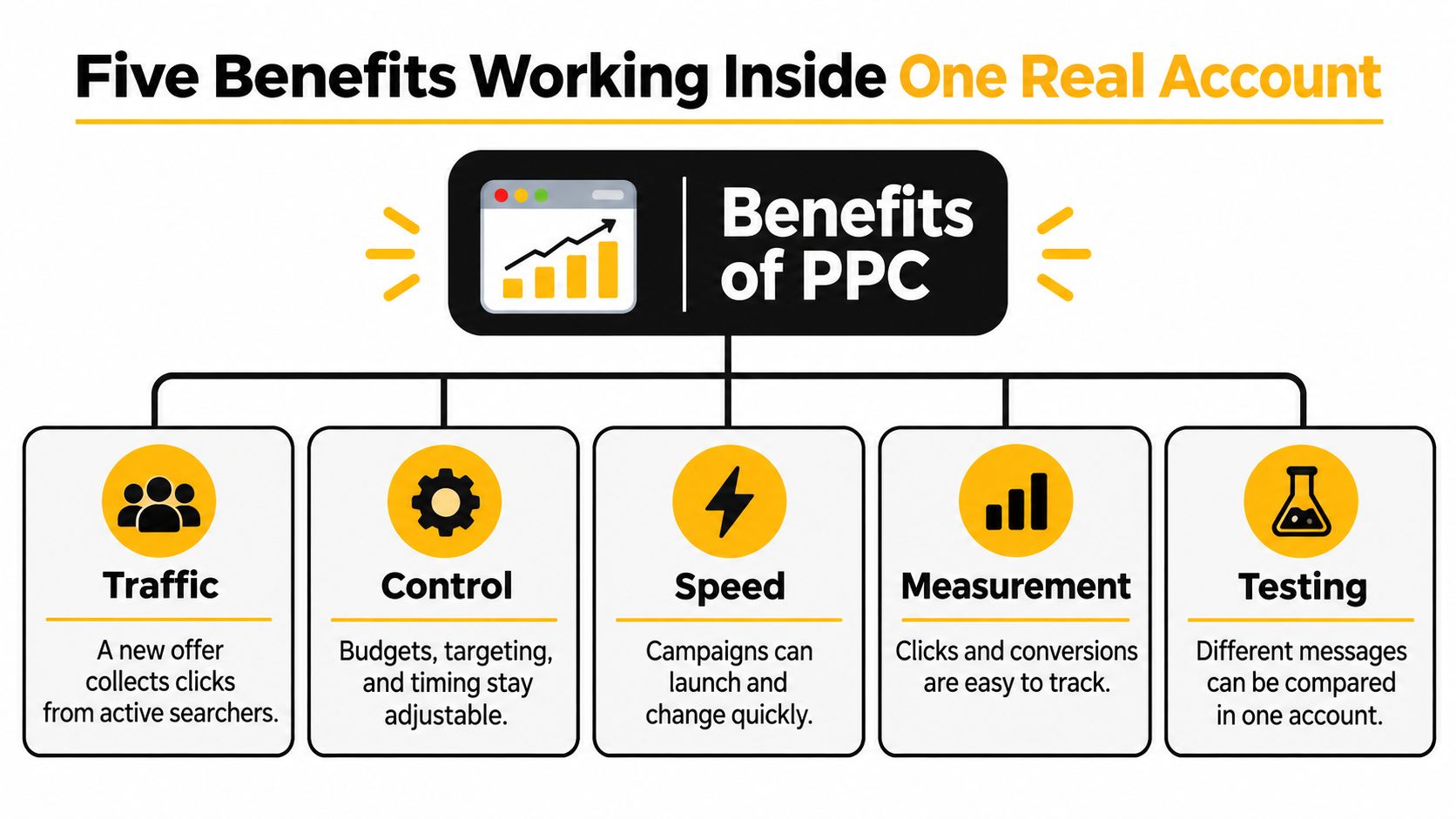
Traffic arrives already filtered by intent. The shop bids on a specific product name and separately on a vague category term like running shoes. The product name query is tighter, usually converts better, and that cheaper click is also the one worth paying for. Meanwhile, organic results keep taking the larger share of clicks on the page, which is fine. Paid search is buying the commercial slice, not the whole pie.
Targeting and speed in the same week
Targeting works when everything matches. The retailer groups keywords by intent, writes each ad group's copy around that theme, and sends clicks to a page about that exact shoe. The Google Ads quality guidance makes the same point at the system level, since Ad Rank weighs bid, auction-time ad quality, landing page experience, expected impact of assets, competition, and query context such as location, device, time, and search intent. Higher quality ads can face a lower minimum bid to show, so alignment cuts your dependence on aggressive bidding. Work on expected click through rate, ad relevance, and landing page experience rather than the visible score.
Speed is the third benefit. A budget, a bid, and a landing page can go live this week. If the category term burns cash by Thursday, you cut it by Friday and move budget into the product name. Channels that need months to produce a signal can't give you that feedback loop, and a seasonal shoe launch doesn't have months to spare.
Measurement and ROI close the loop
Measurement only helps if it's honest. Read impressions, clicks, cost, and conversions in the platform, then check them against CRM leads, qualified pipeline, or repeat purchases. A platform conversion is a signal, not cash in the till.
A cheap click that never becomes a margin-covered sale is just cheap waste.
ROI is where the five benefits settle their argument. A lower cost per click from better relevance matters only if contribution margin covers that click after conversion rate does its work. Judge the account on incremental conversions and profit per click, not the Quality Score badge. Before your next campaign, name which one of these five benefits you're buying. If you can't name it, you're not ready to fund it.
Why Automation Still Needs a Human Filter
Automation isn't a benefit on its own. It's a reach machine that will happily spend your budget on queries you'd never have chosen by hand. Campaign analytics is where that supervision happens, in the queries behind the clicks.

The Google Ads AI Max announcement covers AI Max for Search campaigns, introduced in May 2025, combining broad match and keywordless expansion with reporting on how assets perform against conversions rather than impressions. That expansion can surface demand your hand-built keyword list missed, and it can just as happily spend on demand you never wanted. The difference between the two outcomes is an audit of expanded queries, conversion quality, brand fit, and whether the marginal reach still earns a profit. If you want a wider frame for that oversight habit, this guide to supervising AI on Meta lays out the human in the loop thinking that transfers well to paid search.
The search terms loop
The Google Ads search terms report documentation explains that the report shows the actual search queries that triggered your ad when a significant number of people searched those terms, and it frames the report as a source of negative keyword ideas. The loop is simple. You spot an irrelevant query, add it as a negative keyword, and future eligible auctions stop spending on it. Say a plumbing campaign surfaces free plumbing course and plumber salary in the report. Both become negatives, while emergency plumber near me stays because it signals a buyer ready to call.
Run that loop on a schedule, not once. Every week of broadened reach pushes new queries into the report, so a fixed review cadence is what turns an expanding campaign into a controlled one.
Watch how the loop plays out in a real review session before you apply it to your own account.
Don't overcorrect. Excluding every query that hasn't converted yet chokes off useful intent, because plenty of good queries haven't had enough clicks to prove themselves. Reserve negatives for clearly junk or consistently poor terms. Privacy limits add one more caution. Browser restrictions and consent rules mean platform conversions are a clue, not proof, so compare them with first party leads or run a holdout before calling a test a win. Cleaning junk queries improves efficiency, but it doesn't by itself prove your ads caused those sales. For any automated campaign, ask one question: which control keeps the new reach profitable?
How Agencies In House Teams and Small Shops Use PPC
Search is a durable channel, not a passing format. The IAB/PwC Internet Advertising Revenue Report recorded $88.8 billion in U.S. search advertising revenue in 2023, up 5.2% year over year. Money that large sticks around because ads appear when people actively search for products, services, or solutions. The same channel, though, pays off differently depending on who's spending. If you're weighing who should run it, this comparison of in-house versus agency marketing helps frame that call.
Where PPC pays off by team
| Audience | Where it pays off | Check before you scale |
|---|---|---|
| Agency | Fast tests and client reporting across many accounts | Junk queries and margin, not just clicks |
| In-house team | Owned landing pages matched to CRM or repeat buyers | Platform conversions versus real pipeline |
| Small business | One offer or one local area on a small test budget | Cost per lead versus margin, not ad position |
| Freelance specialist | Several accounts optimized without manual busywork | Time spent on negatives versus accounts managed |
Agencies win on testing speed across portfolios. When an agency spots a week of bad queries eating a client's budget, it pauses that theme, reports the decision in margin terms, and reallocates to a cleaner test. The loss mode is just as specific. Junk queries pile up unnoticed across dozens of accounts, and the monthly report shows clicks while the client's profit leaks.
In-house teams win on ownership. They can rewrite the landing page Tuesday and pair search terms with qualified leads from the CRM by Friday, so ad clicks get matched to pipeline instead of applause metrics. They lose when every platform conversion gets treated as incremental revenue without anyone asking whether the sale would've happened anyway.
Small shops win by staying narrow. A shop that spends a few hundred dollars on one product name in one town learns quickly whether local demand exists. It loses when it chases top position with a bid the margin can't carry. Freelancers, meanwhile, win by batching negative keyword work into one Friday session across a handful of accounts, and lose when copy and paste cleanup eats the hours that make the work profitable. Pick the row that matches your team, and skip advice written for a different one.
Sample Numbers That Justify a Test Budget
Benchmarks are only useful when you run them through your own margin. The infographic below shows the format for that sanity check, with cross-industry averages you'd compare against your numbers before committing a dollar.
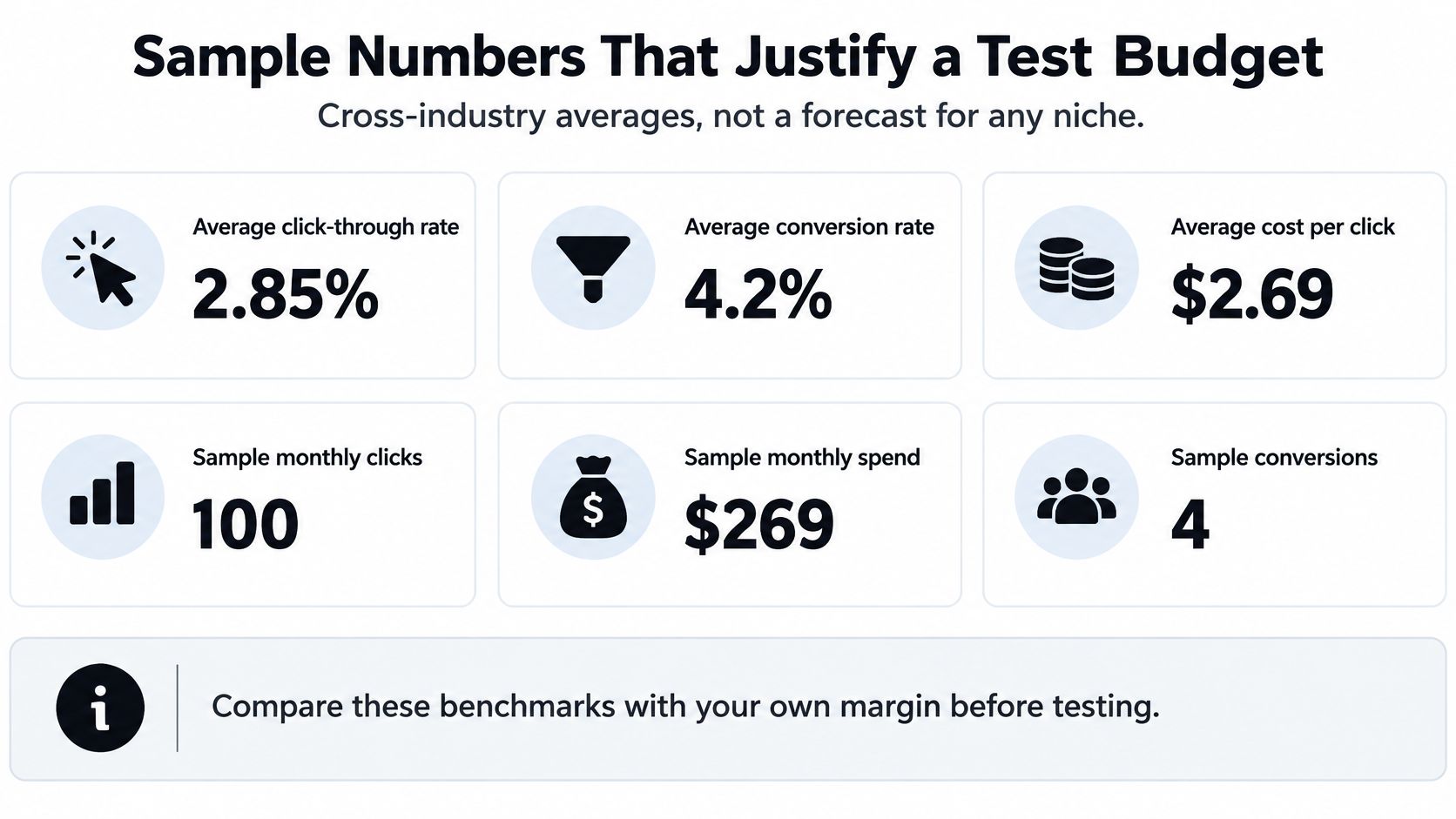
The MediaPost report on LocaliQ's WordStream benchmarks put the average cost per lead from Google Ads at $53.52 in 2023 across the industries analyzed. That's a cross-industry average, not a forecast for your niche. A plumber, a SaaS firm, and a shoe store will land in very different places. Still, it gives you a concrete rate to test a budget against, which beats guessing. If you want the companion math for returns, this return on ad spend formula shows how to work it from your own figures.
Sample monthly budgets using published averages
| Monthly spend | Leads at $53.52 | Planning value at 2x |
|---|---|---|
| $1,000 | about 19 | $2,000 |
| $5,000 | about 93 | $10,000 |
| $10,000 | about 187 | $20,000 |
Use click through rate only as a sense of scale here. The Semrush roundup of Google Ads statistics reported an average click through rate of 6.42% in 2024, about 1 in 16 impressions producing a click. It tells you how often an impression becomes a click on average. It doesn't forecast your clicks, because you still need impression volume, and volume depends on demand for your queries.
Break even check: Cost per lead divided by margin per closed lead gives the close rate you need just to cover media cost.
Say a service business keeps $200 in gross margin per closed lead. At $53.52 per lead, it needs roughly 1 in 4 leads to close, about 27%, before media cost is covered, and that's before overhead. Now picture a low margin product where a closed sale leaves $30. The same lead cost never works, no matter how tidy the account is, so the benefit there is the learning rather than the sale. Privacy rules can hide part of the journey too, so compare platform lead counts with your CRM before scaling the $5,000 row to $10,000. Swap in your own close rate and margin, and keep a row only if profit per lead stays positive.
Decide If PPC Is Worth Your Next Dollar
Spend the test budget when three things are true. People already search for the offer. Your margin can survive a lead near the $53.52 benchmark, or your own better number if you have one. And you can see conversions somewhere outside the ad platform. Those three together are what make the Benefits of PPC real instead of theoretical.
Hold off when the only plan is to outbid competitors. Hold off when nobody will read the search terms, or when a sale can't be tied back to a lead. In those cases PPC doesn't fail loudly. It just spends while you learn nothing.
Set up in this order
- One tight theme with its own ad group.
- A landing page that matches the query.
- A conversion that tracks a real lead, not a page view.
- A weekly search terms pass that turns junk queries into negatives.
That weekly pass is where tooling earns its place. We built Keywordme to work inside Google Ads for exactly this job, and the Pro plan costs $12 per seat per month and includes one-click negative keyword list building, instant keyword match type configuration, negative and positive keyword management, search term-based campaign expansion, help center access, and chat support. Signing up for the free trial gives instant access to the Keywordme Chrome plugin. Judge any tool by hours saved and wasted clicks cut, never by promised returns. Pick the test budget first, then the tooling.
Ready to make that weekly search terms pass painless? Keywordme lets you turn junk queries into negative keywords and promote winning search terms into keywords without leaving your Google Ads account. Start the free trial, run it against your first test budget, and let the hours you save make the case.
