
In-House vs Agency Marketing: A Practical Guide
In-House vs Agency Marketing: A Practical Guide


Choosing between building your own marketing team or hiring an agency is one of those pivotal decisions every business faces. So, which way should you go? The honest answer is, it really depends on your company's stage, goals, and resources.
An in-house team gives you people who live and breathe your brand every single day. On the other hand, an agency provides instant access to a whole crew of specialized talent without the HR headaches.
Understanding Your Core Marketing Options
Figuring out your marketing structure isn't just about allocating a budget. It's a strategic move that defines how your brand talks, grows, and stacks up against the competition. This guide will cut through the generic pro/con lists and give you a real framework for making the right call. We'll dig into the stuff that actually matters—cost, expertise, control, and scalability—to help you build a marketing engine that drives real, sustainable growth.
Ultimately, your path depends on what you need most right now. Is it a dedicated team completely immersed in your brand? Or is it a wide range of expert skills ready to go on day one? For businesses leaning toward bringing in outside help, this guide on digital marketing outsourcing can offer some great context.

The Two Primary Models
When you boil it down, this whole debate is about how you want to access and manage marketing talent. Each path has its own set of trade-offs that will shape everything from your day-to-day workflow to your long-term financial planning.
In-House Team: This is the classic approach. You hire marketers as full-time employees. They become a true part of your company culture, 100% focused on your brand's success. This is the model to beat when deep brand knowledge and cultural fit are non-negotiable.
Marketing Agency: Here, you partner up with an external firm. You're not just getting one person; you're getting access to a team of specialists—from SEO gurus to PPC pros—who work with all sorts of clients and industries. They bring a ton of diverse experience and proven processes to the table, making this the go-to choice for getting specialized skills fast.
To see how they stack up at a glance, let's break it down.
A Quick Look At In-House vs Agency Marketing
Here’s a high-level summary of the main trade-offs you’ll be making.
This table gives you the 30,000-foot view, but the real decision lies in the details of your business. Let's explore each of these factors more deeply.
Evaluating Expertise And Specialized Skills
Let's get one thing straight: the whole "agencies have more experts" line is too simple. The real question in the in-house vs. agency marketing debate isn't about who has more experts, but what kind of expertise you're actually getting. Each path offers a completely different set of skills, and the right choice boils down to what your business really needs to hit that next growth spurt.
An in-house team develops a level of brand knowledge that’s almost impossible to replicate. They’re not just familiar with your products; they live and breathe your company culture. They know the inside jokes, the history behind that one failed campaign from three years ago, and the subtle quirks of your most loyal customers. They are the guardians of your brand's soul.

The Depth vs. Breadth Trade-Off
This is where the real difference lies. It’s all about depth versus breadth. An in-house marketer becomes a master of your universe. An agency, on the other hand, brings a mastery of different disciplines gathered from working across many universes.
Here’s a practical way to think about it: your in-house social media guru knows exactly which meme will land perfectly with your core audience. But an agency’s paid search specialist knows how to tap into audiences you never even knew were looking for you.
An agency gives you instant access to a whole team of specialists—think technical SEO wizards, programmatic ad buyers, or CRO pros—skills that are incredibly tough and expensive to hire for a single role.
Honestly, just trying to recruit a top-tier technical SEO expert can be a huge headache and a massive drain on your budget. With an agency, that expertise is on your team from day one, often for way less than one senior-level salary.
When Specialized Agency Skills Are a Game Changer
Sometimes, an agency's broad, specialized knowledge isn't just a nice perk; it's the key to unlocking growth. Because they work with so many different clients and industries, they spot patterns and opportunities that a team focused on a single brand might completely miss.
Here are a few moments when an agency’s specialized skills really save the day:
- Launching a complex paid media campaign: A solid agency PPC team has probably managed millions in ad spend. They come to the table with battle-tested bidding strategies and deep experience with advanced tools. Our guide on PPC management software for agencies shows just how sophisticated their toolkits can get.
- Navigating a major algorithm update: When Google shakes things up, an agency’s SEO team has already seen the fallout across dozens of client accounts. They can react much faster and more strategically than an in-house team seeing it for the first time.
- Jumping into a new marketing channel: Want to get into TikTok or set up advanced email automation? An agency brings a team that’s already up to speed, saving you from a long and often painful learning curve.
The Irreplaceable Value of In-House Knowledge
On the flip side, there are times when no amount of outside experience can beat the deep, ingrained knowledge of your own team. This is especially true when your brand voice and company culture are everything.
Your in-house team acts as your cultural compass. They make sure every blog post, every ad, and every tweet feels genuinely you. They’re also wired into the company's internal rhythm, ready to jump on product updates or company news in an instant.
It’s a real trade-off. A HubSpot report found that 64% of companies feel agencies give them better access to specialized, technical expertise. This really drives home the point: for deep, niche skills, agencies often hold a clear edge that’s tough to build from scratch.
Unpacking The True Cost Of Marketing
When you're trying to decide between building your own marketing team or hiring an agency, it's so easy to just compare a salary to a retainer. But that’s a rookie mistake. It’s like comparing the sticker price of a car to a monthly lease payment—you're completely missing the bigger financial picture.
Building an in-house team is loaded with hidden costs that can absolutely wreck your budget. You’ve got recruitment fees just to find the right people, which can run into thousands. Then comes the benefits, paid time off, and the never-ending cost of training to keep their skills from getting stale.
On the flip side, an agency retainer might seem like a hefty monthly bill. But what you're really getting is a whole arsenal of services, tools, and expertise bundled into one predictable cost—things that would be incredibly expensive to piece together yourself.
The Hidden Costs Of An In-house Team
Let’s get real about what it actually takes to hire internally. It's way more than just a paycheck.
First off, there's the marketing tech stack. Your team will need professional-grade tools for everything from SEO and social media to email and analytics. Subscriptions to platforms like Semrush or HubSpot can easily cost thousands every single month. An agency already pays for these enterprise-level tools and rolls that access into your fee.
Then you have the management overhead. Someone has to lead your new marketing hires, which means adding another senior salary to the payroll. And don't forget the easy-to-miss costs like office space, new laptops, and other administrative expenses.
A common mistake is underestimating the non-salary expenses. These "hidden" costs—software, training, benefits, and management—can add another 40-60% on top of an employee's base salary.
For instance, putting together a full performance marketing team in-house can set you back between $500,000 and $1,000,000 a year when you factor it all in. This is a huge reason the agency world keeps growing—they offer a much more flexible way to tackle complex marketing challenges.
To get a sense of how fast the industry is expanding, it's worth checking out some stats on the growth of digital advertising agencies.
Analyzing An Agency Retainer
Now, let's break down that agency retainer. It's a fixed monthly cost, but it represents a totally different kind of value. You're not just paying for people's time; you're buying access, efficiency, and a deep bench of expertise without the long-term baggage of being an employer.
That single fee covers a whole crew of specialists—an SEO pro, a content writer, a PPC manager, a designer, you name it—often for the same price as one or two senior in-house hires. You get a diverse set of skills on day one without the headache of recruiting and managing each person.
This model also gives you incredible financial flexibility. If a campaign isn't working, you can pivot your budget with the agency almost instantly, avoiding the painful process of restructuring an internal team.
To make this crystal clear, let's look at a side-by-side comparison of where the money really goes.
Cost Breakdown: In-House Team vs. Agency Retainer
As you can see, the "cheaper" option on paper isn't always the case once all the associated costs are tallied up.
From Sticker Price To True ROI
The real question isn't about which option costs less upfront. It’s about which one will actually make you more money. The entire conversation needs to shift from cost to return on investment (ROI).
To figure that out, you need to calculate the true cost of acquiring a customer under each model. This means looking past the obvious expenses and getting a clear view of the financial impact.
For a great walkthrough on the metrics that actually matter, check out our guide on how to calculate cost per acquisition. It’ll help you move from a simple cost comparison to a smart, ROI-driven evaluation.
Ultimately, the right financial move depends entirely on your budget, your goals, and how fast you want to grow. Once you see the full picture, you can make a strategic decision that sets you up for success.
Who's Really in Control? The Brand Integration Debate
When you get down to the brass tacks of in-house vs agency marketing, the conversation always comes back to control. But this isn't just about who gets to sign off on a new ad. It’s about how deeply your brand’s unique personality is baked into every tweet, email, and landing page.
Your in-house team lives and breathes your company culture. They’re in the meetings, they overhear the chatter in the kitchen, and they absorb your brand's voice by simply being there. This creates an almost subconscious level of brand consistency that's tough to replicate.
Living and Breathing the Brand
The magic of an in-house team is their total immersion. They can pull a developer aside for a quick question, grab coffee with the product team to really understand a new feature, or pivot a campaign on a dime after a quick chat with a sales rep. That constant, informal flow of information is a superpower for keeping marketing perfectly in sync with the rest of the business.
An agency, on the other hand, operates on a more structured rhythm. Communication is intentional. It requires crystal-clear creative briefs, scheduled calls, and a formal onboarding process to teach them all the unwritten rules and subtle quirks of your brand. Great agencies are masters of this process, but it's a different dance entirely.
The trade-off isn't about losing control; it's about shifting your focus. Instead of managing daily tasks, you're managing outcomes. With an agency, you steer the ship by setting clear goals and KPIs, not by micromanaging the crew.
Think of it like this: your in-house team is like a sibling who instinctively knows your weird sense of humor. An agency is a new friend you’re explaining the inside jokes to. They’ll catch on, but it takes a little more upfront effort.
Making an Agency Feel Like Part of the Team
A successful agency partnership all comes down to building a solid communication bridge. If you don't, you'll end up with campaigns that feel just a little... off.
Here are a few ways to keep an agency plugged in:
- Create a shared virtual workspace: A dedicated Slack channel or a project board in Asana can do wonders. It breaks down the stiff formality of email and makes it feel like you’re all in the same room.
- Give them an all-access pass: Invite your agency partners to important internal meetings, like product demos or quarterly strategy sessions. The more context they have, the better their work will be.
- Have a single point person: Designate one person on your team to be the main liaison. This avoids crossed wires and keeps communication streamlined and efficient.
These steps help your external partner feel less like a hired gun and more like a true extension of your team, which is exactly what you want for protecting your brand's integrity.
The Danger of the Echo Chamber
Now for the other side of the coin. That deep brand immersion, while a huge asset for in-house teams, can also create a massive blind spot: creative tunnel vision. When you're too close to something, you can get stuck in an echo chamber, rehashing the same old ideas.
Your team might be hesitant to rock the boat or, worse, not even realize the boat needs rocking. This is where an agency brings a fresh set of eyes. They aren't tied to your company's internal politics or shackled by the "that's how we've always done it" mindset.
Their work with dozens of other clients across different industries gives them a unique perspective. They can spot trends you might miss and connect dots you didn't even know existed. An agency is the one who will ask, "Hey, have you ever thought about doing it this way?" That one question can be all it takes to break through a creative plateau and find new paths to growth.
Achieving Scalability and Speed to Market
How fast can your marketing react when a new opportunity drops in your lap? Or scale up when growth suddenly takes off? This question really gets to the core of the scalability debate when you're weighing an in-house team against an agency. Both setups offer their own kind of agility—it just depends on whether you're running a sprint or a marathon.
Let's be real: hiring, onboarding, and training new people in-house takes time and a ton of resources. If you need to launch a massive campaign, break into a new market, or just pour fuel on the fire right now, an agency can have a full team of specialists ready to roll almost overnight. That kind of speed can be a huge competitive advantage.
The Agency Advantage for Rapid Scaling
Think of an agency as your marketing on-demand button. When a golden opportunity appears—maybe a competitor stumbles or a new social platform blows up—you don’t have time to sift through resumes. You need a team that's already geared up and ready to execute.
An agency walks in with a fully-formed machine. They have the project managers, the expensive tools, and the battle-tested workflows to get complex projects off the ground fast. This is a game-changer for a few key scenarios:
- Aggressive Growth Goals: If you just landed a round of funding and your board wants to 5x user acquisition in six months, an agency brings the immediate firepower you need.
- New Market Entry: Thinking about launching in a new country? That requires specific cultural and market knowledge you probably don’t have on staff. An agency can plug that gap from day one.
- Short-Term Campaigns: Got a massive Black Friday push or a product launch on the horizon? An agency can spin up a dedicated team for a few months and then scale back down, saving you from the headache of permanent hires.
This ability to scale with specialized talent is why so many businesses turn to agencies. In fact, an analysis by RevenueZen found that while only 19% of SaaS companies use a content agency, they see 2.3 times faster organic traffic growth than companies trying to do it all themselves. That statistic from their SaaS content marketing report really highlights the strategic edge agencies can provide when you need to grow quickly.
The In-House Edge in Daily Agility
While agencies are built for those big, fast deployments, in-house teams often have the upper hand when it comes to day-to-day nimbleness. They can pivot on a dime without having to go through formal change orders or get stuck in the confines of a project scope. An agency is usually juggling multiple clients on a set retainer, so asking for a sudden, unplanned change isn't always simple.
An in-house team’s superpower is its proximity to the business. They can hear feedback from the sales team in a morning meeting and have a new ad campaign running by the afternoon—that’s a level of responsiveness an external partner can rarely match.
Picture this: your social media manager overhears a customer service call about confusion over a new feature. They can immediately film a quick Q&A video and post it to clear things up. That kind of spontaneous, real-time marketing is where internal teams truly excel. When they're equipped with the right tools and processes, like solid marketing automation best practices, they can turn their deep brand knowledge into incredibly swift action.
Which Flexibility Matters More to You?
Ultimately, the choice comes down to what kind of flexibility your business needs right now. Do you need the ability to call in the cavalry for a major strategic push? Or do you need the everyday agility to make small, constant adjustments to your tactics? Your answer will point you toward the model that best fits your current stage of growth.
Making The Right Choice For Your Business
So, after all that, what’s the final call in the great in-house vs. agency marketing debate? The honest answer is… it depends. There's no magic bullet here. The right move is completely tied to where your business is right now and where you want to go next.
Think about a brand-new startup. They're likely running on a shoestring budget, so a full in-house team is out, and so is a pricey agency retainer. For them, a scrappy, hybrid approach—maybe leaning on freelancers for specific things like blog posts or social media management—is usually the smartest play.
Aligning Your Model With Your Business Stage
As your company evolves, your marketing needs will change right along with it. What got you off the ground as a five-person team will absolutely hold you back when you’re a 50-person company gunning for growth.
Early-Stage Startups: At this point, it’s all about being flexible and watching every dollar. A great setup is hiring one solid in-house marketing generalist and then bringing in freelancers or a small agency for a specific, one-off project, like getting your initial SEO foundation built. This keeps you agile without draining your bank account.
Growth-Stage Companies: This is where the game changes. You've hit your stride, found product-market fit, and now you need to step on the gas. An agency can be your rocket fuel. They have the people, the processes, and the tools ready to go, helping you ramp up lead gen and brand awareness immediately to capitalize on your momentum.
Large Enterprises: For big, established companies, it's all about brand consistency and deep internal alignment. A sophisticated in-house team is almost always the answer. They live and breathe the brand, ensuring every single marketing touchpoint perfectly syncs up with the company's big-picture goals and complex internal workflows.
This simple chart really nails the core decision-making pivot point.
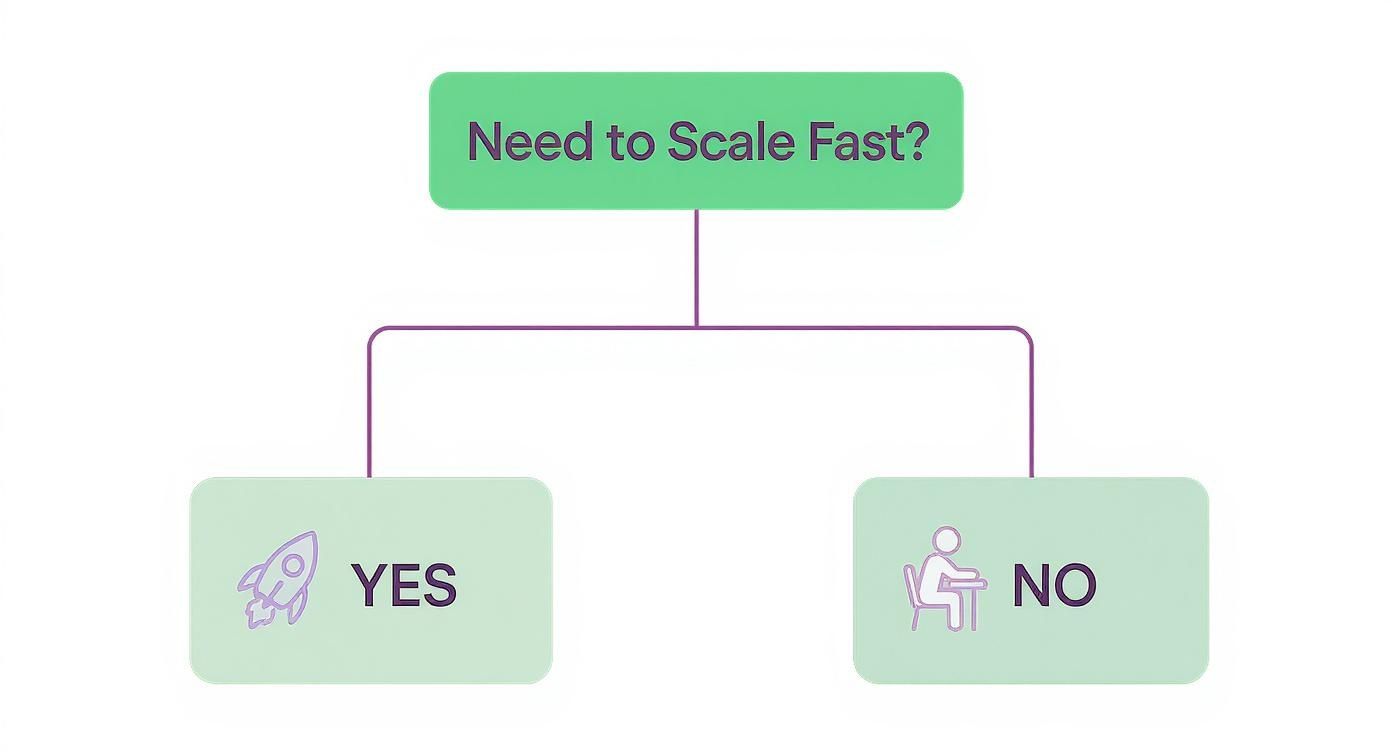
The takeaway is pretty clear: if you need to grow and you need to do it now, an agency’s plug-and-play structure is often the fastest way to get there.
The Power Of The Hybrid Model
For a huge number of businesses, the answer isn’t a stark "either/or" choice. The hybrid model is often the sweet spot, giving you the best of both worlds by blending in-house control with on-demand expertise.
In this setup, you’d have a marketing director or a small core team in-house. They own the strategy, the brand voice, and the day-to-day stuff. From there, they act as mission control, bringing in specialized agencies for the heavy lifting in technical areas.
The hybrid model lets you keep your brand's core strategy and soul in-house while tapping into elite, specialized talent for complex areas like technical SEO, paid advertising, or advanced analytics.
Knowing when to outsource a specific channel is key. If you're thinking about bringing in help for paid search, for example, it really pays to understand how to pick the right Google Ads agency partner.
This approach lets your internal leader build a custom marketing engine, plugging in expert partners exactly where they’re needed most. You get the passion and brand immersion of an in-house team combined with the raw power and scalability of an agency—a truly flexible and potent formula for growth.
Got Questions? Let's Clear Things Up
Still on the fence about whether to go in-house or hire an agency? It's a huge decision, so it’s completely normal to have a few questions bouncing around. Let's tackle some of the most common ones to help you feel confident in your choice.
Is It Better To Work In-House Or At An Agency?
Honestly, this comes down to what you want for your career and how you like to work. There’s no single "better" option.
Working in-house means you get to go deep. You live and breathe a single brand, becoming a true specialist in its mission and goals. It’s about focused, consistent growth.
On the flip side, an agency is all about variety and speed. You'll be thrown into different industries and tackle a wild range of marketing problems, often all at once. It’s a fast track to learning a massive amount in a short time. They're just two very different career paths.
What's The Biggest Downside Of An In-House Team?
If there's one common pitfall, it’s the risk of hitting a creative wall. When your team only thinks about one brand, day in and day out, it's easy to get tunnel vision. Fresh, innovative ideas can be harder to come by.
The deep focus of an in-house team is both its greatest strength and a potential weakness. Without outside perspectives, they can get stuck in an echo chamber, missing out on the cool new strategies an agency sees across dozens of industries.
This insular setup also makes it tough to find and afford super-specialized talent. Think high-level technical SEO or programmatic advertising experts—those skills are expensive and hard to hire for full-time.
Why Do Companies Ditch Their Agency And Go In-House?
This is a classic move for businesses that hit a certain size and maturity. As a company scales, having total control and a team that’s completely synced up with the brand becomes a top priority.
The main reasons for making the switch usually boil down to these:
- Total Control: They want more hands-on management of their brand's voice and daily marketing moves.
- Smarter Spending: Once the marketing budget gets big enough, paying hefty agency retainers can start to feel less efficient than building a dedicated internal team.
- Tighter Integration: Marketing needs to be woven directly into other departments, like product and sales, for seamless collaboration.
Bringing marketing in-house is less about firing an agency and more about a strategic shift. It’s a sign that a brand is maturing and ready to fully own its marketing destiny.
Ready to supercharge your Google Ads workflow? Keywordme eliminates the tedious, manual tasks of keyword management. Clean up junk terms, expand campaigns with winning keywords, and boost your ROI—all in a fraction of the time. Start your free 7-day trial today and see the difference.
.svg)