
What Is RTB Marketing? a Guide to Real-Time Bidding
What Is RTB Marketing? a Guide to Real-Time Bidding


You're probably here because RTB feels half familiar and half slippery. You've heard it in PPC meetings, seen it in display campaign docs, maybe even nodded along when someone said “programmatic,” but if you had to explain it clearly to a new teammate, things would get fuzzy fast.
That's normal. RTB sits behind a lot of the ads people see every day, yet most explanations are either too technical or too shallow to be useful. The simplest way to think about it is this: RTB is a high-speed marketplace for ad impressions, one that behaves a bit like a stock market where buyers and sellers react in real time.
If you want the short version before we go deeper, RTB helps advertisers decide whether a single ad impression is worth buying, right as a page loads. That decision happens so quickly that the user usually never notices it.
What Is RTB and Why Does It Matter
A common moment goes like this. Someone browses a pair of running shoes, leaves without buying, then opens a news site and sees an ad for athletic gear. To the user, it feels almost psychic. In reality, a fast automated process decided that ad slot was worth competing for.
That process is Real-Time Bidding, which is the RTB commonly meant in discussions of RTB marketing. It's a programmatic auction model where ad inventory is bought and sold per impression, through near-instant transactions, much like financial markets where bids are placed and the winning trade happens immediately if the bid clears, as described in Wikipedia's overview of real-time bidding.
There's one catch that trips people up. RTB can also mean “Reason-to-Believe” in brand strategy. That overlap creates real confusion, and it's one reason so many marketers walk away from RTB discussions with mixed definitions in their heads. One useful summary of that confusion appears in this RTBs in marketing presentation.
The simple analogy that makes RTB click
Think of RTB like a high-speed stock market for attention.
A publisher has something to sell: one ad impression. An advertiser has a reason to buy: reaching a specific person in a specific moment. Software evaluates that opportunity instantly, decides how much it's worth, and enters a bid if the impression matches the campaign.
If the bid wins, the ad appears. If it doesn't, another advertiser gets the slot.
That matters because digital advertising used to rely much more on bulk buying and manual deals. RTB shifted the model toward impression-level decisions. Instead of paying for a broad package and hoping the right audience is inside it, advertisers can choose whether each single opportunity is worth it.
Practical rule: If you remember only one thing, remember this. RTB is not “buying websites.” It's buying individual chances to show an ad.
That's why RTB became so central to modern display advertising. It gives advertisers more control over who they reach and when they reach them. It also gives publishers a way to monetize inventory dynamically instead of depending only on slower manual negotiations.
If you want a broader primer on programmatic mechanics before going deeper into auctions, this piece on mastering automated advertising is a helpful companion read. For a wider look at where the space is headed, Keywordme's take on digital advertising trends gives useful context around the larger ecosystem RTB sits inside.
How the RTB Auction Actually Works
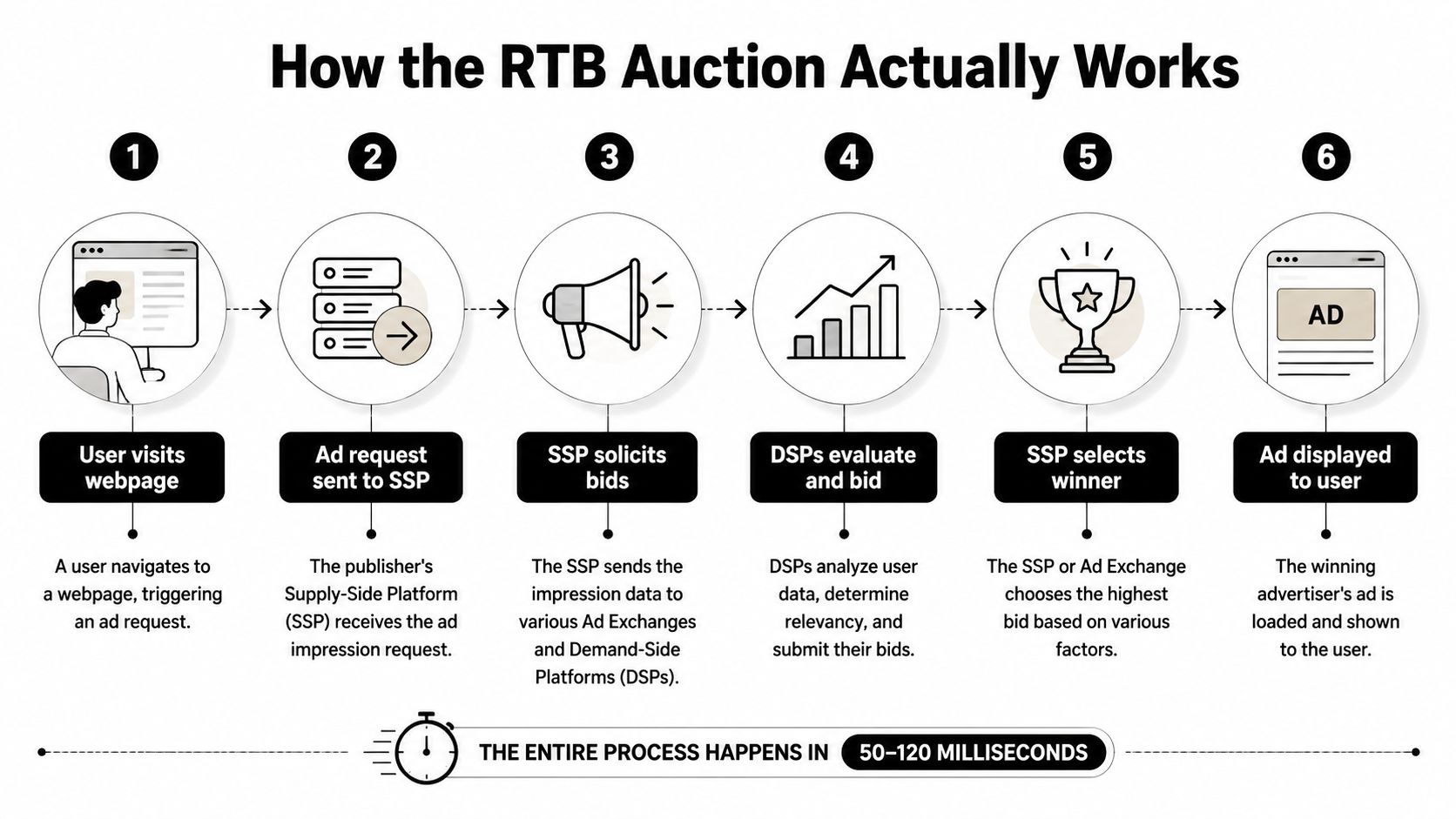
The strange part about RTB is that something this complex happens so fast. The full path from page load to ad display is typically around 100 milliseconds (0.1 seconds), according to AdButler's explanation of the RTB process.
That speed matters. If the auction drags, the page drags. Nobody wants a banner ad delaying the content they came to read.
What happens in the split second
Here's the auction in plain English.
A user opens a webpage.
The page includes ad space that can be filled programmatically.The publisher's system flags an available impression.
This impression is the thing being sold. Not a whole website package. Just that one opportunity.Information about the impression gets sent out.
The bid request can include details relevant to advertisers, such as device type, location, inventory details, and other signals used for decision-making.Advertisers evaluate the opportunity.
Their systems decide whether the impression fits the campaign. If yes, they bid. If not, they pass.A winner is selected.
The highest eligible bid usually wins the chance to serve the ad.The ad renders on the page.
All of this finishes before the user notices anything unusual.
Why the decisioning has to be so tight
RTB isn't just “an auction, but fast.” It's a system built for instant judgment. A technical explanation from Xapads on real-time bidding notes that this bid request to render cycle runs within 50 to 100 milliseconds, and that the exchange commonly relies on OpenRTB as the protocol for sharing bid request information.
That's where many newcomers get confused. They assume advertisers manually choose placements as the page loads. They don't. The software is doing the evaluation in real time, using campaign rules and available signals to decide if this one impression is worth chasing.
A simple example helps.
| Step | What the system asks |
|---|---|
| Impression appears | Is this inventory relevant to our campaign? |
| User and page signals arrive | Does this look like the kind of audience or context we want? |
| Bid logic runs | Is the impression worth our price threshold? |
| Auction ends | Did we win at a price that still makes sense? |
Most RTB mistakes start before the bid. They start when teams haven't defined what a valuable impression looks like.
What “open auction” really means
RTB is commonly described as an open auction or open marketplace, where advertisers can decide in real time whether to bid or skip based on the context and available signals, as summarized in AI Digital's write-up on real-time bidding.
That “skip” part is important. Good RTB strategy isn't just about winning auctions. It's about refusing the wrong ones.
The Key Players in the RTB Ecosystem
RTB only makes sense once you know who's doing what. A lot of beginner confusion comes from hearing acronyms like DSP and SSP tossed around as if everyone should already know them.
The cleanest way to map the ecosystem is this: buyers, sellers, and the marketplace between them.
The three main platforms
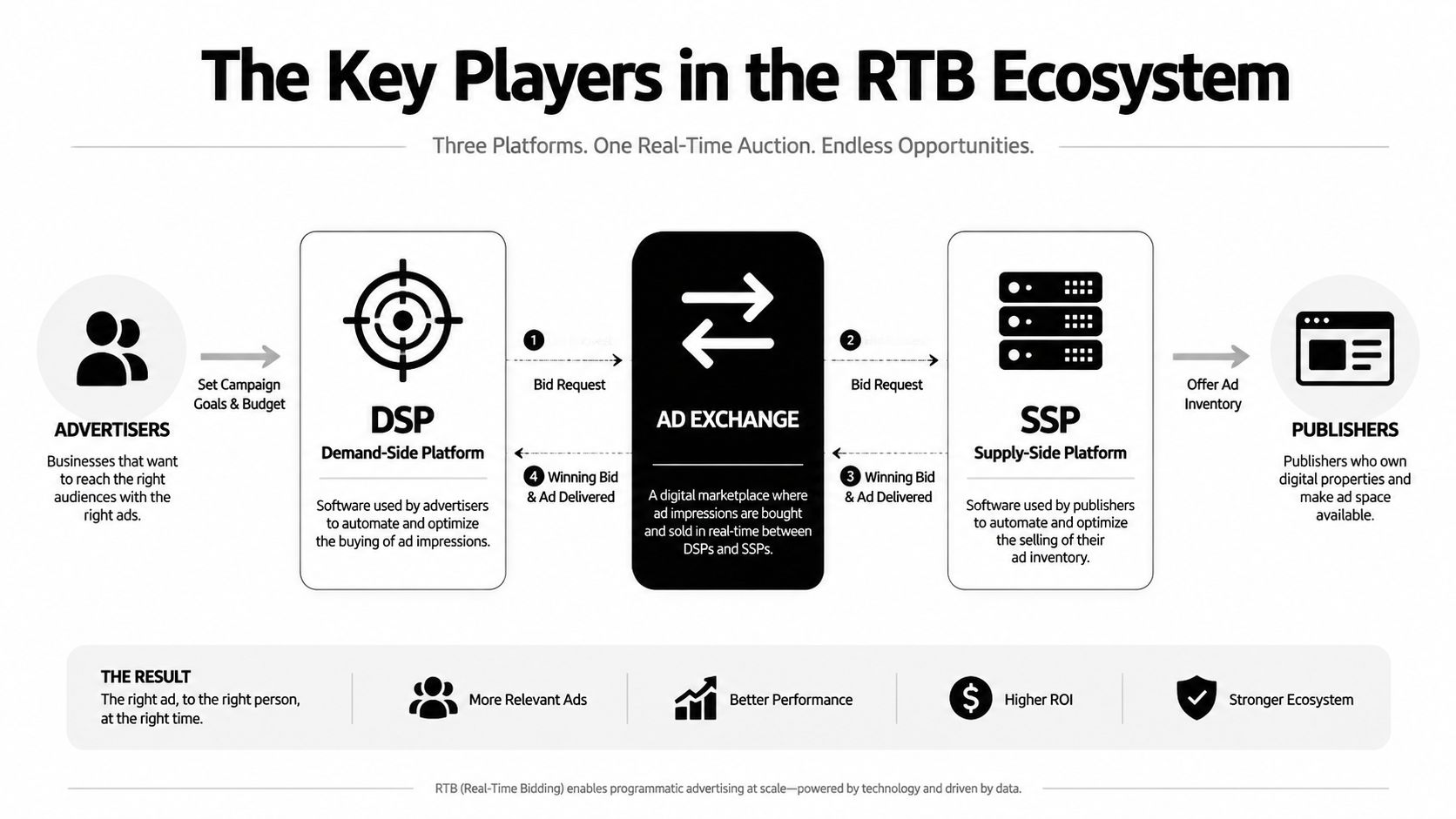
The RTB setup depends on a three-part structure connecting SSPs, Ad Exchanges, and DSPs, as outlined in SmartyAds' overview of why marketers should care about RTB.
Demand-Side Platform or DSP
This is the advertiser's buying software. It helps teams decide which impressions to bid on and how much to bid.Supply-Side Platform or SSP
This is the publisher's selling software. It helps publishers make their inventory available and manage how it's sold.Ad Exchange
This is the marketplace layer where the auction happens between buying and selling systems.
If you work in PPC, the DSP is the side that feels most familiar. It's where campaign settings, targeting logic, bidding rules, creatives, and budgets often live.
A marketplace analogy that holds up
Say a publisher runs a news site.
The publisher wants to sell ad space efficiently. The SSP helps package and expose that opportunity. The Ad Exchange creates the environment where bids can compete. The DSP represents advertisers who are looking for the right impression at the right price.
That's the whole chain.
A DSP is not the ad exchange, and an SSP is not the publisher. They're tools acting on behalf of those sides.
A quick visual can help if you prefer to see the flow in action.
Why this split exists
This division of labor isn't accidental. It keeps the market functional.
A publisher shouldn't need a direct one-to-one manual negotiation with every advertiser. An advertiser shouldn't need separate technical buying relationships for every site they want to appear on. The ecosystem scales because each platform handles a specific role.
Here's the shorthand I give new team members:
- DSPs buy
- SSPs sell
- Exchanges match demand with supply
Once that lands, RTB jargon gets a lot less intimidating.
Benefits and Limitations of RTB Marketing
RTB gets talked about like a miracle tool in some circles and a risky black box in others. Both views miss the point. It's powerful, but it's not self-driving. You get an advantage, not automatic success.
One reason marketers keep leaning into RTB is sheer market momentum. The global RTB market was estimated at US$38.4 billion in 2023 and is projected to reach US$242.2 billion by 2030, with a projected 30.1% CAGR, according to this GlobeNewswire market report on RTB growth. That doesn't mean every campaign will perform well. It does mean the model is firmly embedded in digital advertising.
Where RTB earns its keep
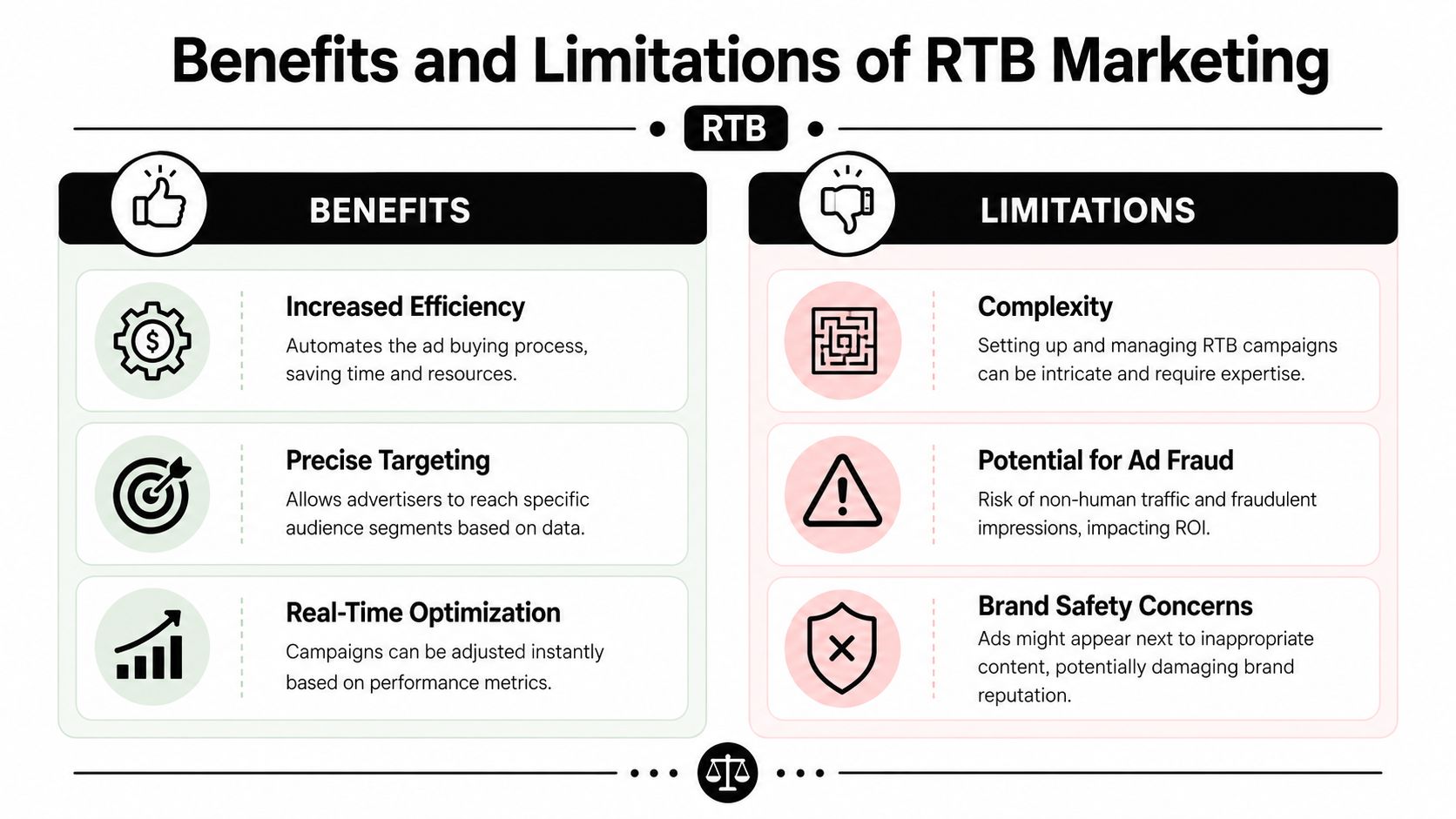
RTB is especially useful when teams need flexibility.
Better buying control
You can evaluate impressions one by one instead of committing to broad inventory upfront.Faster optimization
Teams can adjust bidding logic, audiences, and creative strategy without waiting on slow manual deal cycles.Wider inventory access
RTB opens access to a broad pool of available ad space across different publishers and environments.
Where things get messy
The hard part is that RTB introduces real operational risk.
| Benefit | Limitation |
|---|---|
| Impression-level buying | More moving parts to manage |
| Real-time optimization | More room for setup errors |
| Broad scale | More exposure to quality-control problems |
Three issues come up again and again:
- Complexity: RTB isn't difficult because the idea is hard. It's difficult because the execution has many settings, systems, exclusions, and quality checks.
- Ad fraud: Not every impression is equally trustworthy. Some inventory is low quality, and some traffic may not represent real user value.
- Brand safety: A relevant impression can still be the wrong placement if the surrounding content harms the brand.
For teams worried about invalid activity and wasted spend, Keywordme's guide to preventing click fraud is worth reading alongside any RTB plan.
The best RTB campaigns don't chase every available impression. They narrow the field and protect quality first.
That's the tradeoff. RTB gives you scale and precision, but only if your guardrails are tight.
Getting Started with Real-Time Bidding
If you're new to RTB, don't start by obsessing over bid mechanics. Start by defining what a worthwhile impression means for your business. Teams that skip that step usually end up buying a lot of activity and learning very little from it.
The more useful starting point is strategic: what do you want from RTB? Brand visibility, site visits, lead generation, retargeting support, or product-level promotion? A display campaign can't answer that for you. Your setup has to.
A sensible setup for first campaigns
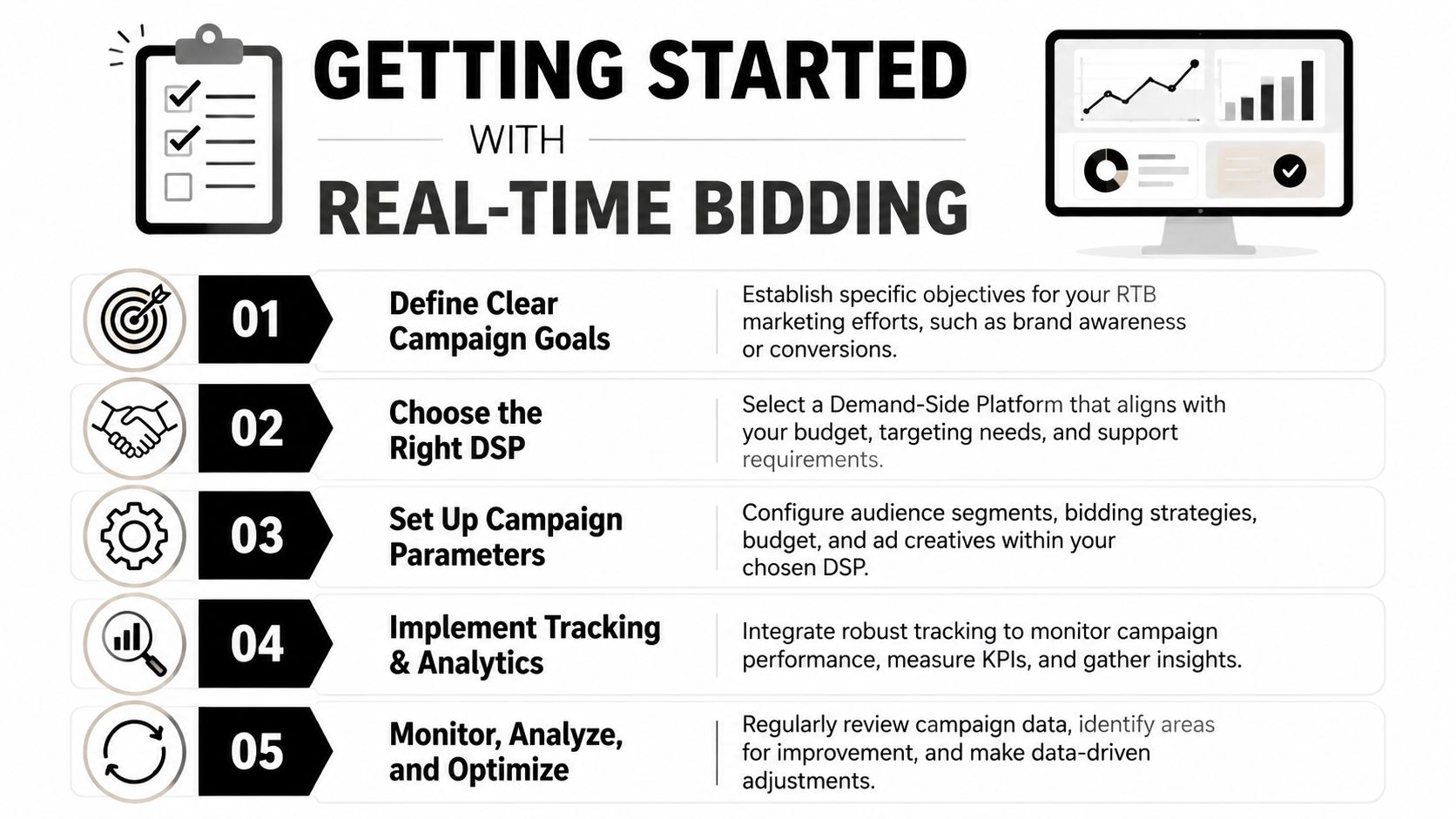
A good first RTB campaign usually follows a straightforward checklist.
Define the campaign goal
Pick one primary objective. If you try to optimize for awareness, traffic, and conversions all at once, your reporting gets muddy fast.Choose a DSP that fits your team
Some platforms give deep control but need stronger hands-on expertise. Others are easier to manage but less flexible.Set campaign parameters carefully
Audience logic, geography, creative format, exclusions, and bid strategy all shape quality more than most newcomers expect.Implement tracking early
If measurement is an afterthought, optimization becomes guesswork.Review search, placement, and performance signals often
Early patterns tell you where your waste is hiding.
Why post-cookie thinking matters now
Older RTB advice often breaks down. Many guides still talk as if third-party cookie-driven targeting is the default center of the system. It isn't safe to build your long-term strategy on that assumption.
A useful framing from TechCrunch's discussion of RTB in a post-cookie world is that RTB strategies need to pivot toward contextual targeting as a primary source for bid valuation in a privacy-first environment.
That changes how smart teams think.
Instead of only asking, “Who is this user?” they also ask, “What is this page about? What is the user doing right now? Does this context make the impression valuable even with less individual-level data?”
In a privacy-first setup, context is not a fallback. It becomes part of the core bidding logic.
What to prioritize as a beginner
If I were training a new PPC specialist on RTB today, I'd push these habits first:
Use first-party signals when available
Your own customer and site data tends to be more strategically useful than shaky third-party assumptions.Treat contextual relevance seriously
The page, content category, and surrounding environment can tell you a lot about whether a bid makes sense.Keep creative aligned with context
Even a well-priced impression underperforms if the message doesn't fit the moment.Start narrow, then expand
Tight controls make it easier to learn what's working before you scale.
RTB is still highly effective. It just rewards marketers who build for where digital advertising is going, not where it used to be.
Measuring Success in Your RTB Campaigns
A beginner mistake in RTB is treating impressions and clicks as the whole story. They matter, but they don't tell you whether the campaign is creating business value.
The stronger question is simpler: Did the impressions you bought lead to the outcomes you wanted?
Metrics that actually help you decide
A practical RTB review usually includes a mix of efficiency, quality, and outcome metrics.
Conversions
These tell you whether the campaign is producing the action you care about, such as purchases, leads, or signups.Cost per acquisition
This helps you judge whether the campaign is economically viable, not just active.Return on ad spend
Useful when revenue tracking is available and trustworthy.Viewability and placement quality
An impression served is not always an impression that had a meaningful chance to be seen.
That last point gets overlooked a lot. Cheap inventory can look attractive until you realize it's weak on visibility, context, or user quality.
How to read the data without fooling yourself
Don't optimize off one metric in isolation.
| If you only watch | You may miss |
|---|---|
| Clicks | Low-quality traffic |
| Conversions | Hidden waste higher up the funnel |
| CPA | Weak volume or poor long-term customer value |
| ROAS | Attribution gaps and delayed impact |
A better rhythm is to review outcomes alongside input quality. If a placement drives clicks but no useful downstream action, that's not a scaling opportunity. It's a clue.
For teams trying to sharpen that kind of decision-making, Next Point Digital's data-driven strategies offer a useful mindset for turning campaign data into action instead of noise. And if your reporting is still too shallow, Keywordme's guide to website visitor tracking can help you think more clearly about how user behavior connects back to campaign performance.
One easy first step is this: pick one RTB campaign and audit it around a single question. Which placements, contexts, or audience setups are producing meaningful outcomes, and which ones are just producing activity? That question will improve your RTB skills faster than staring at click volume ever will.
If you want to clean up search terms faster, expand winning keywords, and reduce wasted spend without all the manual busywork, Keywordme gives PPC teams a simpler way to manage keyword optimization at scale.
.svg)