
Value of a Lead: A Practical Guide for Google Ads ROI
Value of a Lead: A Practical Guide for Google Ads ROI


You can spend a week cleaning search terms, tightening match types, and trimming CPLs, then still end up staring at a flat revenue report. That usually means the account has been optimized around lead volume, not the value of a lead. Two rows in the CRM can look identical on paper and still send very different amounts of cash through the pipeline.
That gap shows up fast in Google Ads. One campaign feeds exclusive, contactable prospects who answer the phone and move into quotes. Another sends in shared inquiries that get recycled, ignored, or never progress past the first touch. Same cost, same form fill, completely different business outcome.
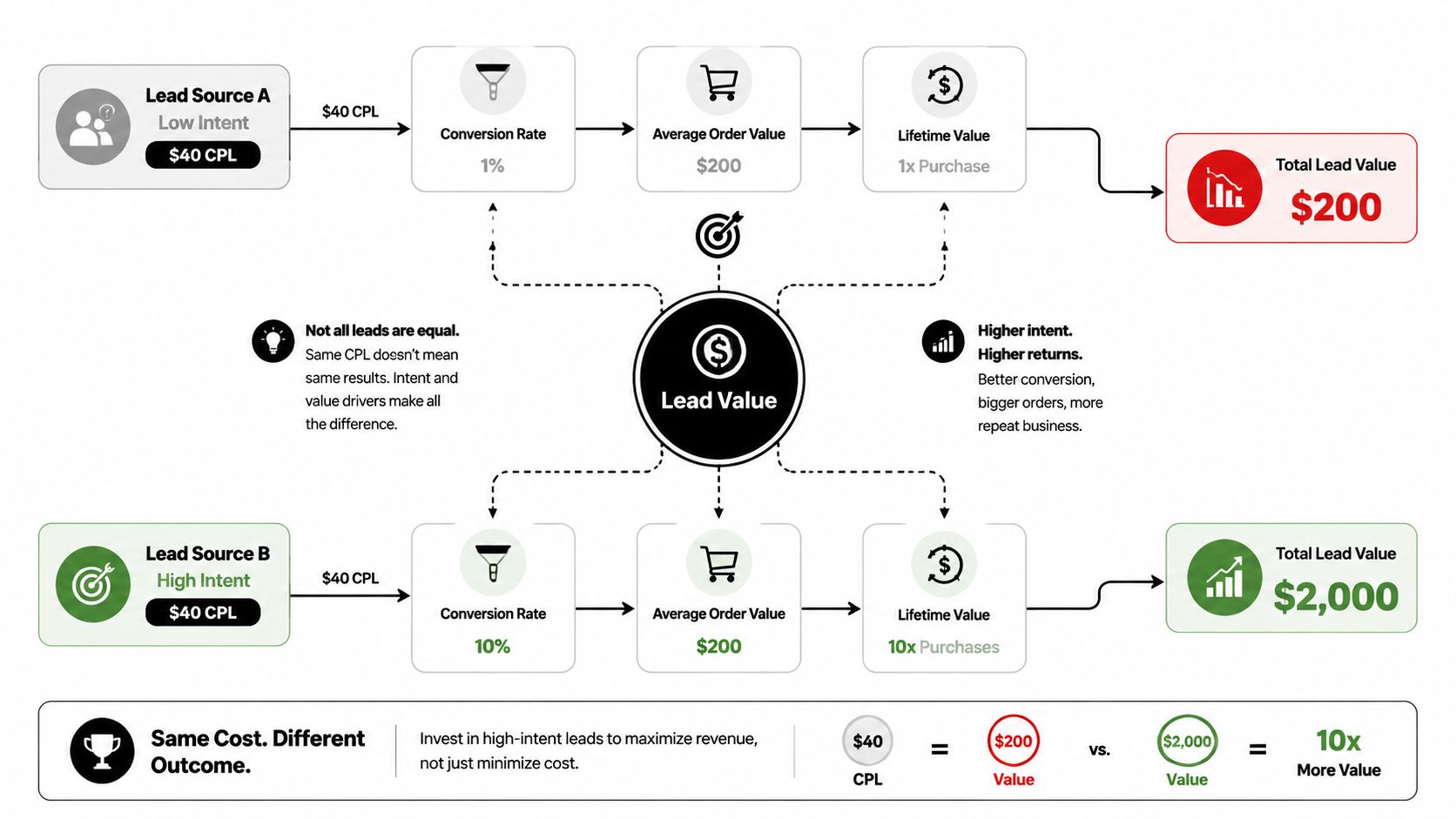
The practical fix is to stop treating a lead as a contact record and start treating it as a revenue-bearing asset. That means looking at source quality, contactability, and downstream close rate together, then using that number to steer bidding, keyword structure, and budget allocation. If you want a useful companion on the qualification side, lead qualification best practices is a solid reference point for how teams separate real opportunities from noise.
Why Two Identical Leads Can Be Worth Wildly Different Money
A freelancer running Google Ads for a home-services business can be fooled by the spreadsheet pretty easily. Two leads both cost $40 CPL, both land in the same dashboard, and both get logged as “new inquiries.” One comes from an exclusive homeowner search, reaches a live person, and turns into a booked estimate. The other comes from a shared lead flow, never gets answered, and dies in the CRM.
That's why the value of a lead is not the same thing as the price of a lead. Lead cost tells you what you paid to capture the contact. Lead value tells you what that contact is likely to return after sales, follow-up, and close rate are factored in. When those two numbers are confused, accounts often look efficient right up until revenue stalls.
The three things that decide whether a lead pays off
The first driver is source quality. High-intent search, exclusive inquiries, and tightly matched terms usually bring better close behavior than broad or low-intent traffic. The second is contactability, because a lead that never answers can't become an opportunity. The third is downstream conversion, which includes what sales does after the handoff and how quickly they follow up.
Practical rule: if a lead can't be contacted or can't reach opportunity stage, it shouldn't be priced like a real lead.
That's also where the metric stops being vanity and starts acting like a bridge. The value of a lead is the point where ad spend meets real revenue, which makes it the only number that can tell you whether a cheap click helped. A useful background on lead quality alignment is the discussion of performance marketing conversion insights, especially when teams need to separate raw volume from actual business outcomes.
The Core Lead Value Formula and Its Lifecycle Upgrade
The cleanest working formula is simple: Lead Value = total sales value / total number of leads. That's the version most teams can implement fast because it maps directly to a campaign or channel report. If a source generated more revenue per lead than another source, it deserves more budget.
Here's the catch. That formula works well for a one-time sale, but it gets thin fast in recurring revenue businesses. A SaaS lead that converts into a customer once may look mediocre at first blush, then become excellent after renewals, expansion, and retention are counted. In practice, the lead's real value is the average revenue it generates across its full lifecycle, not just at first purchase.
Formula snapshot: Lead Value = total sales value ÷ total number of leads
Using a lifecycle lens changes the bidding conversation. A business with stronger retention can justify a higher allowable cost per lead because the first sale is only part of the return. That means two companies with the same first-sale conversion rate can still have very different target CPAs, because one keeps customers longer and the other loses them quickly.
For teams that want to dig deeper into the retention side, Keywordme's customer lifetime value guide is worth a look because it helps connect lead economics to the rest of the customer journey. The important point is that lead value rises when retention, repeat purchase rate, and average order value rise. If your spreadsheet ignores those levers, it's undercounting the payoff of acquisition.
How Lead Value Changes by Product, Channel, and Cohort
The mistake I see most often is treating lead value like a fixed sticker price. It isn't. Lead value shifts by what you sell, where the lead came from, and how warm the audience already was when they clicked. A B2B software inquiry from a branded search campaign behaves differently from a cold e-commerce email signup, even if both came through the same Google Ads account.
Product type changes the economics first
In high-consideration offers, the same lead can support a much higher downstream return because close rates and deal sizes tend to be larger. In lower-ticket environments, a lead may need to convert quickly and repeatedly to justify the same spend. That's why a simple CPA target often fails when teams try to scale across multiple lines of business.
The pricing range below helps frame that variance. The CPL ranges come from lead pricing benchmarks, and the implied lead value uses the same 10% close-rate assumption across each row, so you can see how the economics shift when lead costs move up or down. The close-rate assumption is just a modeling lens, not a universal truth.
| Industry | CPL range | Implied lead value at 10% close rate |
|---|---|---|
| Commercial lending | $25-$200 | Equals about one-tenth of the total sales value generated across those leads |
| B2B technology | $100-$400 | Equals about one-tenth of the total sales value generated across those leads |
| Legal services | $200-$800 | Equals about one-tenth of the total sales value generated across those leads |
| Home services | $50-$300 | Equals about one-tenth of the total sales value generated across those leads |
| Insurance | $50-$150 | Equals about one-tenth of the total sales value generated across those leads |
Channel and cohort also change the outcome
Branded search usually behaves better than broad prospecting because the user intent is already closer to the offer. Likewise, a past-buyer cohort usually outperforms cold traffic because the audience already knows the brand and has a proven relationship with it. That doesn't mean every cold lead is worthless, only that the same CPL can generate a very different effective lead value depending on audience warmth.
The revenue lesson is straightforward. If you optimize one target CPA across every channel, you'll overpay for weak sources and underbuy the ones that close. A tighter setup starts with channel-level economics, then moves into cohort-level refinement, which is where the margin usually appears.
A Step-by-Step Lead Value Calculation You Can Reuse
The easiest way to calculate lead value is to follow the funnel stage by stage and refuse to skip any link. Raw leads matter less than qualified leads, qualified leads matter less than opportunities, and opportunities matter less than closed-won revenue. When a stage leaks, the lead's value collapses fast.
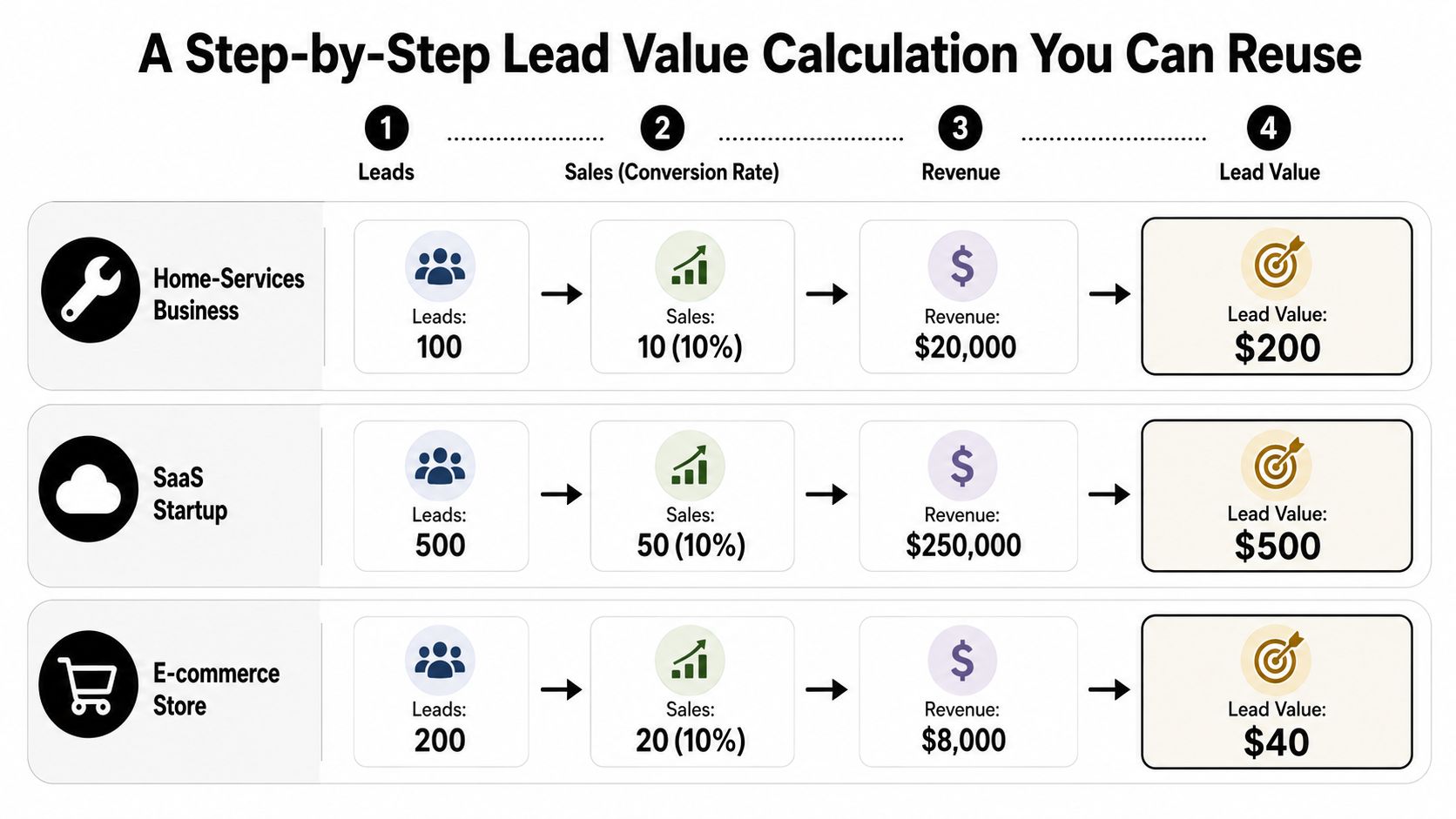
Home services, SaaS, and e-commerce behave differently
A home-services business with a $4,800 average ticket and a 15% close rate should not price leads the same way as an e-commerce list builder. If 100 leads create 15 customers, the lead value is driven by the average sale and the ratio of closed jobs to raw inquiries. In that model, every stage between contact and booked job matters because missed calls or slow follow-up cut the number immediately.
A SaaS company needs a different frame. A lead may not become a customer until after qualification, demo, and sales review, so the math has to track SQL conversion, opportunity creation, and contract value instead of assuming an instant sale. That's especially true when first-year value is only part of the economic picture.
An e-commerce brand sits somewhere else again. The lead might be an email opt-in rather than a direct sale, so its value shows up through repeat purchase behavior, list quality, and eventual order volume. If the opt-in never turns into an engaged subscriber, the lead value is mostly theoretical.
A reusable spreadsheet pattern
Use the same structure every time:
- Count leads, then separate raw from qualified.
- Track closed revenue, not just form fills.
- Divide revenue by leads to get a working lead value.
- Stress-test each stage so you can see where the funnel leaks.
A lead is only as valuable as the slowest stage that still has to happen before revenue lands.
That staged view is what keeps the model honest. It also keeps you from celebrating a cheap lead source that never reaches opportunity, because the revenue line tells the story.
Turning Lead Value Into Target CPA and Bid Strategy
Once you have a believable lead value, the next move is to make Google Ads care about it. If the platform only sees form fills, it'll keep hunting the cheapest conversions, not the most profitable ones. That's how accounts end up buying junk traffic with great-looking reports.
The simplest rule is to translate lead value into an allowable acquisition cost, then leave margin for fulfillment and retention. In practice, that means your target CPA should usually sit below lead value, not right on top of it. I like to think of it as giving the business room to breathe after the sale is booked.
Which bidding strategy fits the data you have
If you're early and only trust raw conversion volume, Maximize Conversions can work as a learning phase. If you've got solid offline data and consistent close behavior, Target CPA is usually the better control lever. If your account has revenue data flowing back in, Maximize Conversion Value can be the cleanest way to make Google optimize toward better leads rather than more leads.
To connect the math to execution, PCC Chase McGowan's CPA guide is a useful reference for target CPA thinking, especially when teams need a practical framework instead of theory. The same logic pairs well with how to calculate cost per acquisition when you're checking whether a campaign can afford its own economics.
Make the algorithm see the right signal
Offline conversion imports matter because Google can't optimize around revenue it can't observe. If a lead source produces more closed deals, import that downstream event so the bidding system has a better signal than just a thank-you-page hit. That's where audience and device bid adjustments become meaningful too, because you're no longer guessing which clicks are better, you're feeding the system actual business outcomes.
A useful working habit is to ask one question before changing bids. Does this change improve lead value, or just lower the visible CPL? If it only makes the dashboard prettier, it probably isn't helping.
Using Lead Value Inside Keywordme to Find and Kill Waste
Lead value becomes useful the moment it starts changing how you organize search terms. In practice, that means high-close-rate queries deserve their own exact-match treatment and cleaner ad groups, while weak-intent terms should get pushed out fast. The metric stops being abstract and starts acting like a sorting rule.
Use the number to decide what gets structure
When a search term consistently produces a higher lead value, it deserves tighter control. That usually means extracting it into its own keyword set, matching the offer to the query more closely, and avoiding the kind of broad bucket that hides performance differences. Low-value terms, by contrast, should be grouped cautiously or excluded if they keep pulling spend without helping revenue.
That's also where negative keywords get sharp. If a term's lead value can't support the business's target CPA margin, it belongs on the exclusion list. Keywordme's negative keyword workflow is relevant here because it's built around cleaning search term waste and applying those exclusions without the usual copy-and-paste drag.
Make the workflow match the economics
Once you've assigned lead value by term or cluster, use it to inform match type. Strong terms can justify exact or phrase control, while messy, low-value queries usually need a stricter filter. You can also use bulk actions to enforce the same rules across campaigns instead of hand-tuning every ad group one by one.
Keywordme fits this kind of work because it handles keyword cleanup, match type assignment, and negative list building in one place, which is useful when the account has grown too messy for manual upkeep. The point isn't the tool itself, it's the discipline of letting lead value decide where the spend goes. That's how a search account stops chasing cheap volume and starts backing terms that pay back.
Hidden Quality Risks That Quietly Destroy Lead Value
A lot of accounts don't lose lead value in one dramatic blow. They bleed it through small quality problems that look harmless in isolation. The CPL stays flat, the lead count stays healthy, and the revenue line gets worse.
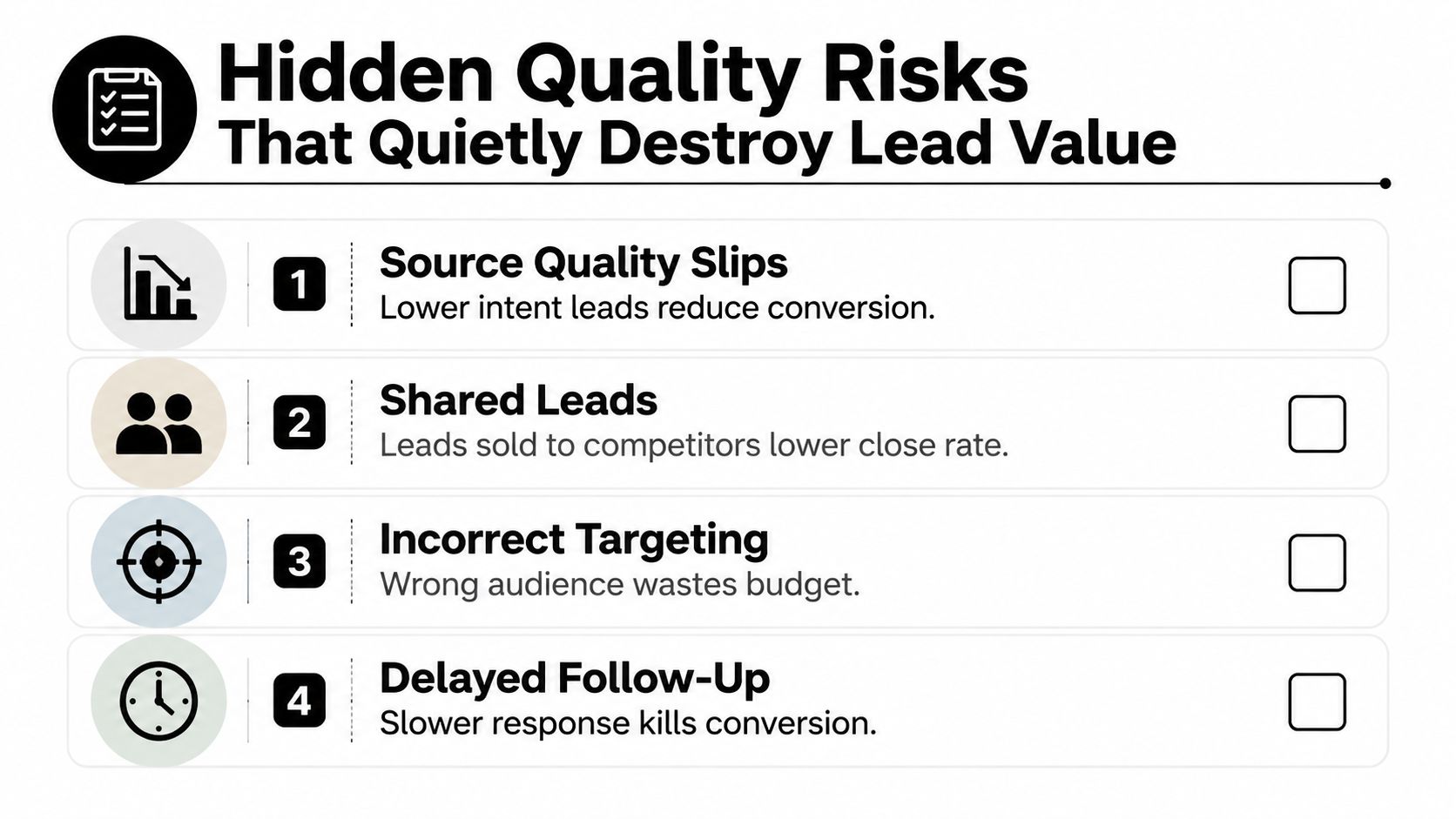
Three failure modes I keep seeing
Shared leads are the fastest way to shrink value without changing the cost line. If the same inquiry gets sold to multiple vendors, your close rate drops because the buyer is already being worked by competitors. Non-contactable submissions are the next problem, because they never turn into conversations, which means they never turn into pipeline.
Ad-account attribution leakage is the quieter one. When conversion tracking is miswired, good traffic can be mistaken for bad traffic, and bad traffic can be kept alive because the reporting looks acceptable. That kind of confusion does real damage because it stops managers from cutting the right waste.
The monthly audit that catches the drift
Check contact rate first, because you can't improve a lead you can't reach. Check exclusivity next, because shared environments usually compress close rate. Then review the lead-to-opportunity ratio and the time-to-first-touch, since slow sales follow-up can erase value even when the source was decent.
If the lead can't be reached fast, it's already cheaper than you think.
This is why I treat lead value as a running metric, not a one-time calculation. The moment source quality slips, the old math becomes optimistic fiction. The right move is to keep re-testing the number against actual contact and close behavior, then cut anything that drags the average down.
A One-Page Lead Value Playbook
The whole workflow fits on one page if you keep it disciplined. Start with the calculation, then decide what CPA the business can support, then audit the quality risks that make the number drift. After that, the only job is to keep the account aligned with what closes.
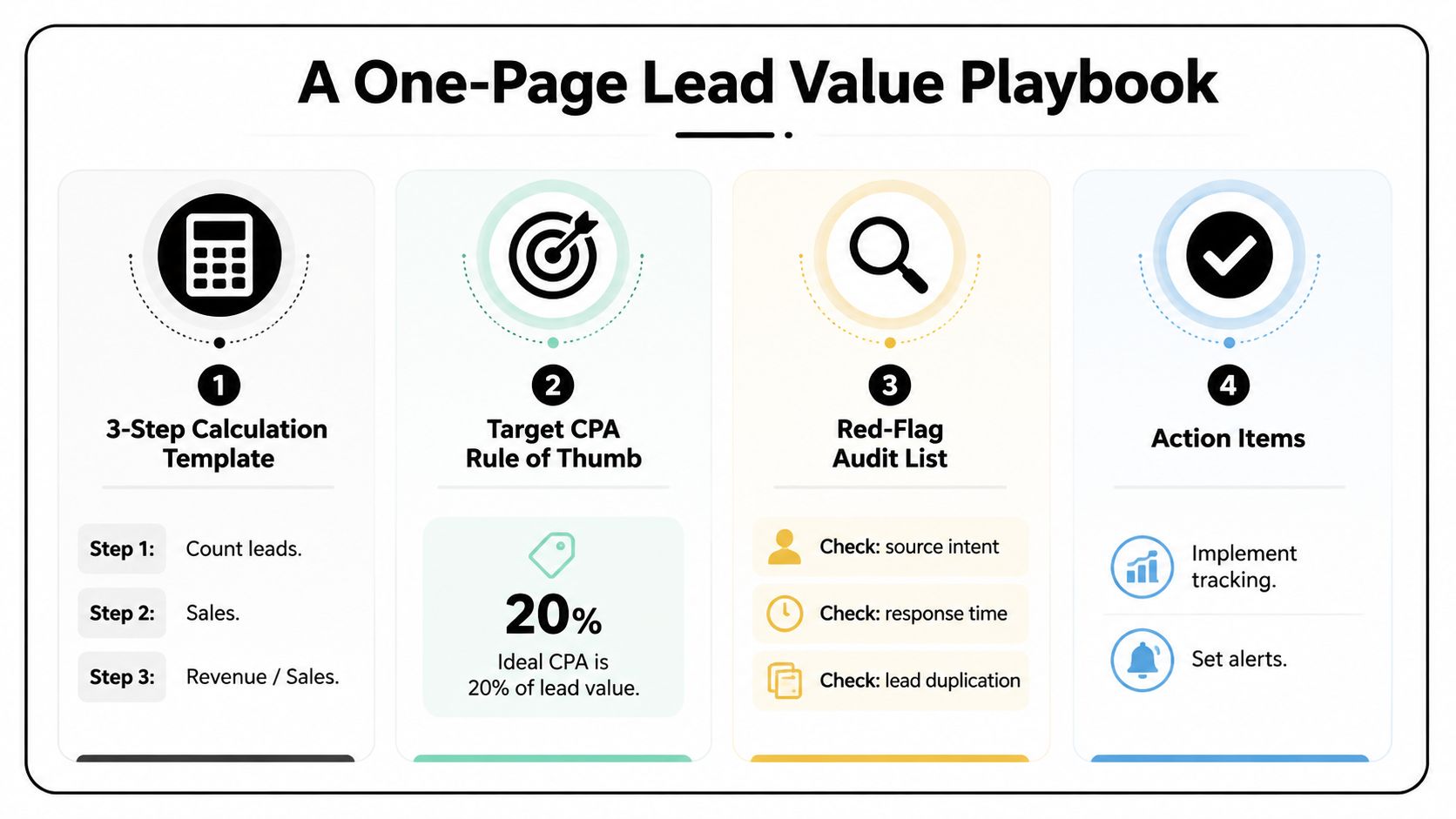
The 30-minute sprint
Count leads, closed sales, and revenue, then divide to get your working lead value. Set a target CPA that leaves margin between cost and return. Review source quality, response speed, and duplicate exposure before you touch bids again.
The practical cleanup list
Extract the search terms that close. Push weak terms into negatives. Lock in tighter match types for the queries that bring better customers. Then make the account reflect the economics instead of the vanity metrics.
The smartest habit is simple. Recalculate lead value with real closed-loop data every quarter, then let that number drive bidding, keyword structure, and exclusions. If you want to tighten the workflow without living in spreadsheets, visit Keywordme and see how it helps teams clean search terms, build negative keyword lists, and organize Google Ads around the leads that pay back.
.svg)