
Thanks for Your Purchase: 7 Templates That Convert
Thanks for Your Purchase: 7 Templates That Convert


A receipt confirms a transaction. It doesn't necessarily reassure the buyer, show them what to do next, or give them a reason to return. A well-timed thanks for your purchase message can do all three, provided it's built around the customer's immediate need rather than the company's desire to promote another offer.
The right message might confirm delivery expectations, create a quick first win, map progress, welcome someone into a community, or reduce perceived risk. The seven templates below move from reassurance and first value to loyalty and risk reduction. Adapt each one to the actual product, your support capacity, and evidence you've verified from real customers. A useful companion to this approach is the SelfServe retention playbook, especially when you're designing the broader experience around the message.
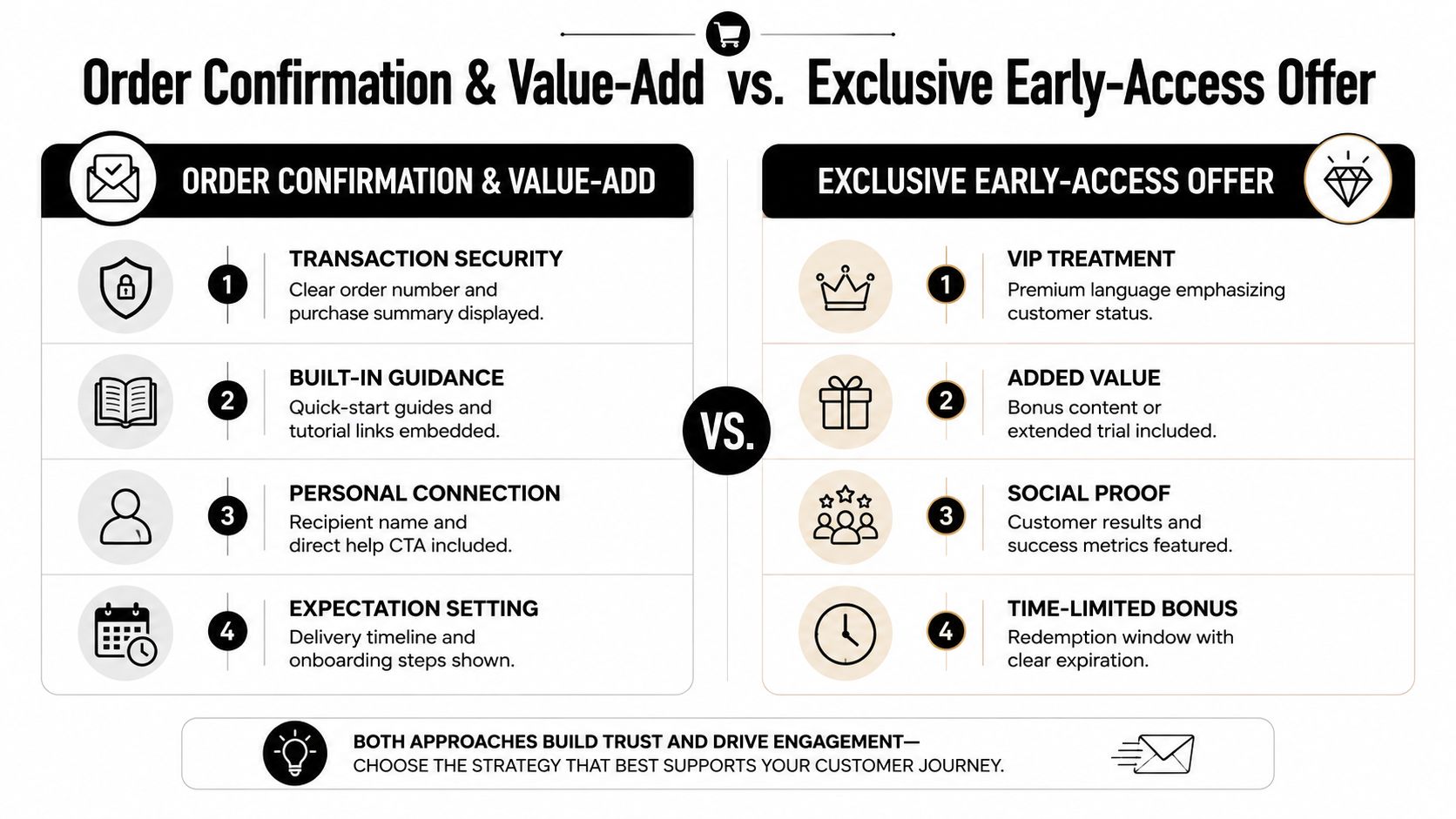
1. Order Confirmation & Value-Add
A standard order confirmation answers one question: did the purchase go through? A stronger version answers the next question too: what should the customer do now?
This format works especially well for products that need setup, care, or explanation. Keywordme could use it to confirm a seven-day free trial, thank the customer for choosing the platform, and send them directly to the Chrome plugin setup guide. A Shopify store might add product care instructions to the receipt. HubSpot-style onboarding can introduce a short feature walkthrough without turning the confirmation into a sales brochure.
Subject-line direction: Keep the subject functional and reassuring, such as “Your Keywordme trial is active” or “Order confirmed, your setup starts here.”
Timing: Send it immediately after checkout. Purchase confirmations need to arrive within minutes, and one industry guide recommends delivery within 30 seconds. ReferralEarl's post-purchase guidance also separates the immediate confirmation from a later review request, which should follow delivery rather than compete with the first reassurance.
Use clear sections for the order details, next step, support route, and optional learning resource. Personalize the content by product tier or item purchased, then test the layout in Gmail, Outlook, and mobile clients.
Practical rule: The confirmation should make the customer feel oriented, not marketed to.
Suggested microcopy:
Thanks for choosing Keywordme. Your seven-day trial is active. Start by installing the Chrome plugin, then review your first search terms. Need help? Chat with our team or visit the help center.
A progress indicator can show the next onboarding steps, but keep the primary call to action singular. If the buyer has to choose between setup, an upsell, a survey, and a community link, the message has stopped confirming and started creating friction.
2. Exclusive Early-Access Offer
An early-access message turns appreciation into privileged access. That can work well when the customer has already shown intent and the offer improves their experience, but it fails when “exclusive” means another promotion with a new label.
Keywordme might thank a new customer and invite them to try an upcoming match-type automation or an advanced negative keyword template before wider release. Slack has used beta access as a way to involve workspace administrators, while Canva can make an annual subscription feel more valuable by including access to premium template packs.
Subject-line direction: Lead with access, not discount language. “You're invited to try our new automation” feels more relevant than “Special offer inside.”
Timing: Send the invitation after the purchase confirmation has done its job. The customer should first know that the transaction is complete and understand the next product step. Then give the early-access message one clear action and a visible expiration date, such as “Valid through 30 days from purchase,” if that deadline is real.
Build the email around a compact structure:
- Why you're receiving this: Thank the customer and explain why their account qualifies.
- What they get: Name the feature, resource, or access level precisely.
- What to do: Provide one activation or redemption link.
- What happens next: Explain how support and feedback work.
Track redemptions with a dedicated link or event. Segment access by customer tier where the product experience supports it, and follow up once with people who haven't redeemed the offer. Don't keep repeating the invitation. For related retention and expansion thinking, see Keywordme's cross-sell and upsell guide.
Suggested microcopy:
Thanks for choosing Keywordme. We're giving you early access to our advanced negative keyword templates. Activate access here, try one workflow in your next campaign, and tell us what would make it more useful.
The offer should reward the purchase without distracting from adoption. If the customer hasn't activated the core product, early access may be premature.
3. Success Milestone Tracker
A thank-you email can become the first page of a progress story. Instead of sending one appreciative note and going silent, show customers the practical milestones that indicate they're getting value.
For a Keywordme user, the sequence might begin with Chrome plugin activation, continue with reviewing the first set of keywords, and move toward saving negative keywords. Duolingo uses streaks and milestone celebrations to keep attention on continued behavior. Fitbit does something similar with activity milestones, while Grammarly can help users notice changes in their writing over time.
Subject-line direction: Make progress feel concrete. “Your first Keywordme milestone starts today” is more useful than “Welcome to the platform.”
The first message should acknowledge the purchase, identify the first milestone, and preview the next one. A later reminder can arrive 3–5 days before an expected completion date, provided that timing reflects actual customer behavior rather than an arbitrary automation rule. Keep milestones achievable. A customer who sees an unrealistic roadmap may conclude that the product is complicated.
A practical sequence could look like this:
- Activation: Install the plugin and connect the right account.
- First working session: Review search terms or add an initial negative keyword.
- Routine adoption: Return to the workflow and save useful changes.
- Expansion: Apply the process across another campaign or account.
Add screenshots or a short demonstration for milestones that require explanation. Badges and progress bars can help, but only when they reflect meaningful product actions. Don't turn routine account administration into a game if the customer wants a fast professional workflow.
Suggested microcopy:
You're on step one. Activate the Chrome plugin today. After your first review session, we'll show you the next workflow that fits your account.
The message should celebrate movement, not pressure customers to complete arbitrary tasks. Measure the next meaningful action, such as activation or a saved keyword, rather than treating email opens as the outcome.
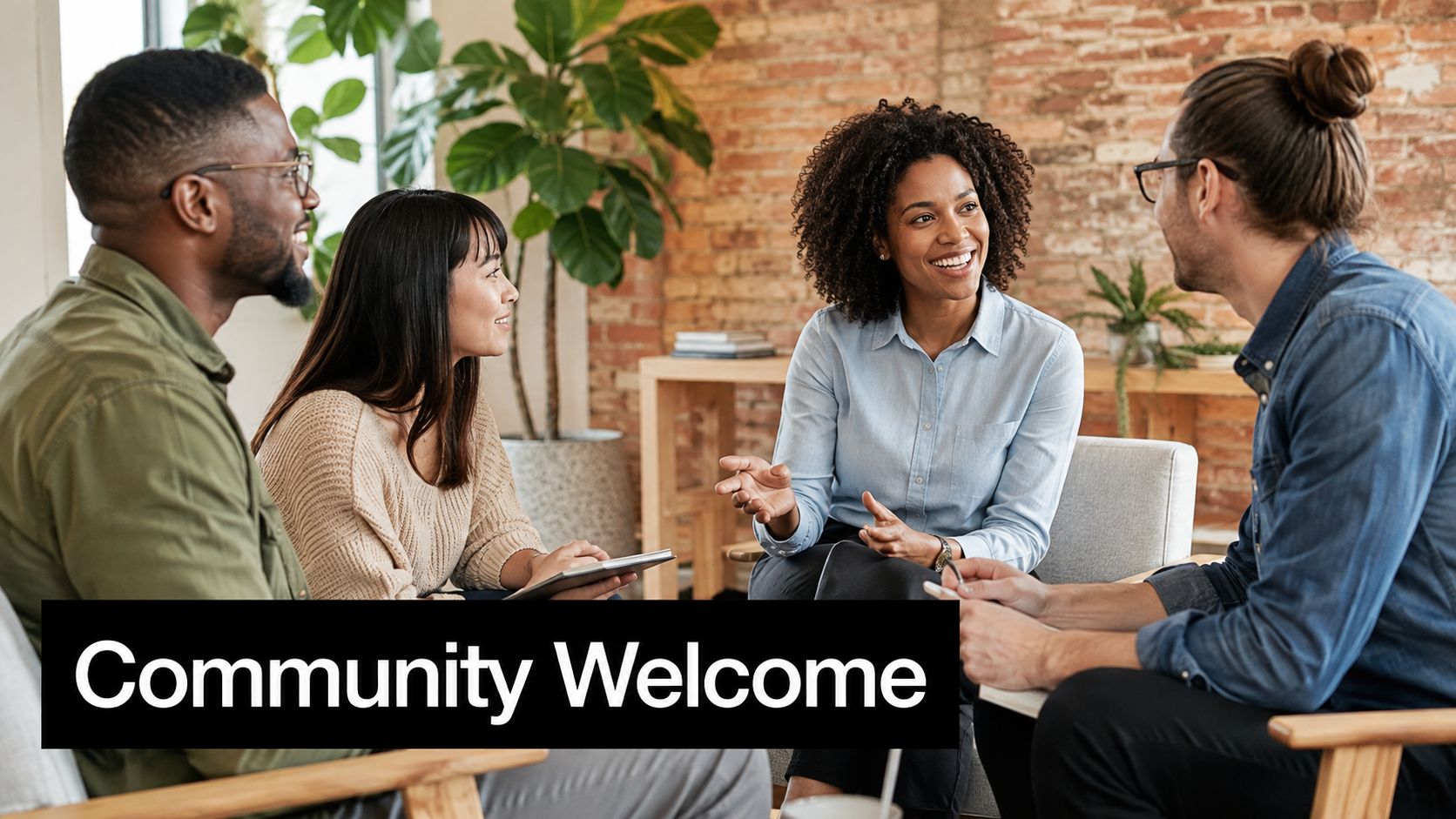
4. Social Proof & Community Welcome
New buyers often want confirmation that they made a sensible choice. A community welcome can provide that reassurance while giving them a place to ask questions, share progress, and see how other customers use the product.
Keywordme could invite agencies, freelancers, and in-house marketers into a space organized around wins, questions, and resources. A PPC community might feature customer workflows, campaign lessons, or anonymized search-term examples. Notion's user community model shows how templates can become conversation starters, while Zapier frequently uses customer stories and integration examples to make product use feel concrete.
Subject-line direction: Emphasize belonging. “Welcome to the Keywordme community” is a stronger fit than “See what other customers are buying.”
The proof must be real and permission-based. The supplied example of an agency saving $4,200 per month in wasted ad spend within the first 60 days should only appear if that result has been verified and the customer has agreed to its use. If public attribution isn't appropriate, anonymize the result and explain the context without implying that every buyer should expect the same outcome.
Social proof should reduce uncertainty, not manufacture certainty.
Invite the customer to one community destination, not several competing groups. A useful welcome email might include a short introduction, a resource channel, and a prompt such as “Tell us which Google Ads workflow you want to improve first.” Team members should participate early so the community doesn't feel empty after signup.
Suggested microcopy:
Thanks for joining Keywordme. You'll find practical PPC questions, workflow examples, and customer wins in the community. Introduce yourself with the account type you manage and the task you'd most like to simplify.
A community welcome isn't a substitute for support. Make the support route visible, and don't ask new customers to publish their results before they've had enough time to experience the product.
5. Quick-Win Tutorial Email
The fastest way to make a thank-you message useful is to help the customer complete one valuable task. A short tutorial turns positive purchase intent into product behavior before the customer gets distracted.
For Keywordme, that might be “Add your first 50 negative keywords in 5 minutes.” The precise task should match what a new user can complete with the account, permissions, and data available at that point. Canva can guide a new customer through creating a first design. Mailchimp can lead a user through sending a first campaign. Stripe can give developers a direct path to processing a first payment.

Subject-line direction: State the result and the effort. “Clean up your first search terms in five minutes” is clearer than “Get started with Keywordme.”
Keep the tutorial narrow. Use a screen recording, test the task yourself with a fresh account, and time the process accurately. Add a “stuck?” route that opens chat or the relevant help article. A completion message can reinforce the result without pretending the customer has mastered the full product.
Keywordme can support this kind of onboarding with marketing automation best practices, especially around event-based follow-ups and audience relevance.
The email's copy can follow this pattern:
Thanks for choosing Keywordme. In this short walkthrough, you'll identify your first irrelevant search terms and add them to a negative keyword list. Start the tutorial, then contact support if your account looks different.
Place the call to action above the detailed steps, then repeat it only if the email is long enough to require scrolling. Don't pack several tutorials into one message. One completed action creates more useful momentum than a resource library the customer never opens.
Here's the accompanying walkthrough:
6. Personalized Success Plan Email
A generic thank-you says the company noticed the transaction. A personalized success plan says the company understood why the customer bought.
This approach suits products with different audiences, workflows, or implementation paths. Keywordme might separate agencies, in-house teams, and freelance PPC specialists, then recommend different starting actions for each group. An agency may need a repeatable account workflow. An in-house marketer may care about search-term cleanup across active campaigns. A freelancer may prioritize speed and client-ready organization.
Subject-line direction: Reflect the customer's stated goal. “Your Google Ads optimization plan” is more useful than “Welcome to Keywordme.”
The message should mention the information the customer provided during signup or purchase, then connect it to a small number of relevant actions. Capture industry, company size, account type, and primary goal only when you can use those fields responsibly. Personalization that exposes unnecessary data can feel intrusive, especially when the customer doesn't remember providing it.
A practical plan might include:
- First phase: Connect the account and complete the most urgent cleanup task.
- Next phase: Apply match types or build a negative keyword workflow.
- Review phase: Examine what changed and decide where to expand.
Recommend 2–3 features only when each one is relevant to the customer's stated objective. A short consultation can help refine the plan for complex accounts, but don't make a call mandatory for routine onboarding. The Rendemo user onboarding comparison offers useful context for evaluating how guided experiences differ from generic product tours.
Suggested microcopy:
You told us you manage Google Ads for ecommerce accounts. Start with search-term cleanup, then use match-type assignment for the campaigns with the most activity. We'll send the next recommendation after you complete those steps.
Schedule follow-ups around the customer's actual phase, not a fixed promotional calendar. Relevance matters more than volume.
7. ROI Guarantee or Risk-Reversal Frame
A risk-reversal message can reduce buyer's remorse, but it's the easiest approach to misuse. A guarantee is only credible when the product can influence the promised outcome, the customer can understand the conditions, and the company can honor the remedy without creating a maze of exclusions.
For Keywordme, a statement such as “Save $500 or more per month in wasted ad spend within 60 days, or receive a full refund” should never be published unless it's backed by verified customer data, a defined measurement method, and approved terms. The same caution applies to examples associated with Beachbody, USAA, or Basecamp. Their guarantees shouldn't be copied as if they apply to another product or audience.
Subject-line direction: Lead with confidence and clarity. “Your purchase is protected” works only if the protection is easy to understand.
Explain what counts as success, what access or setup the customer must complete, and how the refund process works. Keep the language plain. A dashboard can show progress toward the agreed metric, while milestone reminders can tell the customer whether they're on track. Don't promise outcomes that depend mainly on budget, market demand, account history, or customer behavior.
A guarantee is a product promise and an operational commitment, not a persuasive sentence.
The email can use this structure:
Thanks for choosing Keywordme. We'll help you track the workflow connected to your agreed success measure. Review the terms, complete the setup steps, and contact support if you need help interpreting your progress.
Before launch, ask legal and customer support teams to review the wording, eligibility, evidence requirements, and refund path. The customer should not have to argue with support to access a remedy the company advertised. For practical measurement context, see Keywordme's guide to improving ROI.
A risk-reversal frame works best when it follows a strong onboarding experience. Confidence grows from visible progress, not from an oversized promise.
7-Point Post-Purchase Comparison
| Template | Implementation Complexity 🔄 | Resource Requirements ⚡ | Expected Outcomes ⭐📊 | Ideal Use Cases 💡 | Key Advantages ⭐ |
|---|---|---|---|---|---|
| Order Confirmation & Value-Add | Medium 🔄, needs fulfillment sync & dynamic content | Low–Medium ⚡, copy, links, minor dev | ⭐⭐⭐, reduces buyer's remorse; ↑ onboarding CTR 📊 | New purchases, trial activations | Confirms transaction; drives immediate adoption; sets expectations |
| Exclusive Early-Access Offer | Medium 🔄, segmentation & inventory control | Medium ⚡, offer management, tracking, CRM | ⭐⭐⭐⭐, increases upsell rate and urgency 📊 | VIP segments, launches, upsell campaigns | Creates FOMO; boosts CLTV; encourages referrals |
| Success Milestone Tracker | High 🔄, tracking, automation, multi-step cadence | High ⚡, analytics, automation, content series | ⭐⭐⭐⭐, improves retention and measurable success 📊 | High-touch SaaS, retention-focused onboarding | Structured engagement; measurable progress; leads to case studies |
| Social Proof & Community Welcome | Medium 🔄, community setup & moderation required | Medium ⚡, community management, curation | ⭐⭐⭐, increases trust and advocacy 📊 | B2B SaaS, agencies, products benefiting from peer support | Builds trust; generates testimonials; reduces support load |
| Quick-Win Tutorial Email | Medium 🔄, produce short video/GIF and sequence | Medium ⚡, screen recording, simple design, testing | ⭐⭐⭐⭐, rapid time-to-first-value; fewer support tickets 📊 | Fast activation goals; feature adoption drives | Delivers fast wins; highly motivating; shareable |
| Personalized Success Plan Email | High 🔄, data collection + dynamic personalization | High ⚡, segmentation, automation, possible human review | ⭐⭐⭐⭐, increases perceived value and long-term adoption 📊 | High-ACV accounts, agencies, consultative sales | Feels consultative; boosts relevance, retention, and revenue |
| ROI Guarantee / Risk-Reversal Frame | Medium–High 🔄, legal review + clear metrics | Medium ⚡, tracking dashboard, refund ops | ⭐⭐⭐⭐, reduces anxiety; can lift conversions 📊 | Price-sensitive buyers; competitive markets | Removes risk; strong trust signal; competitive differentiator |
Turn Gratitude Into the Next Win
Choose the message based on the customer's state immediately after purchase. If they're uncertain, use the order confirmation and value-add format. If they need momentum, send a quick-win tutorial. If the product takes sustained practice, build a milestone tracker. If the purchase involves a meaningful perceived risk, use a carefully documented guarantee or reassurance frame.
The body copy matters, but it isn't the whole system. The subject line sets the expectation. Send timing determines whether the message feels helpful or late. One focused call to action prevents the customer from having to decide what matters. Permission-based personalization makes the message relevant without making it feel watched.
Post-purchase messages also deserve measurement discipline. Omnisend's 2026 data reports a 47.63% open rate for order follow-up emails, compared with 35.75% for abandoned-cart emails. Klaviyo reports that post-purchase emails can see open rates almost 17% higher than the average email automation. Those figures show why the channel earns attention, but an open isn't the customer outcome. Track activation, tutorial completion, support resolution, repeat purchase, or another action that matches the message.
A 2014 field study found that a simple thank-you email from a restaurant president, sent after a satisfaction survey, was associated with repeat visits rising 50% for men and 57% for women over the following 12 months. The same study found that the acknowledgment worked best when sent two days after feedback, and the thank-you-only version performed as well as or better than versions with gifts or rewards. Read the field study report. The lesson isn't that every brand should copy a restaurant email. It's that appreciation can be commercially meaningful when the timing and context fit.
Avoid stuffing the message with promotional language. Transactional email has different compliance and deliverability considerations, so authenticate the sending domain, separate transactional and marketing streams, and write the confirmation as a confirmation rather than an advert. NitroSend's transactional email guidance explains this distinction, while MailAdept's spam trigger words checker can help you review risky wording before launch.
Select one template, replace its proof and promise with facts from your real product experience, test it across devices, and measure the next meaningful customer action. Don't optimize the thank-you message for sounding grateful. Optimize it for helping the customer move forward.
Keywordme helps Google Ads teams research keywords, clean up irrelevant search terms, assign match types, and build negative keyword lists through a Chrome plugin workflow. Visit Keywordme to explore the seven-day free trial and connect your post-purchase thank-you message to a practical first optimization win.
.svg)