
Cross Sell Upsell: Strategies to Boost Revenue
Cross Sell Upsell: Strategies to Boost Revenue


You already know the trap. New clicks keep getting pricier, the prospecting funnel keeps leaking, and every month you're asked to do more with the same or smaller budget. The fastest way out isn't another cold-audience hack, it's squeezing more value from the people who've already bought, already trusted you, and already know your brand. That's where cross sell upsell work earns its keep.
If you've ever stared at a search term report thinking, “Why are we paying for all this traffic when our own customers are the easiest group to convert?”, you're in the right place. The right expansion offer can turn one sale into a better sale, and one account into a longer relationship. For a broader funnel view, it helps to connect this thinking to the rest of your paid strategy, especially a marketing funnel example that shows where expansion revenue fits after acquisition.
The Hidden Goldmine in Your Customer List
A lot of marketers keep chasing the next new buyer because that's what feels visible. Fresh traffic, new leads, new accounts, new MQLs. The problem is that the economics get ugly fast when you keep paying for cold attention instead of making the most of the attention you already own.
Selling to an existing customer is reported to be 60% to 70% more likely to succeed than selling to a new prospect, where success rates are only 5% to 20% in the same benchmark set, and these tactics can generate 20% to 30% more revenue by focusing on that higher-probability audience (Shno marketing statistics). This is why these strategies matter. They're not a nice add-on, they're a more efficient way to monetize demand you've already paid to create.
Think about the practical side. A customer who has already bought doesn't need the same level of trust-building as a stranger. They need the next logical product, the better plan, or the complementary item that makes the first purchase work harder.
Practical rule: If the customer already solved one problem with you, look for the adjacent problem before you go hunting for a net-new lead.
That shift matters in paid media because it changes how you think about ROI. Instead of asking only, “How do I get more clicks?”, you start asking, “How do I get more value per click, per customer, and per account?” That's a very different game, and it's usually the one with better margins.
Upsell vs Cross-Sell The Core Difference
The two tactics get lumped together constantly, but they're not the same move. An upsell is the upgrade path. A cross-sell is the companion path.
A simple fast-food example makes it obvious. If someone orders a burger and you suggest a larger size, that's an upsell. If you suggest fries or a drink, that's a cross-sell. Same buyer, same moment, totally different job.
The cleanest way to keep them straight is to remember that upselling changes the product tier, while cross-selling adds a related product or service. For a useful definition reference, RecurX's upsell glossary lays out the upgrade concept clearly without overcomplicating it.
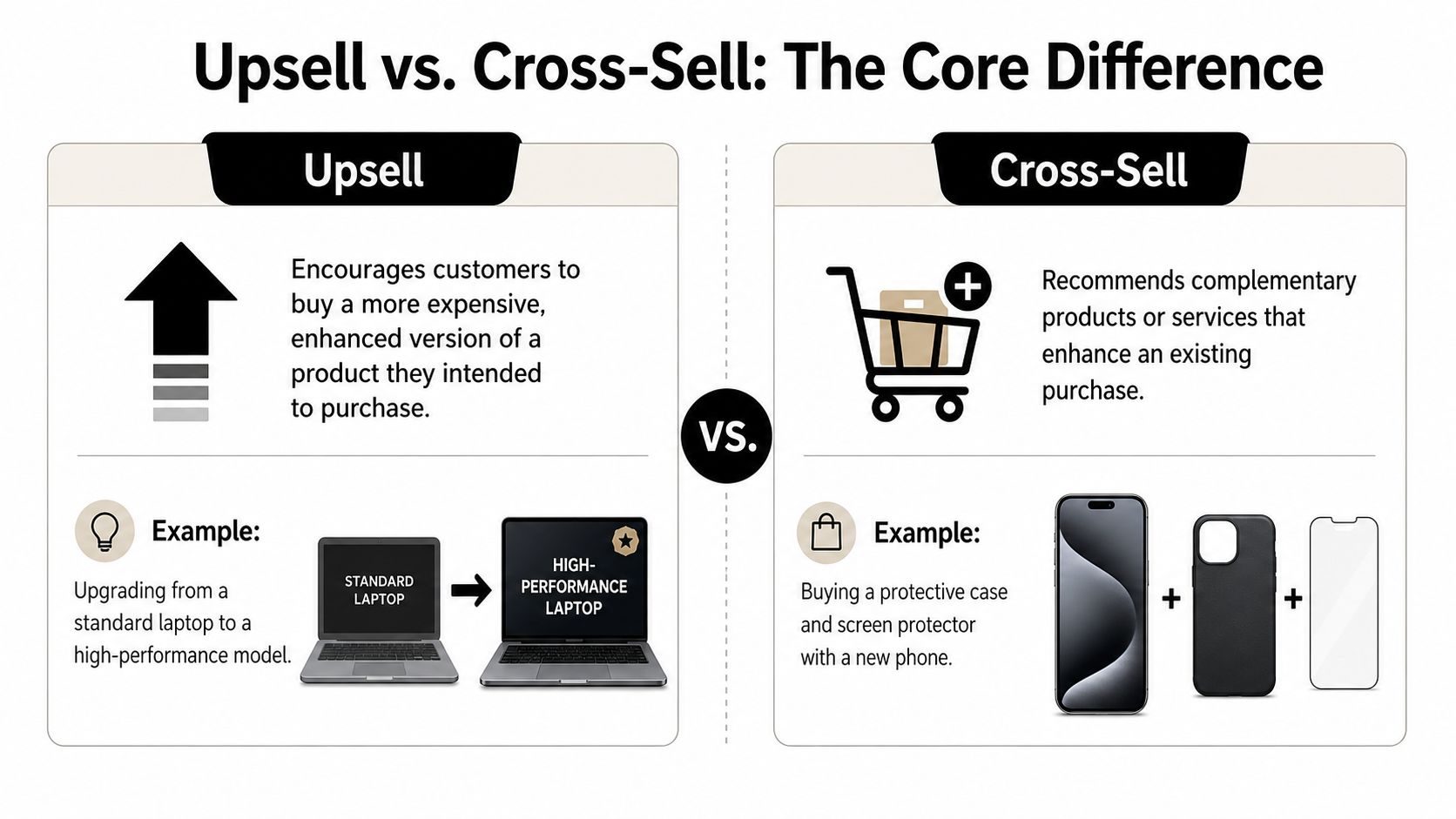
| Dimension | Upsell | Cross-sell |
|---|---|---|
| Core goal | Move the buyer to a higher tier or premium version | Add a complementary product or service |
| Best timing | When the buyer hits a limit, wants more capability, or is evaluating value | When the buyer has a related need the original purchase doesn't solve |
| Product relationship | Same product family, more features or capacity | Adjacent product, bundle, add-on, or accessory |
| Main metric | Upgrade rate, plan expansion, value lift | Attach rate, basket expansion, related-product adoption |
The best shortcut is this. If the offer answers “better version,” it's an upsell. If it answers “what else do you need to make this work?” it's a cross-sell.
A good comparison also helps the team build cleaner campaigns. Sales, support, and paid media people often mix the two and then wonder why conversion rates are messy. If you don't know which motion you're running, you won't know which metric to watch.
How These Tactics Drive Sustainable Growth
The business case gets stronger when you stop looking at expansion offers as one-off transactions. A good upsell or cross-sell changes the economics of the whole account. It lifts the value of each conversion, which helps with customer lifetime value, and it often improves average order value without requiring another expensive acquisition round.
That matters in paid advertising because the value of a conversion is what determines how hard you can push on acquisition. If your existing customers are buying more, upgrading more often, or attaching more items to the base purchase, your paid traffic can tolerate a lot more pressure. You're not just buying clicks, you're buying accounts with expansion potential.
The historical shift is worth noting too. Cross-selling has been embedded in digital commerce for at least a decade, and one benchmark says that by 2020, 80% of U.S. e-commerce businesses were already using it. Another industry report says cross-selling contributes 10% to 30% of e-commerce revenue on average (Salesgenie cross-selling statistics). That doesn't make it a gimmick. It makes it part of the operating model for modern growth teams.
Expansion revenue works best when the first sale is treated like the start of the relationship, not the end of the conversion.
For B2B and subscription businesses, this is especially important. Usage depth, add-on demand, and plan expansion all feed into retention and revenue quality. If you sell one account a second relevant product or a higher tier, you often reduce dependence on constant top-of-funnel spend.
That's why strong teams watch these motions like core performance channels, not side projects. They're a way to make the same customer base work harder, with less waste and better yield.

If you want the metric conversation in plain language, think in terms of what the account is worth over time. A strong customer lifetime value framework helps you judge whether expansion revenue is compounding or just creating short-term spikes.
When to Cross-Sell and How to Do It Right
Cross-sell success starts with relevance, not volume. A useful offer doesn't feel like a random extra item, it feels like the obvious next thing the customer forgot to buy or didn't yet realize they needed. The best cross-sell is the one that closes a gap in the original purchase.
For e-commerce, that usually means an accessory, a protection item, or a complementary service that helps the buyer use the original product better. For SaaS, it might be a related module, a reporting layer, or a workflow tool that fits the way the customer's process has expanded. The key metric to watch is the attach rate, the share of customers buying the complementary product (Prospeo on upsell and cross-sell rates).
A helpful way to time the offer is to ask when the customer's workflow has clearly expanded. If they've added new users, new channels, or a new use case, the need for a related product gets easier to justify. That's when the pitch feels helpful, not opportunistic.
You can also use channel timing to reduce friction. A checkout offer works well when the add-on is obvious and low effort. A post-purchase email works better when the buyer needs a little more context before saying yes. For Shopify teams looking at basket growth, this cross-sell strategy for Shopify stores is a useful companion read because it focuses on practical AOV optimization without making the offer feel forced.
Practical rule: Cross-sell after you've identified the missing piece, not before you've diagnosed the problem.
That one rule keeps a lot of campaigns from turning into noisy upsell sludge. The moment you stop guessing and start matching the offer to the actual gap, conversion usually gets cleaner.
When to Upsell and How to Win the Upgrade
Upsells work best when the customer has already hit a ceiling. In B2B, the strongest trigger is often product usage. When a customer approaches plan limits for seats, storage, or features, the value of upgrading becomes obvious because the constraint is real, not theoretical (Monday.com on cross-selling and upselling).
That's a much stronger moment than a generic “upgrade now” message. The user is already feeling friction. They don't need persuasion in the abstract, they need relief. If the higher tier removes the bottleneck, the pitch makes sense.
The framing matters more than the label. Don't sell “premium.” Sell speed, room to scale, less manual work, or access to the feature they were already trying to use. The upgrade should feel like the next logical step in their journey, not a pricing trick.
A good way to think about this is behavior. Power users, limit-hit accounts, and teams asking for functionality you only offer in higher tiers are all showing you intent. Those are stronger signals than broad firmographic guesses because they reflect actual need. Once you see that, the upsell can move through the right motion, usually renewal, customer success, or account management.
If you're looking for a tighter implementation pattern, Tagada's 1-click upsell guide is a practical reference for reducing the number of steps between intent and upgrade.
The key is to make the upgrade feel inevitable. The more closely the new tier matches the friction the customer is already experiencing, the less resistance you'll get.
Your Google Ads Playbook for Cross-Selling and Upselling
Google Ads is where a lot of teams leave money on the table. They spend heavily acquiring first-time buyers, then run the same generic messaging to everyone and wonder why expansion revenue stays flat. The smarter move is to build separate campaigns for existing customers and treat them like a different audience, because they are.
Start with Customer Match for known customers and remarketing for users who already engaged with your site, product, or checkout flow. Then split by business logic, not by vanity segments. Existing buyers who purchased one product line shouldn't see the same message as customers who already maxed out a plan or bought a bundle six months ago.
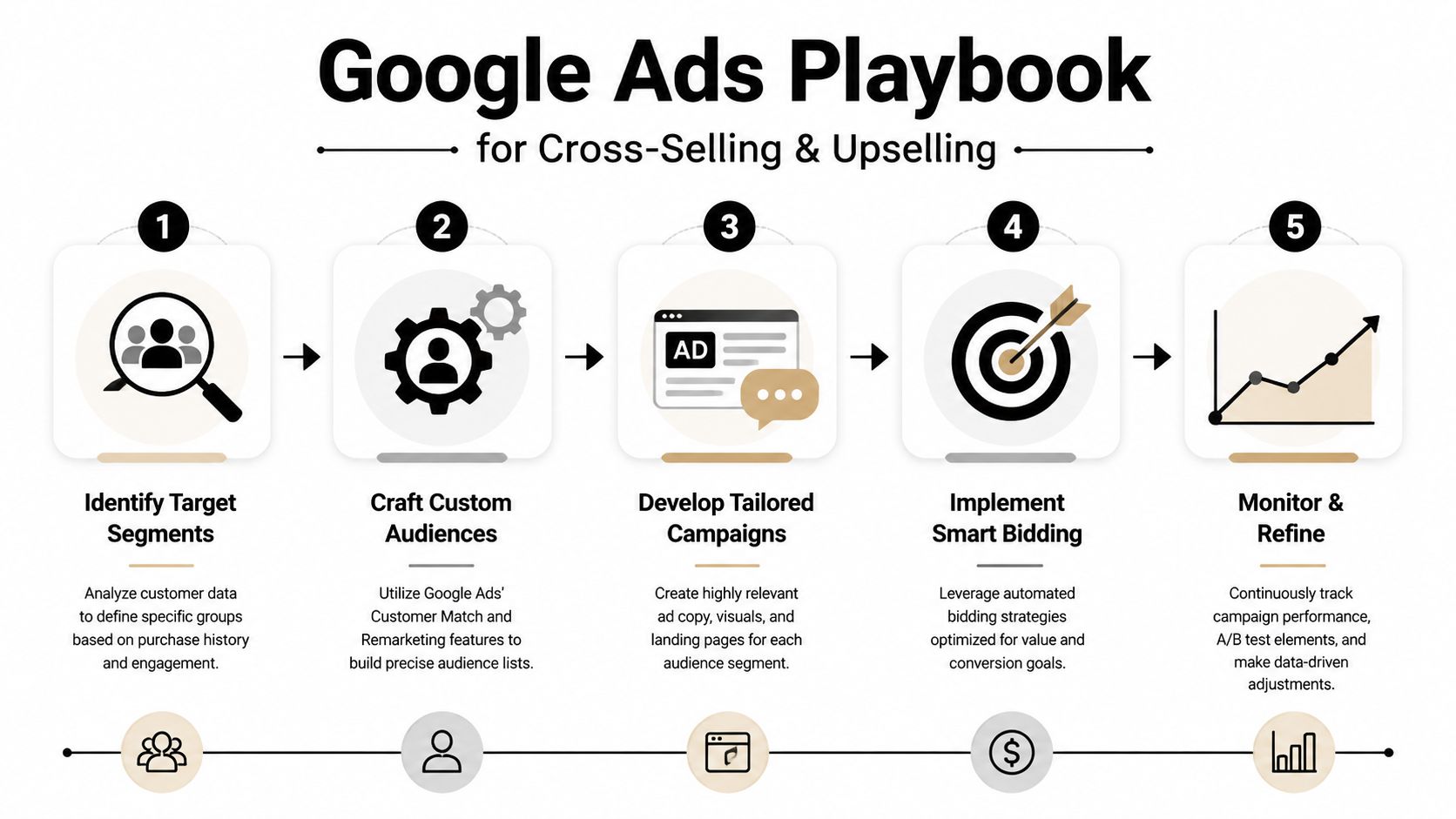
The clean workflow looks like this:
- Identify target segments. Pull customer lists, purchase history, product usage, and recent converters.
- Build custom audiences. Separate buyers by product, plan level, and engagement stage.
- Write specific ad copy. Speak to current users, not cold prospects.
- Match the landing page to the offer. Don't send an upgrade-ready user to a generic homepage.
- Monitor and refine. Keep testing audience, creative, and offer placement.
The practical shortcut is in the search term report. Search terms from existing customer campaigns often reveal adjacent intent you can turn into a new offer. If customers who bought Product A keep searching for Product B, that's a cross-sell clue. If they keep searching for “plan limits,” “features,” or “upgrade,” that's an upsell clue. A tool like Keywordme's remarketing ads examples can help you structure that thinking into cleaner campaign expansion.
You can then spin those signals into focused ad groups instead of stuffing them into one bloated campaign. That keeps messaging tight and makes it easier to spot which offer is doing the work.
The warning sign is overdoing it. Too many offers create friction, and one industry guide explicitly warns that excessive offers can frustrate customers and increase cart abandonment, which is why A/B testing offer placement, pricing, and messaging is critical (CCBill cross-sell vs. upsell guide). Keep the offer count tight, keep the CTA simple, and test one thing at a time.
Use ads to reinforce the next best action, not to dump every possible option on the user. When the search term already tells you what they want, your job is to remove friction, not add more of it.
Measuring Success and Avoiding Common Pitfalls
The scorecard for expansion revenue should be simple. For cross-sells, watch attach rate, revenue per order, and how often complementary products are added. For upsells, track upgrade rate, plan expansion, and the effect on account value over time. If you only watch top-line revenue, you'll miss whether the motion is healthy.
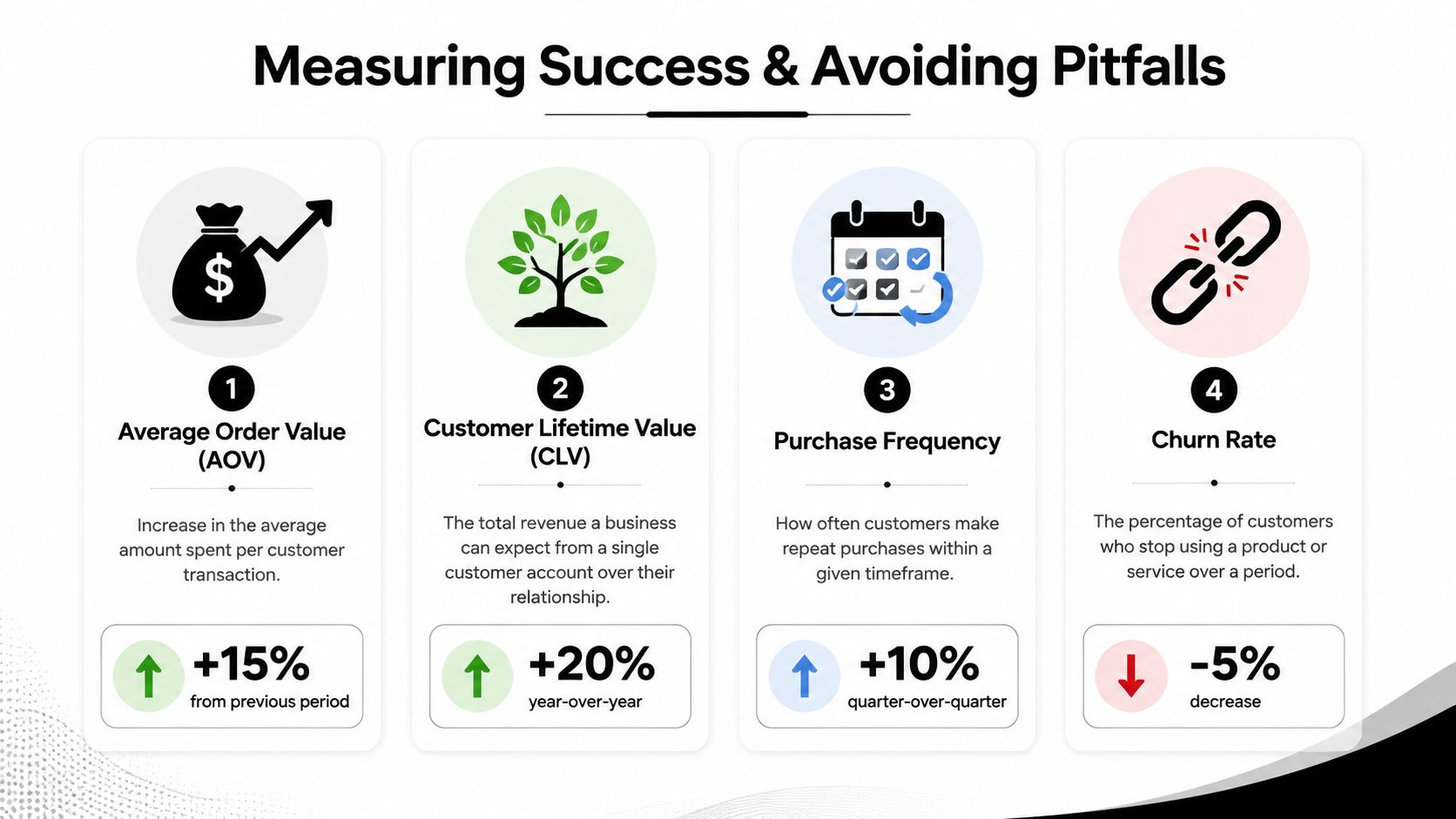
The big mistake is pushing offers too early. A cross-sell should be logically adjacent to the original purchase and should emphasize added value, with the clearest rule being to cross-sell after diagnosing a remaining problem, not before (BigCommerce on upselling and cross-selling). That's what keeps the recommendation from feeling opportunistic.
Another common miss is using the same offer for everyone. A customer at the edge of a usage limit needs a different pitch than a first-time buyer. A buyer looking for complementary accessories needs a different landing page than a user who just wants a higher tier. If you don't separate those intents, you'll blur the message and lower the response.
The final mistake is flooding the buyer with choices. Too much choice can create decision overload, and that's where good revenue ideas turn into abandoned carts or ignored emails. Tight offers, clear timing, and clean relevance usually beat cleverness.
If you want a simple launch checklist, use this:
- Match the offer to the need. Don't cross-sell or upsell until the gap is obvious.
- Track the right metric. Use attach rate for cross-sell and upgrade rate for upsell.
- Test the delivery. Try different placements, pricing cues, and message angles.
- Protect the customer experience. Remove extra offers when they add friction.
If you're ready to turn search terms, customer behavior, and campaign data into cleaner expansion revenue, start with Keywordme and see how much faster your Google Ads workflow gets. Keywordme helps you spot high-intent terms, organize them into actionable campaign structure, and move from wasted clicks to smarter cross-sell and upsell opportunities. Visit it today and build the next layer of revenue from the customers you've already earned.
.svg)