
How to Improve ROI: Boost Ad Performance in 2026
How to Improve ROI: Boost Ad Performance in 2026


SEO Title: How to Improve ROI in Google Ads
Meta Description: Learn how to improve ROI with better tracking, attribution, audits, ads, landing pages, and bidding decisions that lift profit, not vanity metrics.
The report looks ugly, but the workload behind it is very real. Search terms reviewed, bids adjusted, ads refreshed, landing pages tweaked. Then you open performance by campaign and the return still looks flat, or worse, softer than last month.
That's where a lot of PPC teams live. Busy account, constant motion, weak margin.
Most advice on how to improve ROI goes straight to tactics. Change match types. Write sharper headlines. Cut broad match. Test a new offer. Some of that helps. Some of it just creates more movement without fixing the actual leak.
The hard truth is that ROI problems usually start upstream. If attribution is wrong, tracking is noisy, and budgets are being judged on front-end conversions alone, you can optimize all day and still steer the account in the wrong direction.
Your ROI Is Sinking But Your Workload Is Not
There's a familiar pattern in underperforming accounts. The team is doing a lot, but the account isn't learning from the right signals. You end up optimizing for what the platform can show easily, not for what the business keeps.
That gap is bigger than generally acknowledged. A critical 2024 industry finding reveals that 65% of businesses fail to generate any ROI from their digital marketing efforts according to Exposure Ninja's marketing ROI analysis. That isn't a minor efficiency problem. It points to broken strategy, weak audience targeting, and bad measurement discipline.
Why busy accounts still lose money
A lot of campaigns don't fail because nobody touched them. They fail because the wrong things got attention.
- Vanity conversion focus: Leads come in, but sales quality is uneven and nobody feeds that back into bidding.
- Channel siloing: Paid search gets judged in isolation while email, branded search, and direct traffic collect the final credit.
- Misaligned teams: PPC optimizes for form fills, sales optimizes for pipeline quality, and finance wants margin.
If that last point sounds familiar, it helps to tighten the operating model before touching bids. Good sales and marketing alignment strategies usually fix more ROI leakage than another round of headline testing.
Practical rule: If sales says the leads are weak and marketing says conversions are up, you don't have a traffic problem. You have a measurement problem.
What actually changes ROI
The accounts that improve profit usually do three things well:
| Focus area | Weak approach | Strong approach |
|---|---|---|
| Measurement | Last-click only | Multi-touch and stable conversion data |
| Spend control | Reactive cuts | Search term discipline and tighter intent control |
| Scaling | Raise budget fast | Increase budgets carefully and watch revenue efficiency |
That's the path for how to improve ROI. Start with truth in the data. Then remove wasted spend. Then push harder on what converts cleanly and profitably.
Fix Your Measurement Before You Touch a Campaign
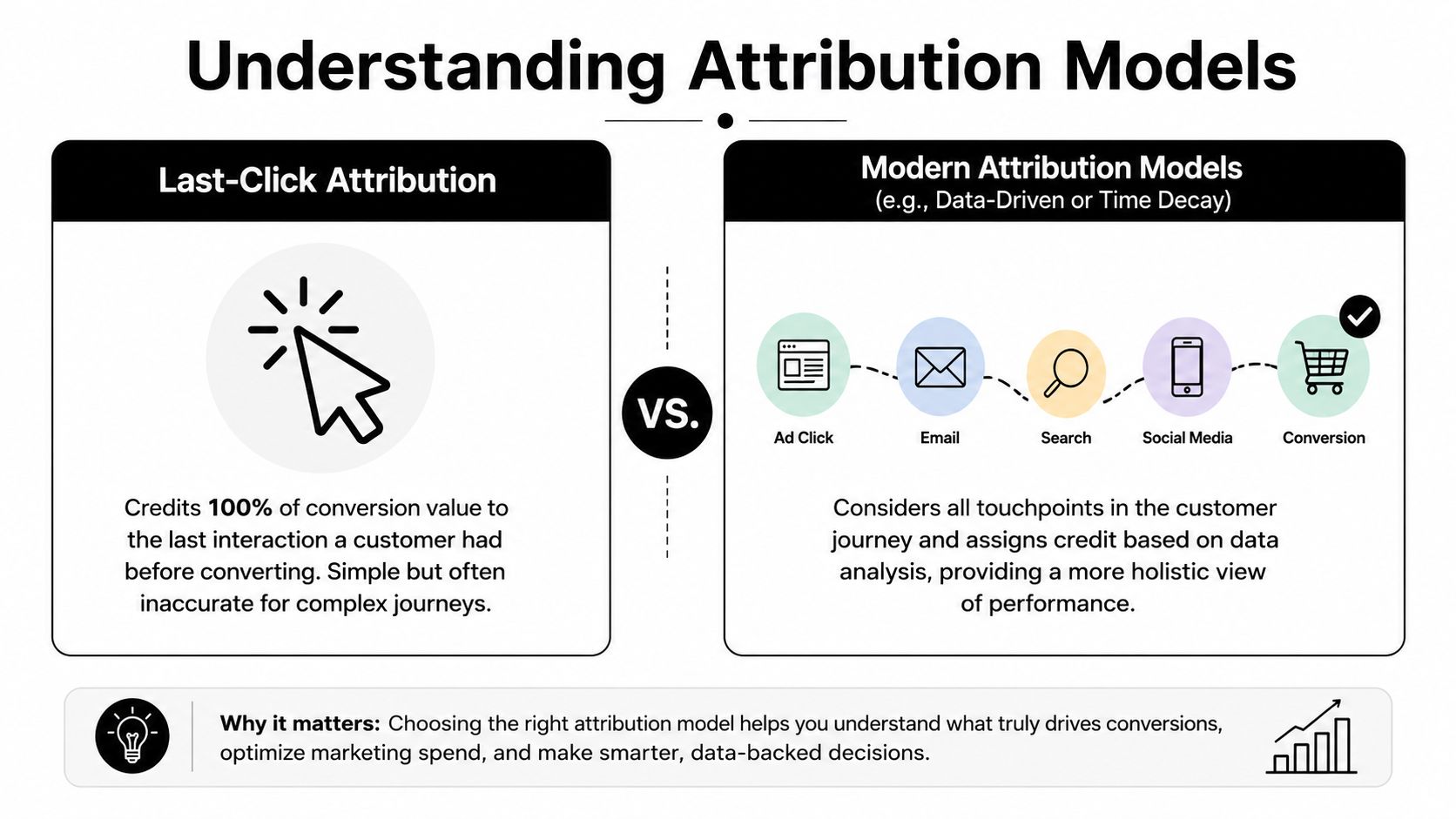
Most PPC accounts still make budget decisions with a last-click mindset, even when the sales cycle is messy and multi-touch. That model is convenient. It's also one of the fastest ways to cut channels that are contributing significantly behind the scenes.
Data shows that 60-70% of conversion value is lost under last-click models. A 2025 study found that shifting to position-based attribution revealed a 35% higher ROI for content marketing campaigns previously deemed ineffective, according to SegMetrics' attribution research.
Last click lies in plain sight
Last-click attribution gives all credit to the final interaction before conversion. In a simple purchase path, that can be fine. In most real accounts, it creates bad budget calls.
Here's what usually happens:
- Top-funnel campaigns look weak: Generic search, YouTube, paid social, and educational content appear to underperform.
- Brand and retargeting look heroic: They mop up demand that earlier touches created.
- Budget gets cut in the wrong place: Demand creation shrinks, then branded volume falls later.
If you're trying to learn how to improve ROI over more than one reporting window, this matters a lot. Short-term efficiency and real business efficiency aren't always the same thing.
Pick a model that matches the sales cycle
You don't need an academic framework. You need a model that reflects how customers buy.
- Last click: Useful only when the path is short and low consideration.
- Position-based: Strong option when you want to value discovery, evaluation, and conversion.
- Data-driven: Best when volume and data quality are strong enough to trust the model.
A good companion read is this digital strategy ROI guide, especially if you're trying to connect ad performance to broader business return instead of platform metrics alone.
Last click is easy to read and expensive to trust.
Tracking has to be stable before bidding can work
Bad tracking wrecks optimization twice. First, it gives you dirty reporting. Then it feeds dirty signals back into Smart Bidding.
The fix is technical, but the logic is simple. Clean first-party signals beat shaky browser-side tracking. That's why server-side tagging and Enhanced Conversions matter. If your setup is inconsistent, your bidding model starts learning from noise.
One practical place to tighten the basics is your Google Ads conversion tracking setup. Before touching bidding strategy, verify that primary conversions, values, and deduplication rules reflect the business outcome you care about.
A quick measurement gut check
Ask these before making any campaign change:
- Would sales agree this conversion is valuable?
- Would finance agree the reported return reflects margin, not just volume?
- Would the path still make sense if you removed the final branded click?
If the answer is no, your reporting is flattering the account. It isn't helping it.
The Foundational Audit That Uncovers Wasted Spend
Once measurement is credible, go hunting for waste. Many accounts find easy wins by doing so, not because the strategy was terrible, but because search query control drifted over time.
The most common leak is still the Search Terms Report. Teams look at campaign-level numbers, assume intent is clean, and miss the junk sitting underneath. Broad match can be useful, but broad match with weak controls is where budget drains away.
Start inside the Search Terms Report
Pull search terms by cost, conversions, and conversion value. Then read them like a buyer, not like a platform user.
You're looking for three buckets:
- Irrelevant intent: Queries that were never going to convert.
- Mismatched intent: Terms related to your offering, but wrong stage, wrong urgency, or wrong user.
- Weak modifiers: Searches that need tighter wording through negatives or different match types.
Maximizing ROI demands using phrase match and exact match keywords alongside broad match to control search queries, reducing spend on irrelevant clicks, while negative keywords must be actively added to exclude non-converting terms, as explained in LSEO's guide to advanced Google Ads ROI strategy.
Match types should create boundaries
A lot of low-ROI accounts have the same shape. Too much broad match, not enough negative coverage, and ad groups carrying mixed intent.
This cleanup is usually less about adding more keywords and more about controlling who gets in.
| Audit area | What to look for | What to change |
|---|---|---|
| Broad match terms | Loose semantic matches | Add negatives, split proven queries into phrase or exact |
| Phrase match terms | Good intent with some drift | Tighten ad copy and expand negatives |
| Exact match terms | Clean intent but weak return | Review offer, page, and bid strategy |
For teams that want a clearer framework, these digital attribution models are useful because query cleanup makes more sense when you understand which touchpoints deserve protection.
Audit the account like an operator
A clean audit doesn't need to be fancy. It needs to be consistent.
- Sort by wasted cost first: Start where the account is bleeding money.
- Review negatives at multiple levels: Campaign, ad group, and shared lists all matter.
- Split proven search terms into their own structures: Don't let high-intent queries sit buried in mixed ad groups.
- Check if ad copy matches the query bucket: Tight intent deserves tight messaging.
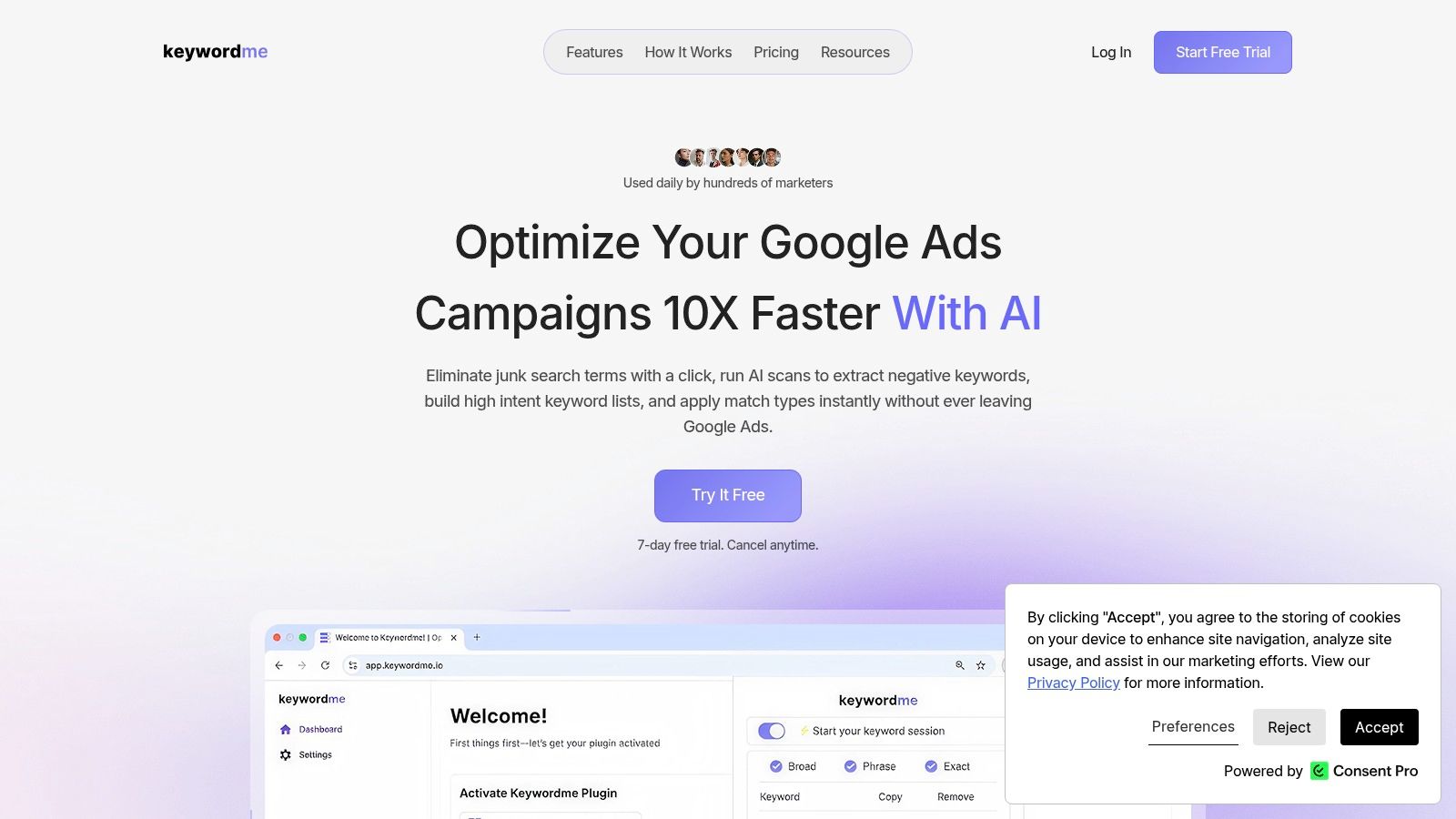
For larger accounts, manual cleanup gets slow fast. Tools can help if they reduce repetitive work. Keywordme is one option. It works inside Google Ads through a Chrome extension, helping teams review search terms, add negatives, and apply match types without all the spreadsheet copying. If you need a more structured process before using any tool, this PPC audit workflow is a solid starting point.
Audit lens: Don't ask whether a query got clicks. Ask whether you'd want ten more of the same user.
Crafting Ads and Landing Pages That Convert
Stopping waste helps, but ROI won't move enough if the traffic that should convert still hits friction after the click. At this stage, the account either compounds value or throws away qualified intent.
A buyer searches, sees your ad, clicks because the promise is relevant, and lands on a page that should feel like a continuation of the same conversation. Too often it feels like a handoff between two teams that never spoke.

Message match is where good clicks go to survive
Strong ad copy doesn't just chase CTR. It pre-qualifies. It tells the right person “yes” and the wrong person “not this one.”
That means the headline, offer, and CTA on the page need to echo the promise in the ad. Not with identical wording every time, but with the same intent.
A few examples of where accounts lose the thread:
- Ad says “book a demo today” and the page opens with a long brand story.
- Ad says “pricing for teams” and the landing page hides pricing context.
- Ad targets a niche use case and the page is generic enough for everyone.
If your conversion path feels disconnected, fix the handoff before you buy more clicks. This guide to PPC landing pages is useful when you need to tighten that ad-to-page continuity.
The click has expectations
When someone arrives from a commercial-intent query, they usually want a few things answered fast:
- Is this for me
- What happens next
- Can I trust this
- How much work is the conversion
That's why the boring improvements often outperform clever ones. Cleaner forms. Sharper headlines. Better CTA labels. Fewer competing links. Clearer proof near the decision point.
The landing page doesn't need to impress everyone. It needs to remove doubt for the person who already raised their hand.
A simple way to review a page is to compare what the ad promised with what the first screen delivers. If the user has to scroll to find the thing they clicked for, the page is already making the sale harder than it should be.
Here's a useful walkthrough on page thinking in action:
Write ads for fit, not just volume
The best-performing ads in serious accounts often aren't the loudest. They're the clearest.
Try this progression:
| Weak ad pattern | Better ad pattern |
|---|---|
| Generic feature list | Specific problem and outcome |
| Broad promise | Buyer-stage-specific promise |
| Click-hungry CTA | Intent-matching CTA |
If the query is exploratory, write for curiosity and relevance. If the query is transactional, write for confidence and speed. That shift alone can clean up lead quality because the ad starts filtering traffic before the form ever sees it.
Advanced Bidding and Budgeting for Maximum Returns
A lot of advertisers sabotage bidding by asking automation to solve data problems or by forcing aggressive return targets too early. Smart Bidding can be excellent, but it isn't magic. It needs clean signals, enough stability, and room to learn.
The better approach is staged. To improve ROI in Google Ads, start with manual or Target CPA bidding. Once conversion data is stable, switch to Target ROAS, but avoid setting unrealistic targets that can throttle reach. Scale budgets by 10–20% every few days while monitoring performance, based on guidance from Attribution App's Google Ads ROAS and ROI framework.
Why high ROAS targets can backfire
This is one of the most common mistakes in mature accounts. Performance gets tight, someone raises the ROAS target hard, and volume falls off a cliff. The campaign may look cleaner for a moment, but reach shrinks and the account loses momentum.
That happens because the system gets more selective. Sometimes that's good. Sometimes it means the campaign stops entering enough auctions to find profitable demand at scale.
A better way to think about bidding:
- Manual or Target CPA: Use these when conversion data is still settling.
- Target ROAS: Use it when values are reliable and conversion quality is well defined.
- Parallel tests: Compare bidding approaches across similar campaigns instead of replacing everything at once.
Field note: If changing the bid strategy causes volume to collapse immediately, the account was probably leaning on a target the market couldn't support.
Budget changes should be boring
When spend increases too quickly, efficiency often softens before the account adjusts. That doesn't mean scaling is wrong. It means aggressive scaling hides the point where marginal traffic gets weaker.
Keep the review anchored to revenue quality, not platform excitement.
A practical budget review looks like this:
- Increase gradually: Small changes are easier to read.
- Watch query quality after each increase: More spend can widen intent.
- Check whether conversion value holds: More conversions alone can fool you.
- Pause and stabilize if CPC pressure rises without return support: Don't force growth when the auction is already resisting it.
Bidding works only when the account is ready
The account has to earn its way into more automation. If tracking is shaky, search intent is messy, or the landing page still leaks qualified traffic, a more advanced bidding strategy just automates bad assumptions faster.
That's the trade-off nobody likes admitting. Automation saves time, but only after the account gives it clean conditions to work with.
Your ROI Improvement Checklist and Quick Wins
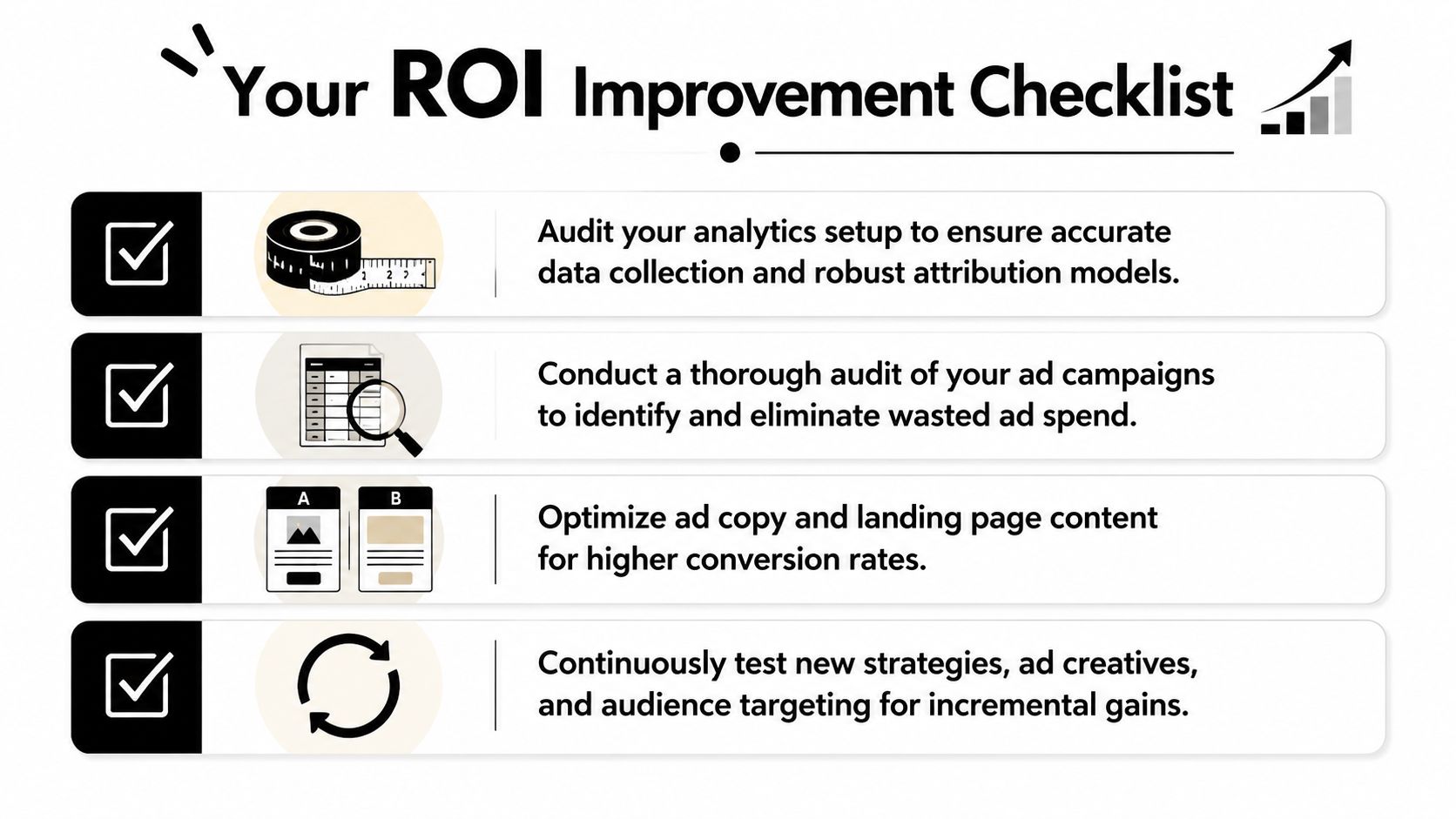
Most ROI gains don't come from one heroic change. They come from a stack of smaller decisions made in the right order. If you want a practical way to improve performance this week, keep the checklist tight and operational.
The checklist I'd run first
- Validate conversion truth: Make sure the primary conversion reflects business value, not just easy volume. If sales wouldn't celebrate it, don't optimize to it.
- Review attribution logic: If branded search keeps taking all the credit, look upstream before cutting awareness or non-brand campaigns.
- Open the Search Terms Report: Find the obvious waste, then tighten negatives and match types around proven intent.
- Check ad-to-page continuity: The offer in the ad should appear fast and clearly on the landing page.
- Review bidding stage: If the campaign still has unstable data, don't rush into return-based automation.
Quick wins that usually matter fast
Some tasks are small but high impact.
| Quick win | Why it helps |
|---|---|
| Build a fresh negative keyword pass from recent search terms | Cuts waste without changing core structure |
| Rewrite one ad group around a single intent theme | Improves relevance and message match |
| Simplify one landing page form | Reduces friction for qualified traffic |
| Split proven queries into tighter match types | Protects budget on high-intent searches |
| Test a more realistic bid target | Restores reach when automation got too restrictive |
None of these are flashy. That's the point. Good ROI work is usually unglamorous and compounding.
Keep the review cadence honest
A lot of teams know how to improve ROI in theory. They struggle because the review process is inconsistent. One week is all bids. The next is all creative. The next is firefighting.
Set a rhythm that separates tasks:
- Measurement review
- Search term cleanup
- Ad and page testing
- Bid and budget review
Do that consistently and the account gets easier to manage because fewer surprises build up underneath.
Better ROI usually comes from fewer blind spots, not more hacks.
The main shift is mental. Stop treating ROI as a front-end conversion score. Treat it like an operating system that connects attribution, traffic quality, conversion quality, and bidding discipline. Once those pieces line up, optimization gets simpler and profit gets easier to defend.
If you spend too much time cleaning search terms, adding negatives, and sorting match types by hand, Keywordme can shorten that workflow inside Google Ads so you can spend more time on strategy and less time on account cleanup.
.svg)