
SEM vs PPC: Key Differences and When to Use Each
SEM vs PPC: Key Differences and When to Use Each


PPC is the pay-per-click model that sits inside SEM, which covers both paid and organic search visibility. Treating the two terms as synonyms is one of the quickest ways to derail a budget meeting.
If your leadership team hands you a quarterly search budget and tells you to ramp up SEM, are they asking you to buy clicks tomorrow morning, or build an organic presence that compounds over the next year? That gap in vocabulary causes real strategy mistakes. Teams end up comparing paid click costs against long-term content investments as if they were the same lever.
Paid search is no longer a minor side tactic. According to TechRT's Google Ads statistics compilation, Google's advertising revenue grew from $51.07 billion in 2013 to $264.5 billion in 2024, while the global search-advertising market was estimated at $168.94 billion in 2024 and U.S. search-ad spending reached roughly $123.6 billion in 2025. With Google holding around 90% of the global search-engine market in early 2026, understanding SEM vs PPC is no longer academic and starts shaping where your money goes. In practice, PPC is the measurable execution layer within your broader SEM plan, where bids, match types, and query data determine what every click costs and which organic pages you should build next.
SEM vs PPC Side by Side
Here is the clean split. Search engine marketing (SEM) is the overarching discipline of earning visibility on search engine results pages, while pay-per-click (PPC) is the specific billing model where you pay an ad platform each time someone clicks your listing.
Why do marketers blur them constantly? Because industry definitions split down the middle. Many practitioners define SEM as the umbrella covering both paid search ads and organic search engine optimization (SEO), while some agencies use SEM as shorthand for paid search alone.
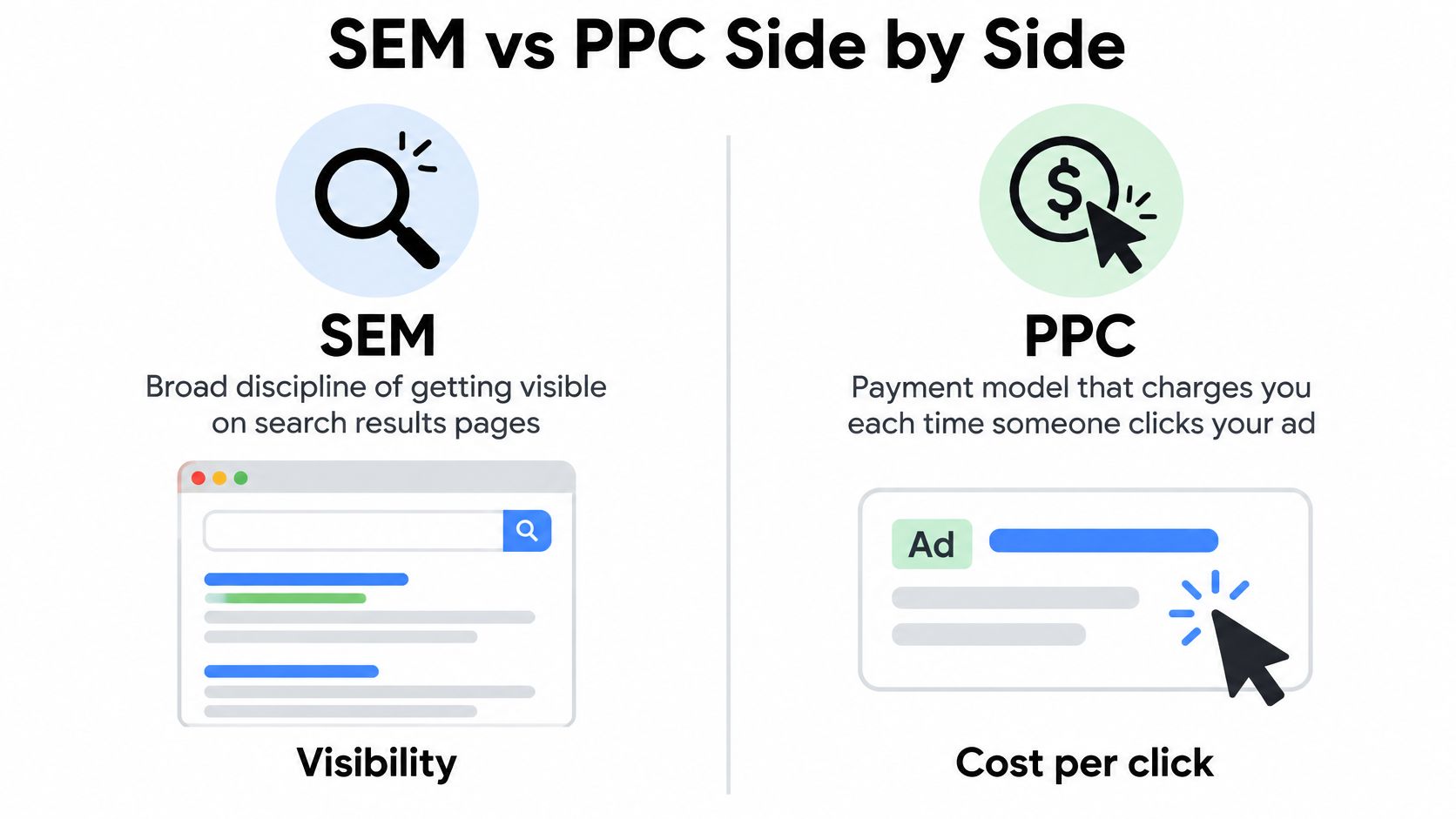
Looking at both side by side makes the operational boundaries obvious before you spend a dollar.
| Factor | SEM | PPC |
|---|---|---|
| Scope | Whole search presence, paid and unpaid | One paid channel inside SEM |
| Pricing | Mixed, depending on tactics | Pay per click won in an auction |
| Speed to visibility | Slow if organic is included | Immediate once the campaign is live |
| Control over placement | Partial, shared with organic rankings | High, set by bids, match types and ads |
| Main metrics | Share of visibility, rankings, traffic | Impressions, clicks, CTR, CPC, conversions, ROAS |
| Best for | Long-term presence and brand reach | Fast, testable demand capture |
How Each Row Plays Out Day to Day
Each row above translates directly into how your week looks. Scope determines whether you are managing a single ad account or coordinating paid listings alongside technical site health and content. Pricing splits between blended overhead for organic work plus media spend for SEM, versus direct per-click auction charges for PPC.
Speed to visibility separates waiting months for organic pages to climb from launching a search campaign that shows up today. Control over placement is split in SEM because algorithms govern organic positions, whereas PPC hands you direct levers over bids, keywords, and ad copy. Main metrics follow suit, moving from broad visibility and traffic share across SEM to granular click, conversion, and return on ad spend (ROAS) tracking inside PPC. Finally, best for divides durable market presence from rapid demand capture you can test on Monday and adjust by Friday.
If you're buying a click, you're doing PPC. If you're planning your whole search presence, you're thinking SEM.
Carry that rule into your next planning meeting. Which of those two jobs are you doing this week?
How PPC Fits Inside Search Engine Marketing
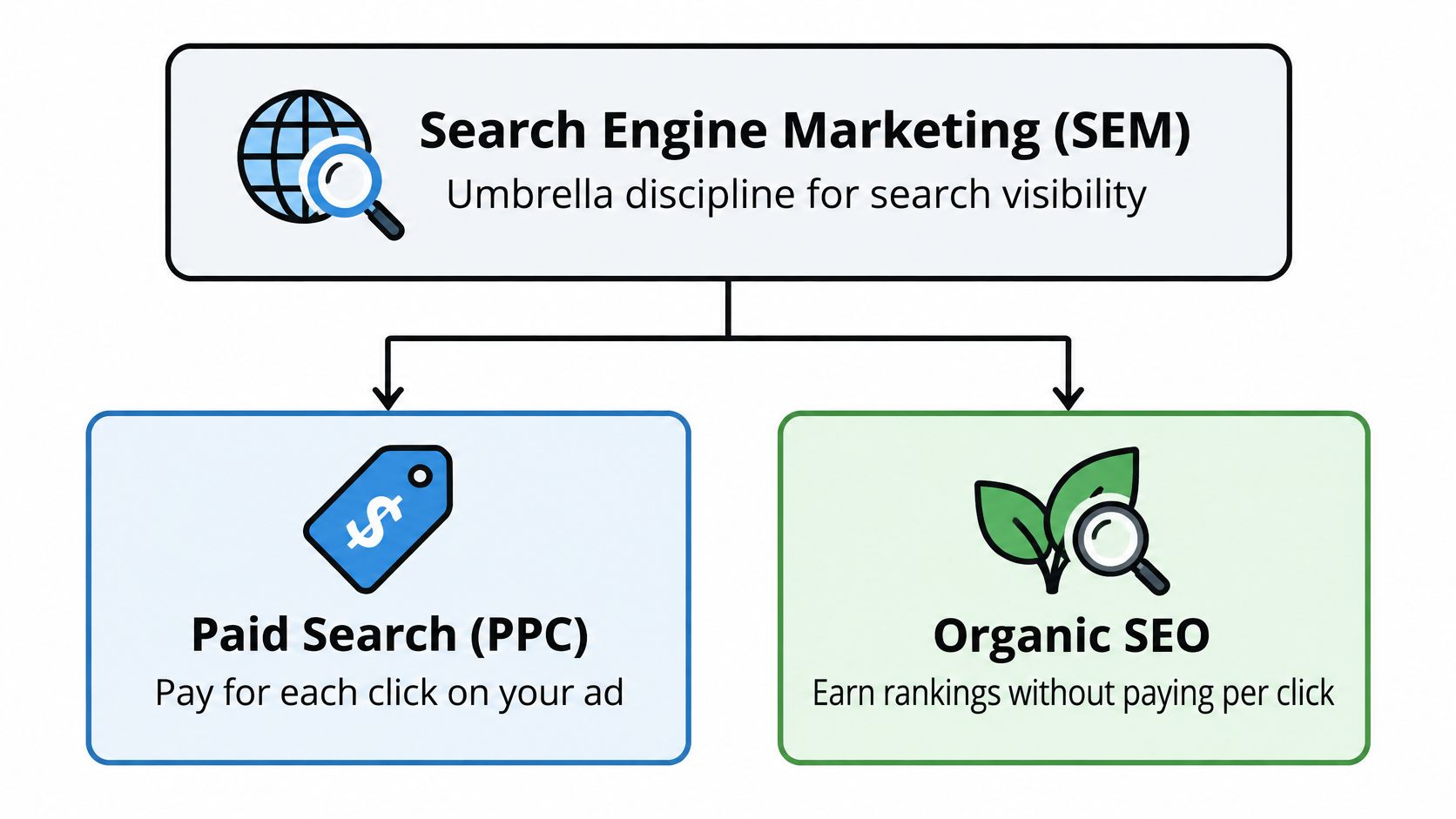
Think of SEM as the roof and paid search plus organic SEO as the two pillars holding it up. Both sit on the exact same search results page, competing for the same searcher's attention, just through completely different mechanics.
Here is how that hierarchy fits together visually.
How Paid Clicks Took Over Search
The split between SEM and PPC isn't accidental. As BeBusinessed's history of paid search documents, the modern PPC model started back in 1998 when GoTo.com rolled out paid listings where advertisers bid for placement and only paid when a user clicked. GoTo.com rebranded as Overture and was later acquired by Yahoo.
Google followed in 2000 with AdWords, originally charging on a cost-per-thousand-impressions basis before shifting to the click-based auction system that grew into Google Ads. Adoption exploded fast, with AdWords surpassing 100,000 advertisers by 2003. Paid search stopped being a weird experiment and became a core customer acquisition engine almost overnight.
Say an online running-shoe retailer wants to own searches for marathon footwear. Their SEM strategy combines two plays: publishing a detailed shoe-fitting guide to earn unpaid organic rankings, while running PPC campaigns on commercial terms like "buy carbon plate running shoes." On a local level, Helbling Digital Media's breakdown on getting found above Cincinnati competitors illustrates how regional businesses pair paid visibility at the top of the page with their broader search footprint.
For a short visual walkthrough of how these search channels intersect inside a modern marketing plan, watch this overview.
What Actually Decides Your Ad Placement
Inside that SEM umbrella, PPC acts as the execution layer where search terms, match types, negatives, and ad-group structure determine where every budget dollar lands. Plenty of beginners assume PPC is a blunt pay-to-win auction where the biggest wallet always grabs spot number one. That's not how Google's auction works.
Every time someone runs a search, Google calculates Ad Rank on the fly. According to U.S. Department of Justice antitrust filings detailing Google's ad auction, Ad Rank combines your bid with auction-time estimates of expected click-through rate, ad relevance, and landing-page experience, measured against minimum Ad Rank thresholds for each slot. A tight ad paired with a fast, relevant landing page can beat a sloppier competitor bidding more, and an ad with a positive bid can still fail to appear if it misses the threshold.
Keyword matching controls whether your ad even enters that auction in the first place. Per Google Ads documentation on keyword matching options, broad, phrase, and exact match types set how closely a user's query must align with your keyword. Google also treats broad-match near-duplicates like "red car" and "car red" as the same keyword, automatically entering whichever version carries the higher Ad Rank. Account structure and match-type discipline therefore control your auction eligibility long before you touch a bid slider.
How Control, Speed and Cost Split SEM and PPC
The sharpest trade-off in SEM vs PPC comes down to time versus marginal cost. PPC buys placement immediately through a live auction, charging you for every single click. Organic search earns placement over time through technical accessibility, content depth, and site authority, without a meter running on each visit.
Because paid clicks cost real money every day, traffic volume means nothing on its own. Efficiency metrics decide whether an account prints profit or drains cash. Looking at LocalIQ's analysis of 16,446 campaigns reported by Search Engine Land alongside WordStream's 2025 Google Ads benchmarks covering more than 16,000 Google Ads and Microsoft Ads campaigns shows exactly what advertisers are paying right now.
| Metric | 2025 average | What it tells you |
|---|---|---|
| Click-through rate | 6.66% | How often a shown ad earns a click |
| Cost per click | $5.26 | Up 12.88% year over year, so auctions are getting pricier |
| Conversion rate | 7.52% | Up 6.84% year over year, so click quality is improving |
| Implied cost per conversion | About $70.00 | CPC divided by conversion rate, close to the reported $70.11 cost per lead |
Reading the Auction Math Without Falling for Averages
Those numbers tell a clear story about rising auction pressure. As Search Engine Land's breakdown of the 2025 benchmark report highlights, average cost per click (CPC) climbed 12.88% year over year to $5.26, while average conversion rate rose 6.84% to 7.52%. Combine that $5.26 CPC with a 7.52% conversion rate and you land right around $70.00 per conversion, nearly identical to the reported $70.11 average cost per lead.
When clicks get nearly thirteen percent more expensive in a single year, you can't absorb the hike by bidding harder. You have to protect conversion quality by cutting sloppy broad-match queries that rack up paid clicks without bringing in qualified buyers.
Even more important, never manage your account against blended averages. Segment your benchmarks by:
- Campaign and query intent: Branded terms, high-intent commercial searches, and competitor bids carry wildly different click prices and conversion rates.
- Device type: Mobile callers looking for emergency service behave nothing like desktop researchers comparing enterprise software.
- Geography: A click in a dense metro area with twenty bidders costs far more than the exact same keyword in a mid-sized town.
- Conversion action: Comparing a newsletter signup against a booked sales call inside one blended cost per lead hides where your budget is leaking.
Using Paid Query Data to Guide Organic Priorities
Smart SEM teams don't keep PPC and SEO in separate silos. Use PPC for urgent, high-value commercial terms where tight messaging and fast split-testing pay off right away. Lean on SEO for informational and long-tail queries where paying for every click month after month would wreck your margins.
Then let the two channels feed each other. Any search query showing strong paid conversion rates, healthy acquisition costs, and steady volume belongs at the top of your SEO content roadmap for a dedicated landing page and strong internal linking. Flip that logic around too: when your site already holds top organic rankings for a non-urgent query, you can often dial down PPC bids on that term and redeploy cash toward gaps where you don't rank yet.
How to Measure PPC Without Fooling Yourself
Here is the trap almost every paid search account falls into eventually: an attributed conversion is not the same thing as a conversion your ad caused.
Platform dashboards love taking full credit for sales that were already halfway across the finish line. Before you double a budget because Google Ads reports a flashy ROAS, you need to understand how credit gets assigned behind the scenes.
Why Attribution Reports Overstate Paid Search
Once conversion tracking is active, Google Ads attribution documentation explains that attribution reports map the touchpoints a customer interacts with before converting, applying an attribution model to divide credit across those steps. Google's data-driven attribution spreads credit using historical conversion patterns for that specific action, whereas older last-click logic hands everything to the final ad clicked.
Neither model solves the core blind spot of observational tracking. Recent incrementality research from Stella's 2025 DTC digital advertising incrementality benchmarks states plainly that multi-touch attribution cannot reliably separate ad-driven conversions from conversions that would have happened anyway.
Picture a returning customer typing your brand name into Google. Your branded search ad sits at the very top, right above your number-one organic listing. They click the ad out of habit and check out. Your PPC dashboard logs an easy, cheap conversion, even though you just paid for a visitor who was already heading to your site for free. Setting up clean cross-channel tracking, such as a solid GA4 attribution setup for lead tracking from Digital Skyrocket, helps align platform numbers with real pipeline, while a structured approach to paid search analytics keeps your reporting grounded in revenue rather than vanity clicks.
Running a Holdout Test Without a Data Science Team
You don't need a PhD or enterprise modeling software to test whether paid search clicks generate net-new business. Start by splitting branded queries and non-branded queries into separate campaigns so brand demand stops disguising weak cold-traffic performance.
Next, run a straightforward geo-based holdout or controlled pause test:
- Pick two groups of comparable regions that share similar historical traffic and conversion volume.
- Pause your branded search campaign, or drop non-branded spend sharply, in the test regions for two to four weeks while keeping control regions steady.
- Track total site revenue and leads across all channels (organic, direct, and paid combined) in both sets of regions, not just the numbers inside Google Ads.
- Calculate incremental profit by comparing the actual revenue drop against the ad spend you saved.
Reality check: If a campaign looks phenomenal on attributed dashboard numbers but total business revenue barely flinches when you pause it, treat that attributed return as an upper ceiling, not a forecast you can scale.
Where AI Search Fits in the SEM vs PPC Split
Every agency and in-house team is hitting the same wall right now. Google AI Overviews and AI Mode are reshaping how results pages look, while Google expands ad placements directly into those AI-generated experiences. The operational headache is simple: standard analytics and ad reports still don't cleanly isolate performance inside AI surfaces from traditional search results.
That leaves a real budget question that classic SEM vs PPC textbook definitions never anticipated. Where do you book the spend, and who owns the results?
Teams generally fall into one of three camps:
- Manage AI visibility as PPC: You treat AI-surface placements as auction-driven, click-priced inventory inside Google Ads, judging them by paid clicks, conversion rates, and cost per acquisition alongside standard Search and Performance Max campaigns.
- Manage AI visibility as SEO: You focus on earning citations inside AI answers through clean technical structure, clear entity signals, and authoritative content, tracking organic referral visibility and brand mentions instead of media spend.
- Treat AI search as a separate SEM line item: You carve out a dedicated budget and measurement bucket covering both paid AI placements and organic citation work, tracking impression share, assisted conversions, and incremental revenue across AI-mediated journeys.
Keep perspective before ripping up your current media plan. According to Search Counsel Co's review of SEO, SEM, and PPC traffic data, a cited study found organic search still drove 42.75% of website traffic while AI search engines accounted for roughly 0.32%. AI surfaces matter strategically and deserve active measurement, but pulling major budget out of proven search campaigns today would be premature.
A Ten-Query Audit You Can Run Today
Because platform reporting still lumps AI impressions and clicks into broader campaign rows without consistent labels, start by building your own manual baseline before shifting budgets.
Pick ten of your highest-intent commercial queries. Search each one manually, record whether an AI Overview or AI Mode block triggers, and log three things in a simple spreadsheet: whether your brand shows up in a paid ad, whether your site gets cited organically inside the AI answer, or whether you are missing entirely. Pair that manual SERP log with tools from DBotMaker's guide to tracking ChatGPT brand mentions so you can spot where competitors are winning visibility outside traditional blue links.
Zoom back out to the core framework. SEM is still the overarching search plan, PPC is still the pay-per-click billing model, and AI surfaces are a placement and measurement question inside that plan, not a fourth competing definition.
How to Trim Search Terms and Stop Wasted Spend
Winning an auction doesn't help you if the search query itself had zero buying intent. That's where negative keywords earn their keep.
According to Google Ads documentation on negative keywords, negative keywords block your ads from entering auctions for unwanted searches. Google supports broad, phrase, and exact negative match types in Search campaigns, and they work differently from positive keywords. With the default negative broad match, your ad won't show if the search includes every word in your negative keyword, even when those words appear in a different order.
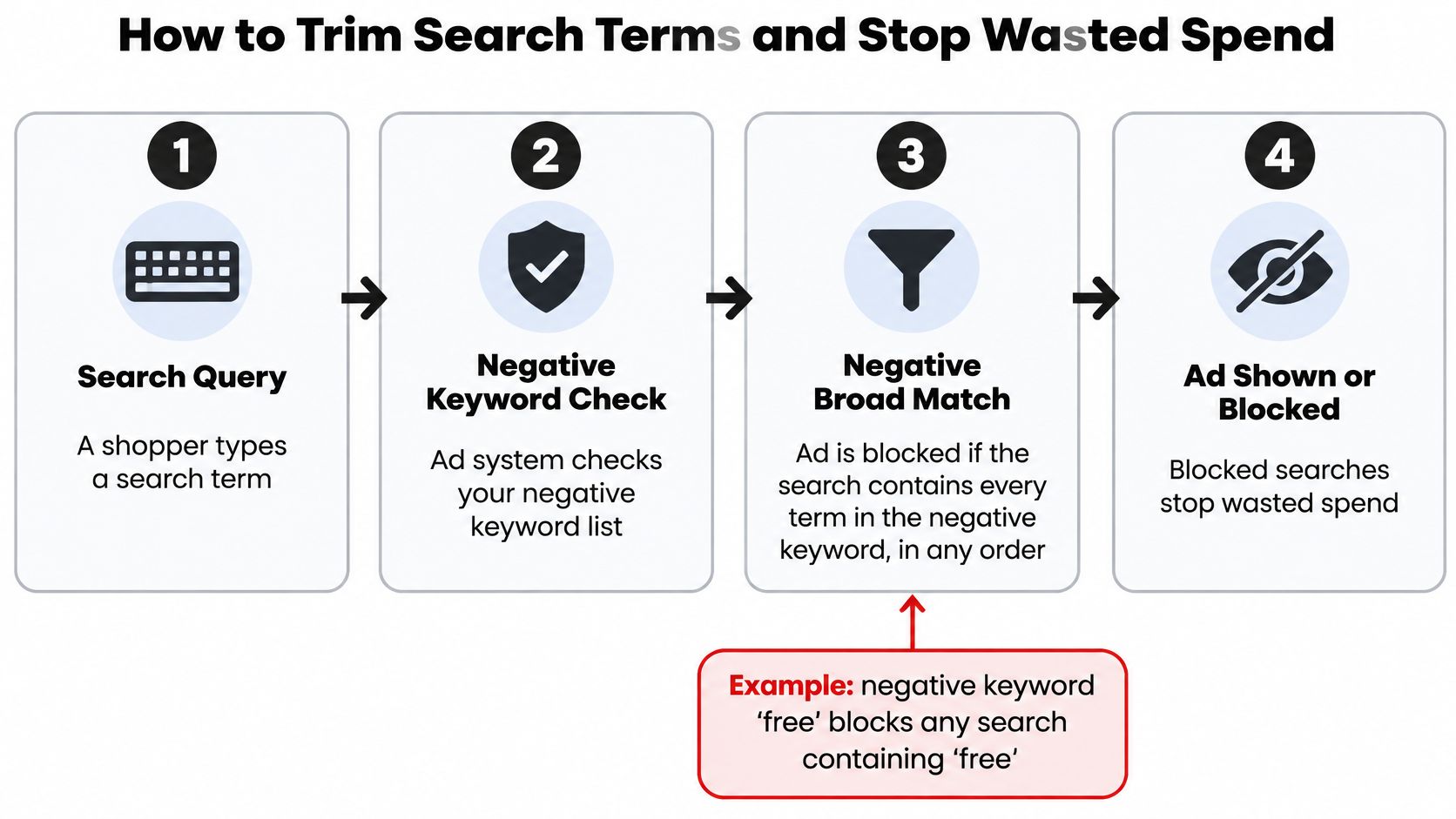
The Six-Step Search Term Cleanup Routine
Bid adjustments alone won't rescue a messy query stream. Run this repeatable workflow to tighten your search terms report every couple of weeks.
- Pull the last 30 days of search terms. Start with a thirty-day window so you capture enough click volume to spot real patterns without letting bad queries bleed cash for a full quarter. Sorting by cost descending puts your biggest leaks at the top immediately. A common slip here is filtering only by clicks instead of spend, which hides expensive, low-volume terms draining your daily cap.
- Isolate queries with spend and zero meaningful conversions. Flag anything burning budget without generating leads, sales, or strong assisted activity. Don't panic over a single cheap click with no conversion yet; look for queries that have burned past your normal conversion threshold or clearly mismatch your offer.
- Bucket every flagged query by intent. Tag each wasted term as irrelevant (wrong product completely), informational (how-to research), competitor (someone hunting for another brand's login or support), or low-intent ("free," "DIY," "jobs," "cheap"). Tagging reveals why your targeting is drifting, which is far more useful than randomly blocking single phrases.
- Apply negatives at the right match type. Add single-word junk modifiers like "free" or "salary" as broad negatives, while blocking nuanced misreads as phrase or exact negatives. Always double-check that a broad negative won't accidentally choke off your highest-converting variations. If you need a refresher on match behavior and list structure, read our walkthrough on how to add negative keywords properly.
- Promote your winners to exact or phrase match. Cleanup isn't only about cutting waste. When you spot a specific search term converting reliably inside a broad-match ad group, pull it out and add it directly as an exact or phrase match keyword so you can assign ad copy written for that query and priority bids.
- Review the impact fourteen days later. Log your spend share on non-converting queries before and after the cleanup so you can verify that conversion rate climbed without strangling qualified impression volume.
Doing steps two through five inside native spreadsheets turns into tedious copy-and-paste work fast. We built Keywordme to strip out that manual friction: on our Pro plan, you can run AI scans to extract negative keywords, build negative or positive keyword lists with a single click or a drag of the mouse, configure match types instantly, and remove junk search terms from your report with one click or a quick mouse highlight, alongside search term-based campaign expansion, help center access, and chat support.
What a Clean Report Looks Like After Thirty Days
Give this routine a full month of consistent passes and your search terms report changes dramatically. Instead of half your budget scattering across student research, competitor support lookups, and bargain hunters, the bulk of your spend concentrates on recognizable commercial variations that actually match your landing pages.
Cleanup target: After four weeks of steady pruning, most of your top-spending search terms should look like exact phrases a paying customer would type right before requesting a quote or pulling out a credit card.
Which Channel to Lead With in Real Situations
Definitions are handy, and benchmarks give you guardrails, but at some point you have to decide where next month's budget goes first. The smartest SEM vs PPC call depends entirely on your timeline, your existing organic footprint, and how urgent the buyer's problem is.
Matching Five Common Scenarios to the Right Starting Channel
Use this lookup table to map your immediate business goal to the channel that should carry the early load.
| Situation | Lead with | Why it works |
|---|---|---|
| New product launch | PPC first, SEO later | Fast visibility and quick tests of offers and messaging |
| Evergreen informational questions | SEO first, PPC for gaps | Organic clicks avoid recurring cost on long-tail demand |
| Seasonal promotion with a deadline | PPC | Budget and timing can be changed in days |
| Local service with urgent demand | PPC plus local organic listing | Captures high-intent calls and bookings |
| Branded search defense | PPC, tested with holdouts | Protects brand results but may cannibalize organic clicks |
Each scenario solves a different constraint:
- New product launch: Nobody is searching for a brand-new category name yet, and your product pages haven't built organic authority. Leading with PPC lets you test headlines, pricing angles, and landing pages within weeks, proving which messages convert before your content team spends months chasing rankings. Exploring the practical benefits of PPC helps clarify how fast-feedback ad tests double as market research.
- Evergreen informational questions: Paying per click for top-of-funnel questions like "how to calculate warehouse pallet spacing" burns cash fast because conversion rates on research queries are naturally low. Let organic articles carry that recurring demand, and use targeted paid campaigns only to patch commercial gaps where your pages haven't reached page one yet.
- Seasonal promotion with a deadline: If you're pushing a Black Friday bundle or a ten-day tax-season offer, SEO can't react fast enough. PPC lets you push bids up on Monday, swap promo extensions on Thursday, and pause the entire push the minute the clock runs out.
- Local service with urgent demand: When a homeowner's water heater bursts at 7 a.m., they aren't reading long guides. Pairing high-intent local PPC ads with an optimized local organic profile puts your phone number in front of ready-to-book callers while building instant credibility through reviews.
- Branded search defense: Competitors love bidding on your company name to siphon warm buyers. Running a lean branded PPC campaign protects the top of the results page, provided you validate it with a regional holdout test so you know you aren't paying endlessly for clicks your organic homepage would have caught anyway.
Your Pre-Budget Checklist Before Spending a Dollar
Before you lock in next quarter's search split, run through four quick checks so your campaign doesn't drift off course:
- Name the primary objective. Confirm in writing whether this campaign exists for immediate demand capture, long-term organic coverage, or a phased handoff from paid into organic.
- Stress-test your top ten queries against margin. Compare what you expect to pay per conversion against your real unit profit, using industry benchmarks only as a rough sanity check rather than a promise. If a click price math-checks poorly before launch, adjust the offer or shift those keywords to SEO.
- Mark one holdout candidate ahead of time. Decide before scaling spend which branded or overlapping campaign gets a controlled pause test, so you measure true incremental lift instead of trusting platform ROAS blindly.
- Lock a thirty-day review on the calendar. Set a firm date one month post-launch to stack attributed dashboard metrics next to your search terms cleanup logs and holdout results.
Keeping that ongoing PPC hygiene tight doesn't require bouncing between exported CSVs and external dashboards. The Keywordme plugin works directly inside Google Ads, so you never have to leave your account to prune junk queries or expand winning ad groups, and at $12 per seat per month for the Pro plan, the math is straightforward when weighed against even a handful of wasted search clicks.
Pick the one scenario from the table above that matches your next campaign, align your team on whether you're executing PPC or planning full SEM, and put that thirty-day review date on the calendar today.
Ready to turn your Google Ads search terms report into a repeatable cost-control engine without leaving your account? Our Chrome plugin lets you clean up junk queries, build formatted negative and positive keyword lists in one click, and expand high-converting ad groups straight inside Google Ads. Visit Keywordme to start your seven-day free trial and cut wasted ad spend on your next cleanup pass.
