
Search Ads vs Display Ads: Which Drives Better Results?
Search Ads vs Display Ads: Which Drives Better Results?


The biggest difference between search ads and display ads is pretty straightforward: Search ads capture existing demand, while display ads create new demand. You use search ads to be there the moment someone is actively looking for what you sell. You use display ads to get your brand in front of people who don't even know they need you yet.
Breaking Down Search Ads vs Display Ads

Trying to choose between search and display advertising can feel overwhelming, but it really boils down to your main objective. Are you trying to get sales right now from customers who are ready to buy, or are you playing the long game and building brand awareness? Figure that out, and you’ll know which path to take.
Here’s an easy way to think about it. Search ads are like setting up shop in a bustling farmer's market where people are actively hunting for fresh produce. They’re already in a buying mindset. Display ads, on the other hand, are like putting up a billboard on a major highway. You're grabbing people's attention while they're on their way to do something else entirely, hoping your message sticks with them for later.
Both are incredibly effective, but they play completely different roles in your marketing strategy.
Choosing the Right Ad Type for Your Goal
Search campaigns are your heavy hitters for performance-based goals. When someone types "emergency plumber near me" into Google, their intent is sky-high. They have an urgent problem. A simple text ad at the top of the search results answers their need directly, making a click and a phone call almost a sure thing.
Display campaigns are all about planting seeds. These ads pop up on websites, apps, and videos all over the Google Display Network, which reaches over 90% of internet users worldwide. An eye-catching banner for a new clothing line on a popular fashion blog introduces the brand to potential shoppers before they’ve even thought about buying a new outfit.
For a quick reference, here’s a look at how they stack up side-by-side.
Search vs Display At a Glance
This table breaks down the core differences to help you make a quick decision.
Remember, this isn't about which one is better, but which one is right for what you need to achieve right now.
The fundamental choice isn't about which is "better," but which is right for your immediate objective. For bottom-of-the-funnel conversions, search ads are unmatched. For top-of-funnel brand building, display ads are essential.
Ultimately, search ads are tactical. They target users with clear commercial intent, which makes them incredibly good at driving immediate action and generating a clear return on investment. If your budget is tight and you need to make sales today, search is almost always where you should start. Once that’s running smoothly, you can start using display ads to fill the top of your funnel and create your customers of tomorrow.
Capturing Demand vs. Creating It
The whole search ads vs. display ads discussion really comes down to one simple question: Are you capturing demand that’s already there, or are you creating it from the ground up? Getting this right is everything. It dictates your strategy, how you spend your money, and what you can realistically expect in return.
Search ads are all about capturing demand. Think of it as a 'pull' strategy. You’re showing up for people who are already looking for what you offer. They have a problem, a question, or a need, and they've gone straight to Google to find a solution.
When someone types "best running shoes for flat feet" into Google, they aren't just killing time. They have a specific, immediate problem. They’re in buy-mode (or at least serious research mode), which makes them an incredibly valuable audience.
The Power of High Intent
This is exactly why search ads are so darn effective for driving sales and leads. You don't have to convince anyone they have a problem. Your job is to show up with the best solution at the very moment they’re looking for it.
The numbers back this up. Search ads consistently blow display ads out of the water on conversions, with an average conversion rate of 3.17% compared to just 0.46% for display. It’s a huge difference, and it all comes down to that active, mission-driven mindset. People clicking search ads want an answer, which means higher-quality traffic that actually converts.
Your search ad isn't an interruption; it's the answer to a question someone is actively asking. This is why it’s the undisputed champion for bottom-of-funnel conversions.
Creating Demand with Display Ads
Display ads, on the other hand, are all about creating demand. This is a 'push' marketing strategy. You’re putting your brand in front of people while they’re busy doing other things, like reading a blog, checking the weather, or watching a video.
These users aren't searching for you. Your ad is an interruption, which means it has to be visually interesting enough to catch their eye and plant a seed. You’re essentially introducing a solution to a problem they might not have even realized they had yet.
Picture someone scrolling through a tech blog. They might see a banner ad for a new smart home gadget. They weren't looking for it, but now they know it exists. That’s a classic top-of-funnel move.
When Push Comes to Shove
Since display ads aren’t triggered by search queries, they rely on targeting people based on their interests, demographics, and online behavior. This is a form of contextual advertising, where the ad aligns with the website's content or the user's profile.
With this "push" approach, you have to set different expectations. The click-through rates and immediate sales will almost always be lower than search. And that's perfectly fine, because the goal isn't always an instant conversion. Display ads are brilliant for other things, like:
- Building Brand Awareness: Getting your name and message in front of a massive audience.
- Remarketing: Bringing back people who visited your site but didn't take action.
- Generating Buzz: Introducing new products and sparking initial interest.
So, think of it this way: a search ad is a direct answer to a need, while a display ad is a conversation starter. It’s about building familiarity so that when that person does have a need, your brand is the first one they remember.
How You Reach People: Targeting and Ad Formats
So, how do you actually get your ads in front of the right people? The real difference between search ads and display ads comes down to their targeting methods and what the ads themselves look like. Think of one as a sniper rifle for capturing active demand and the other as a billboard for creating it.
Search ads are simple, text-based ads that pop up on a search results page. They look almost identical to the organic results, just with a small "Sponsored" label. Their real power isn't in flashy design but in their razor-sharp, keyword-driven targeting. You're not guessing what people want; you're directly answering their questions.
Laser-Focused Targeting with Search Keywords
Keywords are the bread and butter of search advertising. You bid on the exact words and phrases you believe your ideal customer is typing into Google when they're looking for what you sell.
It’s like being a mind-reader. When someone searches "CRM software for small business," you can show them an ad that speaks directly to that exact need. That perfect match between their problem and your ad is what makes search so incredibly powerful.
But it’s not just about the keywords you target—it’s also about the ones you avoid. This is where negative keywords become your secret weapon.
Adding negative keywords tells Google which search terms you don't want to trigger your ads. It's one of the single most effective ways to stop wasting money on irrelevant clicks and unqualified traffic.
For instance, if you sell high-end running shoes, you’d probably add "free" and "cheap" as negative keywords. This keeps you from showing up for bargain hunters who were never going to buy your premium product anyway.
Painting a Picture with Display Targeting
While search is all about precision, display is about reaching broader audiences. Here, you're not targeting keywords; you're targeting people based on who they are, what they like, and where they go online. Visually, these ads are your playground—you can use eye-catching banners, slick animations, or even short video clips.
Your targeting options are incredibly rich and varied:
- Demographics: Aim for users based on age, gender, parental status, or household income.
- Interests & Habits (Affinity Audiences): Connect with people based on their long-term passions, like "home decor enthusiasts" or "avid marathon runners."
- In-Market Audiences: Find people who are actively researching a purchase in your category, like someone "in the market for a new car."
- Topics: Show your ads on websites related to specific subjects, such as finance, sports, or technology.
- Placements: You can even hand-pick the exact websites, YouTube channels, or apps where you want your ads to show up.
You can get really strategic with this. For a deeper look at these options, check out our full guide to Google Ads audience targeting.
The Real Power of Display: Remarketing
Maybe the most potent weapon in the display marketer's arsenal is remarketing. This tactic lets you show ads specifically to people who have already visited your website or used your app. It's your second chance to win them over.
Someone checked out your pricing page but didn't sign up? You can follow them with a display ad that offers a free trial. They abandoned their shopping cart? A visual reminder of that exact product can pop up while they’re browsing a news site, giving them a gentle nudge to finish what they started.
At the end of the day, your choice comes down to your goal. For grabbing immediate, high-intent customers, the keyword targeting of search ads is unbeatable. But for building brand awareness, creating new demand, and re-engaging past visitors, the creative formats and people-focused targeting of display ads are the perfect tools for the job.
Analyzing Budgets, Bids, and Expected ROI
Alright, let's talk money. When you’re staring down the barrel of search ads vs display ads, the first thing that jumps out is the price tag. Clicks on search ads almost always cost a lot more than clicks on display ads, and for a very good reason. It all boils down to user intent and what you're really paying for.
Search ads come with a premium because you're buying a premium moment—the exact second a potential customer is actively hunting for a solution. You aren't just bidding on keywords; you’re bidding for the attention of someone with a problem they need to solve right now. This high-intent traffic is just plain more valuable, so it’s naturally more expensive.
Display ads, on the other hand, are all about reach and getting your name out there. You’re showing your ad to people who are just browsing content online, not actively searching for what you sell. Since the intent is much lower, the cost per click is a whole lot cheaper, letting you get your brand in front of a massive audience without breaking the bank.
Cost Per Click: A Tale of Two Funnels
The cost difference is pretty stark. On average, a click on a display ad will run you about $0.63, while a search ad click averages $2.69 across most industries. That gap—where display is over 4x cheaper—makes total sense when you think about its top-of-funnel role. Still, users who click display ads are 50% more likely to convert than your typical organic traffic, so the spend can definitely pay off.
You pay more for a search ad click because you're paying for qualified intent. You're not just buying a click; you're buying a spot in line to solve a customer's immediate problem.
Think of it like real estate. A search ad is like renting a storefront in a busy downtown shopping district where everyone is there to buy something. A display ad is like putting up a billboard on a major highway—you’ll reach tons of people, but most are just passing through. Both have their place, but that downtown spot costs more for a reason.
Measuring Success: Return on Investment
So, if search ads cost more per click, how do they often deliver a better return on investment (ROI)? The magic is in the conversion rates and your cost per acquisition (CPA). A display campaign might rack up thousands of cheap clicks, but a well-tuned search campaign is far more likely to turn those clicks into actual sales or qualified leads.
For any business focused on direct response, like an e-commerce store or a local service provider, search ads almost always deliver a more efficient ROI. Sure, you pay more upfront for each click, but because those clicks come from highly motivated people, a bigger chunk of them will convert. This usually leads to a lower overall cost to acquire a new customer. To really nail this down, it's crucial to understand the difference between metrics, and this ROI vs ROAS guide is a great resource for that.
Allocating Your Budget Based on Goals
How you slice up your budget between search and display should be a direct reflection of your goals. There’s no single "right" way to do it, but here are some solid starting points:
- Driving Immediate Sales or Leads: If your main objective is to generate revenue now, put the lion's share of your budget (70-90%) into search campaigns. This laser-focuses your ad spend on capturing people at the very bottom of the funnel who are ready to pull the trigger.
- Building Brand Awareness: Launching a new product or breaking into a new market? A bigger slice of your budget should go to display. A 60/40 split in favor of display can help you build brand recognition and create that crucial future demand.
- A Balanced Funnel Approach: Honestly, the best long-term strategies use both. A balanced budget (think 50/50 or 60/40 favoring search) lets you capture existing demand with search while using display for remarketing and keeping the top of your funnel full. You can dig deeper into managing your Google Ads budgets in our article.
At the end of the day, while display ads offer cheaper clicks and incredible reach, search ads are the true workhorse for generating a direct, measurable return. They justify their higher price by delivering traffic that isn’t just browsing—it’s buying.
Practical Scenarios: When to Use Each Ad Type
Knowing the theory is one thing, but making the right call in the real world is what actually gets results. Let's get practical and break down the specific situations where choosing between search ads and display ads is a no-brainer. It all boils down to your immediate goal.
This simple decision tree lays out the core choice: are you hunting for direct sales, or are you building brand awareness?
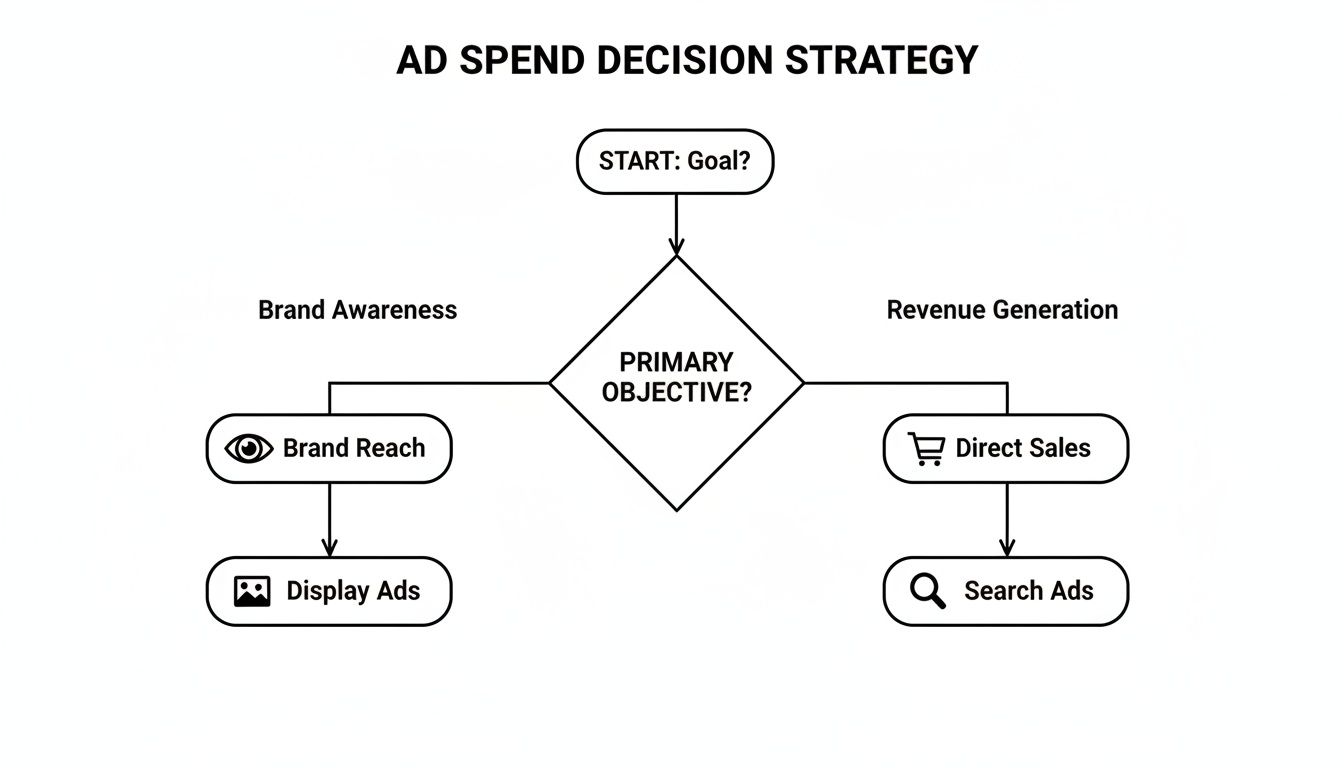
As you can see, the path is pretty clear. If your main objective is to get your brand in front of as many relevant eyeballs as possible, Display is your workhorse. But if you need to drive immediate revenue and grab existing demand, Search is the tool for the job.
When to Go All-In on Search Ads
Search ads are your go-to when you need to connect with high-intent customers who are actively looking for what you sell. Think of them as the closers of your marketing team.
Here are a few scenarios where Search should be your top priority:
- Emergency Services: A plumber, locksmith, or IT repair service lives and dies by urgency. When someone types "emergency plumber near me" into Google, they need help right now. Your text ad at the top of the search results is the fastest way to get that call.
- E-commerce with a Niche Product: If you sell something specific like "vegan leather work boots," you need to be there the moment someone searches for it. Your ad spend is laser-focused on a person with an incredibly high chance of buying.
- Lead Generation for B2B Software: Companies searching for "CRM for small businesses" or "project management software" are in evaluation mode. A well-placed search ad can send them straight to a demo or free trial signup, capturing a super-qualified lead.
- Limited Budgets Needing Fast ROI: If you're a small business and every dollar counts, search ads provide the most direct line to revenue. You’re putting your money where the intent is highest—at the very bottom of the sales funnel.
When Display Ads Are the Smart Choice
Display ads are all about creating demand where it didn't exist before. They’re perfect for introducing your brand to new people and making sure they remember you.
Consider these situations where Display really shines:
- Launching an Innovative Product: Let's say you've created a new gadget no one has ever heard of. The problem? Nobody is searching for it. Display ads let you visually introduce your product to tech enthusiasts and early adopters on the blogs and YouTube channels they already love.
- Building Brand Recognition: For a new online clothing brand, getting your style and vibe in front of fashion-forward audiences is everything. Visual banner ads on popular style blogs build that critical brand recall long before someone even thinks about shopping.
- High-Consideration Purchases: For products with a long sales cycle, like a new car or expensive software, Display is a remarketing powerhouse. You can show ads to people who visited your site, keeping your brand top-of-mind as they do their research over weeks or even months.
The most powerful strategies often don't choose one over the other—they blend both. Use Display to introduce your brand and build an audience, then use Search to capture them when they’re finally ready to buy.
This strategic duo delivers the best results, and the numbers back it up. While search ad spend is projected to hit $137 billion in the US in 2024, display ads dominate in sheer scale, reaching 90% of all internet users. Search click-through rates (averaging 3.17% to 6.42%) are often ten times higher than display's 0.46% to 0.57%, but blending them is the key. You can use display's low average CPC of $0.63 for broad reach and retargeting, then use search ads to convert that warmed-up audience. You can learn more about these Google Ads statistics and what they mean for your strategy.
Making Your Search Ads More Profitable with Keywordme
So, after looking at search ads vs. display ads, you've probably figured out that search is your best bet for grabbing people who are ready to buy. But that's just the first step. The real work—and where the profit is made—is in the day-to-day grind of managing your campaigns.
This is where things can get messy. You find yourself buried in search term reports, trying to figure out which keywords are making you money and which are just burning through your budget. It’s a tedious cycle of exporting data and staring at spreadsheets until your eyes glaze over.
From Data Overload to Decisive Action
The gap between a profitable search campaign and a money pit often comes down to speed. How fast can you react to what the data is telling you? Without a good system, you're stuck manually copying and pasting lists of negative keywords or fumbling to create new ad groups for promising terms. It's slow, full of potential for errors, and distracts you from thinking about actual strategy.
That's the exact headache Keywordme was designed to fix. It's a simple Chrome plugin that works right inside your Google Ads account, turning hours of tedious clicking into a few seconds of work.
Your ability to quickly add negative keywords and expand with proven search terms is what separates a good campaign from a great one. Keywordme helps you do this up to 10x faster, directly impacting your ROI.
A Smarter, Faster Campaign Workflow
Keywordme completely changes how you manage keywords. It lets you take back control of your search campaigns without the usual frustrating manual tasks. You can look at what people are actually searching for and take action right away.
Here’s a quick look at what it does:
- Bulk Negative Keywords: Spot a bunch of irrelevant search terms eating your ad spend? Just select them all and add them as negatives to your campaign or ad group with one click. No more exporting to a spreadsheet.
- Instant Ad Group Expansion: Find a search term that’s converting like crazy and deserves its own ad group? Keywordme lets you create a new ad group and add the keyword instantly—with the right match type—without ever leaving the report.
- One-Click Match Types: You can apply exact, phrase, or broad match types to your keywords straight from the search terms report. This gives you incredibly precise control over your targeting on the fly.
By getting rid of the spreadsheet nightmare, Keywordme helps you stop wasting money on junk traffic and focus your budget on what’s actually working. You'll spend less time on boring tasks and more time making smart decisions that drive up conversions and bring down your cost per acquisition. The end result is a more profitable search campaign that’s a whole lot easier to manage.
A Few Lingering Questions
Still have a few questions? Let's clear up some of the most common things people ask when weighing search ads vs display ads.
Can Search and Display Ads Actually Work Together?
Absolutely. In fact, they work best when you treat them like a tag team. It's the classic one-two punch of digital advertising.
Think of it this way: you can use display ads to get your name out there, build brand recognition, and keep your business top-of-mind with remarketing. Then, when those people are finally ready to buy, your search ads are waiting to capture their business the moment they start looking for a solution.
Which One Should I Use If I Have a Small Budget?
If you're watching every dollar and need to generate leads or sales now, start with search ads. No question. The intent behind a search query is incredibly high, which means your ad spend is laser-focused on people who are already in the market for what you offer.
That kind of precision almost always leads to a faster return on your investment compared to display campaigns. When every penny counts, you need that direct path to revenue.
If you need to bring in money today, search ads are your most direct route. Their intent-driven nature makes them incredibly efficient for any business that needs to see a return quickly.
How Fast Can I Expect to See Results?
This is where the two ad types really part ways. With search ads, you can see traffic, leads, and even sales start rolling in almost immediately. Once your ads get the green light, they're live and ready to show up for relevant searches.
Display ads are a different beast; they're more of a long game. When you're using them for brand awareness, it can take weeks or even months to really see the needle move on brand recall, audience growth, and eventual sales.
Ready to stop wasting money on the wrong search terms and make your Google Ads campaigns more profitable? Keywordme gives you the tools to clean up junk traffic, find high-converting keywords, and optimize your campaigns up to 10x faster. Start your free 7-day trial and see the difference.
.svg)