
What is Contextual Advertising? A Quick Guide
What is Contextual Advertising? A Quick Guide


At its heart, contextual advertising is all about placing ads that make sense right where someone is, right now.
Imagine you're reading a blog post about the best sourdough starter recipes. You look over to the side of the page and see an ad for a new Dutch oven. It just fits. That’s the magic of contextual advertising—it targets the context, not the person.
What Is Contextual Advertising, Really?
So, what’s going on behind the scenes? It's a refreshingly simple and privacy-friendly way to connect with people. Instead of digging into someone's past browsing history, this method focuses entirely on the content they’re looking at in that very moment.
The process is pretty straightforward. An ad platform's tech scans the webpage, figures out what it's about by analyzing its text and keywords, and then—bam!—it serves up an ad that’s a perfect match for the topic. If you're reading a review of the latest hiking boots, you'll probably see ads for outdoor gear, not lawnmowers.
This classic approach is making a huge comeback, and for good reason:
- It’s not creepy. Since it doesn't need personal data or third-party cookies, it sidesteps that unsettling feeling of being followed around the internet.
- It catches people at the right time. You're reaching someone when a topic is already on their mind, which makes them far more likely to be interested in what you have to say.
- It's built for the future. With browsers dropping third-party cookies and privacy rules like GDPR getting tougher, contextual advertising is a solid, sustainable path forward for advertisers.
In a world where everyone's thinking more about data privacy, contextual targeting is becoming the smart choice. A recent survey found that a whopping 79% of consumers would rather see ads that relate to the page they're on than ads based on their browsing history.
This is more than just staying on the right side of regulations; it's about building a better, more respectful ad experience. When brands focus on the content people choose to read, they create a more positive connection with their audience. It’s an old-school idea that’s perfectly suited for the modern internet.
How Contextual Targeting Actually Works
Ever wonder how an ad for a new vegan cheese brand seems to pop up right next to that vegan lasagna recipe you're reading? It’s not a coincidence, but a clever, super-fast process that happens in the time it takes the page to load.
Here's the breakdown. The moment you land on a webpage, an ad platform's tech gets to work, scanning the page's content. Using some pretty sophisticated natural language processing (NLP), the system zips through the text, keywords, and even the overall tone to figure out what the page is really about. In our example, it flags concepts like "vegan," "plant-based cooking," and "lasagna recipe." This part is all about the content, not about you.
With that context figured out, the system then plays matchmaker. It scans its inventory of ads to find one that fits, like our dairy-free cheese brand whose campaign is targeting those exact topics. The most relevant ad gets served up, all in a fraction of a second. The best part? It all happens without needing to know a single thing about you personally.
This image really drives home the difference between targeting the context of the page versus the behavior of the user.
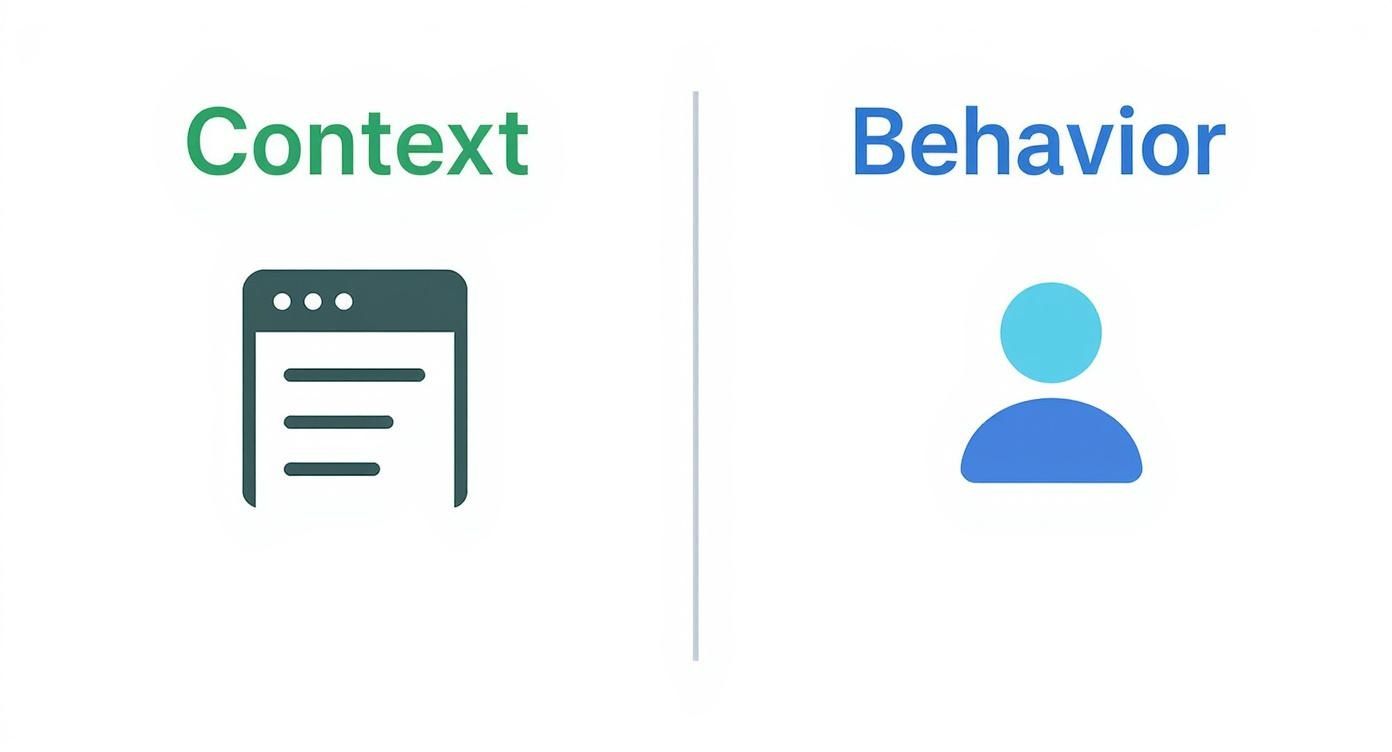
As you can see, the whole game shifts from tracking someone's past actions to simply meeting them where their interest is right now. That’s a huge reason it’s making such a comeback.
The Brains Behind the Ad Matching
This ad-matching process is where the real magic happens. We've moved way beyond simple keyword stuffing; today's systems actually understand nuance and meaning.
- Semantic Analysis: The tech is smart enough to know the difference between "apple" the fruit and "Apple" the tech giant. This ensures your camping gear ad doesn't show up on an article about a different kind of "bear."
- Topic Modeling: It can zoom out to identify broader themes. Instead of just seeing "lasagna," it understands the page is part of a bigger topic like "healthy eating" or "Italian cuisine," opening up more ad opportunities.
- Brand Safety: Crucially, these systems also act as a brand's bodyguard. They actively screen for negative or sensitive content, making sure your ad for kids' toys doesn't appear next to a tragic news story.
By zeroing in on content relevance instead of personal data, contextual targeting is a refreshing and powerful way to approach modern target audience segmentation strategies. It’s a win-win that respects the user while still hitting the advertiser's goals. If you're running campaigns on Google, getting a handle on this is key, and it pays to explore all the different Google Ads audience targeting options to see how they can work together.
Why Is Everyone Suddenly Talking About Contextual Ads Again?
Contextual advertising isn't exactly the new kid on the block, but it's definitely having a major moment. So, what's behind the sudden resurgence? The short answer: privacy.
For the longest time, the digital ad world ran on behavioral targeting. This was all about using third-party cookies to see what you were browsing, what you clicked, and what you bought. It’s why that pair of sneakers you glanced at last Tuesday seemed to stalk you across the internet for a week. It worked, sort of, but it also felt pretty creepy to a lot of people.
Now, that whole system is being dismantled. The era of the third-party cookie is coming to a close as major browsers pull the plug. Add in tough new privacy laws, and it's clear that tracking users' every move is no longer a viable strategy for advertisers.
The “Privacy-First” Revolution
This massive shift has sent marketers scrambling for a new playbook—one that still finds the right audience without being intrusive. And that’s where contextual advertising shines. It’s the perfect hero for this new, privacy-focused era.
The move to privacy-first advertising isn't just a fleeting trend. It's a complete rewiring of how the industry operates. The goal is no longer to chase people based on their digital history but to meet them in the moment, right when their interests are piqued.
This isn't just talk; big market changes are forcing the issue. In the United Kingdom, for example, ad spend is projected to hit a staggering £46 billion in 2025, an 8.2% jump from the previous year. A huge 83% of that market is online, and this growth is happening right as frameworks like GDPR make old-school tracking nearly impossible. You can explore more on this market shift to see just how big the impact is.
At the end of the day, contextual advertising is making a comeback because it's built for the internet of tomorrow. It allows brands to make real connections with people in a way that’s not just effective but also respectful of their privacy.
The Real Benefits of Going Contextual
Okay, so we know contextual ads are great for privacy. But let's get down to brass tacks—what does this strategy actually do for your campaign's bottom line? It’s not just about sidestepping creepy tracking; it’s about gaining a real competitive edge by being smarter with your ad placements.
First off, it just creates a way better experience for the user. Think about it. Instead of an ad for a blender you looked at last Tuesday following you everywhere, a contextual ad pops up right when you're reading a recipe. It feels less like you're being watched and more like a genuinely helpful suggestion.

This kind of perfect timing is what drives real engagement. You're catching people at the exact moment their curiosity is piqued, and that makes them way more open to what you have to say. It’s no surprise that this relevance often translates into much higher click-through and conversion rates.
Stronger Brand Safety and Higher ROI
Here's another huge win: brand safety. Contextual targeting puts you back in the driver's seat, letting you control the digital environment your ads live in. You can make sure your brand only shows up next to content that reflects your values, sidestepping those cringe-worthy placements next to negative or inappropriate articles.
When you add it all up, these perks lead to a much smarter use of your budget.
- Less Wasted Ad Spend: You're not gambling on old user data. You're advertising in a moment of proven, real-time interest.
- Improved User Sentiment: When your ads feel helpful, people feel good about your brand. It's that simple.
- Future-Proof Strategy: Your campaigns won't crumble with the next privacy update or browser change.
At the end of the day, contextual advertising is about sharpening your focus. By zeroing in on a person's immediate mindset, you’re not just interrupting their experience—you're adding value to it. And that almost always leads to a better return on your investment.
Once you have these campaigns humming, knowing how to measure advertising effectiveness is key to proving just how powerful this targeted approach really is.
How AI Is Making Contextual Ads Smarter
Let's be clear: this isn't your grandma's contextual advertising. The tech running behind the scenes these days is incredibly sophisticated, and we have Artificial Intelligence (AI) and Machine Learning (ML) to thank for it.
These aren't just trendy buzzwords. AI has completely changed the game, moving us from simple keyword matching to a much deeper, semantic understanding of content. Think of it like this: an old system could spot the word "apple," but modern AI knows if you're talking about fruit or the latest iPhone.

Today's AI can pick up on nuance, context, and even the emotional tone of a page. This is huge. It means the system can tell the difference between a scary news story about a market crash and a helpful article on smart investment strategies, preventing your ad from showing up in a disastrously wrong spot.
Going Beyond Keywords with Semantic Analysis
This deeper understanding is where AI really flexes its muscles. It opens the door for incredibly granular targeting and real-time tweaks that make ads more precise and effective than ever.
AI has essentially become the brain of modern contextual advertising, giving marketers pinpoint accuracy without creeping on user privacy. In fact, the role of AI in adtech is expected to grow at a 14.3% CAGR from 2025 to 2032. That's because these systems use natural language processing to nail content alignment in a split second.
AI's ability to analyze everything on a page—images, video, audio, the whole shebang—means your ads are placed with surgical precision. It’s the difference between crossing your fingers for relevance and actually guaranteeing it.
This intelligence unlocks some seriously powerful new tricks:
- Sentiment Targeting: Want to avoid negative news? You can tell the system to only place ads on pages with a positive or neutral tone.
- Topic Modeling: Go beyond just one keyword to target broader concepts like "sustainable living" or "home office productivity."
- Predictive Analysis: AI models can even look at a piece of content and predict how well your specific ad will perform there.
While we're focused on contextual ads here, it’s worth understanding the general benefits of AI in marketing to see the bigger picture. And if you're running paid search, checking out how AI is being used for AdWords optimization is a fantastic next step. It's all about getting smarter relevance without making those sketchy privacy trade-offs.
Nail Your Targeting with Keywordme
Getting a contextual ad campaign right really comes down to one thing: fantastic keyword and topic research. This is where the rubber meets the road, and honestly, having the right tool isn't just a nice-to-have, it's essential. This is where a platform like Keywordme comes in, helping you swap out guesswork for a solid, data-backed strategy.
Instead of just skimming the surface with obvious keywords, a good tool lets you dig so much deeper. You can uncover entire topic clusters, related terms, and all those long-tail phrases that your actual audience is using in their searches. This is the stuff great campaigns are built on, letting you create ad groups that are laser-focused and incredibly effective.
From Broad Ideas to Bullseye Accuracy
Let's walk through a real-world example. Say you're selling high-end ergonomic office chairs. Your first instinct might be to target keywords like "office chairs." The problem? That’s casting a super wide net, and it’s not very efficient.
The real goal isn’t just to find an audience; it’s to find the right audience at the exact moment they need you. That means you have to go beyond the basic keywords and get into the topics that signal they’re ready to buy.
Using a tool like Keywordme, you can quickly find out what your ideal customers are actually reading about and searching for. It’s often not what you think.
- Home office productivity hacks
- How to prevent back pain at your desk
- Must-have work-from-home essentials
When you start targeting these contextual categories, your ads pop up in front of people who are already trying to solve the very problem your chair was designed for. That kind of precision is what makes the difference between a campaign that just "works" and one that truly knocks it out of the park.
Got Questions About Contextual Advertising? We've Got Answers.
Even after you've got the basics down, a few questions always seem to surface. Let's run through the most common ones so you can feel totally confident about getting started.
Is This Actually Going to Save Me Money?
You bet. While every campaign is different, contextual advertising is often way more budget-friendly than its behavioral counterpart. Think about it: you're catching people at the exact moment they're interested, which means fewer wasted ad dollars and a much healthier return on your investment.
Another bonus? You’ll often find less competition (and lower costs) when you target niche topics compared to fighting over broad, in-demand audiences.
How Do I Know if It's Actually Working?
Measuring success here is refreshingly straightforward because it’s all about performance. You’ll want to keep a close eye on a few key metrics:
- Click-Through Rate (CTR): Are people actually clicking on your ads when they see them next to certain content?
- Conversion Rate: More importantly, are those clicks turning into sales, sign-ups, or whatever your goal is?
- Cost Per Acquisition (CPA): What’s the final bill for landing each new customer?
By seeing which websites and articles are sending you high-quality traffic, you can ditch the duds and pour your budget into what’s proven to work.
The real secret is to look beyond just the clicks. You're measuring how a person's engagement is influenced by the content around your ad. A high conversion rate from a specific article about, say, "best hiking boots for cold weather," is a massive sign you've struck gold.
Will This Work for My Kind of Business?
Almost certainly. If people are writing, reading, or watching content related to what you sell, you have a place to play. It doesn't matter if it's a blog, a news site, a niche forum, or a YouTube channel.
This approach is a total game-changer for businesses in niche markets. It lets you show up in the very specific corners of the internet where your ideal customers are already geeking out over their interests.
Ready to stop guessing and start targeting with precision? Keywordme gives you the data-driven insights you need to build powerful, effective contextual ad campaigns that connect with your ideal audience. Start your free trial today and see the difference.
.svg)