
12 Best SaaS Marketing Tools to Scale Your Growth
12 Best SaaS Marketing Tools to Scale Your Growth


In the world of SaaS, your marketing stack isn't just a list of subscriptions—it's your engine for growth. The right tools can automate tedious tasks, uncover hidden opportunities, and give you the data needed to make smarter decisions, faster. But with thousands of options, how do you build a toolkit that actually works without blowing your budget?
Finding the perfect mix of saas marketing tools often feels like a full-time job. You need solutions for PPC, SEO, email, analytics, and a dozen other things. The wrong choice means wasted money and missed targets. The right choice, however, can completely change your growth trajectory, giving small teams the power to compete with industry giants. When selecting your stack, it's also smart to consider solutions that align with modern strategies, such as the best product-led growth tools, which focus on user experience to drive acquisition and retention.
This guide cuts through the noise. We're breaking down 12 essential tools across every key category, from managing your Google Ads spend with platforms like Keywordme to analyzing user behavior with FullStory.
Forget generic feature lists. For each tool, you'll get:
- Real-world use cases
- Honest pros and cons
- Clear pricing insights
- Screenshots and direct links
We'll give you the practical details needed to build a powerful, cost-effective stack that drives actual results. Let's dive in and find the perfect tools to fuel your strategy.
1. Keywordme
For PPC marketers drowning in spreadsheets and manual campaign cleanup, Keywordme is an absolute game-changer. It’s a Chrome plugin that works directly inside the Google Ads interface, turning slow, repetitive keyword management into a speedy, almost automated workflow. Its core purpose is to help you stop wasting ad spend and find high-intent keywords faster, all without ever leaving the Google Ads platform. This makes it an essential add-on for anyone serious about optimizing their search campaigns.
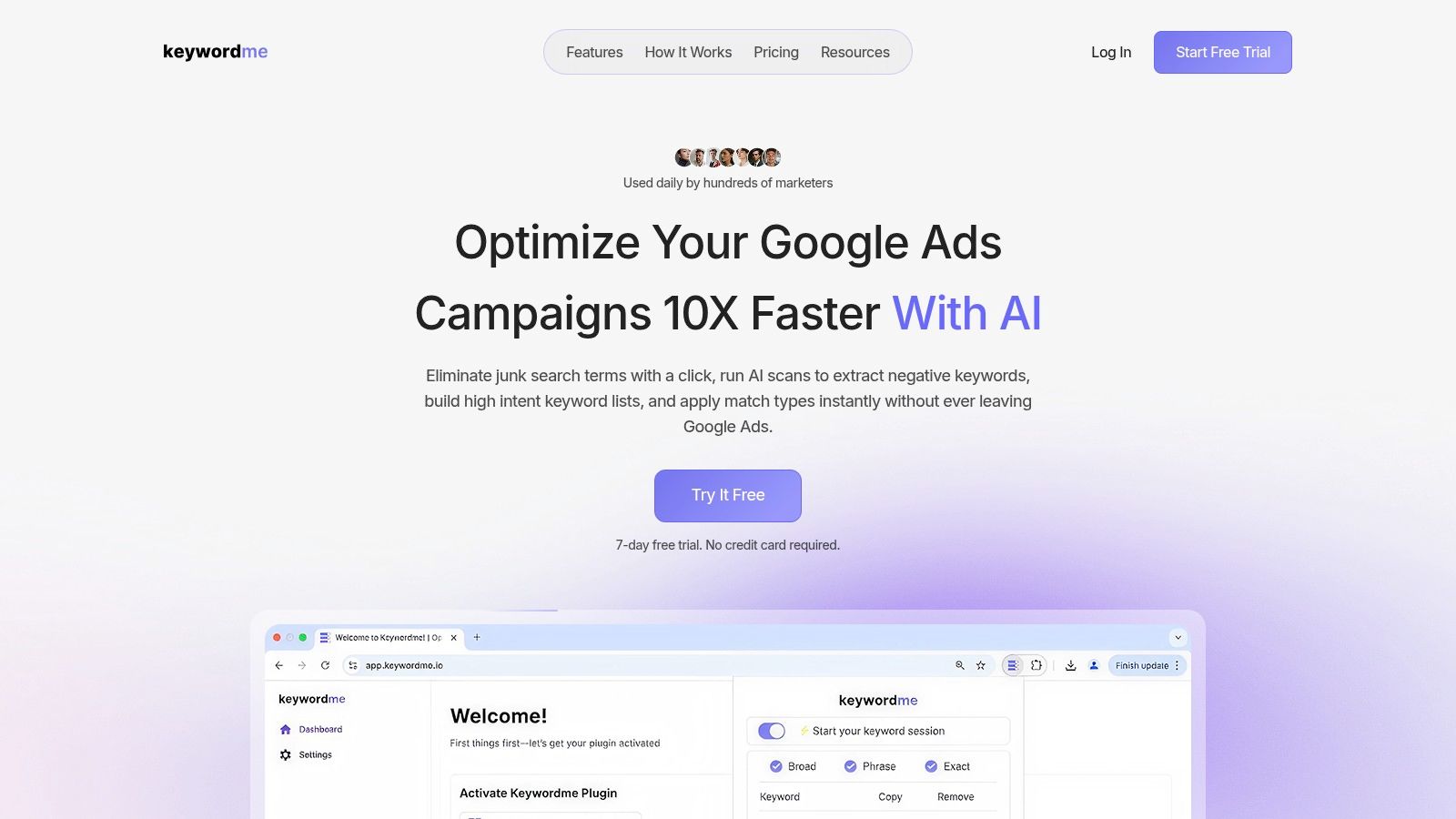
Unlike other PPC tools that require you to export data and analyze it on a separate platform, Keywordme puts powerful controls right where you need them. You can sift through search term reports and eliminate junk terms with a single click, instantly adding them to your negative keyword lists. Its AI-assisted scan is brilliant for spotting irrelevant terms you might have missed, saving you budget that would otherwise be spent on useless clicks. For campaign expansion, you can build new keyword lists from high-performing search terms or the Keyword Planner, apply match types (exact, phrase, broad) on the fly, and even download a fully formatted CSV ready for upload.
“Great tool and a great time saver…must have.” - Mike, Keywordme User
Why Keywordme Stands Out
What makes Keywordme one of the best SaaS marketing tools for PPC is its ruthless focus on workflow efficiency. The bulk features are a standout. You can paste a massive list of keywords, and the tool will auto-format them, remove duplicates, and prepare them for your campaigns. This alone eliminates the tedious copy-paste gymnastics between Google Ads and spreadsheets.
Key Features:
- In-Platform Workflow: Works as a Chrome plugin directly within the Google Ads UI.
- One-Click Negative Keywords: Instantly add irrelevant search terms to negative lists.
- AI-Assisted Scanning: Discovers and suggests negative keywords to reduce wasted spend.
- Bulk Keyword Management: Paste, format, and download large keyword lists without spreadsheets.
- Instant Match Type Application: Quickly apply exact, phrase, or broad match types to new keywords.
Pros:
- Drastically reduces time spent on manual keyword cleanup and list building.
- The in-platform workflow means no more switching between tabs or tools.
- Powerful bulk features accelerate campaign scaling and ad group expansion.
- Simple, affordable pricing at just $12 per seat/month.
Cons:
- It’s a Chrome-only plugin, so users of other browsers are out of luck.
- Focused exclusively on Google Ads, limiting its use for multi-platform campaigns.
You can try it risk-free with a 7-day trial that doesn't require a credit card.
Learn more at Keywordme.io.
2. HubSpot Marketing Hub
HubSpot Marketing Hub is often the first name that comes up when you think of an all-in-one marketing platform, and for good reason. It’s a powerful system that combines email marketing, landing pages, social media management, content creation, and detailed reporting into one package. The real standout feature is its native integration with the robust HubSpot CRM, which gives you a complete, 360-degree view of every contact's journey.

This tight integration means you can build complex automation workflows based on CRM data, like a contact’s lifecycle stage or recent website activity. It’s one of the best SaaS marketing tools for teams that want a single source of truth for all their marketing and sales data. By centralizing everything, you can significantly improve marketing efficiency and get much clearer attribution on what’s actually driving revenue.
Key Features & Considerations
- Best For: In-house marketing teams and agencies needing a unified CRM and marketing automation system.
- Standout Features: The built-in CRM provides a unified contact record, which is a game-changer. Higher tiers offer advanced features like A/B testing, dynamic content personalization, and multi-touch revenue attribution.
- Pros: Having your CRM and marketing tools in one place is incredibly powerful. The platform also has an enormous library of training resources and a huge app ecosystem.
- Cons: The price can escalate quickly as your contact list grows or you add more users. Plus, the mandatory onboarding fees for Professional and Enterprise plans can be a hefty initial investment.
- Pricing: Starts with a free tier with basic tools. Paid plans like Starter, Professional, and Enterprise scale up in features and price significantly.
Website: https://www.hubspot.com/products/marketing
3. Semrush
Semrush is an absolute powerhouse for marketers who live and breathe data. It's a massive suite covering SEO, PPC, content marketing, and competitive intelligence, all under one roof. While others might specialize in one area, Semrush gives you a panoramic view of your entire digital footprint, from tracking keyword positions to analyzing your competitors' ad copy. It’s the kind of tool you open daily to check rankings, research new content ideas, or peek at what your rivals are up to.
The platform truly shines in its ability to connect different marketing functions. You can discover a competitor's top organic keywords, see the ads they're running for those terms, and then use that intelligence to build your own content strategy. This makes it one of the most versatile SaaS marketing tools for teams that need to cover multiple bases without juggling dozens of separate subscriptions. It helps you find and close gaps in your strategy by showing you exactly where your competitors are winning.
Key Features & Considerations
- Best For: SEO specialists, PPC managers, and content strategists who need deep competitive and keyword data.
- Standout Features: The Keyword Magic Tool is exceptional for deep keyword research, including intent and SERP features. Its backlink audit and outreach tools are also top-tier for building a healthy link profile. Newer AI features for content creation and visibility tracking are also notable additions.
- Pros: The sheer breadth of the toolkit is its biggest strength, providing data for nearly every aspect of a digital marketing campaign. It receives constant feature updates and integrates well with other platforms.
- Cons: The interface has a steep learning curve for beginners due to the immense amount of data and features available. The price can also increase quickly with additional users or specialized add-ons.
- Pricing: Offers a limited free plan. Paid plans like Pro, Guru, and Business offer scaling features and data limits based on project needs.
Website: https://www.semrush.com
4. Mailchimp
Mailchimp has long been a go-to for email marketing, especially for small businesses, and it's easy to see why. Its platform is incredibly user-friendly, allowing new users to jump in and create professional-looking email campaigns without a steep learning curve. While it started with email, it has grown into a broader marketing platform with automation, basic CRM functionality, and landing page creation.
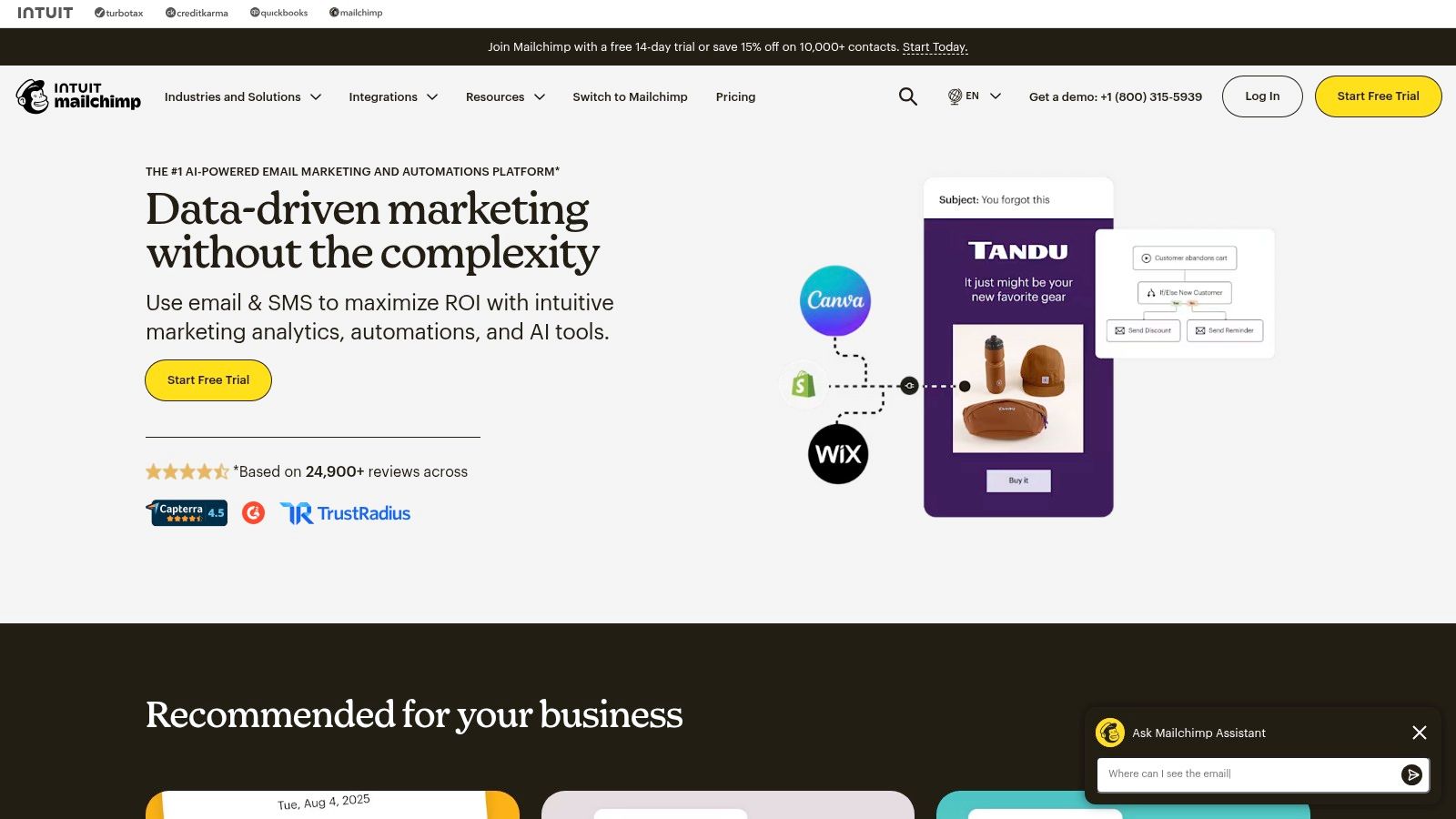
The platform’s strength lies in its fast onboarding and excellent design system, which makes creating beautiful emails a breeze. It’s a fantastic choice for businesses that need to get an email marketing program off the ground quickly. As one of the most established SaaS marketing tools, Mailchimp also offers a large marketplace of integrations, connecting it to almost any other tool you might be using in your stack.
Key Features & Considerations
- Best For: SMBs and mid-market companies needing a strong, easy-to-use email marketing and automation tool.
- Standout Features: Its drag-and-drop email builder is top-notch, and the "Customer Journeys" feature provides solid automation capabilities. Higher-tier plans include AI tools for generating subject lines and email copy.
- Pros: The interface is clean and intuitive, making it one of the easiest platforms to learn. The large ecosystem of integrations and available experts is a huge plus for getting things done.
- Cons: The pricing can get expensive as you scale, and many advanced automation and testing features are locked behind higher-priced plans. The free tier has also become more restrictive over time.
- Pricing: A free plan is available with limited features and contacts. Paid plans include Essentials, Standard, and Premium, which scale with features and audience size.
Website: https://mailchimp.com
5. Optmyzr
For PPC specialists managing multiple accounts or large-scale campaigns, Optmyzr is an absolute workhorse. It's a dedicated PPC optimization suite built to automate tedious tasks across Google, Microsoft, and Amazon Ads. Instead of spending hours pulling reports, adjusting bids, or finding negative keywords, Optmyzr gives you a set of powerful tools to handle these jobs in minutes. It’s designed for efficiency, helping agencies and in-house teams scale their ad management without scaling their headcount.
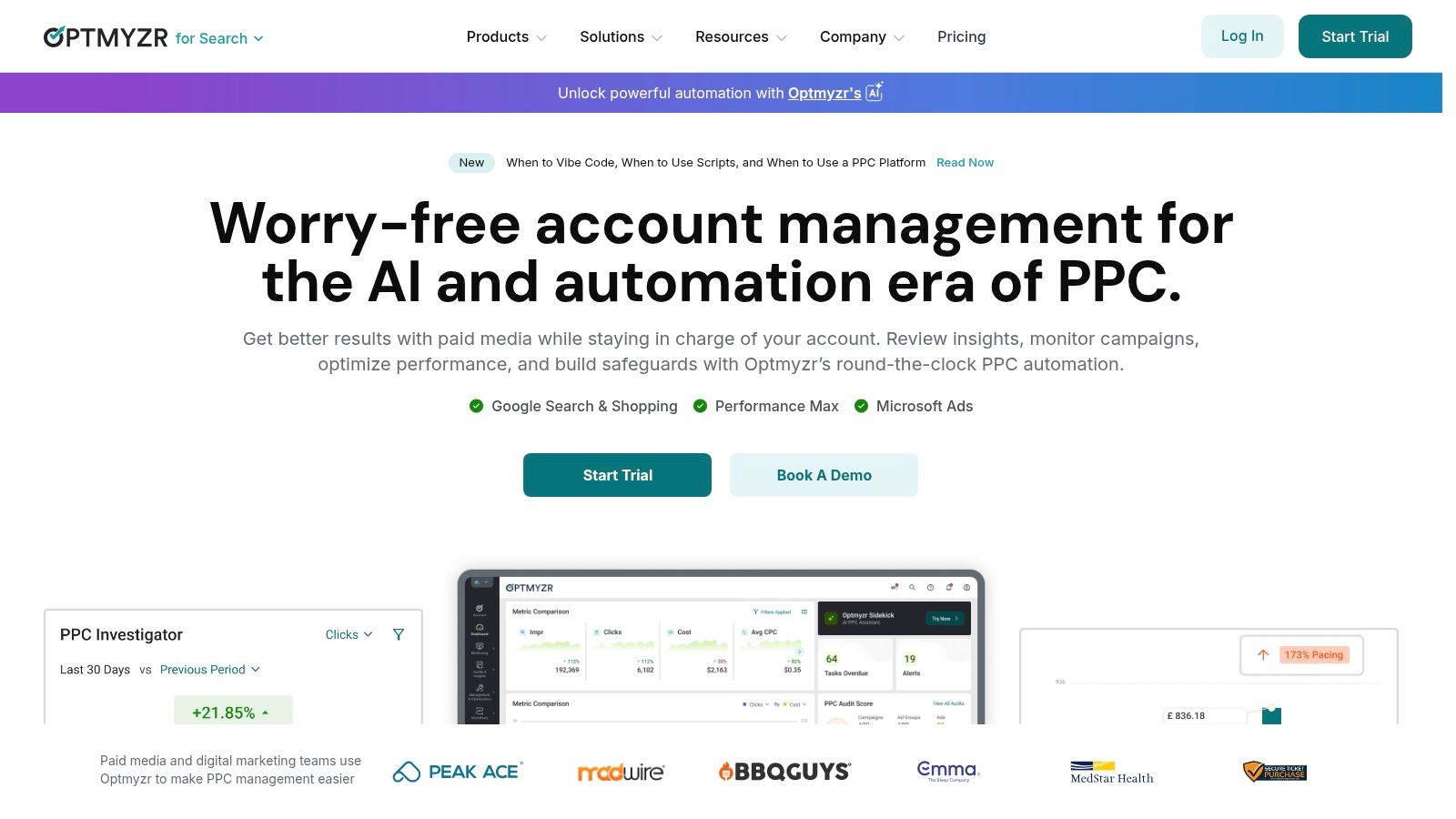
The platform’s strength lies in its Rule Engine, which lets you create custom, automated workflows for almost any optimization task you can think of. This makes it one of the most effective SaaS marketing tools for maintaining account health and performance at scale. By automating repetitive checks and adjustments, you free up valuable time to focus on high-level strategy and client communication. It’s a must-have for anyone serious about managing paid search efficiently, and you can explore more options in this category with a solid PPC tool roundup.
Key Features & Considerations
- Best For: PPC agencies and experienced in-house specialists managing high ad spend or multiple accounts.
- Standout Features: The Rule Engine provides deep automation capabilities. The Shopping Campaign Automator and inventory-driven builds are fantastic for e-commerce, and the cross-platform reporting with white-label options is a huge plus for agencies.
- Pros: Dramatically reduces time spent on manual account optimizations. The automation coverage across search, shopping, and different ad networks is excellent.
- Cons: Pricing is tied to your total ad spend, so it can become costly as your accounts grow. The advanced features have a learning curve and deliver the most value in the hands of seasoned PPC users.
- Pricing: Plans are based on connected ad spend, with tiers like Pro, Pro+, and Enterprise offering more features and user seats.
Website: https://www.optmyzr.com
6. Unbounce
Unbounce is a dedicated landing page builder designed to help marketers quickly create, launch, and optimize high-converting pages without needing a developer. Its primary focus is on boosting campaign performance through better landing pages, popups, and sticky bars. The platform is built from the ground up to give you full control over the user experience for your paid ad campaigns, email promotions, or any other targeted traffic source.
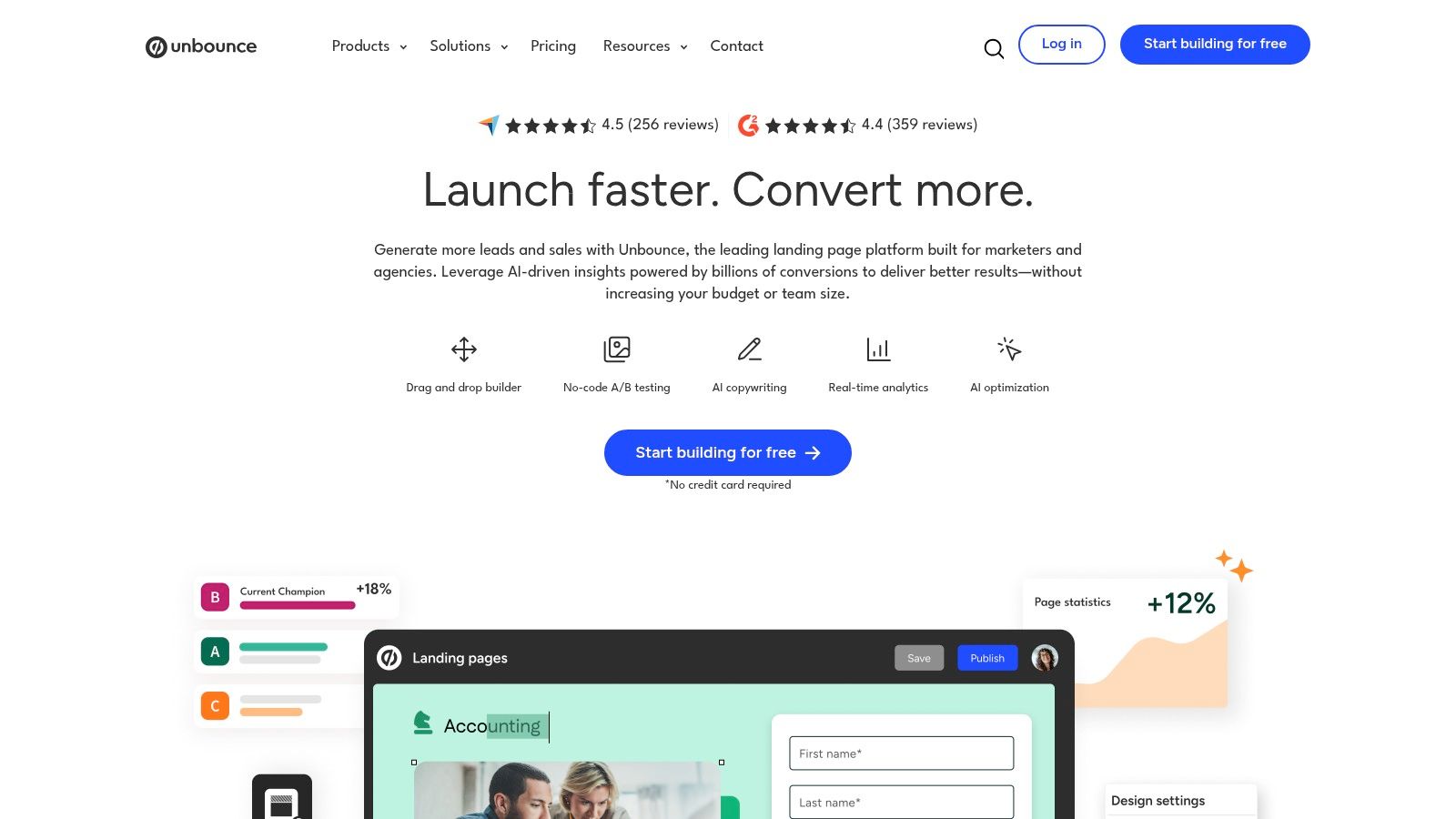
It excels at speed and simplicity. You can go from an idea to a live, professional-looking page in a matter of hours, not weeks. Unbounce is one of the top SaaS marketing tools for performance marketers who live and die by their conversion rates. By rapidly testing different headlines, images, and calls-to-action, you can get the insights needed to maximize your ROI. For those running PPC campaigns, pairing a great ad with a perfectly matched landing page is a non-negotiable step for success, and a solid strategy for landing page A/B testing is critical.
Key Features & Considerations
- Best For: PPC specialists, marketing agencies, and teams that need to deploy and test landing pages quickly for specific campaigns.
- Standout Features: The drag-and-drop builder is incredibly intuitive. Dynamic Text Replacement allows you to match landing page copy to a visitor's search query, and the built-in AI copy generator helps you overcome writer's block.
- Pros: You can deploy pages extremely fast without involving development resources. The A/B testing functionality is straightforward and built directly into the workflow.
- Cons: The platform's plans have specific traffic and conversion limits, which can lead to overage fees or forced upgrades as your campaigns scale. Deeper personalization often requires connecting other tools.
- Pricing: Plans start with the Launch tier, moving up to Optimize and Accelerate, which offer more traffic, conversions, and advanced features like A/B testing and AI tools. A 14-day free trial is available.
Website: https://unbounce.com
7. Sprout Social
Sprout Social is a full-featured social media management platform built for brands and agencies that need more than just basic scheduling. It excels at combining publishing, engagement, analytics, and social listening into a single, polished interface. The platform is especially powerful for team collaboration, offering clear workflows for drafting, approving, and publishing content, which prevents bottlenecks and keeps everyone on the same page.
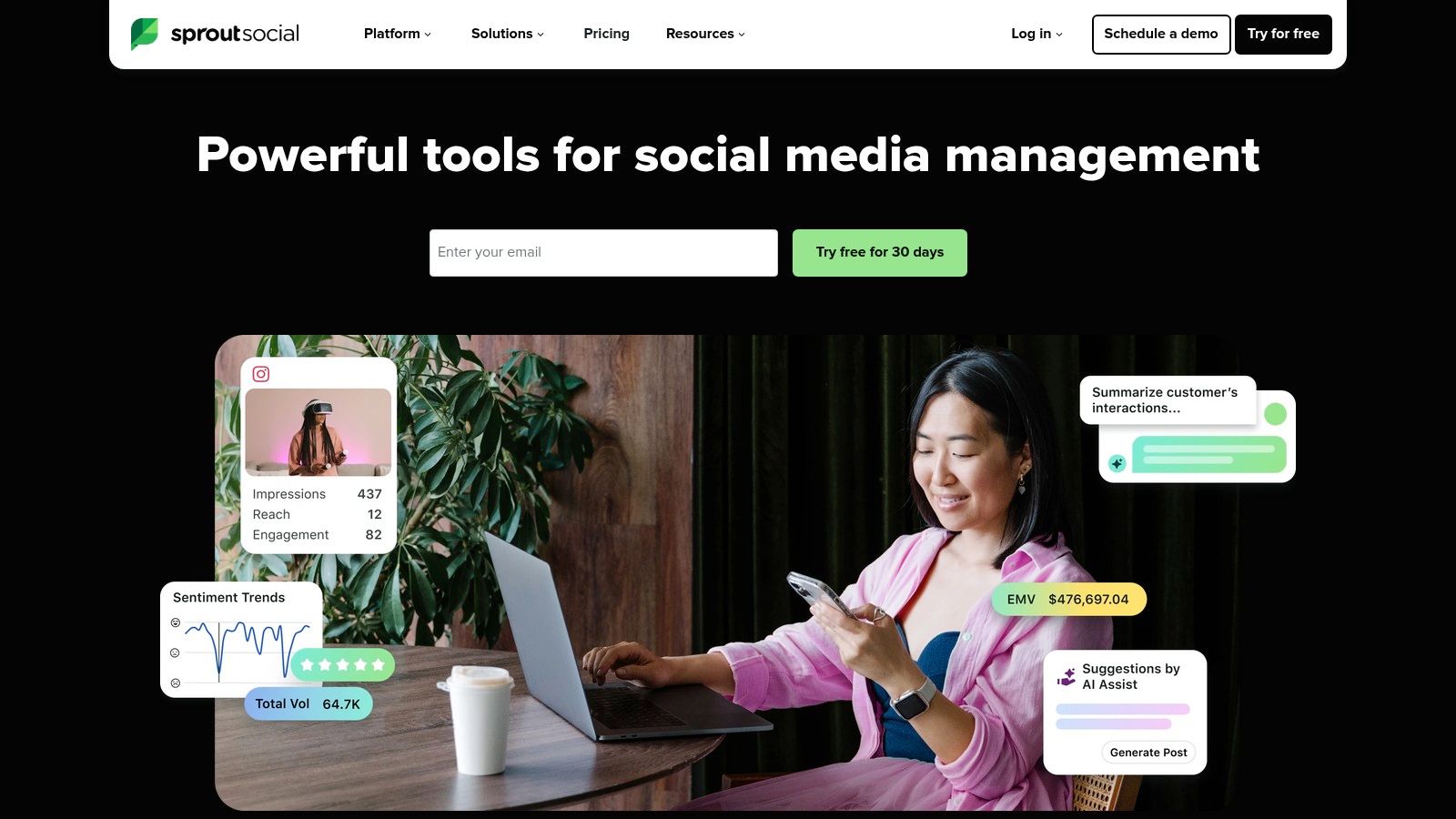
Its unified "Smart Inbox" gathers all incoming messages and mentions from every connected profile, so you can manage community engagement without constantly switching tabs. This makes Sprout Social one of the most effective SaaS marketing tools for providing coordinated customer care through social channels. For a deeper dive into how Sprout Social compares to other platforms, you can find a comprehensive analysis in "Buffer Vs Sprout Social Vs Postfast". The AI-assisted features for generating content ideas and optimizing send times also help teams work more efficiently.
Key Features & Considerations
- Best For: Medium to large businesses and agencies that need robust team workflows and deep analytics.
- Standout Features: The unified Smart Inbox for multi-channel engagement is a huge time-saver. Its reporting capabilities are top-tier, providing presentation-ready reports on performance, trends, and team productivity.
- Pros: Excellent and detailed analytics give you a clear view of your social media ROI. The platform scales well for growing teams with strong permission controls and support options.
- Cons: The per-user pricing model can become expensive quickly for larger teams. Advanced features like social listening and premium analytics are locked behind the higher, more costly tiers.
- Pricing: Plans start with the Standard tier for essential publishing and engagement tools, followed by Professional and Advanced plans that unlock more analytics and team features.
Website: https://sproutsocial.com
8. Mixpanel
While many analytics tools focus on website traffic, Mixpanel dives deeper into product analytics. It's built to answer questions about what users are doing inside your app, making it essential for SaaS marketers focused on activation, feature adoption, and retention. Instead of just tracking page views, Mixpanel tracks events, which allows you to build detailed funnels, analyze user cohorts, and see exactly how people navigate your product.
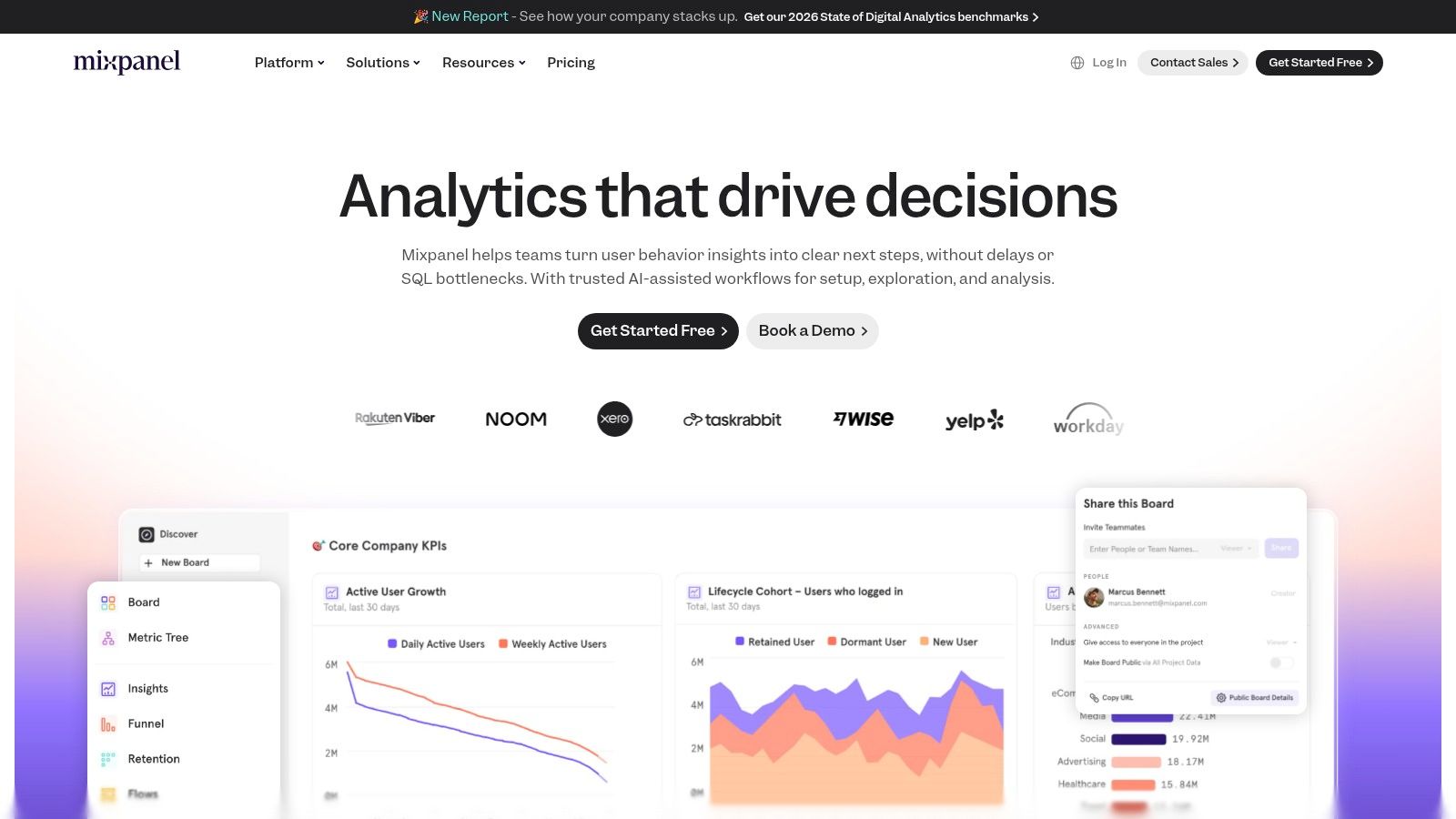
For growth teams, this event-based tracking is a goldmine. You can directly connect marketing campaigns to user onboarding completion rates or measure the long-term lifetime value of users acquired from different channels. This makes Mixpanel one of the most powerful SaaS marketing tools for aligning marketing efforts with actual product engagement and revenue, moving beyond simple lead generation metrics.
Key Features & Considerations
- Best For: SaaS growth and product teams wanting to understand user behavior, improve retention, and measure feature adoption.
- Standout Features: The event-based model allows for deep analysis of user flows and funnels. Its cohort analysis helps you see how user behavior changes over time, and session replays add qualitative context to the quantitative data.
- Pros: Offers incredibly fast self-serve analysis for non-technical users. The free plan is generous, making it easy to get started and prove its value before committing to a paid plan.
- Cons: Proper setup (instrumentation) is critical for data quality, which requires developer resources. Advanced security and data governance features are only available on the more expensive Enterprise plan.
- Pricing: A generous free plan is available. Paid plans like Growth and Enterprise scale with event volume and add more advanced features.
Website: https://mixpanel.com
9. Twilio Segment (Customer Data Platform)
While most tools on this list help you execute marketing campaigns, Twilio Segment is the infrastructure that makes all of them work better together. It’s a customer data platform (CDP) designed to collect, clean, and control your customer data from every touchpoint, then send it to any tool in your stack. Think of it as the central nervous system for your marketing data, ensuring every platform from your email provider to your analytics suite gets the same consistent, real-time information.

The power of a CDP lies in creating a unified customer profile. Instead of having separate, siloed data in Google Analytics, your email tool, and your ad platforms, Segment combines it all into a single view of the user. This makes it one of the most foundational SaaS marketing tools because it solves the "data mess" problem that plagues so many companies. With clean data pipelines, you can build smarter audiences, deliver truly personalized experiences, and finally trust your attribution models.
Key Features & Considerations
- Best For: Growing SaaS companies that use multiple marketing and analytics tools and need a single source of truth for customer data.
- Standout Features: The massive catalog of over 700 "Connections" (sources and destinations) is its core strength. Its Unify and Engage products allow you to create unified customer profiles and build audiences for cross-channel campaigns directly within the platform.
- Pros: Dramatically reduces engineering time spent on building and maintaining one-off integrations. It creates a reliable data layer that powers real-time personalization and better decision-making across the board.
- Cons: The setup requires a strategic approach; its ROI is directly tied to how well your teams adopt it. Advanced features like audience building (Engage) are locked behind higher-tier, more expensive plans.
- Pricing: Offers a Free tier for up to 1,000 visitors/month. The Team plan is the next step up, with pricing based on Monthly Tracked Users (MTUs). Custom pricing is available for Business plans.
Website: https://segment.com
10. Clearbit by HubSpot (B2B Data Enrichment)
For B2B SaaS companies, knowing who is visiting your site is just as important as knowing what they do. Clearbit, now integrated directly into HubSpot, is a data enrichment powerhouse that solves this problem. It automatically enriches your contact and company records with over 100 data points, like company size, industry, location, and the technology they use. This turns anonymous email signups into detailed, actionable B2B profiles right inside your CRM.
The real magic happens when you use this enriched data to improve your marketing. You can create highly targeted segments for account-based marketing (ABM) campaigns, shorten your lead forms to boost conversions (since Clearbit fills in the blanks behind the scenes), and score leads more accurately. As a SaaS marketing tool, it’s essential for any team that wants to stop guessing and start making data-driven decisions on lead quality and personalization.
Key Features & Considerations
- Best For: B2B marketing and sales teams using HubSpot who want to power their ABM and lead qualification efforts with rich firmographic data.
- Standout Features: Real-time enrichment of contact and company data directly within HubSpot. Intent data helps you identify companies actively researching solutions like yours, giving you a huge competitive advantage.
- Pros: The seamless integration with HubSpot Workflows is a game-changer for automating lead routing and segmentation. It dramatically enhances lead quality and enables precise ABM targeting.
- Cons: It’s designed almost exclusively for HubSpot customers since the acquisition, so standalone options are limited. Pricing and credit usage depend on your HubSpot tier and add-ons, which can get complex.
- Pricing: Integrated into HubSpot’s Marketing Hub and Sales Hub at the Professional and Enterprise tiers, with credit-based usage for enrichment.
Website: https://www.hubspot.com/products/clearbit
11. Intercom
Intercom pioneered the conversational marketing space, and it continues to be a top choice for SaaS companies looking to engage website visitors and users in real-time. It’s more than just a live chat widget; it’s a complete customer communications platform. You can use it for lead capture on your marketing site, user onboarding with in-app messages and product tours, and customer support, all from one shared inbox.
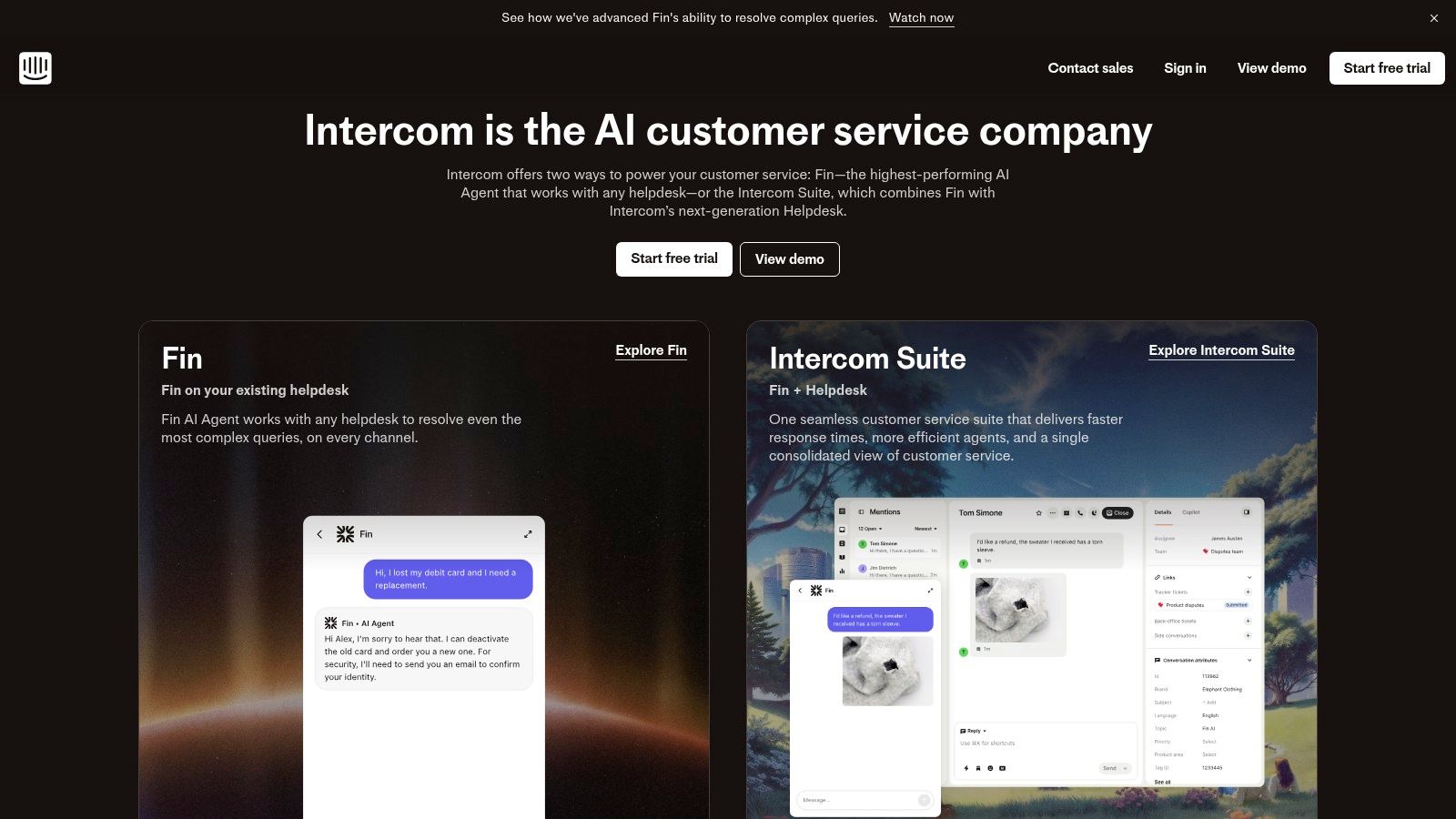
The platform's strength lies in its ability to centralize conversations across channels like your website, email, and even SMS. Its recent push into AI with its agent "Fin" and a copilot for your team means you can automate initial conversations and scale your ability to respond instantly. For product-led companies, Intercom is one of the essential SaaS marketing tools because it connects marketing touchpoints directly to the in-product experience, creating a seamless journey from prospect to power user.
Key Features & Considerations
- Best For: Product-led SaaS companies and businesses wanting to scale customer communication with a mix of human and AI support.
- Standout Features: The AI Agent (Fin) can handle a large portion of initial queries, freeing up your team. The product tours and in-app messages are perfect for driving feature adoption and onboarding new users.
- Pros: It provides a unified, channel-agnostic view of every customer conversation. The automation and AI capabilities are powerful for scaling lead qualification and support without adding headcount.
- Cons: The price can climb quickly. Key features like product tours are add-ons, and seat-based pricing can become expensive for larger support or sales teams. Usage-based costs for AI and certain channels can also add up.
- Pricing: Starts with a plan for very small businesses. The main plans are Starter, Professional, and Premium, with costs scaling based on seats and contacts.
Website: https://www.intercom.com
12. FullStory
FullStory goes beyond standard analytics by showing you the why behind your data. It's a digital experience intelligence platform that captures user sessions, allowing you to watch exact replays of how people interact with your site or app. This lets you see where users get confused, encounter bugs, or abandon a purchase, providing qualitative insights that quantitative tools like Google Analytics can't offer.
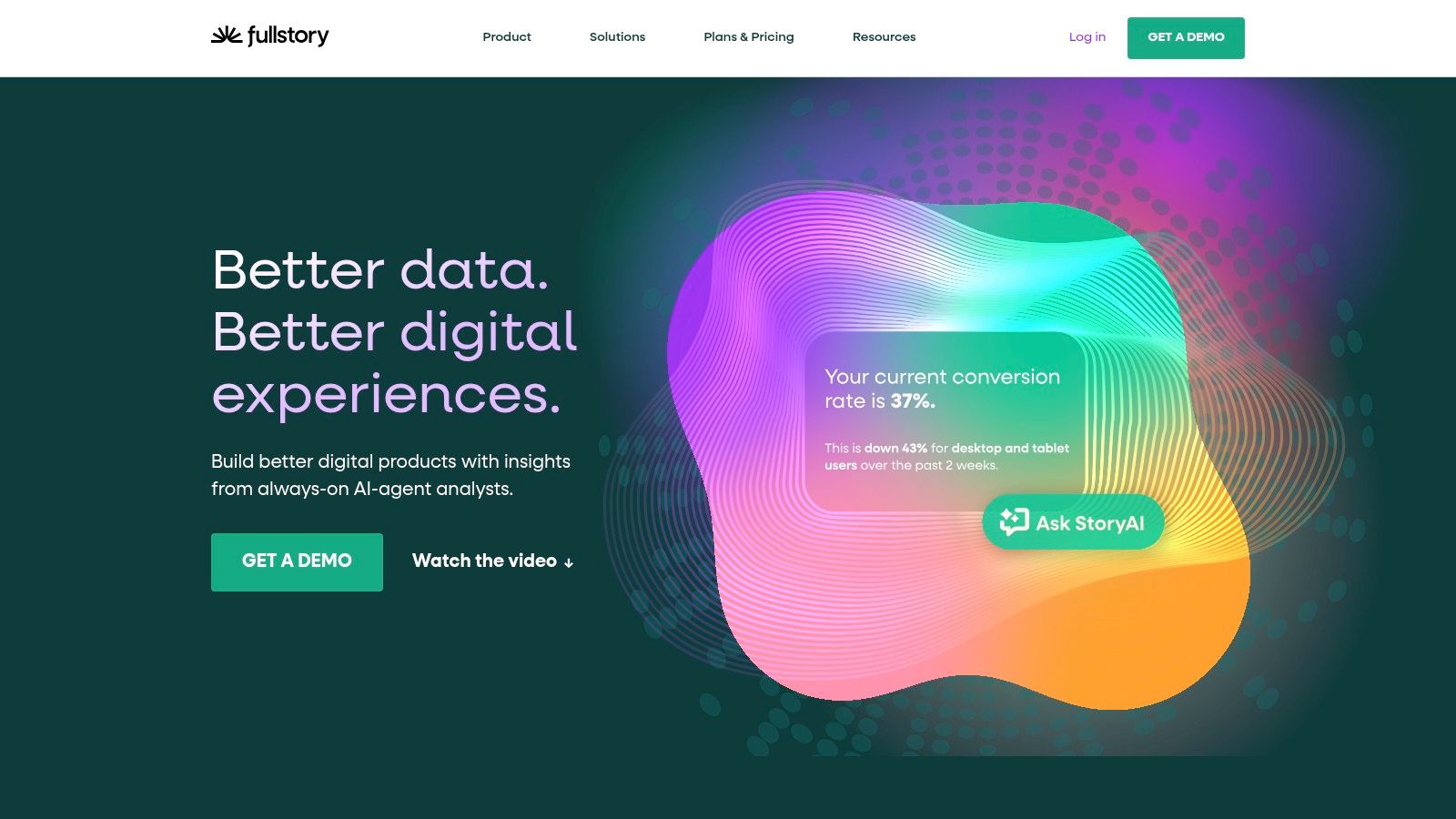
For marketers, this is like looking over a user’s shoulder to understand their journey. Instead of guessing why a landing page has a high bounce rate, you can watch recordings of users who left and spot the exact friction point. FullStory automatically flags "frustration signals" like rage clicks and dead clicks, making it one of the most powerful SaaS marketing tools for conversion rate optimization (CRO) teams who need to quickly identify and fix UX issues that hurt revenue.
Key Features & Considerations
- Best For: CRO specialists, product managers, and marketers focused on improving user experience and conversion funnels.
- Standout Features: Session replays with developer-friendly console logs are a huge plus. The platform’s ability to automatically detect and segment by frustration signals (like rage clicks) helps prioritize what to fix first.
- Pros: Combines qualitative session replays with quantitative tools like heatmaps and conversion funnels in one place. It helps you quickly connect user behavior to business outcomes.
- Cons: Proper setup and data governance are needed to get the most out of it and protect user privacy. Advanced enterprise features are locked behind the higher-priced tiers.
- Pricing: Offers a free plan with a limited number of sessions. Paid Business and Enterprise plans are available with custom pricing based on session volume.
Website: https://www.fullstory.com
Top 12 SaaS Marketing Tools Comparison
Building a Smarter, More Efficient Marketing Stack
So, there you have it. We've walked through a dozen powerful SaaS marketing tools, from all-in-one giants like HubSpot to specialized platforms designed to solve very specific, very real problems. The big takeaway? There's no single "best" tool. The perfect marketing stack is the one that’s built for your team, your budget, and your unique challenges.
Chasing every new, shiny tool is a recipe for a bloated budget and a disconnected workflow. The goal isn't to collect software; it's to create a system where each tool talks to the others, feeding valuable data back and forth to give you a clear, complete picture of your customer's journey. Think about how a customer data platform like Twilio Segment can enrich profiles in your CRM, or how insights from a session replay tool like FullStory can inform the A/B tests you run in Unbounce. That’s where the real magic happens.
How to Choose Your Next Tool
Feeling overwhelmed by the options? Don't be. Here’s a simple framework to guide your decision-making process as you evaluate new saas marketing tools:
- Identify the Core Problem: What’s the biggest bottleneck in your marketing right now? Is it lead quality? Wasted ad spend? A messy content calendar? Don't buy a tool looking for a problem to solve. Start with the pain point. For many PPC managers, that pain is the manual, soul-crushing work of building and managing keyword lists in spreadsheets.
- Audit Your Current Stack: What are you already using? What’s working, and what’s collecting digital dust? Check for overlapping features. If you’re paying for Semrush, you might not need another keyword research tool unless it offers something fundamentally different.
- Prioritize Integration: A tool that lives on an island is a liability. Your tools need to communicate. Does the new software integrate directly with your CRM, your analytics platform, and your email provider? Native integrations are almost always better than relying on third-party connectors like Zapier, so prioritize them.
- Run a Pilot Program: Never commit to an annual plan without a proper test drive. Most SaaS companies offer free trials or limited free-forever plans. Get your core team members to actually use the tool for a couple of weeks. Does it save them time? Does it provide insights they couldn't get before? Is the user interface intuitive, or does it feel like a chore to use?
Implementation is Everything
Once you’ve made a choice, the work has just begun. Proper implementation is what separates a tool that delivers a 10x return from one that just becomes another monthly expense. Assign a clear "owner" for each tool on your team, someone responsible for becoming the go-to expert. Schedule training sessions and, most importantly, define what success looks like. Set clear KPIs before you start. For a tool like Keywordme, success might be a 15% reduction in wasted ad spend and a 50% decrease in the time it takes to launch a new campaign.
Ultimately, the right saas marketing tools act as force multipliers. They automate the tedious, repetitive tasks that drain your energy, freeing you and your team to focus on what truly matters: strategy, creativity, and connecting with your customers. Your stack should empower you, not weigh you down. Choose wisely, implement thoughtfully, and you’ll be well on your way to building a more efficient, effective, and data-driven marketing machine.
Tired of juggling spreadsheets and manually building keyword lists for Google Ads? Keywordme is the specialized SaaS marketing tool that automates keyword generation and campaign structuring right inside your Google Ads account, saving you hours of tedious work. Stop wrestling with VLOOKUP and start focusing on strategy by trying Keywordme today.
.svg)