
RSA Google Ads: A Practical Guide to Responsive Search Ads
RSA Google Ads: A Practical Guide to Responsive Search Ads


SEO Title: RSA Google Ads Practical Guide
Meta Description: RSA Google Ads explained for real PPC teams, from asset writing to search terms, reporting, and negative keyword workflows that scale.
You open Google Ads to build a standard Search campaign, and the old comfort blanket is gone. Expanded Text Ads are no longer the format you can fall back on, and the interface keeps nudging you toward Responsive Search Ads.
That's where most frustration starts. Not because RSAs are mysterious, but because they shift the job. You're no longer writing one finished ad. You're building a set of assets, then trusting Google to assemble them in the auction. If the account is clean, that can work well. If search terms are messy and the ad group theme is loose, RSAs expose those problems fast.
What RSA Google Ads Are and Why They Run Your Campaigns Now
You open a new Search campaign, start drafting ad copy, and Google asks for a bank of headlines and descriptions instead of a finished ad. That shift changes the job immediately. You are no longer choosing a single message to show every eligible searcher. You are giving Google a set of approved assets to match against live query intent.
Google pushed that model into the mainstream when Responsive Search Ads replaced Expanded Text Ads as the format advertisers can create and edit in standard Search campaigns, as summarized in this RSA transition history.
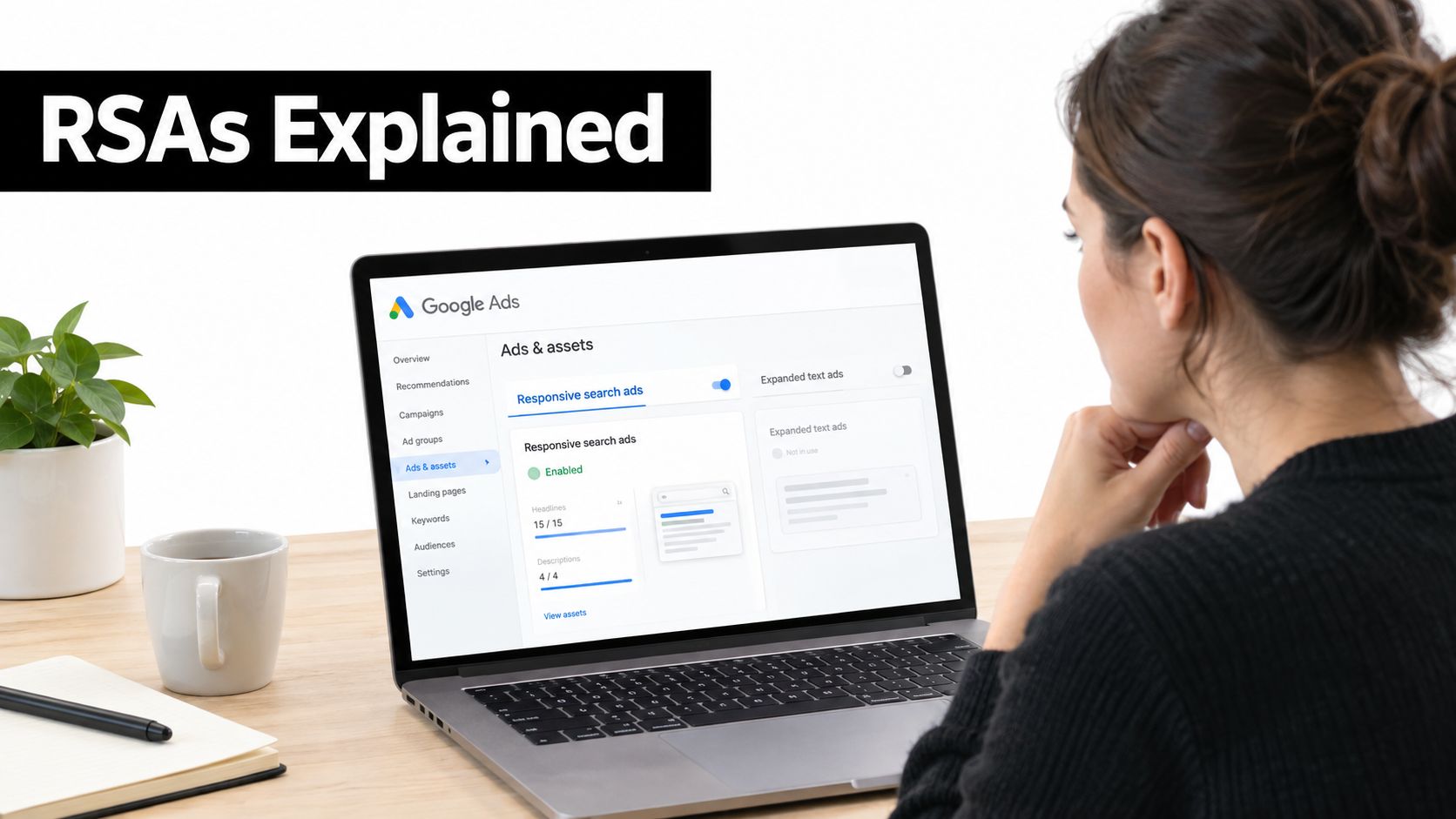
One ad slot, many creative assets
An RSA is a modular search ad. You upload multiple headlines and descriptions, and Google assembles combinations at auction time based on the search, device, and other signals in the account.
That sounds efficient, and often it is. It also means creative performance depends on account structure more than many teams expect. A well-written RSA in a messy ad group still struggles because Google can only match assets as well as the incoming query set allows.
Three operating realities matter in practice:
- Your copy has to cover intent range. Brand, offer, qualifier, and call to action all need enough variation to fit different searches.
- Google controls the assembly. You approve the parts, but you do not control the exact line-up every time the ad serves.
- Search quality shapes RSA outcomes. Loose match behavior, weak negatives, and mixed ad group themes give the system too many bad chances to "learn" from the wrong traffic.
That last point gets missed in a lot of RSA advice. Asset variety helps, but query quality decides whether that variety pays off. If search terms drift, Google can keep finding new combinations without getting any closer to the searches you want.
For local advertisers or smaller teams that need outside support, it helps to review how experienced shops structure search campaigns before scaling. A useful example is this page on expert PPC services near you, especially if you're comparing hands-on account management approaches.
Why this format now runs almost everything
RSAs fit how Google wants Search campaigns to operate. The platform can test more combinations than a manual ETA workflow ever could, and it can adapt those combinations faster across a large volume of auctions.
That does not mean automation replaces ad management. It shifts where the work sits.
The human job is to define the message, tighten the ad group theme, and keep the search term report clean enough for dynamic matching to make sense. Google is good at selecting among decent assets for a relevant query. It is much less reliable when the campaign keeps admitting weak queries that should have been blocked with negatives.
How RSAs Assemble and Serve Ads
A common RSA problem looks like a creative problem at first. CTR softens, combinations look awkward, and the ad strength badge starts getting blamed. In practice, the issue is often simpler. Google is assembling from a weak asset pool, then matching those assets against queries that were never tight enough to begin with.
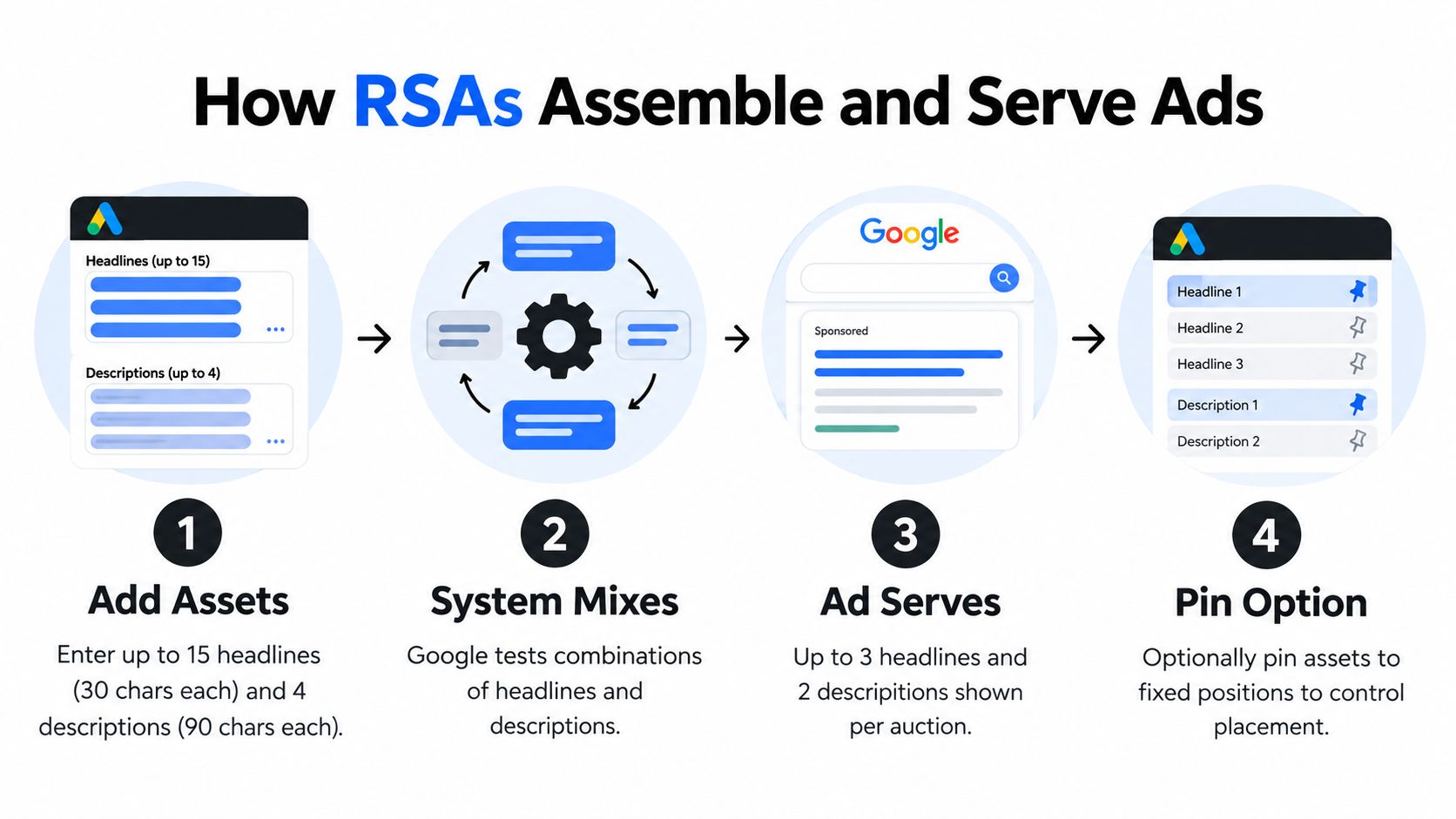
The asset limits that shape everything
RSAs give you a fixed set of inputs. You can load multiple headlines and descriptions, and Google assembles eligible combinations at auction time. As noted earlier, the format caps how much copy you can provide and how long each asset can be. Those limits affect the writing more than many advertisers expect.
Headlines have to work on their own. Descriptions have to add meaning without relying on one specific headline beside them. If an asset only makes sense in one exact pairing, it is brittle and will eventually serve in a weaker combination.
That is why repetitive headline sets underperform. Five versions of the same benefit do not create useful variation. They just give Google more ways to say the same thing.
What happens in the auction
Google does not rotate full ads the way expanded text ads used to. It evaluates the query, the user context, and the predicted performance of available assets, then builds a version for that auction.
Three moving parts decide what the user sees:
- Eligible assets: The headlines and descriptions you gave the system
- Auction-time selection: The combination Google predicts will perform best for that search
- Traffic quality: The search term that triggered the ad in the first place
That third piece gets overlooked.
If the ad group is tightly themed and the negative list is doing its job, dynamic assembly has a fair shot at matching the query well. If search terms are drifting into research intent, job seekers, support queries, or adjacent services you do not sell, RSA flexibility starts working against you. Google can still assemble a valid ad. It just will not be a useful one for your business.
I see this constantly in broad match builds. Advertisers rewrite assets when the bigger issue is that the account is feeding the RSA irrelevant auctions.
Why weak assets drag down the whole ad
One vague headline can contaminate a lot of combinations. A generic line like "Top Solutions for Your Needs" might pass policy and fit the character count, but it does nothing to sharpen relevance. Pair that with a broad description and the final ad reads like it could belong to any advertiser in the auction.
The result is not just awkward copy. It is weaker intent matching.
RSAs work best when each asset covers a distinct job, such as product type, offer, proof point, qualifier, or call to action. That structure gives Google real options to test. It also makes poor search terms easier to spot, because the combinations that win start to reflect actual query intent instead of generic ad language.
Why pinning usually hurts more than it helps
Pinning has a place. Legal lines, required disclaimers, and fixed brand language sometimes need it. Google's guidance on pinning says to use it sparingly and, when possible, pin multiple assets to the same position so the system still has room to test combinations in that slot: Google Ads pinning guidance.
That matches account reality. Heavy pinning usually strips out the main advantage of an RSA, which is combination testing across different searches. Once too many assets are locked into place, the ad starts behaving like an older static format with less flexibility and no real gain in control.
Use pinning for actual constraints, not for reassurance. If copy only sounds good when half the ad is pinned, the asset set needs work, or the query mix does.
The Performance Case for RSAs
A familiar account pattern looks like this: impressions are healthy, Smart Bidding is active, and the RSA has plenty of asset coverage, but conversion quality is uneven. In those cases, the ad format usually is not the first problem. The bigger variable is whether Google is matching those assets to searches that deserve traffic in the first place.
Google's case for RSAs is tied to automation working together, not to the format in isolation. In Google's Search automation guide, the benchmark is based on advertisers moving from Expanded Text Ads to Responsive Search Ads while also using broad match and Smart Bidding. That context matters.
RSAs can improve performance because they let the system test many message combinations inside one ad instead of forcing manual ad-versus-ad rotation. They can adapt better to different query intent, device context, and auction conditions. In large accounts, that testing speed is a practical advantage.
It still depends on account quality.
Three conditions usually separate strong RSA performance from disappointing RSA performance:
- Enough conversion signal: Low-volume campaigns rarely give the system enough feedback to sort weak combinations from useful ones.
- Distinct asset angles: Rewritten duplicates waste slots. Google needs materially different headlines and descriptions to test.
- Clean query input: Search terms and negatives shape whether dynamic matching produces relevant ad combinations or just automates spend on loose intent.
That third point gets ignored too often. A strong RSA does not rescue weak search-term control. If irrelevant or low-intent queries keep entering the campaign, Google may find a combination that wins clicks, but those clicks still may not turn into revenue. The account then reports "learning" while efficiency slips.
This is the main trade-off with RSAs. They usually outperform older static formats on scale and testing speed, but they also increase the value of upstream account work. Asset writing matters. Query filtering matters just as much.
| Feature | Expanded Text Ads | Responsive Search Ads |
|---|---|---|
| Creative format | Fixed copy | Dynamic asset combinations |
| Testing method | Manual ad-to-ad testing | Automated combination testing |
| Control over exact message | High | Lower |
| Learning speed | Slower in practice | Faster when data is strong |
| Best use case | Tight control needs | Ongoing scalable optimization |
For brand-safe or compliance-heavy advertisers, the lower control is a real cost. Message order can shift. Weak assets can combine awkwardly. Teams that care about exact phrasing often need tighter reviews, stronger exclusions, and a shorter tolerance for broad query expansion.
The practical case for RSAs is straightforward. They are usually the better default in modern Google Ads, but their lift comes from pairing flexible creative with disciplined search-term mining and negative-keyword management. Without that, the system is just testing more ways to say the wrong thing to the wrong search.
Writing RSA Headlines and Descriptions That Actually Convert
Most weak RSA Google Ads copy has the same issue. The writer filled all the slots, but didn't create real variation.
An RSA works better when you treat assets like a message set, not a final script. Each line should add a different angle, not a reworded duplicate.
Build variety on purpose
Start with a broad mix of angles. Don't write fifteen keyword-heavy headlines and call it done.
Use a spread like this:
- Brand headlines: Your company name, product line, or service category
- Benefit headlines: What the customer gets
- Feature headlines: What the product or service includes
- Use-case headlines: Who it's for or when it helps
- Offer headlines: Pricing hook, demo, consultation, free shipping, or trial language
- Action headlines: Book, compare, buy, schedule, request, start
A smart workflow is to draft the core message first, then force yourself to add angles you'd normally skip. If all your headlines sound like landing page H1 variants, the ad won't have much room to learn.
For help with basic ad construction before you refine RSA-specific assets, Keywordme has a straightforward guide on how to create a Google ad.
Make descriptions do actual work
Descriptions shouldn't just repeat the headlines in sentence form. Use them to answer the questions a searcher still has after reading the top line.
A useful structure:
- What it is
- Why it matters
- What to do next
That usually creates cleaner assets than stuffing every description with the same sales promise.
| Angle | Headline Example (≤30 chars) | Description Example (≤90 chars) |
|---|---|---|
| Benefit | Save Time on Reporting | Cut manual PPC cleanup and focus on higher-value optimization work. |
| Feature | One-Click Match Types | Apply exact, phrase, or broad match faster across live search campaigns. |
| Offer | Start Your Free Trial | Test the workflow, review search terms, and launch cleaner updates. |
| Use case | Built for PPC Teams | Manage search-term cleanup and expansion without messy spreadsheets. |
| Brand | Keywordme for Google Ads | Organize keyword and negative keyword work in one workflow. |
Keep each asset self-contained. If a headline only makes sense when another specific headline appears beside it, it isn't ready.
What to leave out
Skip filler like “top quality,” “trusted solution,” and other broad claims that could belong to any advertiser. Also avoid writing multiple headlines that differ by only one word. Google can't learn much from tiny variations that express the same intent.
The best RSA writing isn't clever. It's modular, distinct, and useful.
Reading Asset, Combination, and Ad Strength Reports
Good RSA management happens in the reports, not in the asset editor. Writing is the start. Interpretation is where performance improves.
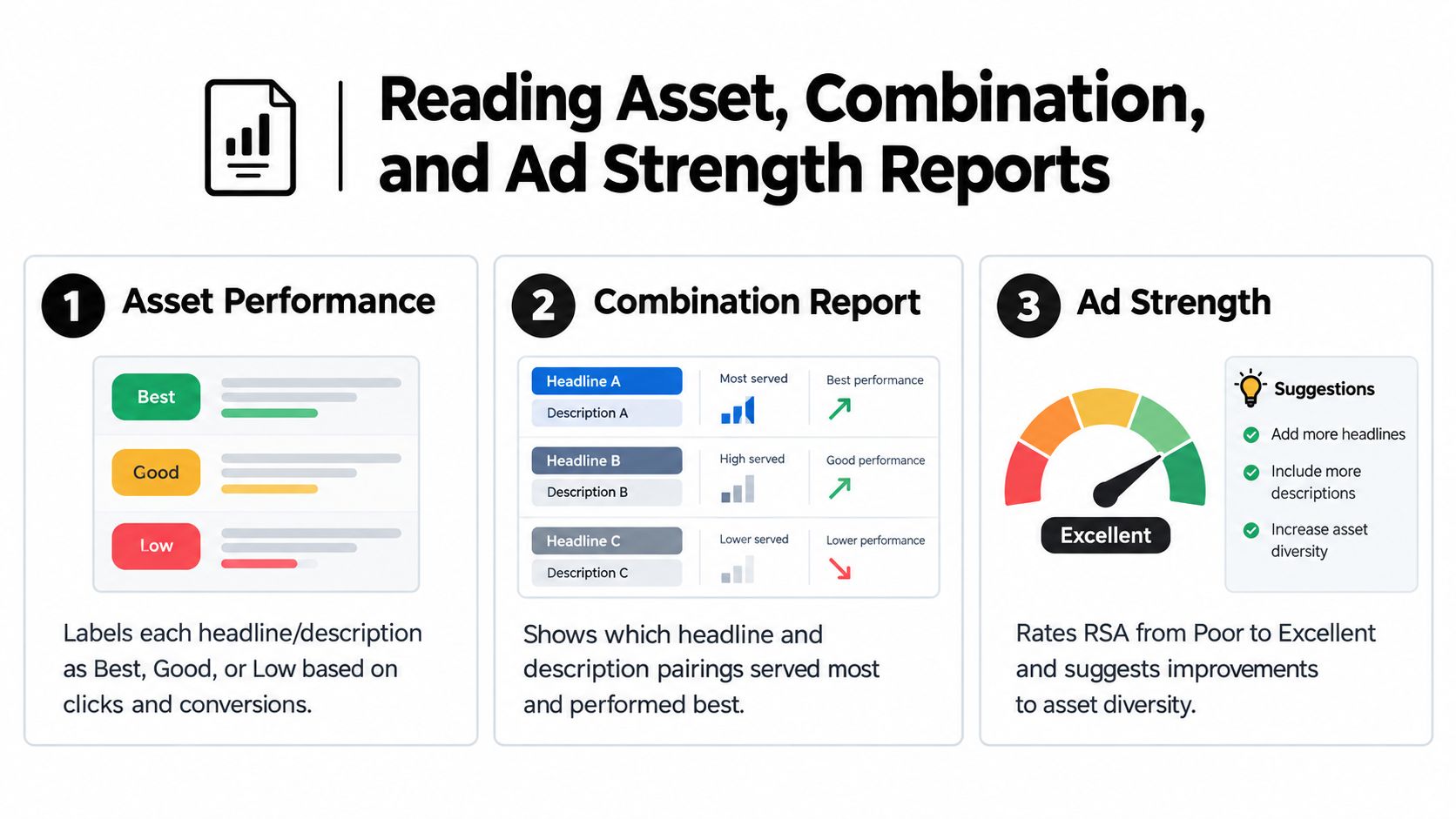
Asset reports show what to replace
Google now provides asset-level and combination-level reporting for RSAs, replacing the old simplified performance label with fuller statistics for each asset in Google's asset reporting documentation.
That matters because ad-level averages can hide weak lines. A decent RSA can still contain several assets that aren't pulling their weight.
Look for patterns such as:
- Low-value generic headlines: Usually too broad or too similar to other assets
- Descriptions with weak contribution: Often long, padded, or disconnected from the query
- Overused brand lines: Good to have, but not if they crowd out stronger commercial messaging
Combination reports reveal what actually served
Google also lets you inspect the Combinations tab from the ad's asset details to review which headline and description combinations served, as shown in Google's combinations report guide.
That's one of the most useful RSA reports in the interface. It shows how your modular writing behaves in the wild.
If your favorite headline rarely appears in top combinations, don't defend it because you like it. Rewrite it.
For teams with multiple markets or location-heavy campaigns, it also helps to track local search performance in parallel so you can compare whether certain asset themes align with regional demand rather than assuming one RSA pattern fits every area.
If reporting still feels noisy, this Keywordme article on how to read Google Ads reports properly is a useful companion for sorting signal from clutter.
Ad Strength is a prompt, not a verdict
Ad Strength is useful, but it's not the final judge of business value. It nudges you toward diversity, relevance, and broader testing. That's helpful. But a stronger score doesn't automatically mean more revenue.
Use it as a drafting assistant. Trust conversion-linked reporting for the actual keep-or-cut decisions.
Common Mistakes That Sabotage RSA Performance
A common RSA failure looks like this: the ad strength score is fine, the account has plenty of headlines, and performance still drifts. In most cases, the problem is not that Google failed to mix assets cleverly. The problem started earlier, with weak variation, over-control, or traffic that never matched the ad group in the first place.
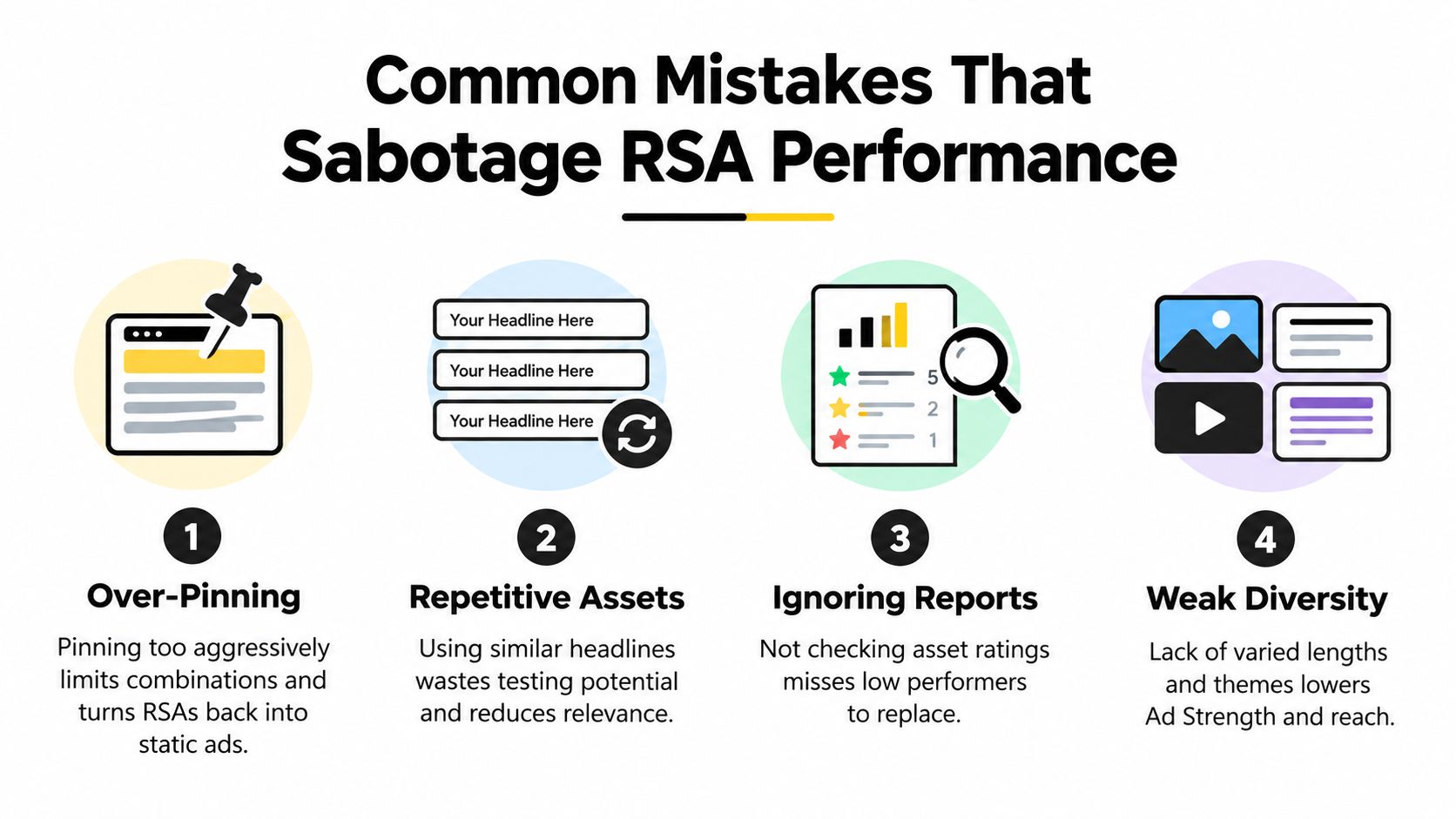
Mistakes that look harmless but slow performance
The same patterns show up across underperforming RSA accounts:
- Over-pinning: Pinning too many assets cuts down the combinations Google can test and often forces average copy into premium positions.
- Repetitive headlines: Fifteen versions of the same claim do not give the system useful creative range. They just create noise.
- Tiny ad groups with thin traffic: Very narrow structures can leave RSAs without enough volume to learn which messages fit which searches.
- Ignoring low-quality query mix: If an ad group attracts mixed intent, the RSA will look inconsistent even when the assets are solid.
- Letting weak assets sit too long: Old headlines often survive because nobody wants to touch a live ad. That slows improvement.
These are management errors, not format flaws.
The static-ad mindset is the core problem
RSAs work best when the account is built for testing and pruning, not for preserving one perfect message. That is the shift many ETA-era advertisers still resist.
The practical workflow is simpler than people make it:
- Write assets around different intents and buying angles.
- Give the ad enough clean traffic to serve across meaningful searches.
- Review what keeps showing up and what keeps getting ignored.
- Replace duplicate angles first, then rewrite weak phrasing.
That last point matters. I see more accounts hurt by five headlines saying nearly the same thing than by having too few assets.
Strong RSA management depends on creative variety and query quality together. If the search traffic is off-theme, even well-written assets will look weaker than they are.
What modern RSA management looks like
Good RSA management keeps a human in charge of structure, intent, and pruning. Google handles assembly well. It does not fix cluttered messaging or confused targeting.
When an RSA underperforms, check three things before rewriting everything: pinning, duplicated asset angles, and whether the ad group is matching to searches that belong somewhere else. That review usually finds the issue faster than adding more headlines.
This is also why RSA work cannot sit in a copy silo. The ad only performs at scale if the keyword targeting and negative keyword cleanup keep feeding it relevant searches.
Connecting RSA Optimization to Search Term and Negative Keyword Workflows
This is the part most RSA advice misses. Creative quality matters, but search-term hygiene decides whether dynamic creative gets a fair shot.
Google notes that RSAs are broadly available across languages and supported in Ads Editor, the API, and mobile, which underlines that they're the standard format now. The bigger operational challenge is how to manage the keyword and negative-keyword workflow around them at scale, as discussed in Google's RSA availability documentation.
Better queries make better RSAs
If the ad group keeps matching to searches with mixed intent, your RSA will look inconsistent even when the assets are solid. People often try to solve that with more pinning. That's usually the wrong fix.
A cleaner approach is a weekly search-term routine:
- Pull recent search terms
- Sort by commercial relevance, cost, and conversion pattern
- Flag irrelevant or off-theme queries
- Push those into the right negative list level
- Review whether the surviving traffic still matches the asset set
That's where a tool like Keywordme fits practically. It's built to help with search-term cleanup, match type assignment, and negative keyword handling so teams can move faster without relying on manual copy-paste work.
The feedback loop most teams need
Strong RSA optimization isn't “write 15 headlines and hope.” It's a loop.
One side of the loop is creative. The other side is traffic quality.
Use cross-negatives, branded exclusions where appropriate, and tighter intent grouping to stop junk traffic from teaching the model bad lessons. When the incoming query stream gets cleaner, RSA reporting becomes more trustworthy because the ad is being judged on better opportunities.
If you want a practical workflow for filtering irrelevant traffic faster, this guide on adding negative keywords is directly relevant.
Clean search terms first when relevance slips. Pinning headlines to force order is usually a brittle workaround.
Your RSA Launch and Optimization Checklist
A workable RSA process doesn't need to be fancy. It needs to be consistent.
Days 1 to 30
Launch with enough variety to give the system room to learn.
- Write distinct headlines: Aim for a broad spread of value props, brand lines, action lines, and use cases.
- Add complete descriptions: Use all available description slots with clear, non-duplicative messaging.
- Keep pinning light: Only pin when a real business rule requires it.
- Check Ad Strength before launch: “Good” or “Excellent” is a sensible minimum if the message still reads naturally.
Days 31 to 60
The first month after launch is usually where the account tells you whether the asset set is diverse or just looks full.
Focus on review rhythm:
- Look at asset performance regularly.
- Remove or replace weak angles after the ad has had enough opportunity to rotate.
- Add new assets instead of shrinking the pool too aggressively.
- Watch whether replacements improve message coverage or just rename the same idea.
Days 61 to 90
By this point, the goal is not just maintenance. It's refinement.
Audit the account for warning signs:
- Stagnant Ad Strength: Often a sign of repetitive inputs
- Nearly identical headlines: Suggests weak testing depth
- Conversion softness after pin changes: Can indicate over-control
- Search-term drift: Means the creative is being judged by the wrong traffic
A mature RSA account is managed like an adaptive system. You write modular copy, observe what served, clean the query stream, and feed the ad better inputs over time. Teams that still run RSAs like fixed ads usually end up doing more manual work for worse learning.
Keywordme helps PPC teams turn messy search-term data into usable keyword and negative keyword actions, which is exactly where RSA performance often gets won or lost. If your Responsive Search Ads are suffering from junk queries, weak match type control, or slow cleanup workflows, visit Keywordme and see how it fits your Google Ads process.
.svg)