
PPC Keyword Research: A Guide to Boosting Campaign ROI
PPC Keyword Research: A Guide to Boosting Campaign ROI


Let's be real—PPC keyword research isn't just about finding search terms. It's about finding the right terms that connect you with people who are actually ready to buy. Done right, it’s the engine that drives your entire ROI. Done wrong? Well, you're just throwing money at clicks that go nowhere.
Why Smart PPC Keyword Research Is Your Unfair Advantage

The world of pay-per-click is a straight-up battlefield. Your competitors are everywhere, and every single dollar in your budget has to count. A sharp keyword strategy is what separates the campaigns that build profitable businesses from the ones that just light money on fire.
Think of it this way: a keyword is a direct look into your customer’s mind. It reveals their problems, their desired solutions, and—most importantly—how close they are to pulling out their wallet. Guessing what those keywords are is a fast track to a failed campaign.
The Pillars of Modern PPC Keyword Research
A winning strategy isn't a single action; it's a combination of several core pillars working together. Understanding these pillars is the first step toward building a campaign that doesn't just run, but thrives.
| Pillar | What It Means | Why It Matters for ROI |
|---|---|---|
| Discovery | Finding a wide range of relevant search terms, from broad concepts to specific, long-tail phrases. | Uncovers new customer segments and opportunities you might have missed, expanding your reach. |
| Intent Classification | Sorting keywords based on whether the user wants to learn, compare, or buy something right now. | Lets you focus your budget on high-intent keywords that drive sales, not just empty clicks. |
| Organization | Grouping keywords into tight, logical ad groups that share a common theme. | This is the key to writing hyper-relevant ads, which boosts Quality Score and lowers your costs. |
| Optimization | Continuously refining your keyword list by adding negatives and testing different match types. | Protects your budget from irrelevant searches and fine-tunes your targeting for maximum efficiency. |
Each of these pillars supports the others. A campaign that masters all four is one that's built for long-term profitability.
Navigating Today's PPC Minefield
Let's be honest, the game is getting tougher. The global PPC market has swelled to $218.3 billion, but the biggest headache for 50% of advertisers is dealing with signal loss from new privacy rules.
Even as Google pushes its AI-powered broad match, an overwhelming 78% of PPC professionals still trust exact match for the control and results it delivers. You can dig into the numbers yourself in the 2026 global report on PPC trends.
This all points to one clear truth: precision is everything now. You can't just "set it and forget it." You need a methodical workflow to find, manage, and optimize your keywords.
A great keyword strategy isn't just about finding terms to bid on. It's about building a defensive wall against wasted spend and an offensive plan to capture high-intent customers.
The Foundation of a Profitable Campaign
Every keyword decision you make has a ripple effect across your entire campaign. When you build on a solid keyword foundation, you directly improve your most important metrics:
Ad Relevance: Tightly themed ad groups allow you to write ad copy that feels like it’s reading the searcher’s mind. This connection is powerful.
Quality Score: Higher relevance earns you a better Quality Score. Google sees that you're giving users what they want and rewards you with lower costs-per-click (CPCs) and better ad placements.
Conversion Rates: When you target users who have clear "I want to buy this" intent, you naturally attract traffic that converts. This is how you really crank up your ROI.
Without a systematic approach to PPC keyword research, you’re flying blind. This guide gives you that system—a clear, actionable plan to get your campaigns out of the red and firmly into the black.
Finding High-Impact Keywords Beyond The Obvious
Let's be honest. If your entire keyword research process starts and ends with Google Keyword Planner, you're leaving a ton of money on the table. It's a decent starting point, sure, but it's also what every single one of your competitors is using. To actually get an edge, you have to dig deeper.
The real goal is to find those profitable keywords your competitors haven't even thought of yet. This means looking beyond the obvious and tapping into some less-traveled sources of inspiration. Let's walk through how to uncover these gems hiding in plain sight.
Get Inside Your Customer’s Head
The best keywords don't come from a tool; they come directly from your customers. Before you even think about opening a keyword planner, you need to put yourself in their shoes and brainstorm how they actually talk about their problems.
Start by asking some simple questions:
- What specific pain points are people trying to solve with our product?
- What words would a truly frustrated customer use to describe their situation?
- Forget features. What "job" is our service really doing for them?
- What's the dream outcome they're hoping for?
Think about it. If you sell high-end running shoes, your customers aren't all just searching for "running shoes." They might be typing in "best shoes for marathon training," "running shoes to prevent shin splints," or even "lightweight racing flats for 5k." Each one of those is a different problem, a different intent, and a potential gold mine for a new ad group.
The point isn't to guess what people search for. It's to understand their problems so well that you instinctively know the exact words they'll use to find a solution.
Ethically Spy on Your Competitors
Your competitors are already spending a small fortune to figure out what works. Why not learn from their investment? Seriously, analyzing what the competition is up to can fast-track your own research and point you directly to proven, high-value terms.
Don't just glance at their ad copy. You need to dig into the actual keywords they're bidding on. Tools like Semrush are fantastic for this, letting you peek behind the curtain to see which paid keywords are driving their traffic. You can often uncover entire keyword themes you hadn’t considered.
Look for the patterns. Are they bidding heavily on terms with clear commercial intent, like those including "buy," "pricing," or "quote"? Are they targeting super-specific long-tail keywords? Reverse-engineering their strategy helps you fill the gaps in your own and gives you a benchmark. You might even spot an opportunity where their ad copy is weak, giving you an opening to swoop in with something much more compelling.
Mine Your Own Data for Hidden Gems
Sometimes, the most valuable keywords are already sitting in your own backyard. Your company's internal data is an unfiltered, authentic source of the exact language your customers are using. This is where you find the real-deal, high-intent phrases that actually convert.
Here are the first places I always look:
- Internal Site Search: What are people typing into the search bar on your website? These queries show you exactly what your most engaged visitors want but can't immediately find.
- Customer Support Tickets & Live Chats: Your support team is on the front lines. Go through those chat logs and support tickets. Look for recurring questions, problems, and the specific phrasing people use. It's raw, and it's invaluable.
- Sales Team Conversations: Grab a coffee with your sales reps. Ask them about the most common questions and objections they hear right before a prospect signs on the dotted line. This is pure, conversion-focused language.
This internal data is so potent because it comes directly from people who are either already customers or are on the verge of becoming one. It helps you find keywords with a much higher probability of converting. If you want to dive deeper here, check out our guide on how to find low-competitive keywords for some more advanced tactics.
Master the Search Terms Report
Finally, we get to the ultimate source of truth in the PPC world: the Search Terms Report in Google Ads. This isn't a list of keywords you think will work; it's a report of the exact search queries people typed into Google right before they clicked your ad.
This report is your single most important tool for ongoing optimization. By making it a habit to review it weekly, you can do two critical things:
- Discover New, High-Performing Keywords: You'll spot search terms that are driving conversions that you're not even bidding on yet. Grab them, add them to the right ad group (probably as a more precise match type), and capitalize on what's already working.
- Identify Negative Keywords: This is just as important. You'll see all the irrelevant, money-wasting searches that triggered your ads. Add them to your negative keyword lists immediately to stop the bleeding.
This is where a tool like Keywordme can make your life so much easier. Instead of spending hours manually copying and pasting from messy spreadsheets, you can analyze your Search Terms Report and add new keywords or negatives with a single click. It turns a tedious chore into a quick, strategic move that directly boosts your ROI.
Alright, you’ve done the legwork and unearthed a mountain of keywords. That's a solid start. But right now, what you have is just raw potential—a messy pile of terms that, if left disorganized, will absolutely burn through your ad budget.
Let’s be real: a random keyword list is the fastest way to get disappointing results. The magic happens in how you structure everything. This is where we turn that raw list into a lean, mean, profit-generating machine by creating a campaign structure that just clicks with what people are searching for.
Grouping Keywords by What People Actually Want
The single most important concept to nail down is user intent. You have to get inside the searcher's head. Are they just browsing, or are they ready to pull out their credit card? If you don't separate these two groups, you're basically trying to sell a new car to someone who just wants to know how to change their oil. It’s a waste of everyone's time and, more importantly, your money.
For PPC, we can boil most searches down to three core intents:
- Informational: People are looking for answers. Think "how to fix a leaky faucet" or "what is a good interest rate." They're in research mode, not buying mode.
- Navigational: They know where they want to go. Searches like "Facebook login" or your own brand name are just a shortcut to a specific site. You usually don't bid on these unless they're for your own brand.
- Transactional: This is where the money is. These are the people ready to do something. You'll see words like "buy," "pricing," "for sale," "quote," or specific product names like "buy Nike Air Max 90."
Your first job is to sort that big keyword list into these buckets. Transactional keywords are your bread and butter for any campaign driving sales. Informational keywords? They're perfect for a blog post or a lead magnet, but sending that traffic directly to a product page will kill your conversion rates.
A well-structured account isn't just about being organized. It's about mirroring your customer's journey and putting your budget behind the searches that actually lead to a sale.
Building Ad Groups That Are Laser-Focused
Once your keywords are sorted by intent, it's time to build out your tightly-themed ad groups. This is the tactical bedrock of any PPC campaign that actually performs well.
Here’s the golden rule: every keyword in an ad group should be so closely related that one single, hyper-relevant ad works perfectly for all of them.
Let's say you sell artisanal coffee beans. Shoving all your keywords into a single ad group called "Coffee" is a classic rookie mistake that Google will penalize you for.
Instead, you get granular. You create specific ad groups that look something like this:
- buy dark roast coffee beans
- best dark roast coffee online
- rich dark roast coffee
- ethiopian yirgacheffe beans
- single origin ethiopian coffee
- buy ethiopian coffee beans
- coffee subscription box
- monthly coffee delivery
- best coffee bean subscription
See how specific that is? Now you can write an ad for the "Dark Roast" group that talks about deep, chocolatey notes, and a totally different ad for the "Ethiopian" group that highlights its bright, fruity profile. That level of relevance is what earns you high Quality Scores.
A high Quality Score is Google's way of telling you that you're doing a great job. They reward you with better ad placements and—here's the best part—lower ad costs. Keeping a close eye on your Cost Per Click (CPC) is crucial, and a tight ad group structure is one of the most powerful levers you can pull to bring it down.
Using the Right Tools to Build Your Structure
Honestly, building this kind of structure by hand in a spreadsheet is a complete nightmare. It’s tedious, and it’s way too easy to make a costly mistake. This is exactly where modern PPC tools can save your sanity and your budget.
Think about combing through your Search Terms Report. You’ll find all sorts of new, long-tail keywords that are already converting. The old way involves manually copying those terms, figuring out which of your 50 ad groups they belong in, and then adding them one by one. It’s painfully slow.
This is where a tool like Keywordme really shines. Instead of that clunky manual process, you can analyze your search terms and, with a single click, add a promising new keyword directly into its most relevant ad group. It turns a ten-minute task into a ten-second decision. You're no longer just organizing keywords; you're actively refining your campaign structure based on real performance data, making sure every dollar is spent with precision. This is how you scale without getting lost in a sea of spreadsheets.
Stop Wasting Money: Master Match Types and Negative Keywords
Alright, you've done the hard work of finding and organizing your keywords. Now comes the fun part—the part where you tell Google exactly who can see your ads and, more importantly, who can't.
This is where the pros really separate themselves from the beginners. Getting a handle on match types and building a solid negative keyword list are the two most powerful things you can do to protect your budget and make sure your ad spend actually turns into profit.
Let's look at how to turn that messy list of potential keywords into a well-oiled, money-making machine.
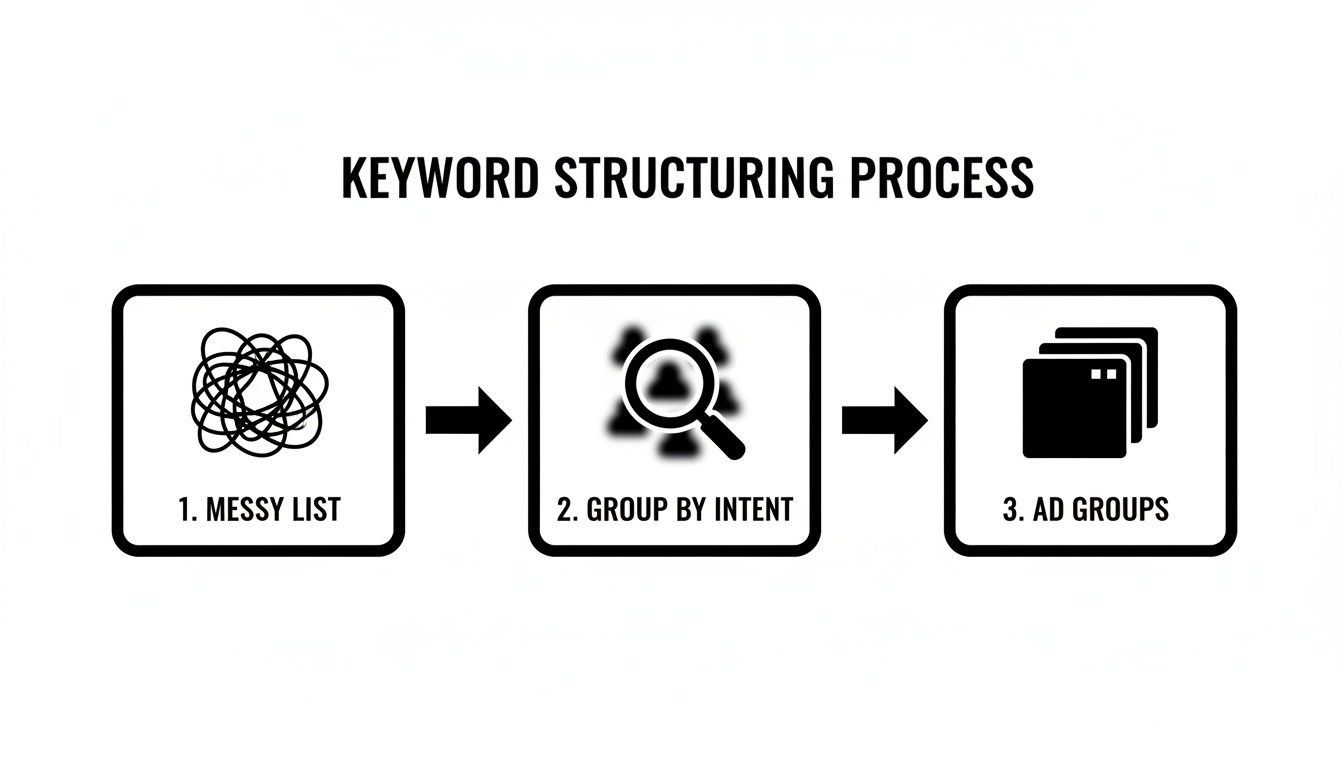
As you can see, it’s all about moving from chaos to clarity, with user intent driving every single decision you make along the way.
Choosing Your Match Types Wisely
Think of keyword match types as instructions for Google. They dictate how much wiggle room the algorithm has when matching your keywords to what someone types into the search bar. You can be incredibly precise or give it a lot of freedom.
There are three main match types you'll be working with:
- Broad Match: This gives Google the most control. Your ad might show for searches that are just related to your keyword, including synonyms or topics Google thinks are relevant. It’s got the widest reach but also carries the highest risk of burning your budget on irrelevant clicks.
- Phrase Match: This is your middle-of-the-road option. Your ad can show up for searches that include the meaning of your keyword. So, if you're bidding on "women's running shoes" as a phrase match, your ad could appear for "running shoes for women" or "best shoes for women to run in."
- Exact Match: This gives you the tightest control. Your ad will only show for searches that have the same meaning or intent as your keyword. It has the smallest reach, but the clicks you get are usually hyper-relevant and more likely to convert.
Getting the right balance between reach and relevance is key. This table breaks down when to use each match type based on your goals.
Choosing the Right Keyword Match Type
| Match Type | Best For | Budget Control | Reach Potential |
|---|---|---|---|
| Broad Match | Maximum reach, discovering new keywords, awareness campaigns. | Low | High |
| Phrase Match | Balancing reach with relevance, targeting a specific audience. | Medium | Medium |
| Exact Match | Targeting high-intent users, maximizing ROI on proven terms. | High | Low |
For a much deeper look at the nuances here, check out our guide on Google Ads keyword match types for some more advanced strategies.
Don't make the classic mistake of setting a new campaign on broad match and just letting it run. Trust me, it’s a recipe for wasted money. Starting with tighter control using phrase and exact match is almost always the smarter, safer bet.
My Battle-Tested Approach to Match Types
So, how do you put this into practice? I always recommend starting tight and then strategically loosening the reins based on what the data tells you.
First, launch your new campaigns or ad groups using only phrase and exact match for your core keywords. This forces your budget to go toward highly relevant searches right out of the gate, giving you a clean baseline to measure performance.
After a week or two, it’s time to dig into your Search Terms Report. This is your treasure map—it shows you the actual queries people typed before clicking your ad. Hunt for the terms that are driving clicks and, most importantly, conversions.
When you find a winning search term that was triggered by a phrase match keyword, "graduate" it. Add that exact search term as a new exact match keyword in the same ad group. This lets you bid more aggressively on a proven winner and take full control.
Your Secret Weapon: Negative Keywords
If match types are your offense, negative keywords are your defense—and a strong defense wins championships (and saves you a ton of money).
A negative keyword is simply a word or phrase you tell Google to block. If a search query contains your negative keyword, your ad won't show. Period.
For example, if you sell high-end, premium coffee makers, you'd immediately want to add words like "free," "cheap," "used," and "repairs" to your negative keyword list. This instantly stops you from paying for clicks from people who are clearly not your customers.
Finding these budget-draining terms isn't a one-and-done task; it's a weekly habit. Your Search Terms Report is your best friend here. Every single week, you should be combing through it, looking for irrelevant queries to add to your negative list.
This is where a tool like Keywordme can be a real game-changer. Instead of spotting a bad term in a spreadsheet and then manually adding it in Google Ads, Keywordme lets you do it with a single click. See a junk term? Click "Add as Negative." Done.
Turning this tedious chore into a quick, repeatable action is the fastest way to plug budget leaks and boost your campaign's ROI.
Turning Your Keyword Strategy Into an Optimization Engine
So you’ve done your research and built out your keyword list. Great. But that list isn’t a trophy you just stick on a shelf—it’s a living, breathing part of your campaign that needs constant attention.
The truth is, launching your campaigns isn’t the finish line. It’s the starting line. The initial setup gets you in the game, but the real wins come from the ongoing cycle of testing, learning, and refining. This is how you build a powerful feedback loop: analyze what's working, cut what's not, and go all-in on your winners. This isn't about random tweaks; it's about creating a system that keeps your campaigns agile and profitable for the long haul.
Focusing on Metrics That Actually Matter
When you first open up your Google Ads account, it’s easy to get buried under a mountain of data. Clicks, impressions, click-through rate… it’s a lot to take in. But when it comes to optimizing your keywords, only a few of those numbers really tell you if you’re making money or just lighting it on fire.
Here are the metrics I live and die by:
- Conversion Rate: This tells you what percentage of clicks from a specific keyword lead to a real action—a sale, a lead, a sign-up. A keyword with a thousand clicks and zero conversions is a major liability.
- Cost Per Conversion (CPA): This is your bottom line. How much does it cost you in ad spend to get one customer? If your CPA is higher than your profit margin on that sale, you’ve got a serious problem.
- Return on Ad Spend (ROAS): For any e-commerce business, this is king. It measures how much revenue you earn for every dollar you spend. A 4:1 ROAS is a great benchmark, meaning you’re making $4 for every $1 you put in.
Don’t get distracted by vanity metrics like impressions or even CTR. A high click-through rate feels good, but if those clicks are from the wrong people and never turn into customers, it’s just an expensive ego boost. Always trace your keyword performance back to real business results.
A Clear Framework for Taking Action
Once you're focused on the right metrics, making decisions becomes a lot less about guesswork and more about data. You can finally stop being emotionally attached to that one keyword you thought was going to be a home run.
Here’s a simple framework to put into practice:
- Pause the Bleeders: Find any keyword that’s spending money without bringing in conversions. If you see a keyword racking up a decent number of clicks but has zero sales to show for it, pause it. Stop letting it drain your budget.
- Double Down on Winners: When a keyword is consistently bringing in conversions at a good price, it’s time to give it more gas. You can increase its bid to get a better ad position and capture even more of that high-quality traffic.
- Promote Your Best Search Terms: This is where the magic happens. Dive into your Search Terms Report to see the exact queries people are typing that lead to conversions. If a profitable search term was triggered by a broad or phrase match keyword, grab it and add it as its own exact match keyword. This gives you total control over a proven money-maker.
This cycle—analyze, pause, invest, and promote—is the heart of long-term PPC success. It forces you to constantly shift your budget away from waste and toward what’s actually working. A big part of this is also knowing how to improve website conversion rates so that the expensive, high-intent traffic you're buying actually turns into results.
Don't be afraid to be ruthless. The goal isn't to have the biggest keyword list; it's to have the most profitable one. Pausing a non-performing keyword isn't failure—it's just smart optimization.
Speeding Up Your Optimization Workflow
Trying to manage this optimization cycle by hand can be a real drag, especially as your campaigns get bigger. Bouncing between spreadsheets, the Search Terms Report, and the Google Ads interface to make these changes is slow and leaves a lot of room for error.
This is exactly where a purpose-built tool becomes a game-changer. Instead of a clunky, multi-step process of copying and pasting, you need a workflow that lets you act on your insights instantly.
With a tool like Keywordme, this whole optimization engine gets a major upgrade. You can look at your Search Terms Report and, in a single click, pause a junk term, add a new negative, or promote a winning query to become its own exact match keyword. A task that might have taken an hour of manual grunt work can be done in minutes.
This speed is a huge competitive advantage. It lets you react to what the data is telling you faster than your competitors can. You can learn more about this in our deep dive on improving ROI with keyword performance analysis.
Ultimately, turning your strategy into an optimization engine is about making small, continuous improvements that add up over time, ensuring your ad spend works harder and smarter for you every single day.
Your PPC Keyword Research Questions Answered
Even after you’ve got the basics down, a few questions always seem to pop up. Honestly, they’re the same ones we all had when we started. Let's clear the air on some of the most common sticking points in PPC keyword research.
How Often Should I Really Do PPC Keyword Research?
Here’s the thing: keyword research isn't a "one and done" task you check off a list. If you treat it that way, you're leaving money on the table. The market, your competitors, and the way people search are always changing.
You have to build it into your routine.
- Your Weekly Pulse Check: At the very least, you need to dive into your Search Terms Report once a week. This is your first line of defense. You'll catch and block irrelevant search queries with negative keywords and, just as importantly, spot new search terms that are performing well.
- Your Monthly/Quarterly Deep Dive: This is where you zoom out and get strategic. At least once a month (or quarterly for more stable accounts), you should be analyzing bigger trends, hunting for entirely new keyword categories, and rethinking your campaign structure based on what the data is telling you.
Consistent keyword optimization isn't just another task on your to-do list. It’s the habit that separates the campaigns that break even from the ones that consistently drive profit.
What Is a Good Number of Keywords Per Ad Group?
Everyone wants a magic number, but it doesn't exist. The real goal isn't hitting a specific keyword count; it's achieving perfect relevance. The only number that matters is one: one single, unified theme per ad group.
Think of it like this: every single keyword in an ad group should be so closely related that one specific ad feels tailor-made for all of them. The moment you find yourself writing a generic ad just to cover all your keywords, you’ve gone too far. That's your cue to split the ad group.
Sure, many strong ad groups land somewhere between 5-20 keywords. But an ad group with three perfectly matched keywords is fantastic. One with 25 can also work, as long as they are all variations on the exact same theme. The instant you have to dilute your ad copy to squeeze in one more keyword, it’s time to break it up.
Can I Just Use Broad Match with Smart Bidding?
This is a tempting one, especially with how much Google pushes this combo. But going all-in on broad match right from the start is a huge gamble. It's like giving the algorithm your credit card with no spending limit and just hoping it figures things out.
The biggest danger is burning through your budget on junk traffic before the smart bidding algorithm even has a chance to learn. It needs conversion data to get "smart," and you're the one paying for its education, click by expensive click.
A much safer, more professional way to approach this is to earn your way into using broad match.
- Establish a Baseline: First, launch your campaigns with phrase and exact match keywords. This gives you control, helps you build a strong negative keyword list, and lets you gather clean performance data.
- Identify Your Winners: Once you know what’s actually converting, you have a solid foundation to stand on.
- Test with a Leash: Now, you can carefully test broad match. Isolate it in its own campaign or ad group with a strict budget. This lets you see if it can uncover new opportunities without torching your core budget.
Never just "set it and forget it" with broad match. It demands a watchful eye, especially when it's just getting started.
Ready to stop juggling spreadsheets and start optimizing your campaigns up to ten times faster? With Keywordme, you can clean up junk search terms, expand your ad groups with proven winners, and manage your entire keyword workflow in one place. Start your free trial and see how much time and money you can save at https://www.keywordme.io.
.svg)