
How to Find Low Competitive Keywords for Your PPC Ads
How to Find Low Competitive Keywords for Your PPC Ads


Finding low-competitive keywords is all about spotting the opportunities everyone else is overlooking. The real game isn't chasing massive search volumes; it's about finding those specific, high-intent search terms where you can actually win, letting your content or ads rank faster and without breaking the bank. Think of it as choosing relevance over sheer reach—you're targeting people who are much closer to making a decision.
The Real Advantage of Overlooked Keywords

Forget about the high-stakes bidding wars for popular, super-broad keywords. The smartest wins in digital marketing almost always come from the terms nobody else is paying attention to. These overlooked, low-competition keywords are a goldmine, especially if you're trying to get the most out of every ad dollar or climb the organic rankings.
Zeroing in on these less-contested terms can completely change your strategy for the better. It’s the difference between shouting into a crowded stadium and having a one-on-one conversation with a customer who’s ready to buy.
Why Targeting Low Competition Just Works
It all comes down to efficiency. When you go after a term like "shoes," you're throwing yourself into the ring with global giants who have bottomless budgets. But what if you target "waterproof trail running shoes for wide feet"? Suddenly, the competition thins out, and the person searching that phrase has a very specific need, which signals a much higher intent to buy.
This hyper-targeted approach unlocks some serious advantages:
- Lower Costs: In paid search, fewer competitors directly translates to a lower Cost Per Click (CPC). Your budget stretches further, bringing in more of the right kind of visitors for the same spend.
- Higher Conversion Rates: Specific questions attract users who know exactly what they want. When your landing page or ad perfectly matches their need, the chance of them converting goes through the roof.
- Faster Rankings: For SEO, it's infinitely easier to get a new or smaller site to rank for a niche term than for a massively competitive one. These early wins are crucial for building momentum and authority.
The real magic of low-competition keywords is how perfectly they align with user intent. You stop chasing vanity metrics like huge search volumes and start focusing on what actually moves the needle: conversions.
A solid competitive analysis framework is a must-have here. It helps you pinpoint gaps in the market and uncover those overlooked keywords where your rivals are weak—or better yet, completely absent.
Moving Beyond the Search Volume Trap
So many marketers get hung up on high search volume, but that's often a trap. A keyword with 10,000 monthly searches that brings in zero conversions is completely worthless next to a term with just 100 monthly searches that consistently drives sales.
This is where you have to appreciate the power of specificity. These valuable keywords are almost always longer phrases, what we call long-tail keywords. If that's a new concept for you, our detailed guide on long-tail keyword research is a fantastic place to start.
At the end of the day, mastering how to find low-competition keywords is about building a sustainable, budget-friendly marketing strategy that delivers a real ROI. It’s not about being louder than the competition; it's about being smarter.
Decoding the Metrics That Actually Matter
Finding keywords that are actually low-competition isn't a guessing game. It's about knowing which numbers to trust and, more importantly, which ones to ignore.
A massive search volume might look impressive on a spreadsheet, but it’s often a vanity metric that leads straight to wasted ad spend. The real gold is buried a little deeper, in the data that seasoned PPC pros live and die by.
Think of it like being a stock market analyst. You wouldn't just buy a stock because its name is popular. You'd dig into the P/E ratio, trading volume, and market sentiment. That same analytical rigor applies here—you have to look past the flashy numbers to find keywords that are genuinely undervalued.
Beyond Search Volume: The Real Indicators of Competition
The first step is a simple but powerful mindset shift. Stop asking, "how many people search for this?" and start asking, "how many advertisers are bidding on this?" This change in perspective is everything.
Two key metrics help us answer that question. The first is Keyword Difficulty (KD%), which you've probably seen in SEO tools. It estimates how tough it would be to rank organically in the top 10. While it's a great starting point for SEO, it doesn't paint the full picture for paid ads. Our guide on what is keyword difficulty breaks this down in more detail.
For PPC, the metric that truly matters is Competitive Density. This number, usually on a 0-to-1 scale, tells you exactly how many advertisers are in the ring, actively bidding on a keyword. A high score means a full-blown bidding war. A low score? That’s your green light.
A low Competitive Density score is your signal that you've found fertile ground. It means fewer advertisers, which almost always translates to cheaper clicks and a better chance for your ad to be seen.
This isn't just theory. Data from tools like Semrush shows that while a KD% under 30% is a good target for SEO, a Competitive Density score below 0.2 is the real sweet spot for PPC. We've seen agencies cut their wasted ad spend by 20-30% just by focusing on these low-density terms.
In the US market, where Google has a massive 89.57% search share, these overlooked keywords can hit a 7.52% average conversion rate—completely blowing away the performance of high-competition terms.
Before we move on, let's put the most important metrics in one place. Think of this as your cheat sheet for quickly evaluating keyword opportunities.
Key Metrics for Assessing Keyword Competition
A quick reference guide to the most important metrics for identifying low-competition keywords and what they mean for your PPC strategy.
Ultimately, a balanced approach is best. A keyword with low competitive density and a decent search volume is often the perfect combination to start with.
Reading the SERP for Hidden Clues
Keyword tools are fantastic, but they don't tell the whole story. The best analysts always pair tool-based data with a quick, manual review of the Search Engine Results Page (SERP). What you see on the live results page provides context that numbers alone never will.
When you search for a target keyword, pay close attention to what Google is showing you. These SERP features are direct clues about the competition and what users really want.
Here’s what to look for:
- Heavy Ad Presence: Are the top four ad spots consistently filled by major brands? This is a dead giveaway of a highly commercial and competitive term.
- Shopping Ads: A big carousel of Google Shopping results signals strong e-commerce intent and fierce competition from retailers.
- Video Carousels: If YouTube videos are dominating, it suggests users prefer visual content for this topic. Your text-based ads might struggle to get traction here.
- Local Packs: A map with local business listings means Google sees the search as local. If you aren't a local business, trying to compete is an uphill battle.
This combination of hard data and real-world SERP analysis is how you go from guessing to knowing. It’s also crucial to understand modern keyword rankings and visibility reports to move beyond outdated tracking methods. This complete view is how you spot the genuine opportunities that your competitors have completely missed.
Your Toolkit for Unearthing Hidden Gem Keywords

Alright, now for the fun part. With a clear idea of the metrics that matter, it's time to roll up our sleeves and actually find these keywords. This isn't about finding one magic tool that does all the work. It’s about being a bit of a detective, using a few smart techniques to piece together a killer keyword list.
The whole process really boils down to starting with a few core ideas—your "seed keywords"—and then branching out into the long-tail variations that your customers are actually typing into Google.
Start with Simple Seed Keywords
Think of seed keywords as the jumping-off point for your entire research project. They’re the broad, obvious terms that describe what you do. Seriously, don't overthink this.
If you sell custom coffee mugs, your seeds are exactly what you think they are:
- "coffee mugs"
- "custom mugs"
- "personalized gifts"
Let's be real: you're probably never going to rank for these on their own. They're way too competitive. But that’s not the point. We’re going to use them as springboards to find the specific, high-value long-tail keywords that will actually make you money.
Uncover Gold in Google's Own Backyard
Some of the best keyword ideas are hiding in plain sight, and they don't cost a dime. Google itself gives you a direct pipeline into what real people are searching for. You just have to know where to look.
Google Autocomplete is always my first stop. Start typing a seed keyword, and just watch the suggestions that pop up. That list is a goldmine. Typing "custom coffee mugs for..." might instantly show you "custom coffee mugs for coworkers" or "custom coffee mugs with logo cheap."
Next, scan the "People Also Ask" (PAA) box. These are the literal questions your audience is asking. Seeing something like, "How to design your own coffee mug?" is a huge signal. It's a high-intent keyword from someone who is clearly deep in the buying process.
Finally, always scroll to the bottom of the page and check out the "Related Searches." This is where you'll often find different angles you hadn't even considered, like "photo mug no minimum order" or "engraved ceramic mugs."
Don't sleep on these built-in Google features. They give you raw, unfiltered data on real user behavior, which can be more valuable than the polished metrics from a paid tool.
Mine Customer Language from Online Communities
Want to know what your audience is really thinking? Go where they are. Forums and communities like Reddit and Quora are absolute treasure troves of natural language and unsolved problems.
Just search for your niche. A subreddit like r/coffee or a Quora topic on "Gift Ideas" will be overflowing with people talking about their needs, frustrations, and what they're looking for.
Keep an eye out for posts where people are:
- Asking for recommendations: "Where can I find a good quality travel mug that doesn't leak?"
- Complaining about a problem: "I ordered a custom mug and the picture quality was terrible."
- Comparing products: "Is it better to get an engraved mug or a printed one?"
Every one of these threads is packed with the exact words your customers use. This kind of phrasing makes for incredibly effective, low-competition keywords because it's authentic and hyper-specific.
Ethically Steal Your Competitors' Best Keywords
Why reinvent the wheel when your competitors have already done some of the heavy lifting? Peeking at the keywords your rivals are ranking for is one of the fastest ways to find proven winners.
You can plug a competitor’s domain into a keyword research tool and see what’s driving their traffic. You’re not trying to copy their entire strategy. You're looking for the low-hanging fruit—keywords they rank for, but not very well, or terms with low difficulty scores that you could easily snatch. You can find some great options in our guide to the best PPC keyword research tools, many of which work just as well for SEO.
This gives you a pre-vetted list of keywords that you know have commercial intent in your market. It's an incredibly efficient way to build out your list. When you combine this with your seed keywords, Google's suggestions, and community research, you end up with a powerful, diverse set of keyword targets to work with.
Sorting the Gold from the Gravel: How to Validate and Prioritize Your Keyword List
Alright, so you’ve got a big, beautiful list of potential keywords. That's a great first step, but a spreadsheet full of terms isn't going to make you any money on its own. Now for the crucial part: separating the real opportunities from the duds.
This is where we move past the raw numbers and get our hands dirty. It’s all about looking at what’s actually happening on Google's results page to figure out where you have a fighting chance. Think of it as combining cold, hard data with your own human intuition to make sure every dollar you spend is working for you.
Put on Your SERP Detective Hat
Your best intelligence won't come from a tool; it comes from manually searching for your top keywords. What you see on that live results page gives you a level of real-world context that no software can fully capture. You’re looking for cracks in your competitors' armor and clues about what searchers really want.
When you eyeball the SERP, you’re basically trying to answer one question: Can my ad actually win here?
Keep an eye out for these telltale signs of the true competitive landscape:
- Who owns the top spots? Are the first few results dominated by massive, household-name brands like Amazon, Forbes, or Home Depot? If you’re seeing giants, breaking through is going to be an uphill battle, no matter how good your ad is.
- How crowded is the ad block? Are all four top ad slots filled with slick, professional-looking ads? A full house signals a high-stakes, commercial keyword where you’ll need to bid aggressively just to be seen.
- What’s the searcher's goal? Look at the type of content ranking. Is it all blog posts? Product pages? Videos? Local business listings? This tells you exactly what Google believes users are looking for and helps you nail your own ad copy and landing page.
This manual check is non-negotiable. I've seen it a hundred times: a keyword looks perfect on paper—low difficulty, good volume—but a quick look at the SERP reveals it’s an absolute warzone.
Getting a Feel for Real-World Click Potential
Validation is also about making an educated guess on your potential click-through rate (CTR). Targeting the right keywords has a massive impact on how visible your ads are and, by extension, how many clicks you pull in. This is exactly where focusing on validated low-competition terms really pays off.
WordStream’s Google Ads benchmarks show that while the average CTR across all industries is 6.66%, some less-crowded niches blow that out of the water. For instance, the Arts & Entertainment category hits an impressive 13.10% CTR.
How is that possible? Because terms with a Competitive Density under 0.2 allow ads to stand out instead of getting lost in the noise. By finding these validated sweet spots, you can aim for those higher industry benchmarks. You might even hit outstanding conversion rates, like the 13.07% CVR seen in the Pets category.
A Dead-Simple Framework for Prioritization
Once you've manually vetted your top contenders, you need a system to rank them. This stops you from just picking keywords that "feel" right and forces you to put your budget behind the terms with the highest probability of success.
A simple scoring system in a spreadsheet is all you need. It’s a way to merge the quantitative data from your tools with the qualitative insights from your SERP analysis into a single, actionable score.
The goal isn't just to find low-competition keywords; it's to find the best low-competition keywords. Prioritization is what turns a good list into a profitable campaign.
Here’s a simple model to get you started:
Just add up the scores for each keyword. The ones with the highest totals are your priority targets. They represent that perfect sweet spot: decent search volume, weak competition, and a dead-on match for what you sell. This is how you build a campaign that’s designed to win right out of the gate.
Building a Smarter, Faster PPC Workflow
Knowing the theory is one thing, but actually putting it into practice day after day is what gets you results. The real challenge isn't just finding good keywords; it's turning that research into profitable Google Ads campaigns without getting lost in a sea of spreadsheets. It's time to build a workflow that's smart, fast, and repeatable.
This is where you graduate from being a keyword researcher to a campaign architect. A slick process doesn't just save you time—it prevents costly mistakes and ensures your campaigns are built to win from the very start. It’s all about creating a system that connects your validated keyword list directly to your campaign structure.
Ditching the Spreadsheet Chaos
Let's be honest, the old way of doing things is a total productivity killer. You export a search terms report from Google Ads, dump it into a monster spreadsheet, and then spend hours filtering, sorting, and manually pasting new keywords or negatives back into your campaigns. It's slow, tedious, and a recipe for human error.
Modern PPC management requires a much more integrated approach. This is where a tool like the Keywordme Chrome plugin completely changes the game by letting you do all this work directly inside the Google Ads interface. Think about it: you can analyze real-time search term data and take action immediately, without ever having to switch tabs.
With this kind of in-platform workflow, you can:
- Kill junk terms on sight: See an irrelevant search term gobbling up your budget? One click and it's on your negative keyword list. Done.
- Find hidden gems: Spot a high-converting search term that isn't a keyword yet? You can add it to the perfect ad group with the right match type in seconds.
- Build powerful negative lists: Group similar garbage terms together to create shared negative lists, applying them across multiple campaigns to protect your entire account from wasted spend.
This is all about working smarter, not harder. You're making data-driven decisions in the moment, collapsing a process that used to take an hour into just a few minutes.
This flow is really about turning a raw list of ideas into a concrete, prioritized action plan.
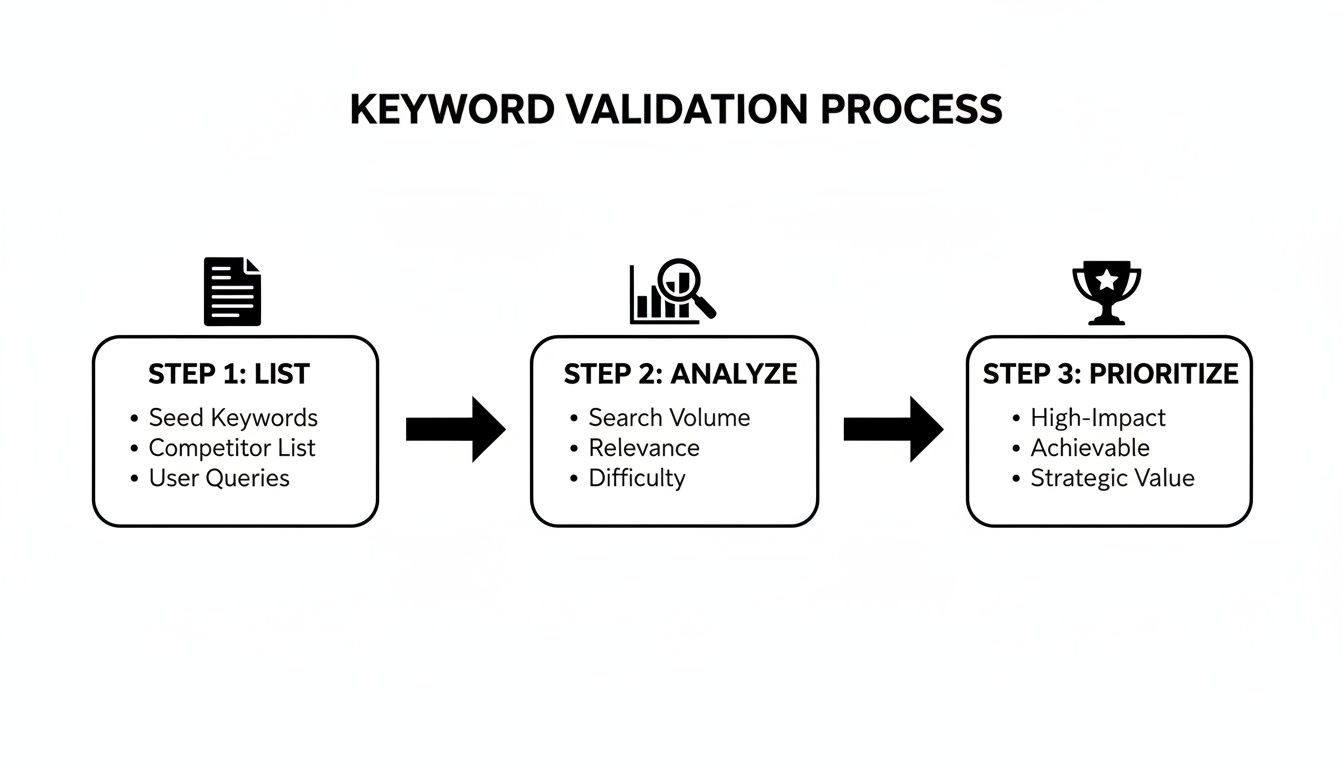
You can see the simple but powerful progression here: gather your potential keywords, analyze whether they're actually viable, and then prioritize them for execution.
How This Directly Boosts Campaign Performance
Adopting a smarter workflow has a real, measurable impact on your KPIs. One of the biggest levers you can pull in Google Ads is your Quality Score. It’s Google’s rating of your keyword and ad relevance, and it has a massive effect on your costs.
A high Quality Score can literally slash your Cost Per Click (CPC) by up to 50%. Low-competition keywords are a fantastic shortcut to better scores because their specificity makes it easy to create tightly-themed, hyper-relevant ads, especially when using exact or phrase match. While Google Keyword Planner gives you a basic competition level, a tool like Keywordme refines this by using real, live search term data from your own campaigns. This lets you find terms that aren't just low-competition in theory, but are proven performers in the real world. You can see how top agencies do this by checking out some detailed Google Ads metrics research.
The speed of your workflow directly impacts your profitability. The faster you can cut wasteful search terms and double down on what’s working, the better your ROI will be.
For example, while the average conversion rate across all industries sits around 7.52%, highly relevant campaigns in niches like Animals & Pets can hit an incredible 13.07% CVR. That’s the power of matching a specific search query with the perfect ad and landing page. We’ve seen an agency in the legal space—where the average CTR is a paltry 5.97%—lower its Cost Per Lead by 25% just by focusing on keywords with under 0.2 competitive density and constantly refining its negative lists with an efficient workflow.
This constant cycle of optimization, made possible by a faster process, is what separates the average campaigns from the exceptional ones.
Common Questions About Finding Low-Competition Keywords
Even with the best strategy, a few questions always seem to pop up. Let's dig into some of the most common ones I hear from marketers about finding and using these hidden gem keywords. Getting the small details right can really make or break a campaign.
Think of this as a quick chat to clear up any confusion before you dive in. I’ll give you some straight, no-fluff answers to help you put all this into action with confidence.
How Do I Balance Low Competition with Search Volume?
Ah, the classic question. It's a balancing act, for sure, but maybe not in the way you think. The trick is to stop obsessing over individual keywords and start thinking in terms of topics and intent. You’re hunting for that sweet spot where someone is clearly looking to buy, even if the search volume isn't setting any records.
Honestly, a single keyword with 100 monthly searches and obvious purchase intent is worth so much more than a vague term with 10,000 searches that never converts.
Stop chasing that one unicorn keyword. Instead, build an army of smaller, super-specific, and profitable keywords. Their combined traffic often blows bigger terms out of the water, and the quality is night and day.
For example, don't just target one big, expensive term. Instead, find a handful of related low-volume keywords and group them into a tightly-themed ad group. This lets you pool their traffic potential while making your ad copy and landing page a perfect match for each specific search.
How Quickly Can I See PPC Results with This Strategy?
This is where things get exciting. The real beauty of using this strategy for PPC is the speed. The feedback loop is almost immediate. Unlike SEO, where you could be waiting months to see if your efforts paid off, paid search gives you data on day one.
As soon as your ads targeting these low-competition keywords go live, you’ll see impressions, clicks, and your Cost Per Click (CPC) data roll in within hours. Since you're intentionally avoiding the mosh pit of high-stakes bidding wars, your ads have a much better shot at getting seen right away, and your initial costs should be noticeably lower.
This instant feedback means you can test, learn, and tweak at a pace you just can't match with a high-competition strategy. You'll know right away which keywords are winners and which are duds, letting you double down on what works without burning through your budget.
Can a Low Competition Keyword Still Be Hard to Win?
Yes, absolutely. And this is a super important point. It’s exactly why you can't just blindly trust the metrics from a keyword tool. Those numbers are a great starting point, but they don't always tell the whole story.
Here’s a scenario I’ve seen play out dozens of times:
- A keyword tool flags a term with a low "Competition" or "Keyword Difficulty" score.
- The search volume is decent, and the estimated CPC looks like a bargain.
- On paper, it’s a green light.
But then you actually Google the term yourself. You might see the top organic spots and all the ads are completely owned by household names—think Amazon, Forbes, or WebMD. These are brands with massive authority and user trust. They're incredibly tough to beat, no matter how low the bidding competition seems.
This is why manual SERP analysis is non-negotiable. You have to put on your detective hat, look at the real search results, and ask one simple question: "Can my ad or my content realistically win a click here?" Sometimes the data says it’s an easy win, but only a human eye can spot an unmovable giant standing in your way.
Ready to stop wrestling with spreadsheets and start building smarter, more profitable campaigns? Keywordme plugs directly into your Google Ads dashboard, turning hours of mind-numbing keyword work into a few clicks. Clean out the junk, find new winners, and optimize your campaigns up to ten times faster. Give the free trial a spin and see for yourself.
.svg)