
7 Peak Times to Post on TikTok in 2026
7 Peak Times to Post on TikTok in 2026


Sunday at 9 a.m. is the strongest single time identified in a 2026 analysis, followed by Monday at 1 p.m. and Sunday at 1 p.m. Early evening, late evening, and weekend windows are also useful starting points, but your best time is the hour your own TikTok analytics shows followers are active, converted to their local timezone and tested consistently.
The popular advice says there's one perfect hour to publish. TikTok data doesn't support that certainty. A large Buffer analysis of 7.1 million TikTok posts points to Sunday morning and Monday lunchtime, while Sprout Social's March 2026 benchmark places a broad weekday afternoon window from 2 p.m. to 6 p.m. local time. A separate SocialPilot analysis of 700,000 posts identifies 8 a.m. and 8 p.m. as leading times, with 2 p.m. to 4 p.m. next.
That disagreement is useful. It tells you to treat the following windows as testable hypotheses, not guarantees. Compare follower activity, convert each recommendation to the audience's timezone, account for regional and industry differences, match timing to content intent, and record the results in a simple analytics log. For broader paid-search work, Keywordme can help with Google Ads keyword research, search-term cleanup, and campaign optimization, but TikTok analytics should guide organic publishing.
1. Morning Rush From 6 a.m. to 9 a.m.
Morning publishing is a sensible starting test for audiences that check TikTok while getting ready, commuting, or taking a first break. It also aligns with the broader pattern identified in the 2026 Apaya timing summary, which describes 6 a.m. to 9 a.m. as one of the most useful default bands across timing research.
The important distinction is between audience availability and content suitability. A short workout demonstration, morning briefing, coffee routine, or productivity prompt fits a quick-scroll mindset better than a complex product explanation. That doesn't prove morning posts will outperform on your account. It gives you a clean reason to test them.

Make the morning test easy to compare
Use a similar content format across morning trials. A vertical, mobile-first video with an immediate visual hook can work well when viewers are distracted, but don't assume a trending sound or a particular length will rescue a weak opening.
Try different points inside the window rather than treating 6 a.m. and 9 a.m. as interchangeable. If your followers live across regions, schedule according to the dominant audience's local time, then record which region responds best.
Practical rule: Morning timing is a useful test when your content solves a morning problem. It isn't evidence that every account should publish before work.
For Google Ads teams, Keywordme belongs in the connected search workflow, not as a substitute for TikTok evidence. You can use it to organize keywords, handle negative search terms, and refine campaigns around offers that complement the organic post. Keep the organic timing decision inside TikTok analytics.
2. Lunch Break Window From 11 a.m. to 1 p.m.
Lunch is a testable window, not a universal advantage. Buffer's analysis identified Monday at 1 p.m. as the second strongest single posting time, after Sunday at 9 a.m., while Sunday at 1 p.m. also ranked among the leading results. That supports testing lunch hours, but broad dataset findings cannot predict how your followers will respond.
Lunch viewers often have limited attention. Recipe clips, compact tutorials, beauty demonstrations, short comedy, and snackable educational videos can fit a distracted session. A slow opening can still lose viewers before timing has an opportunity to help.

Use intent as the filter
Match the post to what people may want during a break. A food brand could test a recipe or product-use idea. A B2B creator might answer a common workplace question, while a fashion account could condense a longer guide into one outfit decision.
Audience schedules still vary. Students, office workers, parents, and shift-based employees may open TikTok at different points in the lunch period. Compare activity and results across the window before expanding your schedule.
- Hook immediately: Put the payoff, question, or visual change near the opening.
- Build a series: Recurring lunch content can give viewers a reason to return, provided the cadence remains sustainable.
- Separate paid and organic evidence: A restaurant testing lunch specials can pair a TikTok recipe clip with a Google Ads campaign targeting “lunch near me” keywords, then track which search terms drive profile visits from the video.
Use the same idea at different points, such as 11 a.m. and 1 p.m., and compare retention, engagement, and profile activity. If you're comparing paid social strategies, Instagram ads and follower growth offers channel context, not proof that TikTok follows the same schedule.
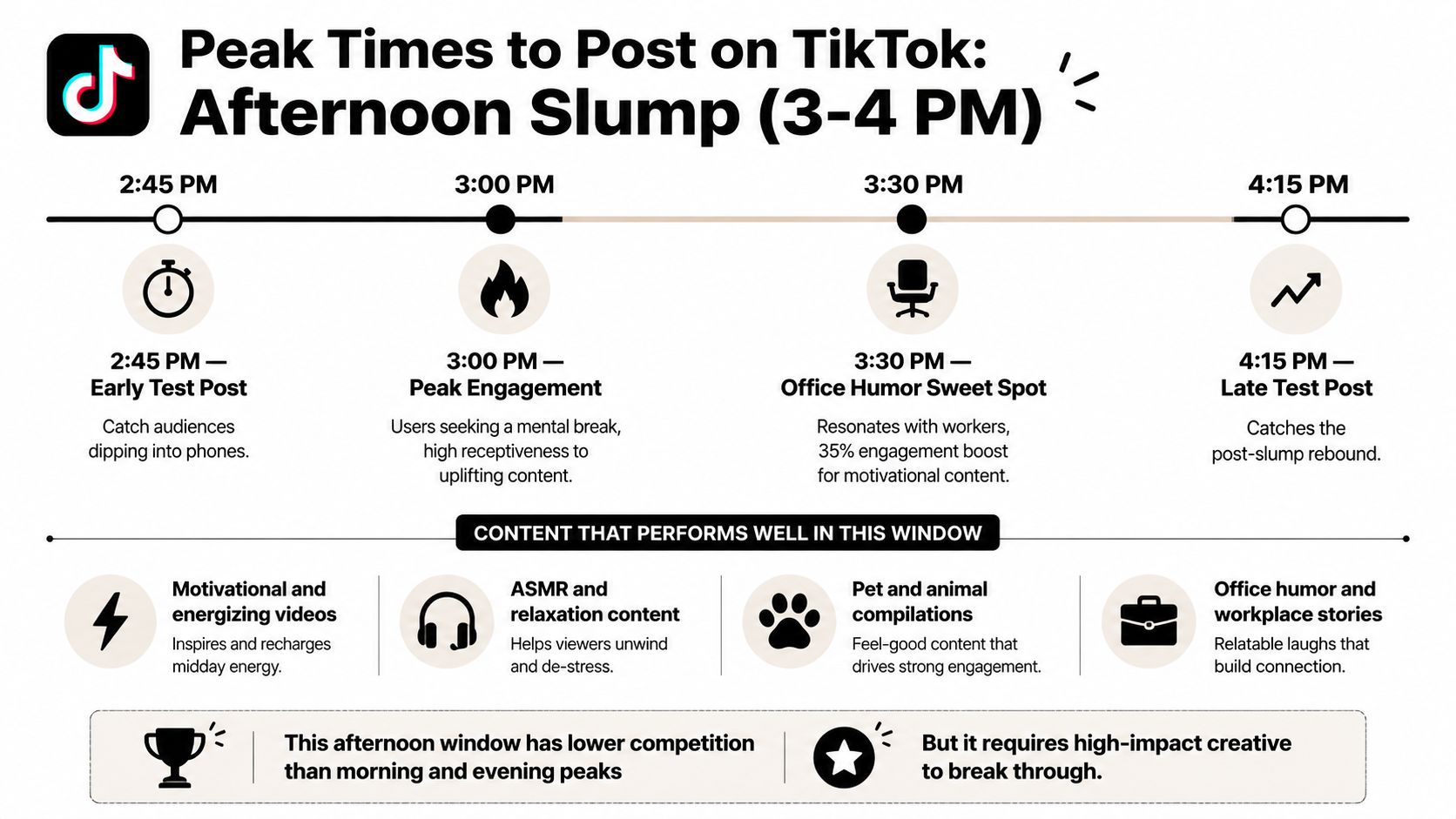
3. Afternoon Slump From 3 p.m. to 4 p.m.
The afternoon slot looks weaker if you rely only on the broadest weekday patterns, but it remains a worthwhile test because multiple 2026 summaries place 2 p.m. to 4 p.m. near a strong TikTok window. Sprout Social's wider 2 p.m. to 6 p.m. local-time benchmark also gives this period room for testing, especially from Tuesday through Thursday.
The opportunity isn't necessarily a universal afternoon surge. It may come from a specific audience segment, such as students finishing classes, workers taking a break, or viewers in a region where the local clock differs from your own.
Match the creative to low attention
Afternoon content should make the next action obvious. Try a quick demonstration, a surprising comparison, a reaction, a workplace joke, or a concise motivational idea. ASMR, pet videos, and other low-friction formats can also be tested when the audience wants a mental reset rather than a detailed lesson.
The key is to avoid changing too many variables at once. If you move from 3 p.m. to 4 p.m., keep the format, topic strength, and publishing cadence reasonably comparable. Otherwise, you won't know whether the clock or the creative caused the result.
Don't dismiss an afternoon slot because it feels quiet in your own feed. Your personal scrolling pattern isn't a proxy for your followers.
Keywordme can support competitor keyword research and Google Ads remarketing preparation around a related campaign. It can't establish when TikTok viewers are active. Record views, watch time, shares, saves, and conversions from the organic post independently.
A small shift can reveal a useful local pattern. Test the central window first, then compare it with nearby times such as 2:45 p.m. or 4:15 p.m. only if your publishing process can keep the comparison fair.
4. Early Evening From 5 p.m. to 7 p.m.
Early evening is a useful test window, not a guaranteed magic hour. Timing roundups often place stronger engagement across broader evening periods, such as 6 p.m. to 10 p.m. or 6 p.m. to 11 p.m., as noted in Apaya's roundup of TikTok timing patterns. That pattern supports testing the transition from work, school, or errands into leisure, but it does not prove that 5 p.m., 6 p.m., or 7 p.m. will lead on your account.
Use the window to test leisure-oriented creative, including entertainment, music, lifestyle, fashion, and user-generated content. A product video may also perform well if it feels native to TikTok rather than interruptive. Keep the topic and format comparable while changing the clock time, then review watch time, shares, saves, profile visits, and conversions alongside views.
A practical sequence is simple: choose one anchor time, publish similar posts there, and establish a baseline. Test an earlier and later slot afterward. This separates a genuine timing effect from differences in topic, hook, or distribution.
Paid promotion introduces a separate question. For an early-evening TikTok about dinner recipes that drives profile visits, use Keywordme's in-feed advertising guidance when expanding a Google Ads keyword list with terms such as “easy dinner ideas.” Exclude unrelated terms such as “breakfast meal prep.” TikTok analytics still determines organic timing, while keyword research supports the related search campaign.
5. Late Evening From 8 p.m. to 11 p.m.
Late evening deserves its own test because it sits inside the evening pattern repeatedly highlighted in 2026 timing summaries. Buffer's analysis found strong evening behavior overall, while SocialPilot's separate study identified 8 p.m. as one of the best times to post, alongside 8 a.m., with 2 p.m. to 4 p.m. as the next strongest window.
This is a useful period for storytelling, entertainment, gaming clips, music, commentary, and series content. Viewers may have more uninterrupted time, but that assumption needs evidence from your account. A global audience can make the same clock time represent very different viewing contexts.
Test for depth, not just reach
A late-evening post should have a reason to keep watching. Build a clear narrative, use a strong opening question, or create a sequence that rewards completion. Don't add length merely because the clock suggests viewers have more time.
Test 8 p.m., 8:30 p.m., and 9 p.m. only as separate experiments, not as a promise that one of them will win. Compare similar content types and note whether the audience changes by region.
Late evening may be valuable when viewers watch deeply, even if it doesn't produce the highest raw reach.
For an international account, inspect comments, shares, and follower growth by location where available. A post that attracts meaningful interaction from a target market may be more useful than one that generates broad but poorly qualified exposure.
Keywordme can help identify and clean search terms for a related Google Ads campaign. It won't tell you whether a late-night TikTok audience prefers gaming, comedy, or long-form storytelling. Let the post-level data answer that question.
6. Late Night From 11 p.m. to 12:30 a.m.
Late night works best as a targeted test, not a default recommendation. It may suit night owls, gaming communities, music-production audiences, international followers, and viewers who consume niche content outside standard workday routines.
Broader evidence supports evening activity, but it does not establish a universal peak from 11 p.m. to 12:30 a.m. A smaller, more focused audience may generate stronger saves or comments. Another account may lose early momentum because too few relevant followers are online.
Test a specific audience segment
Begin with an audience hypothesis. A creator with followers across several regions could test whether publishing late in one home timezone reaches another market during its active evening. A gaming account might compare a highlight clip with a community update, while an ASMR account tests calm, low-distraction creative against its usual schedule.
Judge the slot through more than views:
- Audience fit: Do interactions come from the market or community you want?
- Depth of response: Do viewers complete videos, save, share, or comment?
- Delayed performance: Does the post continue attracting attention after the initial publishing period?
Late-night results can also show whether content remains discoverable asynchronously. Timing advice varies because audience composition and distribution patterns vary, so one account's quiet hour may be another account's opportunity.
Keywordme can support the Google Ads side by helping with keyword expansion and negative keyword handling for relevant search campaigns. Do not treat paid-search data as proof of TikTok follower activity, and handle sensitive audience assumptions carefully.
Keep the test limited and intentional. Compare similar posts across late-night and more active local-time windows, then review audience fit, response depth, and delayed performance. If the slot produces no useful signal, change the window instead of forcing the schedule.
7. Weekend Peak From Saturday to Sunday, 12 p.m. to 8 p.m.
Weekend timing deserves its own experiment because leisure routines differ from weekday schedules. Buffer's 2026 study found Sunday at 9 a.m. as its strongest single posting time, followed by Monday at 1 p.m. and Sunday at 1 p.m., based on 7.1 million TikTok posts. SocialPilot's 2026 analysis of 700,000 posts produced a different pattern. That disagreement makes a fixed weekend rule difficult to defend.
Start with separate Saturday and Sunday tests. Keep the content goal and format similar, then log reach, watch time, shares, saves, follower growth, and conversions. A travel creator, for example, could compare a Saturday afternoon destination video with a Sunday morning planning tip. A stronger result is not just more views. It is stronger response from the audience the account intends to reach.
Use three timing checks:
- Include Sunday morning: Buffer's result makes 9 a.m. a useful comparison point, even though this section focuses on the broader 12 p.m. to 8 p.m. weekend range.
- Sample the afternoon and evening: Divide 12 p.m. to 8 p.m. into smaller local-time slots instead of treating eight hours as one window.
- Separate audience locations: Convert each test to the timezone where the main audience lives. Regional accounts may see different weekend peaks from accounts serving one market.
A travel creator testing Saturday afternoon TikTok posts could use Keywordme's guide to social media ad platforms to build a Google Ads campaign around high-intent terms such as “weekend getaway deals,” while excluding low-intent searches such as “cheap flights today.” That paid-search setup can support channel planning, but it does not prove organic TikTok performance. Use TikTok Studio Analytics to decide whether the weekend slot deserves another test.
7-Point Comparison: TikTok Peak Posting Times
| Time Window | 🔄 Complexity | ⚡ Resource Needs | ⭐ Expected Outcomes | 💡 Ideal Use Cases | 📊 Key Advantages |
|---|---|---|---|---|---|
| Morning Rush (6–9 AM) | 🔄 High, intense algorithm competition, precise timing | ⚡ Moderate–High, mobile-first edits, frequent posting, ad timing | ⭐⭐⭐⭐, high CTR & awareness for time-sensitive offers | 💡 Quick motivational, news briefs, flash sales, workout clips | 📊 Captures high-intent commuters early in day |
| Lunch Break (11 AM–1 PM) | 🔄 Medium, predictable window, needs consistency | ⚡ Moderate, 30–90s polished clips + coordinated ads | ⭐⭐⭐⭐, sustained watch time, strong saves/shares | 💡 Comedy, food/recipe, quick tutorials, retargeting | 📊 Relaxed audience receptive to entertaining/educational content |
| Afternoon Slump (3–4 PM) | 🔄 Low–Medium, lower competition, needs punchy creative | ⚡ Low–Moderate, short high-energy assets, simple edits | ⭐⭐⭐, good engagement for mood-boosting content | 💡 Short energizing videos, ASMR, office humor, pet clips | 📊 Opportunity to re-engage mid-funnel with lower ad costs |
| Early Evening (5–7 PM) | 🔄 High, prime-time saturation, scheduling critical | ⚡ High, high-quality production + paid amplification | ⭐⭐⭐⭐⭐, peak engagement and conversion potential | 💡 Entertainment, product launches, long-form brand content | 📊 Largest reach and conversion rates; best for scaling campaigns |
| Late Evening (8–11 PM) | 🔄 Medium, strong but slightly less saturated than prime | ⚡ Moderate–High, longer-form production for extended sessions | ⭐⭐⭐⭐, extended watch times, strong Gen Z engagement | 💡 Long storytelling, music, comedy, gaming highlights | 📊 Longer session durations; good for awareness and series content |
| Late Night (11 PM–12:30 AM) | 🔄 Low, niche scheduling, timezone planning required | ⚡ Low, targeted niche content, efficient ad spend | ⭐⭐⭐, smaller volume but highly engaged viewers | 💡 ASMR, niche hobbies, international-targeted content | 📊 High engagement per viewer; cost-effective for niche audiences |
| Weekend Peak (Sat–Sun 12–8 PM) | 🔄 Medium, different algorithm behavior; strategy shift needed | ⚡ High, polished, longer-form content for binge sessions | ⭐⭐⭐⭐, prolonged sessions, high shares and conversions | 💡 Lifestyle, travel vlogs, DIY, long tutorials, binge content | 📊 Extended attention spans and stronger shareability on weekends |
Turn Posting Times Into a Repeatable Test
The practical answer isn't to copy a chart forever. Choose one or two windows, convert them to your primary audience's local timezone, and keep the comparison fair. If you test a morning slot against an evening slot, avoid changing the topic, format, hook quality, and posting frequency so dramatically that timing becomes impossible to isolate.
Start with the evidence-backed windows that cover different behaviors. You might test Sunday at 9 a.m., Monday at 1 p.m., a weekday afternoon inside Sprout Social's 2 p.m. to 6 p.m. local-time range, and an evening slot around 8 p.m. SocialPilot's analysis supports the latter as a useful test, while Buffer's dataset shows why weekend mornings and Monday lunch shouldn't be ignored.
Record every post in one log. Include the publishing date, local timezone, content type, topic, hook, views, watch time, engagement, shares, saves, follower growth, and conversions. Don't compare a polished product launch with a casual reaction clip and call the difference a timing result.
Review patterns instead of isolated winners
Review TikTok analytics regularly, then separate weekday results from weekend results. Also segment regional performance where the data allows it. A global average can hide the fact that one audience is active in the morning while another responds during its evening.
Repeat promising tests rather than accepting one unusually strong post as proof. Timing can support early attention, but it won't repair weak creative, unclear positioning, or poor retention. The data-driven TikTok content plan is a useful way to connect timing experiments with broader content planning, but your own account remains the deciding evidence.
Keywordme can support related Google Ads keyword and search-term optimization, including negative keyword handling and campaign expansion. TikTok analytics should determine the organic publishing schedule.
Keywordme helps marketers research Google Ads keywords, clean up junk search terms, manage negative keywords, and expand campaigns from real search data. Visit Keywordme to connect your paid-search workflow with a more disciplined approach to TikTok timing tests.
.svg)