
In Feed Advertising: 2026 Guide to Boost ROI
In Feed Advertising: 2026 Guide to Boost ROI


In feed ad units already hold a 35.44% share of the global Native Advertising Market in 2024, and that market is projected to grow from USD 104.63 billion in 2024 to USD 346.86 billion by 2032 according to SNS Insider's native advertising market report. That's the number that should reset how you think about this channel.
A lot of marketers still treat in feed advertising like a side format. Something you test after search, paid social, and display are already running. In practice, it's become one of the core ways brands get in front of people without screaming for attention.
That shift matters because in-feed ads don't win by interruption. They win by fit. If the message matches the environment, the ad feels like part of the browsing experience instead of a speed bump. When teams understand that, performance usually gets better. When they don't, they burn budget on ads that look native at first glance but feel off the second someone sees them.
Why In-Feed Advertising Is Dominating Digital Marketing
In-feed ad units already account for the largest share of the native advertising market, and that growth reflects a larger shift in how digital attention is bought and won.
Media budgets moved in this direction for a practical reason. Standard display still has a role, but it often asks people to pause what they are doing and look somewhere else on the page. Feed placements work with existing behavior. People scroll, compare, pause, and keep moving. Ads that match that pattern have a better chance of earning attention before they ask for a click.
That change shows up in campaign performance discussions every week. A banner can still drive reach. An in-feed placement usually gives you a better shot at attention quality, message absorption, and post-click intent if the creative matches the environment.
Why buyers and platforms both like this format
Platforms like in-feed ads because they fit naturally into social streams, editorial feeds, and content discovery surfaces without breaking the user experience. Advertisers like them because they can introduce a product, offer, or point of view inside the content flow instead of shouting from the margins.
Context does a lot of the heavy lifting here. A strong in-feed ad matches the shape, pacing, and expectations of the surrounding feed. That is not the same as hiding the ad. The unit still needs clear sponsorship signals. It just should not feel visually out of place.
Practical rule: The best in-feed ad looks like it belongs in the feed and makes its commercial intent clear within a second or two.
Mobile behavior pushed this format even further. A large share of paid media now lives inside swipeable, scroll-heavy environments where people make snap decisions. In-feed placements suit that behavior better than formats built for desktop sidebars and page chrome.
What this means for marketers in the trenches
Treat in-feed as a strategic discipline, not a leftover placement option.
The upside is bigger than click-through rate. Teams that get this channel right build a full-funnel loop. They use feed creative to earn attention, targeting to put that message in front of the right audience, and measurement to decide whether the traffic is producing revenue or just cheap engagement. That is why the format keeps gaining ground. It helps connect the why, the how, and the what now.
A few practical consequences follow:
- Creative has to communicate fast: Feed users decide in a moment whether something deserves a stop.
- Targeting improves good ads. It does not rescue weak ones: Precise audience setup cannot fix a poor hook or unclear offer.
- Landing-page alignment affects conversion rate quickly: If the promise in the feed does not match the page after the click, performance drops fast.
- Platform nuance matters: The same concept rarely works unchanged across Facebook, TikTok, LinkedIn, and publisher recommendation feeds.
In-feed advertising is dominating because it aligns with how people consume content now and how platforms package attention. For marketers, the primary opportunity is not using the format once. It is learning how to repeat the cycle well enough to turn impressions into measurable business results.
What Exactly Is In-Feed Advertising
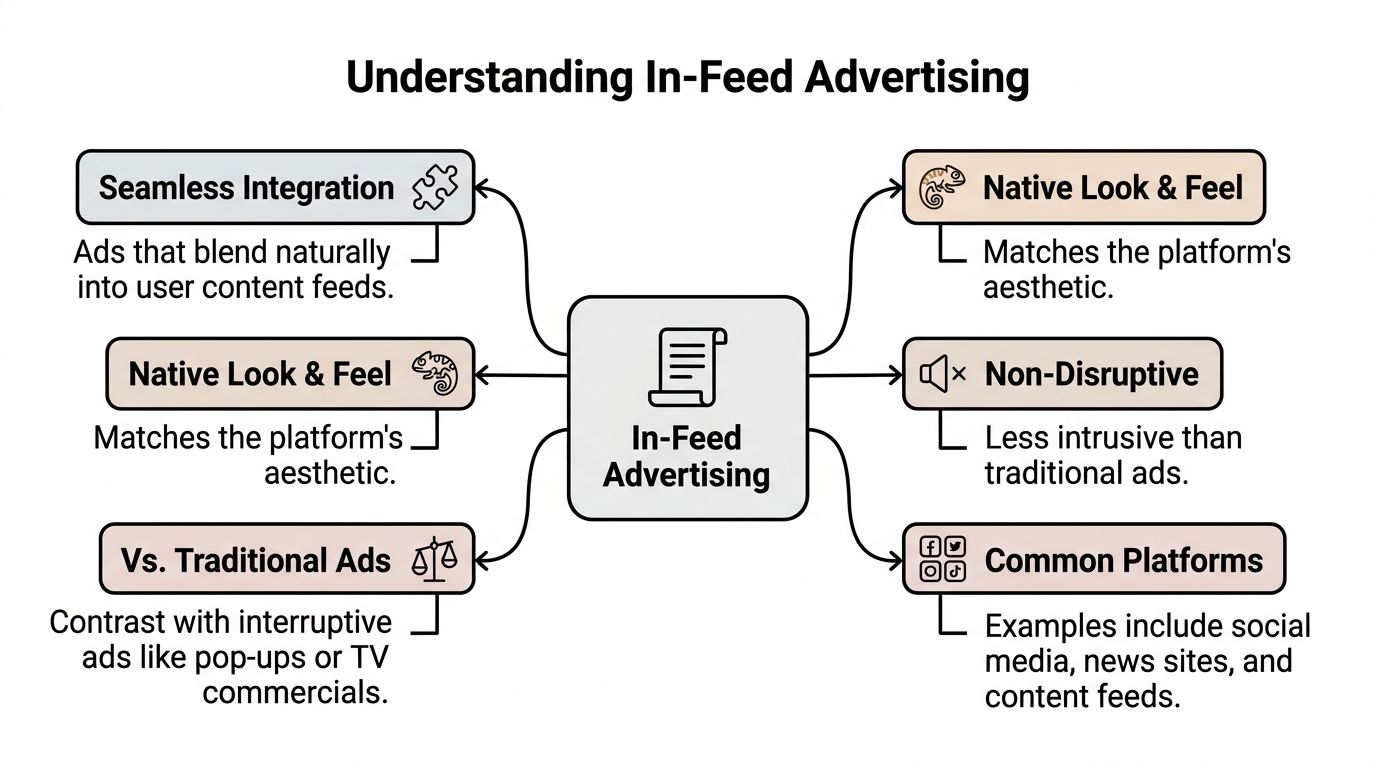
In plain English, in feed advertising is an ad placed inside a stream of content so it looks and behaves like the surrounding experience. Think of a sponsored article inside a magazine layout, not a flashing banner taped over the page. The ad still promotes something, but it appears in the same visual flow as the content a person was already consuming.
That's why the format works when it works. It doesn't ask users to leave their mode and pay attention to a separate advertising container. It joins the stream they're already in.
The simple test for whether something is really in-feed
A quick way to judge the format is to ask one question. If you removed the “sponsored” label, would the unit still visually make sense inside the feed?
If the answer is yes, you're probably looking at a true in-feed placement. If the answer is no, it's probably just a standard ad unit shoved near content.
That distinction matters because native feel isn't cosmetic. It affects how people interpret the message. In-feed ads usually perform best when they borrow the platform's structure, pacing, and tone rather than forcing a separate display concept into a feed.
The three IAB classifications you should know
The industry has a formal way to classify these placements. The Interactive Advertising Bureau defines three types of in-feed advertisements: Content Feeds, Product Feeds, and Social Feeds, as summarized in this publisher guide to in-feed ads.
Here's what that looks like in practice:
- Content Feeds: These appear inside editorial or article-style environments. Think story recommendations on a news site or sponsored placements in a content stream.
- Product Feeds: These are commerce-driven units. The user sees items, offers, or shopping-led recommendations that point toward product pages.
- Social Feeds: These show up on platforms like Facebook, Instagram, or other social environments where ads sit between posts in the main feed.
A junior marketer's mistake is treating all three like the same channel. They aren't. The feed may be the container, but the user mindset changes the job of the ad.
What in-feed ads are not
They're not pop-ups. They're not takeover ads. They're not random widgets pasted at the bottom of a page and labeled “native.” And they're definitely not an excuse to hide weak messaging behind a cleaner design.
A lot of bad in feed advertising fails because the team copies the outer shape of the platform but misses the inner logic. They mimic the feed's design without understanding why someone is in that feed in the first place. Native look helps, but relevance is what keeps the placement from feeling like camouflage.
Social Feeds vs Native Content Platforms
A campaign on Meta or TikTok is not the same thing as a campaign on a native content recommendation platform. Both can be in-feed placements. They just operate in different mental environments.
On social feeds, users are usually in a scrolling, entertainment-first mode. They're catching up, passing time, reacting, sharing, and grazing on content. On native content platforms, the user is often in a discovery mode tied more closely to reading, researching, or exploring adjacent topics.
That difference changes your creative, your offer, and your expectations.
The context is the strategy
If you ignore user mindset, you'll write one generic ad and force it into both environments. That's where spend starts leaking.
A social feed ad usually needs to stop the thumb immediately. The competition is visual, fast, and emotional. A native content feed often gives you a slightly different opening. You still need a strong hook, but the user may tolerate a more curiosity-driven message if it feels related to what they're already reading.
| Aspect | Social Media Feeds (e.g., Meta, TikTok) | Native Content Platforms (e.g., Taboola, Outbrain) |
|---|---|---|
| User mindset | Casual scrolling, entertainment, social validation | Active discovery, reading, topic exploration |
| Creative style | Fast hook, strong visual identity, mobile-native pacing | Headline-led, curiosity-driven, context-matched framing |
| Best message angle | Emotion, identity, utility shown quickly | Relevance, problem-solution, content adjacency |
| Primary friction | Users scroll fast and ignore anything that feels like an ad | Users click but bounce if the landing page doesn't match the promise |
| Typical goal fit | Awareness, engagement, direct response with strong creative | Traffic quality, mid-funnel education, qualified discovery |
| What fails | Slow intros, over-produced brand spots, generic stock visuals | Clickbait headlines, weak article-to-offer transition, off-topic landing pages |
What to change between the two
On social, your opening frame carries a lot of weight. The ad has to communicate visually even before someone reads. If you work with creators or short-form editors, this guide for video creators on platforms is a useful reference for understanding how different feed environments shape content behavior.
On native content platforms, the headline and surrounding context often matter more. The user has already shown some willingness to consume information. That means you can lead with a stronger problem statement, a sharper educational angle, or a recommendation-style framing.
A practical way to view this:
- Social feed ad: “Stop the scroll.”
- Native content feed ad: “Earn the click.”
If your ad works on TikTok but falls flat on a content discovery network, the problem usually isn't the platform. It's that the message was built for entertainment mode and dropped into research mode.
Don't separate this from contextual relevance
The closer your ad matches the page, topic, or browsing moment, the less forced it feels. That's why contextual thinking matters so much in native placements. If you need a solid primer on that overlap, this breakdown of contextual advertising is worth reading alongside your placement strategy.
The short version is simple. Social feeds reward immediacy. Native content platforms reward alignment. Treating them as interchangeable is one of the fastest ways to get mediocre results in both.
Creative and Targeting Best Practices That Work
The first second decides whether an in-feed ad gets a chance to work. In a live account, I care less about whether the concept sounds smart in a meeting and more about whether the user can identify the product, the promise, and the next step fast enough to stay.
That changes how good creative gets built. Platform specs matter, but specs are only the container. Performance comes from message clarity, speed of comprehension, and how tightly the ad matches the audience you chose.

Build creative for feed speed
Users do not study feed ads. They scan, judge, and keep scrolling.
That is why strong in-feed creative gets to the point immediately. Show the product early. State the problem early. If there is a payoff, put it on screen before the audience has to guess why they should care. Long intros, slow brand reveals, and vague lifestyle footage usually burn attention before the sales message even starts.
Here's the review standard I use before anything launches:
- Lead with the point: Open with the offer, problem, or outcome.
- Show the product early: Software should show the interface. Physical products should appear in use.
- Design for silent viewing: Captions, supers, and visual cues carry more weight than many teams expect.
- Match the feed environment: A polished brand video can still underperform if it moves too slowly for an in-feed placement.
- Keep copy tight: Short copy forces better prioritization.
For teams producing short-form ads at scale, these TikTok ad creative insights are useful because they focus on the pacing and structure feed placements reward.
One trade-off matters here. Fast creative is not the same as rushed creative. Cutting every sentence down to fragments can raise curiosity, but it can also lower trust if the viewer still does not understand what is being sold. The goal is quick clarity, not chaos.
Targeting should narrow the promise
Targeting does more than find an audience. It decides how specific your ad can be.
Broad targeting usually forces broad messaging, and broad messaging often produces generic hooks that nobody feels were written for them. Tighter targeting gives you room to make a sharper promise. That is where in-feed campaigns start turning attention into qualified clicks instead of empty traffic.
Three habits improve results consistently:
Segment by intent, not just identity
Job title, age, or gender can help, but intent is what sharpens the angle. Someone researching expense management software is far closer to a buying decision than a generic “small business owner” audience.Match the ad to the stage of awareness
Cold audiences respond better to a clear problem or strong pattern interrupt. Warm audiences can handle direct product claims, proof points, and harder CTAs.Treat the landing page as part of targeting
If the ad promises one thing and the page opens with another, the campaign loses momentum. That gap shows up later as weak conversion rates and expensive acquisitions.
This is the strategic loop many marketers miss. The reason in-feed ads matter is reach and market share. The way you turn that reach into ROI is by connecting targeting to creative, then carrying the same promise through to the click. If any link breaks, scale gets expensive fast.
Test variables in the right order
In-feed testing fails when teams change five things at once and call the result a lesson.
Keep the sequence simple. Test the hook first because that controls attention. Then test the body structure, the CTA, and audience refinement. Save smaller copy tweaks for later, after the opening frame and core angle are doing their job.
Field note: Clean tests feel slower at the start, but they produce better decisions and waste less spend.
A practical example helps. If CTR is weak, start with the opening visual or first line. If CTR is strong but conversions are poor, the problem usually sits in the offer, audience quality, or landing page match. That is how creative and targeting work together in practice. One gets the click. The other helps determine whether the click was worth buying.
Here's a short explainer worth watching if you want to sharpen the creative side before launch.
If you need help tightening messages before they ever hit the platform, this collection of ad copy examples is useful because it shows how different offers get framed clearly without bloated copy.
How to Measure Success and Prove Your ROI
Clicks can rise while profit stays flat. That gap is where a lot of in-feed campaigns get misread.
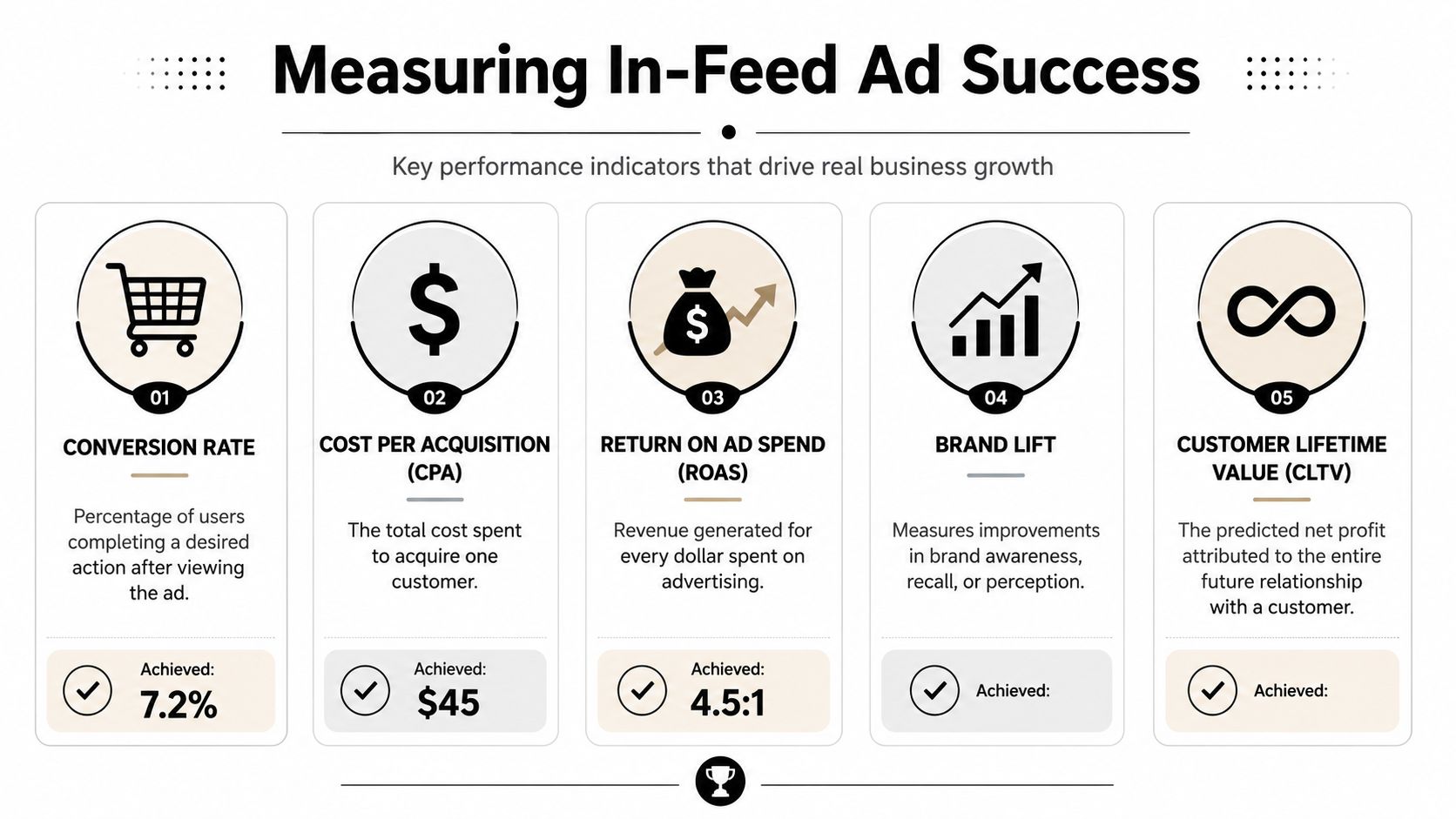
In-feed reporting usually includes familiar metrics such as CPM, CPC, CTR, CVR, CPA, ROAS, and video completion rate. The mistake is giving them equal weight. They answer different questions, and only a few tell you whether the campaign deserves more budget.
CTR is an early signal
CTR helps you judge whether the ad earned attention in the feed. It does not prove the traffic was qualified, and it definitely does not prove the campaign was profitable.
I treat it as the top of the diagnostic chain. Strong CTR with weak conversion rate usually points to a bad handoff. The ad sold one expectation, and the landing page delivered another. Weak CTR with healthy downstream economics often means the offer is solid but the hook is too soft to win the first click.
The metrics that matter most in budget conversations are simpler:
- CVR: Shows whether the traffic and offer fit each other.
- CPA: Shows what you paid for the action that matters.
- ROAS: Shows whether revenue justified the spend.
- VTR: Helps evaluate video creative, especially the opening seconds.
Read performance like a funnel
A flat dashboard hides the story. A sequence explains it.
Start with attention. Move to traffic quality. Then check acquisition cost and revenue return. That order matters because it keeps teams from fixing the wrong problem.
If CTR is low, fix the feed unit first. If CTR is healthy but CVR is weak, inspect audience quality, offer clarity, and landing-page continuity. If CVR is acceptable but CPA is still too high, media costs or targeting efficiency are usually the issue. If conversions are coming through and ROAS still disappoints, the problem often sits in pricing, margins, or average order value.
That is the strategic loop in practice. Creative gets the click. Targeting shapes the quality of that click. Measurement tells you which part of the system is limiting scale.
For teams that need a cleaner way to explain results to clients or leadership, this article on social media ROI is a useful reference because it pushes the discussion past engagement metrics and toward business outcomes.
Build reports around decisions
A good in-feed report should make the next action obvious.
I prefer reporting views built around four questions:
- Is the ad earning attention? Review CTR and video completion trends.
- Is the traffic qualified? Check CVR and on-site engagement signals.
- Is the acquisition cost acceptable? Compare CPA to actual margin, not a target picked in isolation.
- Is the campaign producing return? Use ROAS as the commercial filter before expanding spend.
This matters more than many teams realize. A campaign can look healthy in-platform and still miss the business goal if the reporting stops at clicks, views, and cheap traffic. If your dashboard still leans too hard on those surface metrics, this guide on how to measure advertising effectiveness is a strong next read because it connects media performance to real commercial impact.
Common Pitfalls That Waste Your Ad Budget
One of the biggest mistakes in in feed advertising is assuming every feed placement is worth taking. It isn't. Digital Content Next warns that native slots can “punt users off of the publisher site” unexpectedly and damage trust, and it makes the point plainly that “just because you can does not mean you should” in its analysis of in-feed ad deployment.
That warning applies to advertisers as much as publishers. A click that feels sneaky, forced, or mismatched is rarely a good click.
The expensive mistakes I see most often
Poor fit usually shows up in familiar ways:
- Clickbait framing: The headline wins the click, but the landing page can't cash the check.
- Platform mismatch: The ad uses the wrong tone, pacing, or visual style for the feed.
- Lazy broad targeting: The audience is too wide, so the creative says nothing specific.
- Bad landing-page continuity: The ad promises one thing and the page opens on something else.
- Over-expansion across placements: Teams keep adding feeds because inventory exists, not because the environment suits the offer.
The damage isn't limited to wasted spend. You also train yourself on bad data. A misleading click can inflate top-line engagement and hide the underlying problem for weeks.
Protect trust before you chase scale
Discipline is paramount. Native formats give marketers a lot of room to blend in. Used well, that creates a smoother user experience. Used badly, it creates the feeling of bait-and-switch.
A simple internal review helps. Before launch, ask:
- Does this ad clearly signal what it is?
- Does the landing page match the message and tone?
- Would this placement still make sense if performance dropped and only user experience remained?
The feeds that scale best are usually the ones you curate hardest.
A lot of wasted budget comes from trying to be everywhere at once. Better advertisers don't just ask, “Can we place here?” They ask, “Should this message live here at all?” That question saves more money than most bid tweaks.
Keywordme helps paid media teams clean up search terms, build stronger keyword lists, apply match types faster, and reduce wasted spend without messy manual workflows. If you want a simpler way to tighten Google Ads execution and protect ROI, try Keywordme.
.svg)