
Pay Per Click Software: A Guide to Boosting Your ROI
Pay Per Click Software: A Guide to Boosting Your ROI


Think of pay per click software as your command center for all things online advertising. It takes the often chaotic, spreadsheet-heavy world of campaign management and turns it into a streamlined, data-backed operation. It’s like having a smart co-pilot for platforms like Google Ads, handling the monotonous, time-sucking tasks so you can focus on the big picture.
In short, this software brings some much-needed clarity to where your ad dollars are going, helping you make smarter bets.
What Is Pay Per Click Software Anyway?

Let's be real. Trying to manage a serious pay-per-click (PPC) campaign without the right tools is like trying to build a house with only a hammer. You might get a wall up, but you're not going to get very far, and it’s going to be a frustrating mess. Pay per click software is the full toolkit that lets you build, manage, and scale your advertising effectively.
At its heart, this software is all about automation, analysis, and optimization. Instead of drowning in endless spreadsheets trying to figure out which search terms are working, the software spots patterns, flags irrelevant queries, and helps you structure your campaigns for success. It’s about working smarter, not just harder.
There's a reason this market is exploding. The global search advertising space is expected to hit a mind-boggling US$351.55 billion by 2025. With that much competition, every business is looking for an edge. Software is that edge—it's how you ensure your investment actually pays off instead of getting lost in the noise.
Turning Chaos into Control
So, what does this look like day-to-day? Imagine you just launched a brand new ad campaign. Within hours, you see clicks coming in from search terms that have absolutely nothing to do with what you sell. Each one of those clicks is just money straight down the drain.
Without software, you'd be stuck doing this manually:
- Digging through search term reports every single day.
- Reading line by line, trying to spot the junk keywords.
- Painfully copying and pasting them into your negative keyword lists.
It’s slow, tedious, and a recipe for mistakes. Good pay per click software automates this entire headache, catching wasteful keywords almost as they happen and blocking them for you.
The real magic of PPC software isn't just about saving a few hours. It’s about making your ad spend smarter. It gives you the confidence to increase your budget because you know every dollar is being put to its best possible use.
Here’s a quick look at the difference between doing it all by hand versus letting a dedicated tool do the heavy lifting.
Manual PPC Management vs PPC Software
As you can see, the right tool doesn’t just make the job easier—it fundamentally changes how you approach it.
To really get the most out of these tools, it helps to have a solid grasp of effective pay per click advertising management. The software is built to make that complex job more efficient and profitable, handling the tedious stuff so you can stay focused on strategy. It’s the bridge between raw, messy data and the clear, actionable insights that actually grow your business.
The Features That Actually Drive Results
So, what makes this software tick? Let's get into the nuts and bolts of how it actually helps you win. The real power behind good pay per click software comes down to a handful of core features. These aren't just flashy add-ons; they're the workhorses that turn your ad budget into real, measurable profit.
Think of it like this: trying to manage a complex PPC account manually is like trying to cook a gourmet meal with just a butter knife. You might get there, but it’s going to be messy and slow. The right software hands you a full chef's toolkit—precision instruments for keyword research, automated systems for bidding, and beautiful dashboards for reporting.
Finding Keyword Goldmines
Every great campaign starts with targeting the right keywords. The trouble is, everyone and their cousin is bidding on the obvious, high-traffic terms, which sends costs through the roof. This is where a top-tier keyword research tool becomes your secret weapon.
It helps you dig deeper to find long-tail keywords—those longer, super-specific phrases that people type when they're ready to buy. A good tool won't just give you a list; it'll show you search volume, how competitive a term is, and what you can expect to pay per click. This lets you uncover those low-cost, high-intent gems your competitors are completely ignoring.
Building Campaigns That Just Make Sense
A disorganized campaign is a money pit, plain and simple. When you just dump a bunch of unrelated keywords into one big ad group, your ads become irrelevant, your Quality Score tanks, and your costs spiral upwards.
That's why modern software focuses on helping you build tightly organized campaigns, fast. Instead of spending hours manually creating ad groups, the software can automatically group keywords that are semantically related. This is how you create Single Keyword Ad Groups (SKAGs) or other tightly themed structures that ensure your ad copy is a perfect mirror of what the user is searching for.
When your ad perfectly matches the searcher's intent, your click-through rates jump. Google sees that relevance and rewards you with cheaper clicks and better ad placements. It’s a win-win.
Trying to maintain this level of granular organization by hand is a nightmare, especially as you scale. With the right platform, it's practically automatic. For a closer look at what's possible, check out the modern features of PPC management software.
Making Bulk Changes and Match Types a Breeze
Controlling your keyword match types—broad, phrase, and exact—is fundamental to controlling your budget. But updating them one by one in the Google Ads interface is slow and painful. This is where tools like Keywordme’s Chrome plugin are a total game-changer.
You can manage match types and make other bulk edits on the fly, without ever getting lost in Google’s menus. Need to switch 100 keywords from broad to phrase match? It takes one click. That kind of efficiency can easily save you hours of mind-numbing work every single week.
- Exact Match: Your ad shows for the exact search term. Maximum control.
- Phrase Match: Your ad shows for searches that include the meaning of your keyword. A good balance.
- Broad Match: Your ad shows for related searches. Widest reach, but watch out for irrelevant clicks.
Beyond keywords, a smart strategy often involves running search ads for brand keywords to defend your turf and capture high-intent traffic. Good software makes managing these campaigns just as straightforward, ensuring you’re not leaving any money on the table. It’s how all these features work in harmony that creates a system that’s not just faster, but a whole lot smarter.
How Negative Keywords Stop You from Burning Cash

Wasted ad spend is the silent killer of great PPC campaigns. It’s the money that just trickles away, day after day, on clicks from people who were never going to buy from you in the first place. This is where getting a handle on negative keywords becomes your biggest advantage.
Think of it like fishing. You’re out there trying to catch salmon, but your net keeps pulling up old boots and tangled seaweed. Every piece of junk costs you. Negative keywords are how you tighten the holes in your net to let the junk float by, catching only the fish you actually want.
In Google Ads, this simply means telling the platform which search terms you don't want your ads to show up for. It’s a dead-simple concept with a massive impact on your bottom line.
The Old Way Was a Total Grind
For years, the only way to manage negative keywords was a manual, soul-crushing chore. You’d have to download a search term report, pull it into a spreadsheet, and then spend hours sifting through hundreds—sometimes thousands—of rows of data.
After all that, you’d still have to painstakingly copy and paste the irrelevant terms back into your negative keyword lists in Google Ads. It’s slow, tedious, and shockingly easy to miss something important. If you’re juggling multiple campaigns, this can eat up a huge chunk of your week.
Automation: Your Budget's New Best Friend
This is where good pay per click software completely flips the script. Instead of you hunting down wasteful terms, the software surfaces them for you, essentially plugging the leaks in your ad budget.
Imagine a simple dashboard that flags irrelevant search terms the moment they appear. With a single click, you can block that term across one or even all of your campaigns. A task that used to take an hour now takes maybe a minute.
Here’s exactly how that automated approach boosts your ROI:
- It instantly stops the bleeding. By blocking bad queries right away, you stop paying for clicks that have a zero percent chance of converting.
- Your Click-Through Rate (CTR) improves. When your ads are only shown to people who are actually looking for what you offer, more of them will click. It's that simple.
- It boosts your Quality Score. Google loves relevance. A better CTR and more relevant ads lead to a higher Quality Score, which means you pay less for each click and get better ad positions.
Every dollar you save on a bad click is a dollar you can reinvest into a keyword that actually brings you customers. Over the course of a year, this disciplined approach can add up to thousands of dollars in saved ad spend.
The Rising Cost of Doing Nothing
Ignoring your negative keywords isn't just inefficient; it's getting more expensive every single year. The average cost-per-click (CPC) on Google Ads is projected to hit $5.26 in 2025—a 12.88% jump from the previous year. Every irrelevant click hurts your wallet more than ever.
This trend makes having a solid process essential. Automating your negative keyword management isn't just about saving time; it's about building a defensive wall around your ad budget.
If you want to dive deeper into tactics, our guide on how to find negative keywords is a great place to start. This proactive strategy ensures your ads are only seen by the people who matter: your future customers.
Choosing the Right PPC Software for Your Goals
With so many PPC tools out there, picking the right one can feel like a serious chore. Let's be honest, not all software is built the same. What a massive agency needs is probably way too much for a small business owner just trying to get a handle on their campaigns.
This is your no-nonsense guide to making a smart choice. We'll skip the long list of flashy features you'll never touch and focus on what actually matters for your business. The whole point is to find a tool that slots right into your workflow, not one that makes you reinvent the wheel.
Start With How You Actually Work
The most powerful software on the planet is worthless if it's a nightmare to use. Before you even glance at a feature list, think about your day-to-day. Are you constantly toggling between your Google Ads account and a dozen spreadsheets? Do you basically live inside the search term report, hunting for keywords to negate?
Your first priority should be ease of use. A clunky, confusing interface just adds friction and slows you down, which completely defeats the purpose of using a tool. Look for a clean design and an intuitive layout. If you can find what you need without needing a user manual, you're on the right track.
Next up, think about integrations. Does the software actually connect with the tools you already rely on? A simple but powerful integration, like a Chrome plugin, can be an absolute game-changer. It means you can do essential tasks—like adding negative keywords on the fly or changing match types—without ever leaving your current workflow. That alone can save you from a world of clicking and tab-switching.
Plan for Where You Want to Go
It’s easy to get caught up solving today's problems, but what about six months or a year from now? This is where scalability comes in, and it's a big one that people often forget. The tool you choose should be able to grow with you.
Ask yourself a few key questions:
- Can it handle more campaigns as my business takes off?
- Does it support multiple users if I decide to bring on help?
- Will its features still be useful as my ad spend increases?
Picking a tool that can scale saves you from the massive headache of switching platforms later on. You’re looking for a long-term partner, not a temporary band-aid.
Make Sure the Reporting Makes Sense
Data is just noise until you can turn it into action. A great PPC tool doesn't just drown you in numbers; it presents them in a way that helps you make smarter, faster decisions.
Look for clear reporting and analytics. Can you tell at a glance which campaigns are your winners and which ones are just burning cash? Does the platform help you see your progress over time in a way that actually makes sense? The goal of reporting isn't just to see what happened—it's to understand why it happened so you can double down on what works.
The ultimate test of any pay per click software is whether it delivers real, measurable value. The best way to confirm this is to take it for a spin. Don’t just watch a demo—get your hands dirty.
This is exactly why grabbing a free trial is a must. Taking a platform like Keywordme for a test drive lets you connect your own accounts and see firsthand how it fits your specific workflow and impacts your actual campaigns. It's the only way to be sure it's the right tool for you before you commit. For a deeper look at what to look for, check out our complete guide on pay per click management software.
PPC Software Evaluation Checklist
Ready to start comparing? Use this simple checklist to score different PPC software options based on what your business truly needs. It helps you move past the marketing fluff and focus on the criteria that will actually impact your success.
Once you've rated a few options, the right choice should be much clearer. It’s all about finding the best fit for your goals, your budget, and the way you like to work.
The PPC Metrics That Actually Matter
It’s easy to get caught up in vanity metrics. Seeing a huge number of impressions or clicks can feel like a win, but let's be honest—they don't pay the bills. Real success in PPC isn't about getting the most eyeballs; it's about getting the right ones to click and then turning them into customers. This is where we need to cut through the noise and focus on the numbers that actually move the needle.
Good pay per click software does more than just throw data at you. It connects the dots between an action you take—like adding a new negative keyword—and the outcome, like a lower cost to acquire a customer. This shift turns your ad budget from a blind expense into a predictable, measurable engine for growth.
Moving Beyond Clicks to Conversions
The first big mental shift is to stop asking, "How many clicks did I get?" and start asking, "How many of those clicks actually did something valuable?" This is where your Conversion Rate enters the picture. It’s simply the percentage of people who clicked your ad and then did what you wanted them to, whether that's buying a product or filling out a contact form.
A low conversion rate is a serious red flag. It usually points to a disconnect between your ad, the keywords you're bidding on, and what people see on your landing page. The right software helps you find the problem by highlighting which keywords are eating up your budget with clicks but bringing in zero conversions, letting you cut them loose and stop the bleeding.
This is why choosing the right tool is so critical. Think of it like this:
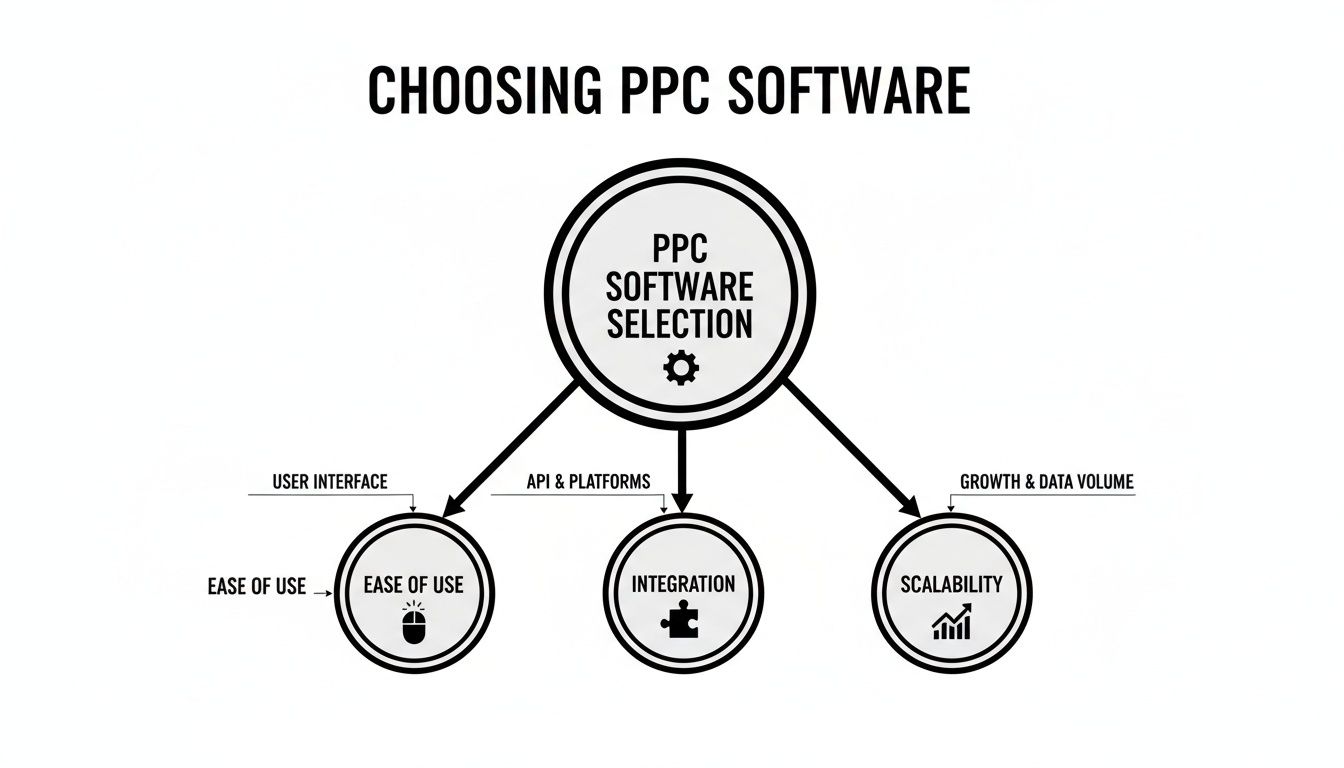
Finding a tool that’s easy to use, fits into your current workflow, and can grow with your business is the foundation for long-term success.
Understanding Your True Costs and Returns
Once you know which clicks are turning into customers, the next question is obvious: what are you paying for each of them? That number is your Cost Per Acquisition (CPA), and it's a brutally honest metric. You just divide your total ad spend by your total number of conversions.
If your CPA is higher than the profit you make from that customer, your campaign is a money pit. Simple as that.
This is another area where software gives you a huge advantage in lowering your CPA:
- Automating Negative Keywords: It works 24/7 to block irrelevant search terms, making sure your budget is only spent on clicks that have a real shot at converting.
- Improving Ad Relevance: Tools that help you build super-focused ad groups lead to higher Quality Scores from Google, which directly lowers how much you pay for each click.
- Focusing on Winners: With clear reporting, you can immediately see which keywords and ads have the lowest CPA and pour more fuel on that fire.
Return on Ad Spend (ROAS) is the ultimate scoreboard for PPC. It tells you exactly how much money you’re making for every dollar you spend on ads. A ROAS of 4:1 means you’re generating $4 in revenue for every $1 you put in.
This is the number your boss or your client really cares about. And the results speak for themselves. On average, businesses can earn $2 for every $1 spent on Google Ads, with some top-tier campaigns hitting returns as high as 800%. This kind of powerful return is why 65% of small and mid-sized businesses run PPC campaigns and lean on tools to make their ad spend profitable. You can discover more insights about these advertising benchmarks on WordStream.com.
Got Questions About PPC Software? We've Got Answers.
Still on the fence? That's perfectly normal. Diving into a new tool always brings up a few questions. Let's tackle the most common ones we hear so you can make a smart decision for your business.
Can't I Just Stick with the Google Ads Platform?
You absolutely can, but it's a bit like trying to build an entire house with just a hammer. You might get there eventually, but it's going to be a long, painful process. For anything beyond a tiny, simple campaign, managing everything manually inside Google Ads is a massive time sink.
You'll find yourself burning hours every week digging through search term reports, hunting for negative keywords, and manually piecing together data. A dedicated tool like Keywordme automates all that grunt work. It’s not just about saving time; it's about eliminating human error and letting you focus on the big-picture strategy that actually grows your business.
How Quickly Will I See a Difference?
The workflow benefits are pretty much instant. Seriously. Tasks that used to be a mind-numbing, hour-long chore—like weeding out irrelevant search terms—suddenly take just a few minutes.
As for your ad performance, you’ll likely see a noticeable improvement in your metrics within a couple of weeks. As the software helps you stop the bleeding from wasted ad spend on bad keywords, your ROI naturally starts to climb. The real magic, though, happens over the long term as you consistently optimize your campaigns with data, not guesswork.
Is This Kind of Tool Actually Affordable for a Small Business?
Definitely. The whole point of modern PPC software is to be accessible to everyone, not just the big players. The trick is to shift your mindset from seeing it as a cost to seeing it as an investment.
Think about it this way: If a tool costs $50 a month but saves you $200 in wasted ad spend while giving you back 10 hours of your time, it's not really a cost at all, is it? It's generating a return almost immediately.
This is exactly why you should look for tools with a free trial. You get to see the value with your own eyes before you ever have to pull out a credit card.
What's the Difference Between Using Software and Hiring an Agency?
Great question. It really comes down to who you want in the driver's seat.
- PPC Software: This is for the DIY-er or the in-house team. It's a tool that makes you smarter, faster, and more effective at managing your own campaigns. You keep full control.
- PPC Agency: This is a "done-for-you" service. You hand over the keys and let a team of experts manage your advertising from top to bottom. It's ideal if you want to be completely hands-off.
The funny thing is, the best agencies almost always use powerful PPC software themselves to get top-tier results for their clients. It just goes to show how critical these tools are for anyone serious about paid search.
Ready to trade manual grunt work for smarter, more profitable campaigns? Keywordme automates the tedious stuff so you can focus on growing your business. Start your free trial today and see the difference for yourself.
.svg)