
Multivariate Testing Guide for Marketers
Multivariate Testing Guide for Marketers


SEO Title: Multivariate Testing Guide for Marketers
Meta Description: Multivariate testing helps marketers find winning page combinations, but only at the right scale. Learn traffic thresholds, setup, and analysis.
You've probably been there. The headline test is done. The button test is done. Maybe you even swapped the hero image last month. Each change gave you a tiny clue, but the page still feels unfinished.
That's where things get tricky.
A landing page isn't a pile of isolated parts. The headline changes how the image feels. The image changes how the CTA reads. A button that looks strong under one headline can feel pushy under another. Marketers often treat those as separate questions when they're really part of the same one.
Introduction and Why You Need Multivariate Testing
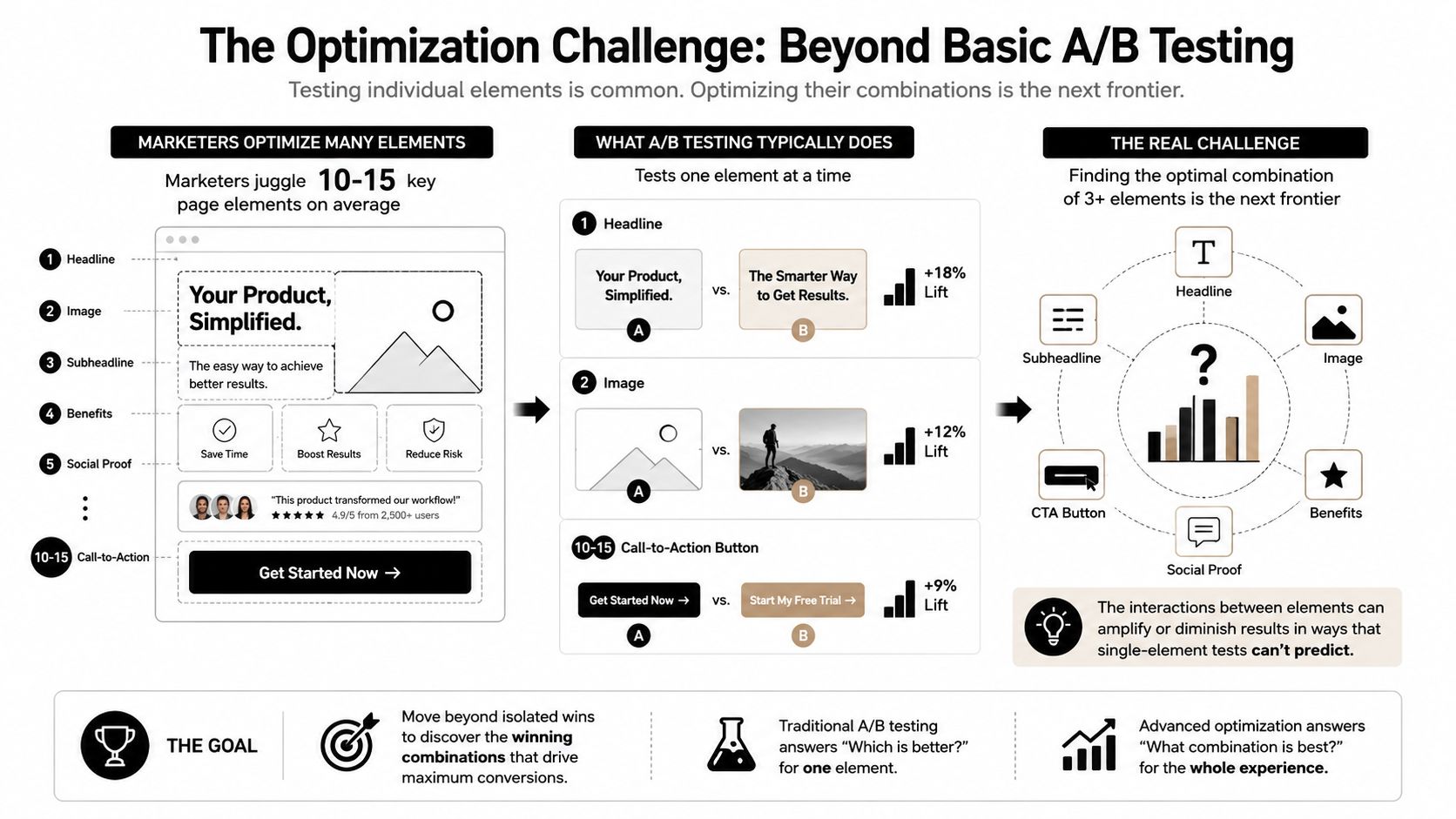
A marketing team finishes three clean A/B tests in a row. One headline wins. One button color wins. One hero image wins. Then the new page goes live, and conversion rate barely moves.
That happens because pages do not work like a checklist of isolated parts. They work more like a recipe. A stronger headline can make one image feel more credible and make another feel out of place. A CTA that performs well with a direct headline can feel too aggressive with a softer one. Multivariate testing helps you study those combinations instead of judging each element alone.
That is why marketers reach for multivariate testing after they have already learned the basics. They want to know which mix of headline, image, offer, and CTA works best together. If your team is still testing simple page ideas, it is often smarter to boost conversions with A/B testing before adding this extra layer of complexity.
The hidden issue is traffic.
A test with 2 headlines, 2 images, and 2 CTAs creates 8 combinations. Your visitors are now split across 8 versions instead of 2 or 3. That sounds manageable until you remember that each version needs enough conversions to separate signal from noise. Many teams are surprised to learn that meaningful multivariate tests often need six-figure monthly visitor counts, especially on pages with modest conversion rates.
That traffic threshold is where many marketers make the wrong choice. Multivariate testing is useful when combinations are the central question and your site can support the math. If traffic is limited, A/B/n testing usually gets you answers faster, with less risk of calling a random fluctuation a winner.
The appeal is still clear. When the page gets plenty of traffic and several elements may interact, multivariate testing can save rounds of sequential testing and reveal combinations you would never spot by changing one element at a time.
For marketers, that is the dividing line. The method is powerful. The statistical barrier is higher than it looks.
Understanding Multivariate Testing Fundamentals
Multivariate testing answers a specific question: Which mix of page elements works best together?
That wording matters.
A/B testing usually isolates one change so you can measure its effect more cleanly. Multivariate testing changes several elements at the same time and measures both the individual pieces and the combinations they create. It works a lot like trying different ingredients in a recipe. You are not only asking whether more salt helps. You are asking whether salt, heat, and cooking time produce the best final dish when combined.
Variables and variations
Start with two terms that sound similar but do different jobs.
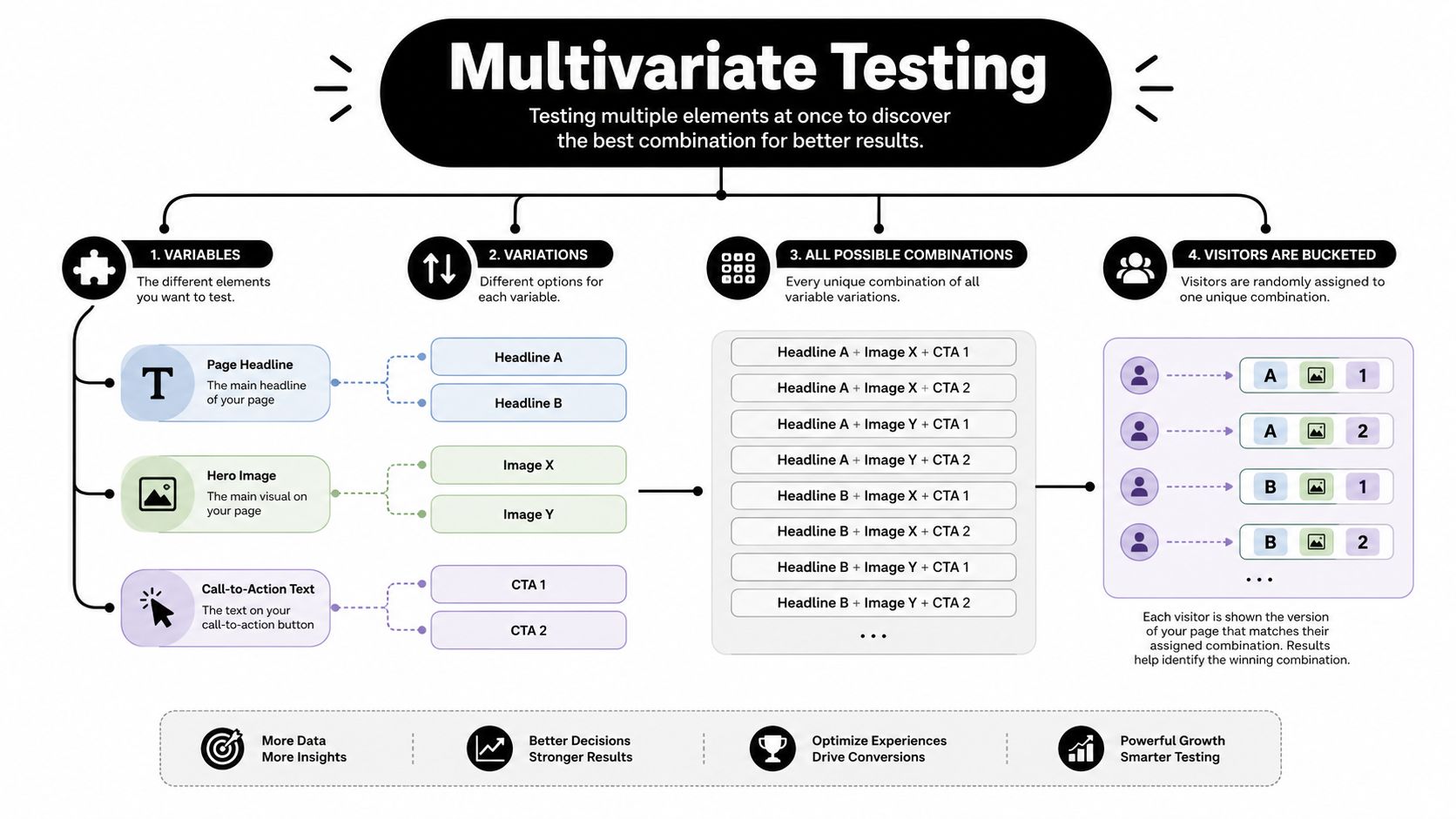
A variable is the part of the page you want to change. A headline is a variable. A hero image is a variable. A CTA button label is also a variable.
A variation is one version of that part. If your CTA says “Start Free” in one version and “Book a Demo” in another, those are two variations of the same variable. The Decision Lab explains multivariate testing in these terms: you define the adjustable components, create different versions of them, assign visitors across combinations, and then measure which combinations and which elements contribute most to performance.
That distinction clears up a common point of confusion. Variables are the categories you change. Variations are the options inside each category.
How combinations multiply
The math gets bigger faster than many marketers expect.
If you test:
- Two headlines
- Two images
- Two CTA texts
you are not testing six separate experiences. You are testing every possible pairing of those choices, which creates eight page versions in total.
That is the core mechanic behind multivariate testing. Each added variable increases the number of combinations, and each added combination divides your traffic again. Adobe explains that multivariate testing is generally used when you want to test at least three elements at the same time, while simpler A/B tests make more sense when fewer elements are involved (Adobe Experience League).
This is also where many teams underestimate the statistical barrier. A test setup can look small on a whiteboard and still become hard to finish once real traffic is split across every version.
Why this differs from A/B testing
A/B testing is built for focused questions.
Which headline gets more clicks? Which CTA gets more sign-ups? Which hero image lowers bounce rate?
Multivariate testing handles a different kind of question. It asks whether one element works better only when paired with another. A headline may perform well with one image and poorly with another. A CTA that looks weak in isolation may become strong when the surrounding message supports it.
That makes multivariate testing useful for pages where the full message matters more than any single part.
A page converts because the experience works together, not because one isolated element happened to improve on its own.
Full factorial, in plain English
The classic form of multivariate testing is called a full factorial design. The phrase sounds more complex than the idea.
It means you test every possible combination of the variables you selected.
Here is the process in plain language:
- Choose the page elements you want to test.
- Create versions of each element.
- Build all possible combinations.
- Randomly assign visitors to those combinations.
- Measure which combinations perform best, and which individual elements appear to help or hurt results.
A spreadsheet is a good analogy here. Add one more column with two choices, and the number of rows expands quickly. Multivariate testing behaves the same way. That is why the method can be powerful on high-traffic pages and impractical on lower-traffic ones. The testing idea is simple. The traffic and statistical requirements are what make it harder in practice.
Designing Robust Multivariate Experiments
A multivariate test often fails long before launch.
A team picks three headlines, four images, and three CTAs. The tool neatly builds every combination, the preview looks polished, and everyone feels ready. Then the traffic gets split into so many tiny buckets that the test crawls for weeks and still cannot produce a trustworthy answer.
That is the hidden barrier marketers miss. Multivariate testing is not just a creativity exercise. It is a sample size problem.
Start with traffic reality
Earlier, we noted that multivariate testing only makes sense when a page has enough traffic and enough conversions to support all the combinations you create. Without that volume, the test becomes thinly spread and hard to read with confidence.
A/B/n is often the smarter choice on lower-traffic pages because it concentrates visitors into fewer versions. You get clearer answers faster.
If you are still deciding between a simpler split test and a combination test, this guide to landing page A/B testing gives a useful baseline for comparison.
A good mental model is slicing a pizza. If you cut one pizza into four slices, each slice is still satisfying. Cut it into 24 slices, and each person gets a sliver. Traffic works the same way.
Count combinations before you design creative
Many marketing teams start with ideas. Start with math instead.
Use this order:
- List the elements you want to test
- Count the versions for each element
- Multiply them to find the total number of combinations
- Check whether your traffic can realistically support that total
This quick calculation prevents a common mistake. Adding one more variable can turn a manageable test into a slow, inconclusive one.
For example, 2 headlines x 2 images x 2 CTAs gives you 8 combinations. Add 3 pricing messages, and now you have 24. The page did not become three times more informative. It became three times harder to test well.
Choose the experimental design that fits your constraints
Design choice matters because not every team is trying to answer the same question.
| Design Type | Best For | Tradeoff |
|---|---|---|
| Full Factorial | Teams that want to measure every combination and examine interaction effects directly | Requires much more traffic, setup work, and QA |
| Fractional Factorial | Teams that need to reduce the number of combinations | Saves traffic, but can miss some interaction patterns |
Improvado explains the difference clearly. Full factorial designs test every permutation, while Taguchi-style fractional methods reduce combinations but may miss higher-order interactions (Improvado).
A full factorial design works like testing every possible outfit combination in a closet. A fractional design is closer to testing a smaller set of outfits to spot patterns faster. You save time, but you may miss a pairing that would have stood out.
Set launch rules before the test begins
Good multivariate tests are disciplined. That includes timing.
Convert recommends running a multivariate test through a full business cycle and waiting until it reaches strong statistical confidence before acting on the result (Convert). That advice matters because traffic is uneven across weekdays, campaigns, promotions, and buying cycles.
A test that looks convincing after a few days may be catching a temporary spike.
Write the stop rule before launch. Define the primary metric. Decide what level of confidence your team requires. Those choices are much easier to make before anyone sees early numbers and starts rooting for a favorite variation.
Focus on interactions that could realistically change behavior
Multivariate testing earns its keep when elements influence each other.
Good candidates include:
- Headline and CTA, where message tone can change click intent
- Hero image and benefit copy, where the visual shapes how the promise feels
- Pricing language and layout, where reading order can affect perceived value
Weak candidates are isolated cosmetic tweaks with no real relationship. If two elements do not work together in the customer experience, testing them together adds complexity without adding much insight.
Keep execution clean enough to trust the result
Before launch, document the following:
- Primary metric, the result that determines the winner
- Variables in scope, so nobody adds changes mid-test
- Combination map, so each experience is easy to identify
- QA checklist, including links, forms, event tracking, mobile rendering, and page speed
- Stop rule, so the test ends by plan, not by gut feel
Reliable multivariate experiments depend on two things at once. The statistics must be sound, and the setup must be orderly. If either side slips, you can end up with a winner on paper that your team should not trust in practice.
Implementing Tests for Landing Pages and Ad Copy
A marketer launches a multivariate test on a landing page, adds three headlines, three hero images, and three CTA buttons, then waits for clarity. A week later, the dashboard is full of numbers but empty of answers. Each combination has picked up only a thin slice of traffic, so nothing is clear enough to trust.
That is the hidden barrier with implementation. Building combinations is easy. Getting enough traffic through each one is the hard part.
Start with the page and the traffic reality
Before you open a testing tool, ask a simple question: can this page support multiple combinations without starving each one of visitors?
Multivariate testing works like slicing a pie. Every new variation creates more slices. If the pie is small, each slice gets too thin to taste. In practice, that means a lower-traffic page often learns faster from a focused A/B or A/B/n test than from a full multivariate setup. If you are still working on single-variable experiments, this guide to landing page A/B testing is a useful next step before adding combinations.
Choose elements that interact on the page
For landing pages, the best variables usually shape the same moment of decision. Good examples include:
- Headline, because it sets the promise
- Hero image or visual, because it changes how that promise feels
- CTA text, because it turns interest into action
These parts work together. A direct headline can make a bold CTA feel natural. The same CTA beside a vague headline may fall flat.
Ad copy follows the same logic. The opening line, supporting value statement, and CTA phrasing should reinforce one another rather than act like separate messages stitched together.
Map combinations before you build them
The number of combinations grows by multiplication, not by guesswork.
Two headlines and three CTA options create six combinations. Add two hero images, and you are already at twelve. That jump is where many teams accidentally outrun their traffic.
A simple setup sheet prevents confusion later. Include:
- Each variable
- Each variation for that variable
- Every final combination
- A clear label for each experience
That map matters for analysis, but it also protects implementation. Without it, teams lose track of what is live, what is broken, and what won.
A practical workflow for landing pages
Keep the rollout plain and controlled.
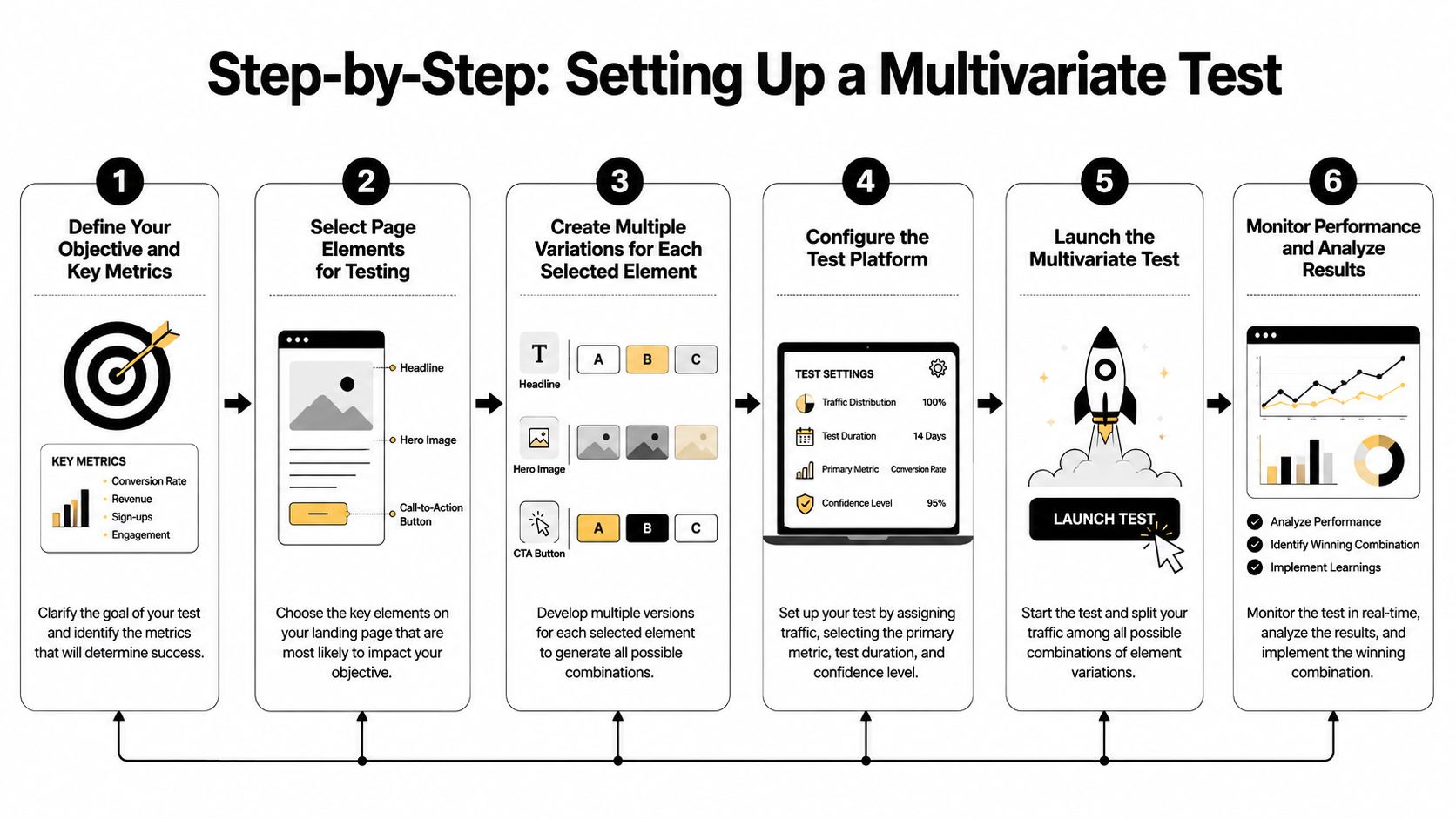
Choose one success metric
Use one primary conversion action, such as form fills, booked demos, or purchases.Limit the variable count
Pick a small set of elements with a believable interaction. If traffic is modest, reduce scope before launch.Build intentional variations
Each change should reflect a real hypothesis. Random alternatives create random lessons.Split traffic evenly across combinations
Let the platform assign visitors randomly and keep allocation stable while the test runs.QA every live experience
Review mobile rendering, tracking events, page speed, forms, and attribution tags for each combination, not just the control.
Here's a useful walkthrough before launch:
Ad copy needs tighter control
Ad platforms add noise that landing pages do not. Placement, device, and format can all change how copy appears.
That is why ad copy multivariate tests should stay narrow. Test message parts that belong together, such as the first line, core value statement, and CTA. Keep the destination page stable when possible. If the ad and the landing page both change at once, attribution gets muddy fast.
QA checks that protect the result
Small setup errors can ruin an otherwise smart test.
Before launch, confirm:
- Events fire correctly on every combination
- Forms submit properly on desktop and mobile
- Dynamic content does not conflict with the testing platform
- UTM handling stays intact for campaign attribution
- Copy remains readable and logical in every combination
Multivariate testing only makes sense when the implementation matches the traffic available. If traffic is thin, fewer versions usually produce better answers. If traffic is strong and the elements interact, a clean multivariate setup can show which combinations change behavior, not just which single edit looks better in isolation.
Common Pitfalls and Best Practices
Most multivariate testing mistakes come from enthusiasm. Teams want broader answers, so they add more variables, more versions, and more ambition than the traffic can support.
The mistakes that derail tests
The first mistake is traffic fragmentation. When you spread visitors across too many combinations, every version collects too little signal. The dashboard still fills up, but the result isn't dependable.
Another common problem is testing weakly related elements together. If the variables don't meaningfully interact, the experiment becomes harder without producing better insight.
A third issue is poor documentation. Teams launch the test, change naming halfway through, forget which experience includes which elements, and then spend more time reconstructing the setup than reading the outcome.
Better habits that protect your data
Use a few simple rules.
Limit scope early
Choose a tight set of high-impact variables. If the list keeps growing, split the work into separate experiments.Write a test brief
Include the hypothesis, variables, success metric, QA notes, and stop rule. Even a short internal doc prevents confusion later.Respect the original design
Don't edit combinations after launch unless something is broken. Mid-test changes muddy the read.Archive losers clearly
A failed combination still teaches you something. Keep a log of what was tested and why it likely lost.
If your broader optimization process needs tightening, this roundup of conversion rate optimization best practices can help you build stronger habits around experimentation.
When to pause instead of pushing through
Sometimes the smart move is to stop.
Pause when:
- tracking is broken
- a major traffic source changes suddenly
- a page redesign sneaks in around the test
- internal teams can't explain which combinations are live
Bad data doesn't become good data just because you wait longer.
The best multivariate testing teams don't just know how to launch. They know when a test no longer deserves trust.
Choosing Tools and Analyzing Test Results
Tool choice matters because multivariate testing creates more moving parts than standard split tests. You need a platform that can manage combinations cleanly, report on interaction patterns, and fit the way your team already works.
What to look for in a platform
Some teams need enterprise control. Others need speed and a simpler interface. Whatever you choose, focus on these capabilities:
- Combination management so variables and live experiences stay organized
- Statistical reporting that helps you interpret more than a single winner
- Traffic controls for allocating visitors without manual hacks
- Integration options with analytics, ad platforms, and reporting tools
- QA visibility so broken variants don't hide in the test
For teams that also have a strong interest in measurement setup across channels, Mastering conversion tracking in 2026 is a useful companion read because attribution quality shapes how trustworthy your experimentation program becomes.
How common tool categories differ
Open-source setups can give analysts flexibility, but they usually demand more internal support.
Enterprise suites such as Adobe Target tend to suit larger organizations that need governance, wider testing operations, and connection to a broader martech stack.
SaaS platforms such as Optimizely are often easier for marketers to operate day to day, especially when speed matters and engineering support is limited.
A practical way to compare options is to line them up against your team's real workflow, not a wishlist. If your team struggles with campaign coordination already, these guides to best campaign management software can help you think through operational fit alongside testing features.
Reading results without fooling yourself
The most rigorous setup still requires judgment.
Improvado notes that full factorial designs test every permutation, while Taguchi fractional methods reduce combinations but may miss higher-order interactions. That matters when you interpret the outcome, because a fractional method can be useful operationally while still leaving some interaction detail unseen.
When analyzing results, ask:
- Did the winner perform consistently, or only in one segment?
- Did one variable help only when paired with another?
- Did the “best” combination align with the original hypothesis, or contradict it?
That last question is worth attention. Surprising results are often the most valuable, especially when they expose how users respond to combinations rather than isolated elements.
Real-World Case Studies in Multivariate Testing
Multivariate testing stories often sound dramatic in hindsight. In practice, they usually begin with a more ordinary problem. A page is decent, individual elements have already been tested, and the team still can't explain why performance feels stuck.
Retail page example
A retail marketer might already know that one headline beats another in isolation and that one CTA tends to attract more clicks. The unresolved question is whether those two “winners” still win when paired with different product imagery.
So the team builds a multivariate test around the hero area:
- one variable for headline
- one for image style
- one for CTA copy
The result they're looking for isn't just the top combination. They also want to know whether a polished product photo works best with urgency-led copy or with calmer, benefit-led messaging. That's the kind of interaction effect A/B testing can miss.
SaaS sign-up page example
A SaaS team often faces a different version of the same issue. The headline, pricing language, and page layout may all seem reasonable on their own, yet sign-up quality varies.
In that situation, a multivariate test can reveal something subtle. A more direct pricing line may perform well only when the layout keeps supporting details close to the form. Move those details farther down the page, and the same copy can suddenly feel too abrupt.
Sometimes the “winning message” isn't winning at all. It only works inside the right layout.
What these examples actually teach
The lesson isn't that every team should jump into multivariate testing. It's that some optimization questions are, at their core, about combinations, not single elements.
When marketers frame the problem correctly, multivariate testing becomes a way to uncover page logic:
- which elements reinforce one another
- which combinations create friction
- which assumptions were only half true
That's what makes it powerful. It doesn't just tell you what changed. It shows how the experience works as a whole.
Conclusion and Next Steps
Multivariate testing is useful when your real question is about combinations. Not just headlines. Not just buttons. The full experience.
It also has a hard entrance requirement. If traffic is limited, if the page isn't stable, or if your team still has major unanswered single-variable questions, A/B/n is usually the better path. Multivariate testing rewards scale, discipline, and patience more than curiosity alone.
A simple checklist before your first test
Check traffic first
Make sure the page can support a combination-based test without starving each variation.Choose a small set of connected elements
Headline, image, and CTA often make more sense together than a random mix of unrelated tweaks.Map every combination before launch
Label them clearly and keep the naming consistent.Set one primary metric
Don't let five competing KPIs fight over the result.Run full QA
Verify forms, event tracking, mobile rendering, and campaign attribution.Wait for a trustworthy finish
Don't declare a winner because the dashboard looks exciting halfway through.
A good multivariate test doesn't just produce a winner. It gives your team a better model of how users respond to the whole page.
That's the value. Better decisions later, not just a prettier report today.
If you want to tighten the keyword side of your paid campaigns while your landing pages and experiments do their job, Keywordme helps you clean search terms, build negative keyword lists, and expand ad groups faster without the usual spreadsheet grind.
.svg)