
Mining Search Terms for Positive Keywords: Expert Guide
Mining Search Terms for Positive Keywords: Expert Guide


SEO Title: Mining Search Terms for Positive Keywords
Meta Description: Mining search terms for positive keywords gets easier with a repeatable workflow for filtering junk, scoring intent, and scaling in Google Ads.
You open a search terms report, scroll for a few seconds, and immediately hit the same problem most PPC teams hit. Too much noise. Random queries, half-relevant phrases, branded searches you don't want to steal budget from, and a handful of terms that might be useful if you had time to sort them properly.
That's the main challenge with mining search terms for positive keywords. The hard part usually isn't finding data. It's turning messy query data into decisions you can deploy inside Google Ads without burning half a day in spreadsheets.
Most keyword research starts with assumptions. You brainstorm what people might search, pull suggestions from tools, and build lists from there. Search term mining flips that. You start with what users typed, then promote proven themes into positive keywords, negative out waste, and tighten campaign structure around real demand.
That's why this process matters so much for ROI. It helps you stop paying for vague traffic and start building around language that already shows intent. Done well, it's less about “keyword discovery” and more about operational discipline.
Beyond the Search Bar The Real Gold Is in Your Reports
Traditional keyword research still matters, but it has a ceiling. It's useful for seeding campaigns, filling content gaps, and expanding themes. It's weaker when you need to know how your account is matching queries in the wild.
Search term mining is different. You're not guessing. You're reviewing the exact language people used before they clicked. That distinction matters because search behavior is massive and highly concentrated. Google processes over 8.5 billion searches per day globally, which is why small improvements in keyword selection can influence very large traffic pools, as noted in this keyword research techniques guide.
What keyword research misses
A planner tool might suggest a clean list of commercial keywords. Your actual search terms report usually tells a messier story:
- Google matched broader than expected and pulled in neighboring intent
- Users used different phrasing than the copy in your campaigns
- Some long-tail queries converted cleanly but were never added as standalone targets
- Other queries looked promising on paper and turned out to be budget leaks
That gap is where profitable work sits.
If you're newer to the report itself, this search terms report breakdown from Keywordme is a good reference for what you're looking at inside Google Ads.
Practical rule: Keyword research tells you what could matter. Search term mining tells you what already touched your budget.
What a positive keyword really is
A positive keyword is a search term you intentionally promote into your account because it deserves focused targeting. Usually that means one of three things:
| Situation | What it signals | Typical action |
|---|---|---|
| The query converts | Strong commercial fit | Add as a keyword with tighter control |
| The query repeats across variations | There's a scalable theme | Build or expand an ad group |
| The query reveals user language | Messaging mismatch in current setup | Update keywords, ads, or landing pages |
That's why the report is worth more than it is often treated. It isn't just a place to dump negatives. It's a feedback loop between query intent, account structure, and landing page alignment.
The teams that get the most out of it don't review search terms as a cleanup task. They treat it as a mining process. Filter the junk first. Validate intent. Group similar winners. Promote only what deserves budget. Repeat on a schedule.
The First Filter From Junk to Potential Gems
Before you score anything, clean the list hard.
That first pass should be fast and ruthless. You are not trying to make nuanced decisions yet. You're trying to remove obvious junk so the useful patterns become visible. Structured keyword mining grew out of query-level optimization as paid search matured with Google Ads, which launched in 2000 as Google AdWords, according to this keyword mining overview.
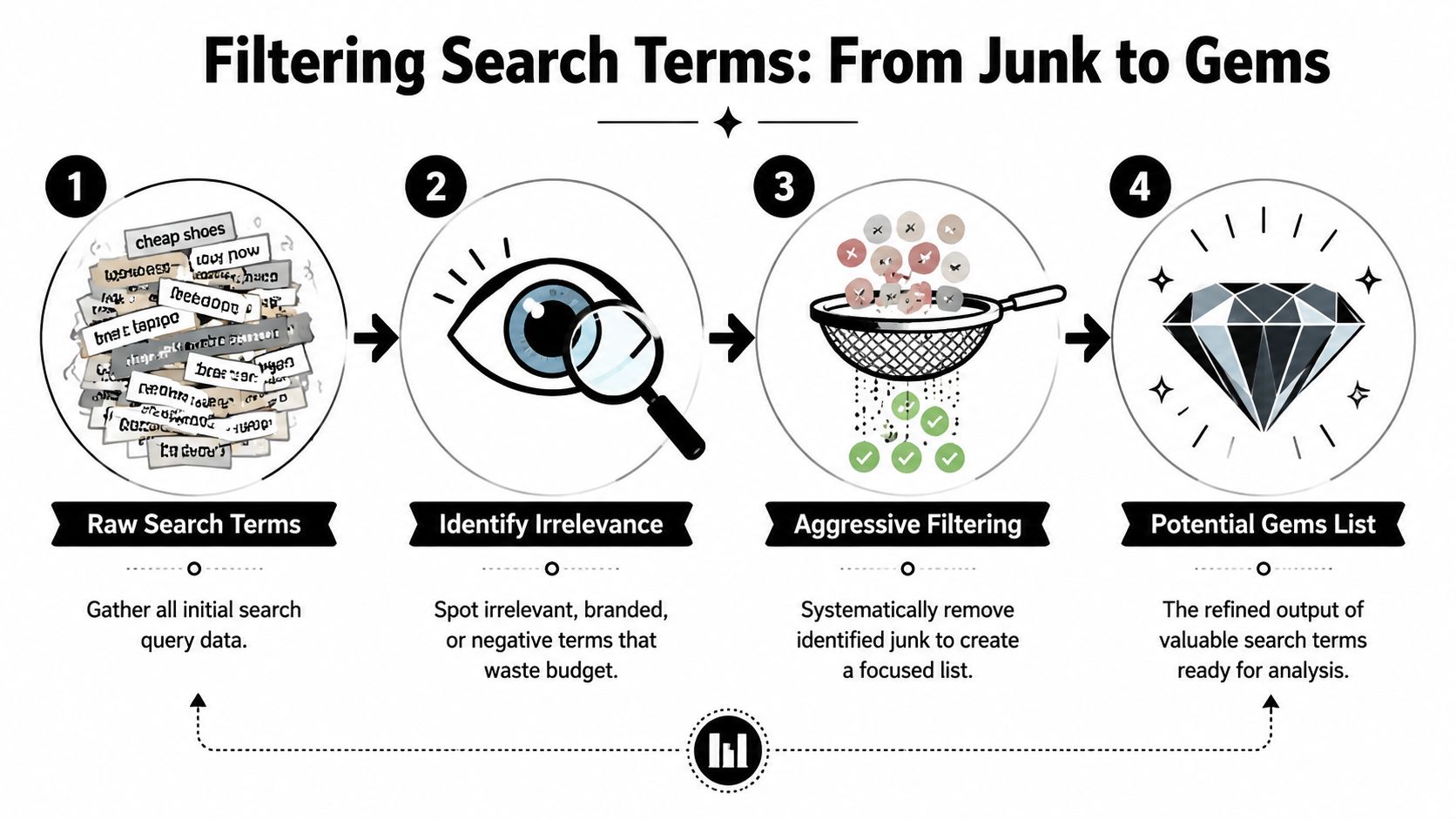
Start with elimination, not opportunity
On the first pass, I'd rather miss a maybe-interesting term than waste time debating junk. The fastest wins usually come from cutting recurring irrelevance categories.
Use a checklist like this:
- Job seeker terms like “jobs,” “careers,” “salary,” or “internship” when you're selling a service, not hiring
- Support intent if the campaign is prospecting and not customer retention
- Research-only phrasing such as “what is,” “definition,” or “examples” when you need transactional intent
- Competitor terms if your policy is to exclude them
- Freebie traffic when the offer isn't free
- Geography mismatches if location matters to fulfillment
A fast way to review the report
Don't read line by line from top to bottom. That's where people lose hours.
Use this order instead:
- Sort by spend or clicks first so obvious waste shows up quickly
- Scan recurring modifiers like free, jobs, meaning, review, login, support
- Group close variants before deciding anything
- Push negatives in batches instead of one-off reactions
A cluttered report makes smart decisions look hard. A filtered report makes strong themes obvious.
What stays in the maybe pile
Not every non-converting term is junk. Some queries deserve a second look even if they haven't closed yet:
- Specific product or service phrasing
- Problem-aware searches
- Comparison intent
- High relevance but weak landing-page alignment
That “maybe” pile is where positive keywords often come from later. But it only becomes visible after the first filter strips out the obvious trash.
One more caution. Don't add broad negatives too aggressively at this stage. A quick cleanup can accidentally block valid traffic if you negate a root word without checking what else rides with it. First-pass filtering should be decisive, but not careless.
Scoring and Prioritizing What Really Converts
Once the junk is out, you need a way to rank what remains. Here, a lot of accounts go sideways. Teams either promote anything that got a conversion, or they chase shiny click-through rates with no business value behind them.
The better move is to use a simple scoring model. Not fancy. Just consistent.
Independent guidance on keyword workflows recommends starting with first-party query data, then moving through exact-query extraction, SERP intent validation, clustering, and prioritization. It also recommends combining Google Search Console or Google Ads search-term data with seed-topic expansion, as described in this keyword research workflow guide.

The metrics that matter most
For positive keyword promotion, I care about four signals:
| Signal | Why it matters | Risk if used alone |
|---|---|---|
| Conversions | Direct proof of business value | Can overvalue one-off noise |
| CTR | Shows message-query resonance | Can reward curiosity clicks |
| Cost | Tells you how expensive the learning is | Can hide profitable intent |
| Intent fit | Predicts whether scale is realistic | Subjective without SERP checks |
A clean search term with conversions usually moves to the top of the list. But that isn't automatic. I still want to know whether the term reflects a repeatable theme or a one-time oddball.
A practical scoring model
You don't need a complicated spreadsheet formula. A simple decision stack works well:
Top tier
Queries with clear commercial intent, strong relevance, and conversion evidence. These are promotion candidates now.Middle tier
Queries with strong CTR or repeat appearances but weak conversion volume. These need more observation or a landing-page review.Low tier
Queries with weak intent, weak downstream performance, or unclear fit. Keep watching or block if they continue to waste spend.
Validate the SERP before you promote
This is the step many advertisers skip.
A search term can look perfect in a report and still fail as a positive keyword if the SERP expects something different from what you offer. Search results tell you what Google thinks the query means. If the page is full of product pages, comparisons, tools, or informational guides, that's a clue about what kind of landing page and match type you should use.
Field note: If the SERP intent and your landing page disagree, the keyword usually underperforms no matter how good the query looks in the report.
Look for clusters, not just winners
Single queries matter. Themes matter more.
If you see several variations around the same topic, don't evaluate them in isolation. Group them. A cluster often deserves its own ad group, dedicated ad copy, or a landing page variant that mirrors the language users keep repeating.
Examples:
- “crm for contractors”
- “best crm for construction company”
- “construction sales crm”
Individually, one may look too small. Together, they reveal a commercial theme worth pulling out.
What not to overvalue
Plenty of terms look attractive and still don't deserve promotion:
- high CTR with no conversion intent
- strong relevance but poor SERP fit
- very narrow long-tails that don't connect to a broader theme
- one-off converters with language no one else is likely to repeat
That last point matters. Good mining isn't just about spotting terms that worked once. It's about finding terms that can carry budget, structure, and messaging over time.
Assigning Match Types for Control and Scale
A mined keyword only becomes useful when you place it in the account the right way. Match type is the control lever. It decides how tightly you hold the query and how much room you give Google to explore around it.
Most accounts don't have a keyword discovery problem. They have an implementation problem.
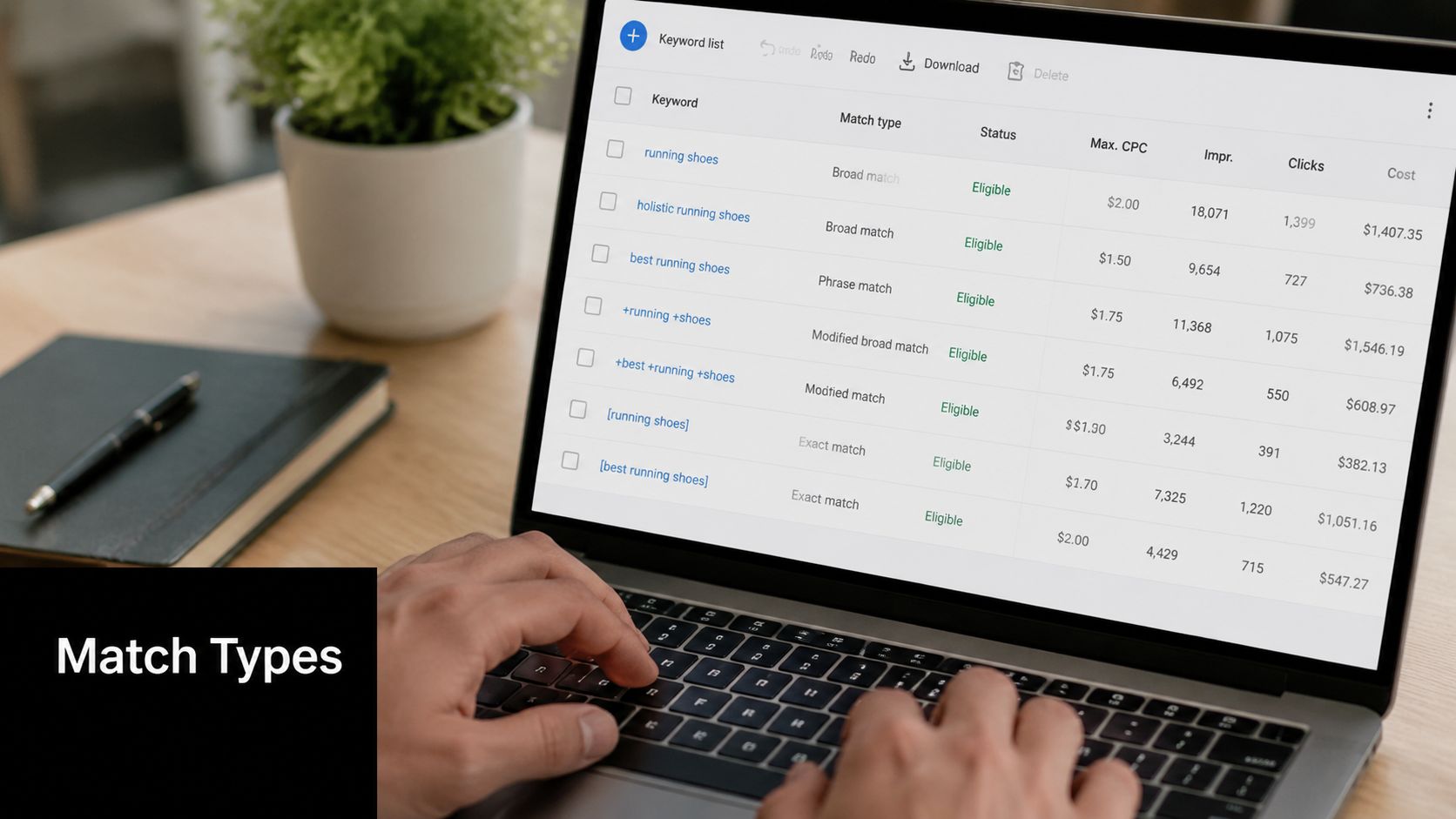
When Exact match is the right move
Use Exact match when the search term has already shown strong intent and you want tight control over spend, query quality, and ad-to-query alignment.
This is usually the right choice for:
- High-converting long-tail queries
- Terms with very specific commercial intent
- Searches that deserve dedicated messaging
- Queries that repeatedly appear as winners
If a term keeps proving itself, don't leave it floating under a broad parent keyword. Promote it and control it.
When Phrase match earns the test
Phrase match works well when you've identified a strong core theme but still want room for close commercial variants. It's the middle ground between precision and discovery.
Good phrase-match candidates usually have:
| Query pattern | Why phrase works |
|---|---|
| A stable core concept | You want to catch close versions |
| Commercial intent with wording variation | Users describe the same need differently |
| Enough relevance to scale | You want more data before tightening further |
Phrase is often the best home for mined themes that are promising but not fully proven at the exact-query level.
Broad match isn't the enemy
Broad gets abused, then blamed.
Used carelessly, it creates noise. Used with clear intent themes, strong negatives, and active review, it can surface adjacent queries you wouldn't find otherwise. Broad is a discovery tool when you're deliberate about the environment around it.
That's why match types should reflect confidence:
- Exact for proven winners
- Phrase for validated themes
- Broad for controlled exploration around solid commercial topics
If you want a deeper refresher on how each behaves in practice, this guide to keyword match types is useful.
Don't assign match types based on habit. Assign them based on how much uncertainty is left in the query.
One more thing. Match type and landing page need to agree. A precise keyword sent to a vague page wastes the precision you just created. If you mined a sharp commercial query, the ad group and landing page should feel just as sharp.
Automating Your Workflow with Keywordme
Manual search term mining works. It just breaks under volume.
Once you're reviewing multiple campaigns, ad groups, or client accounts, the friction piles up fast. Exporting reports. Cleaning columns. Tagging terms. Copying winners into new keyword lists. Formatting match types. Building negative lists separately. Then doing it again next week.
That's where tooling changes the shape of the work.
What should be automated
The judgment should stay human. The repetitive mechanics shouldn't.
For mining search terms for positive keywords, the slowest tasks are usually:
- Filtering reviewed or irrelevant terms
- Grouping similar queries
- Turning approved terms into formatted keyword lists
- Applying match types in bulk
- Building negatives from repeated waste patterns
That's exactly the part a tool should handle.
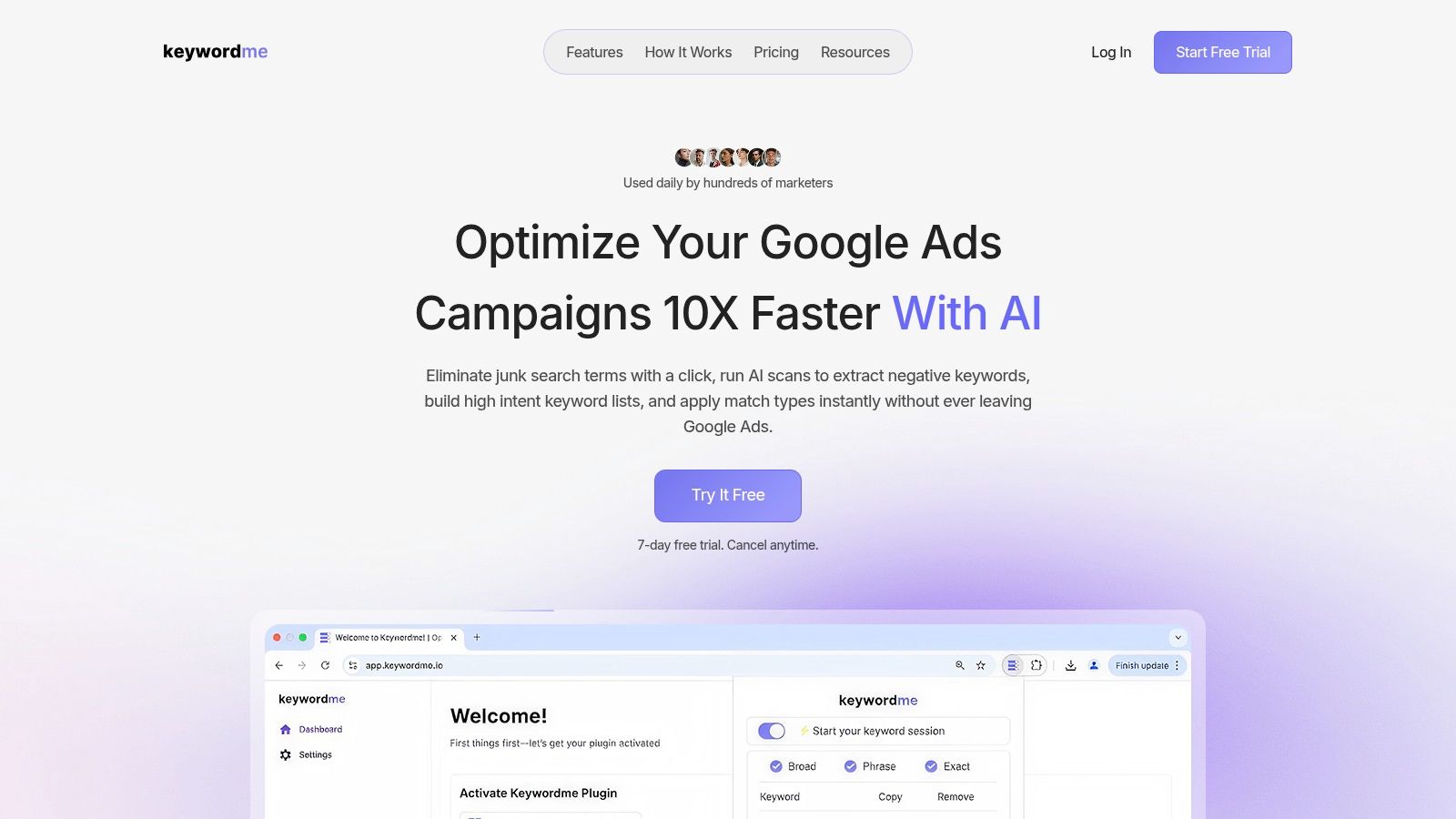
One option is Keywordme's automated Google Ads keyword management workflow, which is built around reviewing search terms inside Google Ads, creating keyword lists from those terms, assigning exact, phrase, or broad match, and handling negatives without bouncing through spreadsheets.
What a scalable workflow looks like
A practical system looks more like this:
- Pull current search terms from active campaigns
- Filter obvious junk and repeated negatives
- Surface promising queries by relevance and performance signals
- Group related terms into themes
- Push approved queries into the right match type in bulk
- Save exclusions so the next review starts cleaner
That sequence matters. Many waste time because they keep rebuilding the same review process from scratch.
After you've seen the interface once, the workflow makes more sense in motion:
Where automation helps and where it doesn't
Automation is useful when it reduces drag. It's not useful when it replaces judgment about intent.
A tool can speed up:
- filtering
- bulk actions
- formatting
- implementation
- repeatability
It can't decide whether a query is too narrow to scale, whether the SERP points to the wrong page type, or whether a theme deserves its own landing page. That part still belongs to the practitioner.
Value is simple. You spend less time moving cells around and more time deciding which queries deserve budget.
Advanced Tips for Scaling Your Keyword Mining
Once the basic workflow is stable, the bigger win is turning it into a recurring system. That's what separates occasional cleanup from real account growth.
Most guidance on advanced research talks about hidden opportunities, but it often skips the harder question. When is a mined term worth expanding, and when is it just an interesting long-tail that will never scale? That gap is called out clearly in this advanced keyword research discussion.
Build a review rhythm people will actually keep
Keyword mining fails when it relies on heroic effort.
Use a recurring cadence and keep the review goals narrow. One pass might focus on wasted spend. Another on promotion candidates. Another on clustering repeated themes into ad groups or landing pages. That's easier to maintain than trying to solve every search term problem in one sitting.
A sustainable review loop usually includes:
- Fresh-query review for newly surfaced search terms
- Theme review for repeated patterns across campaigns
- Promotion review for terms ready to become positive keywords
- Exclusion review for negatives that belong at shared or campaign level
Scale themes, not just terms
A mature account grows faster when you spin out themes instead of celebrating isolated winners.
If you keep seeing related search terms around the same pain point, product category, or use case, that usually points to one of three moves:
| Pattern in the report | Better structural move |
|---|---|
| Similar transactional terms | Create a dedicated ad group |
| Repeated feature-specific language | Rewrite ad copy around that phrasing |
| Consistent niche use case | Build a landing page for that segment |
That's how search term mining starts influencing account architecture instead of staying trapped inside optimization chores.
The best mined keyword is often not a keyword. It's a pattern that tells you how to restructure the account.
Don't overfit to tiny long-tails
Even smart teams still get stuck.
Long-tail queries can be highly valuable, but some are too specific to deserve their own keyword, ad group, or page. A good rule is to ask whether the term represents a broader repeatable theme or a one-off phrasing event. If it doesn't connect to a cluster, it may be better treated as a useful signal rather than a build target.
Watch for these traps:
- Hyper-specific phrasing that doesn't repeat in nearby variants
- Location or modifier combinations with no broader commercial pattern
- Interesting converters that don't reflect scalable intent
- Terms with relevance but no practical expansion path
This matters even more if you run campaigns across many clients or business units. Operational discipline is what makes scale sustainable. If you're thinking about the agency side of that problem, Double My Leads on scaling an agency has a useful perspective on building systems that hold up as complexity grows.
Use first-party language beyond keyword builds
Search terms shouldn't only feed your keyword list.
They should also shape your ads, landing pages, offer framing, and segmentation. The language people use before they click is often more useful than the language brands write in internal docs. When mined terms repeat, that phrasing deserves a home somewhere in the account.
That's the compounding advantage of this process. Each review doesn't just clean traffic. It sharpens how the whole campaign talks to buyers.
If you're tired of turning search term reviews into spreadsheet projects, Keywordme gives you a faster way to filter junk, build positive keyword lists, assign match types, and handle negatives inside your Google Ads workflow.
.svg)