
Mastering Long Tail Searches to Boost Your Google Ads ROI
Mastering Long Tail Searches to Boost Your Google Ads ROI


Forget the dry, textbook definitions. Long-tail searches are simply how real people talk to Google. They’re the super-specific, multi-word questions people ask when they're past the window-shopping phase and know exactly what they’re looking for.
Think less "shoes" and more "best waterproof trail running shoes for wide feet." That's the long tail in a nutshell.
What Are Long Tail Searches, Really?
The easiest way to wrap your head around this is to picture a keyword pyramid. At the very top, you have the "head terms"—those blockbuster, one or two-word searches like "laptops" or "marketing." They get a ton of traffic, sure, but they’re also incredibly competitive, and you have no idea what the searcher actually wants.
The real action happens in the massive base of that pyramid. This is the long tail, a world made up of billions of ultra-specific phrases. These are the conversational queries people type (or speak) into search engines when they have a clear goal in mind.
This diagram shows you exactly how these keyword types stack up.
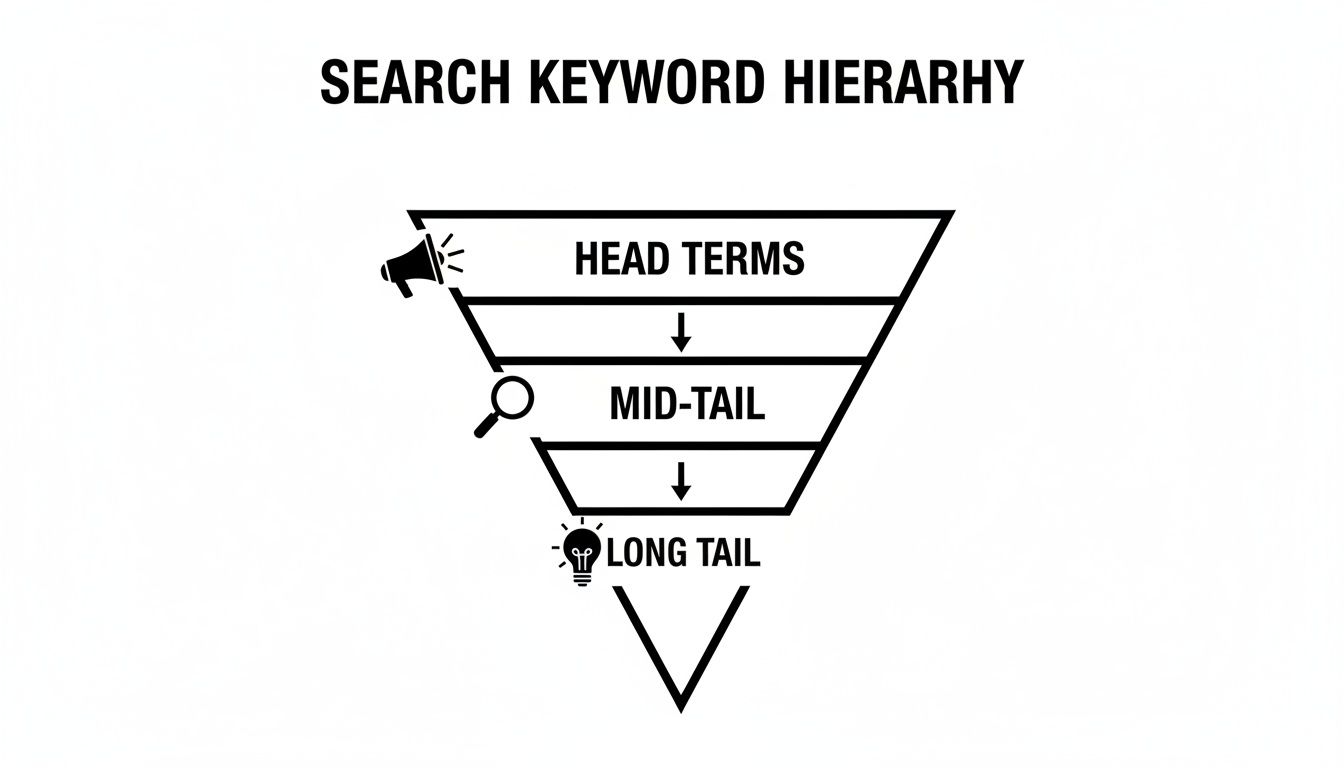
As you can see, even though a single head term gets all the glory, the sheer volume of long-tail searches makes them the biggest opportunity on the map.
Head Terms vs Long Tail Searches at a Glance
To make this crystal clear, let's break down the key differences between these two types of keywords. This table shows you where they shine and where they fall short.
The takeaway here is simple: head terms give you broad reach, but long-tail searches deliver motivated buyers.
The Numbers Don't Lie
The dominance of these specific queries is staggering. Research from Ahrefs found that in their massive U.S. database, a mind-boggling 3.8 billion keywords get fewer than 10 searches a month. In contrast, only about 31,000 keywords get more than 100,000 monthly searches.
That means these supposedly "small" long-tail searches account for nearly 95% of their entire keyword database. This isn't a fluke; it's a trend that’s only grown with voice search and mobile use, where people naturally ask more detailed questions. In fact, Google has said that about 15% of all daily searches are brand new queries they’ve never seen before. You can dive deeper into this in the full Ahrefs keyword distribution research.
This isn't some niche marketing trick. It's a fundamental shift in how people search. Focusing on the long tail means you’re matching your strategy to real human behavior, not just chasing high-volume vanity metrics.
Why Intent Is Your Secret Weapon
The real magic of the long tail isn't just the lower competition—it's the user's intent.
Someone searching for "shoes" is just browsing. They’re kicking tires. But a person searching for "best men's waterproof hiking boots under $200" is on a mission. They have a problem, they have a budget, and they are ready to buy a solution.
This high level of intent gives you some serious advantages:
- Higher Conversion Rates: This traffic is pre-qualified. These users are much more likely to make a purchase, fill out a form, or sign up for your service because you're giving them exactly what they asked for.
- Lower Competition: While your competitors are burning cash fighting over broad terms, you can quietly dominate these specific, high-value niches.
- Better Ad Performance: In Google Ads, this specificity is gold. It leads to more relevant ads, higher Quality Scores, and a much lower Cost-Per-Click (CPC).
When you target these detailed phrases, you stop shouting into a crowded room. Instead, you're having a direct conversation with someone who is telling you exactly what they want to buy. It's the difference between casting a giant, expensive net and dropping the perfect bait right where the fish are biting.
Your Secret Weapon for Higher Conversions

Okay, so we know what long-tail searches are. But why should you actually care? It's simple: they're your secret weapon for landing more conversions without having to empty your pockets.
Think of it like this. Targeting these super-specific searches is like fishing with the exact, perfect bait for the fish you want to catch. Meanwhile, your competitors are just casting a giant, expensive net and hoping for the best.
When someone types a long, detailed search into Google, they're sending you a huge signal. They aren’t just window shopping anymore; they're deep in the buying cycle and know exactly what they need. They've moved past the "what is" phase and are now asking, "which one should I buy?"
And that's where the real impact on your bottom line begins.
Sidestep the Competition and Lower Your Costs
One of the best parts of a long-tail strategy is that you can get out of the brutal bidding wars for those broad, popular keywords. Terms like "CRM software" or "project management" are incredibly expensive because everyone is fighting over them. The Cost-Per-Click (CPC) can be sky-high, draining your budget with very little to show for it.
But when you shift your focus to more specific long tail searches, you’re stepping into a much less crowded market. Phrases like "CRM for small real estate teams" or "agile project management tool with time tracking" have way less competition.
This has a direct, positive effect on your ad account:
- A much lower CPC: You pay less for every click because fewer people are bidding on those exact terms.
- A higher return on ad spend (ROAS): Every dollar you spend goes further, attracting a genuinely interested lead for a fraction of the cost.
- A fighting chance for smaller businesses: You can actually compete with bigger brands and their massive budgets by owning these valuable niche searches.
It's like you're choosing not to out-shout the giants in a packed stadium. Instead, you're having a quiet, productive conversation in a room where you’re the only expert. That’s a game you can win every time.
The Ultimate Boost for Your Google Ads Performance
Here's something you need to know about Google: it doesn't just care about how much you're willing to pay. It cares deeply about relevance. The whole point of the platform is to give users the best possible answer to their question.
When you target a long-tail search, you create a perfect, undeniable match between what the user needs and what you offer.
This hyper-relevance gives your Ad Rank and Quality Score a serious lift. Why? Because you can write ad copy and design a landing page that speaks directly to that specific search. Someone looking for a "vegan leather weekender bag with shoe compartment" who sees an ad mentioning those exact features is almost guaranteed to click.
This isn't just about longer phrases—it's about their incredible power to convert. In fact, long-tail keywords have been shown to convert 2.5 times better than their short-tail cousins because the buyer's intent is so perfectly aligned. You can get a deeper look at how these specific queries drive amazing results over on Nightwatch.io.
By nailing this alignment, you're not just outsmarting your competitors; you're making every single dollar in your ad budget work harder for you.
How to Find High-Value Long Tail Keywords
Alright, so where do you actually find these game-changing long-tail keywords? It’s a bit like being a detective. You have to know where to look, and the best clues are often hiding in plain sight—places your competitors probably aren't even thinking about.
The secret is to stop thinking like a marketer and start thinking like your customer. What specific questions are they asking? What problems are they trying to solve right now? The answers to those questions are your long-tail keywords.
Start With What You Already Have
Your own data is the best place to start. It’s a direct line to what your actual audience is looking for, and it's completely unique to your business.
- Google Search Term Report: This is your number one go-to. Get into your Google Ads account and open up the "Search Terms" report. It shows you the exact phrases people typed right before clicking your ad. You’ll find a ton of super-specific, high-intent queries you can immediately turn into new keywords.
- Your Site’s Search Bar: If you have a search bar on your website, you're sitting on a goldmine. The logs show you what people are looking for once they're already on your turf, which instantly points out what they can't find easily.
- Customer Service Logs: Your support team is on the front lines, talking to customers all day. Ask them what questions, complaints, or feature requests they hear over and over. Every single one is a potential long-tail keyword.
Listen to the Internet's Water Cooler
After you've mined your own data, it’s time to see what people are saying out in the wild. This is where you get the raw, unfiltered voice of your potential customers. To really get good at this, you need to master long tail keyword research.
Community forums are fantastic for this kind of listening:
- Reddit & Quora: Just search for your general topic (like "CRM software") on these sites. You’ll find countless threads where real people are asking for advice, comparing options, and spelling out their exact needs. You'll stumble upon gems like "best CRM for a solo freelance graphic designer" all the time.
- Google's "People Also Ask": When you search for a broad term, Google literally hands you a gift: the "People Also Ask" box. These questions are a direct look into what other searchers are curious about.
Think of each long tail keyword as a direct question from a potential customer. Your job isn't to "find keywords"—it's to find and answer those questions better than anyone else.
The idea is to take a broad "seed" keyword and start adding modifiers. For example, "running shoes" becomes "best running shoes for flat feet" (a problem) or "lightweight running shoes under $100" (a feature + price). It can feel like a lot of manual work, but it's essential. To speed things up, you could check out a dedicated long tail keyword research tool that automates a lot of this discovery.
Of course, digging through all this manually takes forever. That’s exactly what Keywordme was built for. It plugs into your Google Ads data and automatically surfaces the profitable long-tail terms you're missing, letting you add them to your campaigns with just one click. It turns a tedious hunt into an instant win.
Putting Long Tail Keywords to Work in Google Ads

Alright, so you’ve unearthed a great list of high-intent keywords. That’s a fantastic start, but a list by itself doesn't pay the bills. The real magic happens when you know what to do with them in your Google Ads account.
This is where the pros pull away from the amateurs. It all comes down to creating a campaign structure that’s obsessed with relevance. Forget dumping hundreds of keywords into a single ad group—that's a recipe for disaster. Instead, the goal is to group a small, hyper-related set of long tail searches together. This lets you write ad copy that feels like a direct answer to what someone just typed into Google, which is a fast track to a better Quality Score.
Matching Your Keywords to Your Goals
In Google Ads, keyword match types are your control panel. They let you decide how closely a search needs to match your keyword for your ad to pop up. Using them strategically is absolutely crucial for a successful long tail strategy.
Exact Match
[keyword]: This is your sniper rifle. You'll want to use it for your most specific, highest-intent terms. For a search like[men's size 11 waterproof hiking boots], you want absolute control. Exact match ensures your ad only shows for that precise search, giving you maximum relevance and the best shot at a conversion.Phrase Match
"keyword": This gives you a bit more breathing room. It’s perfect for catching slight variations of a core idea. Targeting"vegan leather crossbody bag"will show your ad for searches like “black vegan leather crossbody bag” or “vegan leather crossbody bag for travel.” You get more reach, but the user's original intent stays firmly intact.Broad Match
keyword: Handle this one with care, but don’t write it off completely. Broad match can be a surprisingly good tool for discovering new long tail searches you never would have thought of. Just be ready to keep a close eye on your Search Terms report and play defense.
If you're still getting the hang of which match type to use when, we've put together a guide on how to create long tail keywords that breaks it all down without the guesswork.
Building Your Defensive Wall with Negatives
When you use Phrase and Broad match, you’re bound to attract some oddball clicks that just aren't a fit. That's totally normal, and it's where a strong negative keyword list becomes your best friend. This is your shield against wasted ad spend.
Think of negative keywords as the bouncers for your ad campaign. Their job is to keep the wrong traffic out so you only spend money on clicks from people who are actually likely to buy.
For example, if you sell premium hiking boots, you'd want to add negative keywords like “cheap,” “free,” and “used” to keep bargain-hunters away. Get into the habit of regularly checking your Search Terms report for irrelevant queries and adding them to your negative list. This simple routine can save you a huge chunk of your budget over time.
Finally, bring it all home with compelling ad copy. Your headline and description should feel like you’re reading the searcher’s mind. If they looked for "best noise cancelling headphones for flights," your ad needs to practically scream, "Tired of noisy flights? Find the perfect headphones here!" This seamless experience is what turns clicks into customers.
Optimizing and Scaling Your Long Tail Strategy

Alright, so you’ve launched your long-tail campaigns. Don't pop the champagne just yet. Getting a campaign live is just the first step. The real magic happens next, because a great long-tail strategy isn’t something you can “set and forget.” It’s a living thing that needs constant attention.
This is where you go from getting decent results to getting fantastic results. It’s how you spot a small win and grow it into a reliable source of high-quality leads. The secret is knowing how to read the data and act on it—fast.
Turning Data Into Action
Your job now is pretty straightforward: find what’s working and pour more fuel on that fire. At the same time, you’ve got to mercilessly cut what isn't. This means regularly jumping into your Google Ads account to see which keywords and ad groups are actually bringing in conversions at a cost that makes sense for your business.
Be ruthless about trimming the fat. If a keyword is getting a ton of clicks but zero conversions, it's just burning through your budget. Don't get attached. Pause it and move that money over to your winners.
This constant feedback loop is what makes a long-tail strategy so effective. You’re not just making educated guesses; you're letting real customer behavior tell you exactly what to do next.
Your Search Term Report is way more than just a list of clicks. It's an idea-generating machine that never stops. It shows you, in real-time, how your customers are thinking and searching, giving you a goldmine of new keyword ideas.
Think of this report as your treasure map for both growth and defense. It points you to new, profitable long-tail searches you should be bidding on. It also flags all the irrelevant junk queries that are wasting your money, which you can toss onto your negative keyword list. If you need a refresher on that, our guide on building strong lists of negative keywords for Google Ads is a great place to start.
How to Scale Without the Spreadsheets
Let's be honest, the biggest hurdle to scaling a long-tail strategy is the mind-numbing manual labor. Constantly digging through reports, copying and pasting new keywords, and updating negative lists for dozens of ad groups is a massive time-suck. It can easily turn into a full-time job.
This is where having the right tool gives you an almost unfair advantage.
For example, a tool like Keywordme completely streamlines this workflow. Instead of getting lost in spreadsheets for hours, you can analyze your entire Search Term Report right in one place.
With just a few clicks, you can:
- Add new keywords: Instantly find a high-performing search term and move it into the perfect ad group with the right match type.
- Bulk-add negatives: Spot irrelevant traffic and add it as a negative keyword across your whole account in seconds.
- Discover new opportunities: Let the tool surface those hidden long-tail gems you would have probably missed otherwise.
This kind of efficiency is what lets you scale with confidence. You can finally spend your time thinking about strategy instead of getting bogged down in tedious data entry. It turns optimization from a chore into a quick, repeatable process, letting you 10x your workflow and focus on growing what works.
Common Questions About Long-Tail Searches
Even when you've got a solid strategy, a few questions about long-tail searches always seem to linger. Let's clear up some of the most common ones I hear from marketers, so you can stop second-guessing and start getting results.
Is a Keyword With Only 10 Searches a Month Worth It?
One hundred percent. But you have to change how you think about it.
A keyword with only 10 searches a month isn't about casting a wide net. It's about laser-focused intent. That person searching for "CRM for small real estate teams with Mailchimp integration" isn't just browsing—they're looking to buy. Everyone typing that in is a red-hot lead who's done their research.
Let's break it down:
- You could blow thousands competing for a giant term like "CRM software" (which gets 50,000+ searches a month) and end up with a trickle of low-quality leads.
- Or, you could spend a few bucks on that super-specific term and connect with someone who’s practically holding their credit card.
The real value of a keyword isn't just its search volume. It's the intent behind it. A handful of ultra-qualified searchers will always be more valuable than a huge crowd of window shoppers.
How Many Words Does a Long-Tail Keyword Need to Be?
This is a classic mix-up. "Long-tail" isn't really about word count; it's all about specificity.
Sure, these keywords often have three or more words, but what truly defines them is their low search volume and high specificity. It's a signal that the searcher is deep into their buying journey.
For instance, a three-word phrase like "business coach for women" might actually be a head term if it has tons of search volume and competition. On the flip side, a two-word phrase like "HubSpot developer" could easily be long-tail if it's niche enough. The lesson here? Focus on the intent, not the word count.
Can I Use the Same Keywords for SEO and PPC?
Yes, and you'd be crazy not to! A great long-tail keyword is gold, no matter where you use it. Think of SEO and PPC as two engines on the same plane—they work best when they're working together.
Here’s how they complement each other:
- PPC gives you instant feedback. You can test a new long-tail keyword with a Google Ads campaign and see if it actually converts. If it works, you've just validated a topic for a new blog post or landing page for your SEO efforts.
- SEO builds long-term trust. Ranking organically for a high-intent keyword makes you look like the go-to expert. It delivers a steady flow of "free" traffic that backs up your paid campaigns.
- You can dominate the search results. Owning both the top ad and the #1 organic spot for a specific, valuable search is a power move. It screams authority and tells the searcher you are the answer, making it almost impossible for them not to click one of your links.
Ready to stop guessing and start finding the profitable long-tail searches hiding in your own ad account? Keywordme turns hours of painful spreadsheet work into a one-click process. Clean up junk terms, find new high-converting keywords for your ad groups, and boost your ROI without the headache. Start your free trial at Keywordme.
.svg)