
How to Create Long Tail Keywords That Actually Convert
How to Create Long Tail Keywords That Actually Convert


If you want to create long-tail keywords that actually work, you need to think beyond basic brainstorming. The real trick is to take a broad "seed" keyword and layer on specific details—think about what the user is trying to solve, what they need, and where they are.
This is how a generic term like "running shoes" evolves into a high-intent, money-making phrase like "best waterproof trail running shoes for wide feet." You’re not just finding keywords; you're finding customers on the verge of buying.
Why Long-Tail Keywords Are Your Secret PPC Weapon

Before we get into the nitty-gritty, let's nail down why this matters so much. In Google Ads, it’s tempting to chase those big, high-volume keywords. Terms like "CRM software" or "women's boots" feel like winning the lottery, promising a tsunami of traffic.
But that traffic is brutally expensive and unfocused. You end up in a bidding war against the biggest companies with the deepest pockets.
Long-tail keywords are your way out of that expensive fight. They are the secret weapon for running smarter, more profitable PPC campaigns.
The Power of High Intent
Think about the headspace of two different searchers. The first person types "shoes" into Google. What do they want? Who knows. They could be doing research for a school project, looking for pictures, or just killing time.
Now, imagine someone else searches for "lightweight cross-training shoes for flat feet size 9." This person isn't just browsing. They have a very specific problem and they’re actively hunting for the solution. They know exactly what they need.
That’s the magic of a long-tail strategy. You get your ads in front of people who are way further down the buying funnel, which naturally leads to:
- Higher Conversion Rates: You’re talking to people who want the exact thing you sell.
- Better Ad Relevance: It’s so much easier to write killer ad copy for a super-specific query, which helps boost your Quality Score.
- Increased ROI: You stop wasting money on clicks from casual browsers and start spending on clicks from actual buyers.
Sidestep the Fierce Competition
Broad, "head" keywords are a bloodbath. You're going head-to-head with household names that can afford to burn through cash. When you target long-tail keywords, you’re stepping into a much quieter room.
By targeting more niche, lower-volume phrases, you almost always face less competition. This means a lower Cost Per Click (CPC), letting your ad budget go further and bring in more qualified leads for the same spend.
The data screams this from the rooftops. Long-tail keywords account for a massive 70% of all online searches. Even better, in paid search, they convert at an average of 36% because they signal a user who is ready to take action, not just look around. If you want to dig deeper, you can find plenty of keyword research statistics that confirm these trends.
Ultimately, focusing on long-tails isn't just a tactic—it's a fundamental shift in strategy. It's about choosing precision over sheer volume, and quality over quantity. Before you even open a keyword tool, getting your head in this space is the most important step you can take toward building a Google Ads campaign that actually makes you money.
Finding Your Seed Keywords The Smart Way
Every killer long-tail strategy starts with a few solid "seed" keywords. Think of these as the main trunks of a tree—broad, foundational terms that you’ll later grow into hundreds of specific, high-intent branches. But finding the right seeds isn't about sitting in a room and guessing what your customers want. It's about using real data to listen to what they're already telling you.
Forget the generic brainstorming for a minute. The smartest way to create long tail keywords is to start with what’s already getting you results. Your most valuable insights are usually hiding in plain sight.
Dig into Your Own Data First
Before you even glance at a keyword tool, pop the hood on your own accounts. Your customers are leaving a trail of breadcrumbs for you every single day.
Start by digging into your Google Ads search term report. This isn't just a boring list of clicks; it's a direct transcript of what your best prospects are typing into Google moments before they buy. You might be bidding on "running shoes," but your report could reveal that "trail running shoes for plantar fasciitis" is a consistent moneymaker. Bam. That's a golden seed keyword.
Next, go talk to your customer service team. Seriously. Read through support chats and emails. What specific problems are people trying to solve? What exact phrases are they using? If you see customers constantly asking, "how do I connect your software to my sales platform?" then you've just found an incredibly valuable seed keyword: "connect [your software] to [sales platform]."
Reverse-Engineer Your Competitors
Once you’ve squeezed every last drop of insight from your own data, it’s time to see what’s working for the other guys. Don't just spy on the keywords they're bidding on—look at the language on their best landing pages and in their ad copy.
- Scan their ad copy: What specific features or benefits are they hammering home for their main products? These often double as fantastic seed keywords.
- Study their landing page headings: The H1s and H2s on their top-performing pages are practically a cheat sheet for the core topics they're targeting.
- Look for common threads: Are several competitors all talking about "enterprise solution," "for small business," or "easy integration"? Those aren't accidents; they're signals of what the market wants.
Getting a handle on comprehensive keyword research is crucial here, as it gives you a solid framework for analyzing both your own data and what your competitors are up to.
Use Tools for a Bird's-Eye View
Finally, tools can help round out your list and give you a broader perspective. The Google Keyword Planner is an obvious first stop for checking search volumes and sparking some related ideas.
Try plugging a competitor's URL or a general product category into the "Discover new keywords" feature.
This will give you a quick lay of the land and a list of potential starting points. The key is to take these ideas and validate them against what you learned from your own internal data.
By combining these three angles—your own data, competitor intel, and tool-based research—you build a list of seed keywords that aren't just wishful thinking. They're data-backed concepts, primed and ready to be expanded into a powerful long-tail campaign. For a deeper look at this initial discovery phase, check out our guide on how to find the best keywords for PPC.
Key Takeaway: The goal here isn't to generate a massive list of seed keywords. It's to nail down 5-10 high-quality, core concepts that genuinely represent the problems you solve. Quality over quantity at this stage is what sets you up for long-tail success.
Scaling Your Keyword List With Proven Tactics
Alright, you've got your core seed keywords. Now for the really fun part: turning that short, focused list into hundreds—or even thousands—of hyper-specific, long-tail variations. Think of it as transforming a single fishing line into a massive net that catches exactly the right kind of customer.
The idea isn't just to make the list longer. It's about getting smarter and anticipating the exact phrases your ideal customers are typing into Google. This is how you create long tail keywords that capture genuine intent, not just random clicks.
This whole process starts by sourcing your initial ideas from existing reports, competitor analysis, and even customer support chats.
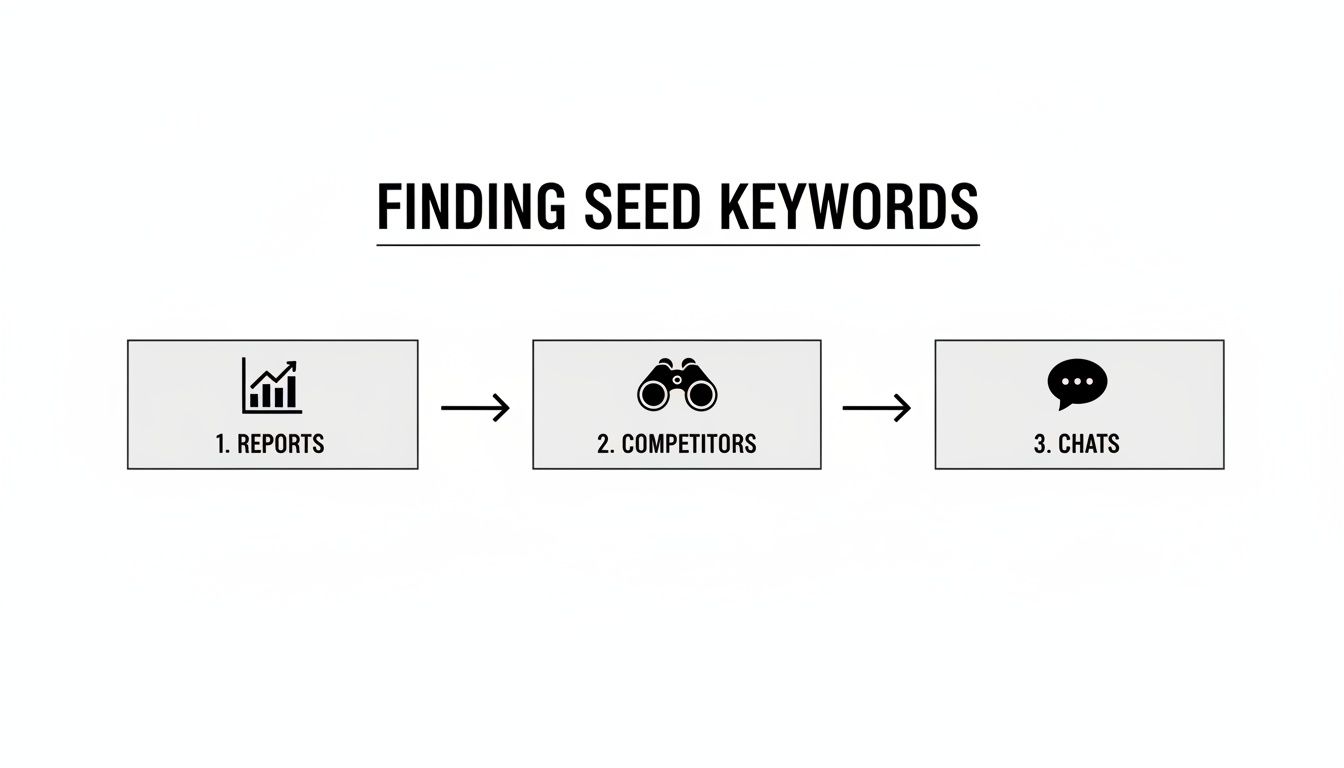
Basing your keyword expansion on real-world data like this means you're building on a solid foundation, not just guesswork.
Master the Art of Keyword Modifiers
The quickest way to scale your list is by using query modifiers. These are simply words or short phrases you tack onto your seed keywords to narrow down the search. They act like filters, honing in on a user's specific need at that very moment.
Let's take a broad seed keyword like "CRM software." On its own, it’s not very useful. But watch what happens when we sprinkle in some modifiers:
- Transactional: "buy CRM software" or "CRM software pricing"
- Informational: "how to use CRM software" or "best CRM software reviews"
- Local: "CRM software for real estate agents in Austin"
All of a sudden, each phrase tells a completely different story about what the searcher actually wants.
To rapidly expand your keyword lists, you can systemically append different types of modifiers to your seed keywords. This helps you cover a wide range of user intentions, from initial research to a ready-to-buy mindset.
Effective Long Tail Keyword Modifiers
Using a mix of these modifiers is a powerful way to ensure you’re capturing traffic at every stage of the customer journey, not just at the very end.
Let Google Be Your Guide
You don't have to invent all these modifiers from scratch. Google gives you a treasure trove of ideas if you just pay attention. The entire platform is designed to predict what people are looking for.
Start by typing one of your seed keywords into the Google search bar and just pause. The Google Autocomplete suggestions that pop up are a direct reflection of real, popular searches. These are the long-tail keywords people are actually using.
Next, run the search and scroll down to the "People Also Ask" (PAA) section. This is a goldmine for understanding the questions your audience has. Phrases like "is [product] good for..." or "how much does [product] cost..." are perfect, high-intent keywords to drop right into your campaigns.
Tapping into Google's own suggestion features is like getting a free peek into your audience's mind. You're not guessing what they're searching for; you're seeing it firsthand.
As you build out your keyword strategy, it's worth exploring how modern AI can give you an edge. Many of the best AI SEO tools can uncover opportunities you might have missed otherwise.
Use a Dedicated Tool to Automate the Grind
Look, you could manually combine your seed keywords with dozens of modifiers in a giant spreadsheet. But trust me, it's a fast track to a massive headache. It's slow, tedious, and you're bound to make mistakes. This is where a specialized tool becomes a lifesaver.
A tool like Keywordme is built specifically to handle this grind. You can plug in your handful of seed keywords, and it will generate hundreds of perfectly organized, ad-group-ready variations in seconds. Instead of wasting hours on mind-numbing copy-and-paste work, you can get it all done in minutes.
The real win here is speed and organization. What used to be an entire afternoon of spreadsheet misery can now be finished before your coffee gets cold. This frees you up to focus on what actually matters—strategy, analysis, and campaign optimization—instead of getting lost in manual data entry. If you want to see what's out there, our guide to the best keyword research tools can help you find the right fit. This kind of automation is the secret to building granular, high-performing campaigns at scale without burning out.
How to Qualify and Validate Your Keyword List
Alright, you've done the work and now you’re staring at a massive list of potential long-tail keywords. It's a great feeling, but this is also where things can go sideways. A giant keyword list is worthless if it’s packed with junk that will absolutely torch your ad budget.
This next step is all about quality control. We need to sift, filter, and scrutinize every single term to make sure it's actually got a purpose and a real shot at converting. This is what turns a messy data dump into a clean, high-performance asset ready for your campaigns.
Think Beyond Search Volume and CPC
When you first look at that long spreadsheet of keywords, the instinct is to immediately sort by search volume and start axing everything that looks too small. Fight that urge. For long-tail keywords, you have to look at metrics like search volume and Cost Per Click (CPC) differently.
A keyword with only 10-20 searches a month might seem pointless on the surface. But in the world of long-tail, that tiny number is often a huge signal of sky-high intent. Don't forget, a staggering 92% of all keywords get 10 or fewer monthly searches. These aren't scraps; they're the core of a highly specific, targeted strategy.
Think about it. A low-volume keyword like "emergency plumbing repair for leaking pipe under kitchen sink" is way more valuable than a generic, high-volume term like "plumber". You know exactly what that person needs, and they need it now.
The real trick is to apply a simple common-sense filter before you even get lost in the numbers. Just read each keyword out loud. Does it sound like something a real person would actually type into Google when they’re ready to buy what you sell? If it sounds clunky, bizarre, or totally off-base, it's gone.
Applying the Common-Sense Filter
This is easily the most important part of the whole validation process. You have to get inside your customer's head and ask one simple question for every single keyword on your list: What is the real intent behind this search?
Let's imagine you sell high-end, handmade leather wallets. Your expanded list might have keywords like these:
- "buy full-grain leather bifold wallet with RFID" – This is a keeper. The intent is clearly transactional, and they're even calling out specific features.
- "how to clean a leather wallet" – This one's a maybe. The intent is informational, not commercial. It's probably not great for a direct-sales campaign, but it could be a fantastic topic for a blog post to attract future customers.
- "free leather wallet patterns" – Get rid of it. This person wants to make a wallet, not buy one. This is a prime candidate for your negative keyword list.
Don't skip this manual review. It’s the single best way to avoid wasting money on clicks from people who were never going to convert, no matter how perfect your ad or landing page is.
Build Your Negative Keyword List as You Go
While you're validating your keywords, you have the perfect opportunity to build out your negative keyword list at the same time. Every time you find a term that’s obviously a bad fit, don't just delete it. Grab the irrelevant word or phrase and toss it onto your negative list.
For instance, if you sell premium software, you might see a search like "free CRM software trial download" and decide to keep it. But if you see "free CRM software source code," the phrase "source code" should be added to your negatives immediately.
Doing this now saves you a ton of time and money later. You're basically building a protective barrier around your campaign before you even spend a single dollar.
A tool like Keywordme can make this whole process a lot less painful. Instead of trying to manage everything in a clunky spreadsheet, you can review your entire list in one clean interface. With just a click, you can delete a bad keyword or add a term to your negative list. It turns a tedious, error-prone chore into a fast, streamlined workflow, so your final list is clean, targeted, and ready to make you money from day one.
Time to Put Your Long-Tail Keywords to Work in Google Ads

Alright, this is where the real fun begins. You’ve done all the heavy lifting—the research, the brainstorming, the filtering. Now you've got a clean, validated list of long-tail keywords ready to go.
But a great keyword list is just the start. The way you set up your campaign is what separates a high-performing account from a money pit. You can't just toss hundreds of keywords into one ad group and cross your fingers. That's a surefire way to get terrible Quality Scores and burn through your budget in record time.
The secret is all in the structure. You need a super-granular, tightly-themed approach to make sure your ads are a perfect match for every search.
Build Granular Ad Groups for Maximum Impact
When you're dealing with long-tail keywords, your goal is to create incredibly specific ad groups. Each one should be a tiny, focused cluster of keywords that are all but identical.
In fact, many of the sharpest advertisers I know swear by a strategy called Single Keyword Ad Groups (SKAGs).
It's exactly what it sounds like: one ad group, one core keyword concept. So, you'd have one ad group dedicated to "buy waterproof hiking boots for men" and a totally separate one for "best waterproof hiking boots for wide feet."
Why go through all that trouble? It's simple, really.
- Insane Ad Relevance: With an ad group this focused, you can write ad copy that practically reads the searcher's mind. This is how you get those eye-popping click-through rates (CTR).
- Better Quality Scores: Google loves this level of organization. When your keyword, ad, and landing page are all perfectly aligned, Google rewards you with a higher Quality Score, which directly leads to a lower cost per click (CPC).
- Higher Conversion Rates: When someone sees an ad that speaks directly to their very specific problem, they're not just more likely to click—they're far more likely to convert.
This hyper-focused approach means your message is always on point, making every single click more valuable.
Choosing Your Match Types Wisely
Once you have your ad groups structured, it's time to pick your keyword match types. For long-tail keywords, you’ll almost always be living in the world of Exact Match and Phrase Match.
Exact Match
[waterproof hiking boots size 11]gives you complete control. Your ad shows only for that exact search. No variations, no surprises. It's the safest, most targeted way to run your ads and avoid wasted spend.
Phrase Match "waterproof hiking boots size 11" offers a bit more flexibility. It allows your ad to show for searches that include your phrase, like "buy waterproof hiking boots size 11 online." It's perfect for catching those slight variations without straying from the user's intent.
Broad Match? Generally, just stay away from it for long-tails unless you have a massive budget and a negative keyword list that's a mile long. If you need a refresher on the details, we've covered it all in our guide to Google Ads keyword match types.
How to Implement This Without Losing Your Mind
Building hundreds of these granular ad groups by hand is, frankly, a nightmare. It's tedious, mind-numbing work that's begging for a copy-paste error to ruin your campaign.
This is exactly where a tool like Keywordme comes in. It's built to handle this exact bottleneck. Instead of clicking around the Google Ads interface for hours, you can get everything done in a fraction of the time.
With Keywordme, you can:
- Bulk Apply Match Types: Grab hundreds of keywords at once and apply Exact or Phrase match with a single click.
- Build Ad Groups Instantly: Automatically create all those tightly-themed ad groups from your keyword list, saving you from the manual grind.
- Manage Negatives Seamlessly: Spot and add irrelevant terms to your negative lists as you go, protecting your budget from day one.
The data backs this up. A wild 92% of all keywords searched are long-tail, but most of them get 10 or fewer searches per month. That low volume is their superpower—it means less competition and higher intent. When implemented correctly, it's a massive opportunity.
By automating the tedious parts, you can finally create long tail keywords and launch these powerful, granular campaigns at scale without burning yourself out.
Got Questions About Long-Tail Keywords?
Even after your campaigns are built and humming along, some questions always seem to surface. Let's dig into a few of the most common things PPC pros run into when working with long-tail keywords. Getting these sorted will help you sharpen your strategy and avoid some common pitfalls.
Think of this as a final sanity check, making sure you're feeling good about every part of your new long-tail approach.
How Many Long-Tail Keywords Should I Stuff in an Ad Group?
There’s no magic number here. The real guiding principle is to keep your ad groups incredibly tight. The more specific, the better.
If you're going all-in with a granular strategy like SKAGs (Single Keyword Ad Groups), you’re literally looking at one core keyword idea per group. But for a more practical, yet still focused, approach, aiming for 5-15 closely related long-tail keywords is a solid sweet spot.
Here's the litmus test: can one single ad and one landing page be perfectly relevant to every single keyword in that group? If the searcher's intent shifts even a tiny bit between keywords, it’s time to spin up a new ad group.
So, How Do I Know if This Long-Tail Thing Is Actually Working?
Success with long-tails isn't about chasing huge impression volumes or a flood of traffic. Forget vanity metrics. You need to be obsessed with the numbers that directly affect your business's health.
These are the KPIs you should be watching like a hawk:
- Conversion Rate: This number should be noticeably higher than in your broader campaigns. It's the most obvious sign you're nailing the whole "matching specific intent with a specific solution" thing.
- Cost Per Conversion / CPA: The goal is to drive this down. Long-tails typically face less competition, meaning cheaper clicks. Cheaper clicks should translate directly into more profitable conversions.
- Click-Through Rate (CTR): A sky-high CTR tells you that your ad copy is resonating perfectly with what people are typing into Google.
At the end of the day, your Google Ads Search Term Report is the ultimate source of truth. Success looks like seeing your ads triggered by the exact, hyper-specific queries from people who are ready to pull the trigger.
Should I Ever Use Broad Match with Long-Tail Keywords?
Woah, slow down. The short answer here is: maybe, but you need to be extremely careful.
Putting a long-tail keyword on broad match gives Google a ton of leeway to show your ad for searches it thinks are related. More often than not, this is a recipe for burning through your budget on completely irrelevant clicks.
A much smarter, safer play is to stick with Phrase Match and Exact Match when you're starting out. These match types give you the control you need to make sure you’re not wasting a dime.
Once a campaign is proven to be profitable and you’ve built a monster of a negative keyword list, then you can cautiously test broad match. But please, do it in a separate campaign and pair it with a smart bidding strategy like Target CPA to keep things from going off the rails.
How Often Should I Be Looking for New Long-Tail Keywords?
Keyword research isn't a "set it and forget it" task. Your market is always shifting, and new ways of searching pop up all the time. You have to treat this as an ongoing process.
Make it a habit to dive into your Google Ads Search Term Report at least once a week. That report is a goldmine for finding the actual long-tail keywords real people are using to find you. Use it to constantly promote high-performers to be new keywords and add all the junk as negative keywords.
Beyond that weekly check-in, doing a bigger, full-scale keyword expansion and competitor deep dive every quarter is a fantastic practice. It keeps you ahead of new trends, seasonal opportunities, and whatever your competitors are trying to pull.
Ready to ditch the soul-crushing spreadsheet work and build high-converting campaigns in a fraction of the time? Keywordme automates the entire process of finding, filtering, and structuring long-tail keywords. Turn hours of grunt work into minutes and build the kind of granular campaigns that actually drive results. Start your free 7-day trial and see what you've been missing.
.svg)