
Local Service Ads: Your 2026 Guide to Success
Local Service Ads: Your 2026 Guide to Success


If you've got a service truck in the field, the phone's already ringing, and your best lead of the day might be the one that lands while you're finishing dinner. That's the kind of moment local service ads are built for, a searcher sees a provider, taps to call, and the lead goes straight to the business that can answer first. For home-service teams, that's exactly why LSAs have stopped feeling like a side experiment and started acting like a core acquisition channel.
What's changed in 2026 is bigger than a new placement. Google has already signaled a phased rollout beginning in August 2026 that lets eligible advertisers manage LSAs directly inside Google Ads, which means the workflow is moving closer to Search and Performance Max instead of living in a separate corner of the platform. That shift matters because the account structure, reporting, and lead handling habits that worked when LSAs felt isolated won't be enough once they sit in the same UI as the rest of the paid search stack.
Why Local Service Ads Matter in 2026
A plumber finishes dinner, wipes his hands, and sees a missed call from a number he doesn't recognize. Ten minutes earlier, a homeowner had searched for help, found a local service ad above the rest of the page, and called the first business that looked credible enough to trust. That's the whole point of the format, the click didn't happen first, the phone call did.
Google's own model makes that behavior possible because LSAs are built around direct customer action. More than 90% of LSA leads arrive by phone according to the industry roundup in the verified data, so this isn't a format for casual browsing. It's a high-intent, phone-first channel where speed-to-answer and call handling matter more than clever ad copy. The same roundup also shows that 29% of consumers prefer clicking LSAs, compared with 11% who prefer traditional Google Ads, which explains why these listings win attention even when they sit beside familiar paid results. Google Local Service ad statistics
Why that matters to a PPC team
For service businesses, the operational question isn't whether LSAs get attention. It's whether the office can answer, qualify, and book those calls without wasting spend on bad fits. The channel is designed to compress demand into fewer, better conversations, which is why the businesses that treat call handling like a media tactic tend to outperform the ones that treat it like reception work.
That's also why the August 2026 integration rollout matters. When LSAs move into the same workspace as Search campaigns, they'll look like one more campaign type, but they still behave differently underneath. If you run local search accounts, you'll need a separate LSA playbook even when the UI stops feeling separate.
The other reason LSAs deserve attention is financial protection. The same verified dataset notes that businesses typically receive 6% to 7% of LSA spend back as credits for unqualified leads, which cushions some wasted spend when disputes are valid. That doesn't make bad lead flow painless, but it does change the risk profile versus many click-based formats.
Practical rule: if the business can't answer quickly, LSAs don't just underperform, they become an expensive way to find out the phone tree is broken.
Local marketing strategy examples for service businesses can help frame the broader local demand side, but LSAs are where that demand becomes a tracked call or booked appointment.
What Local Service Ads Actually Are
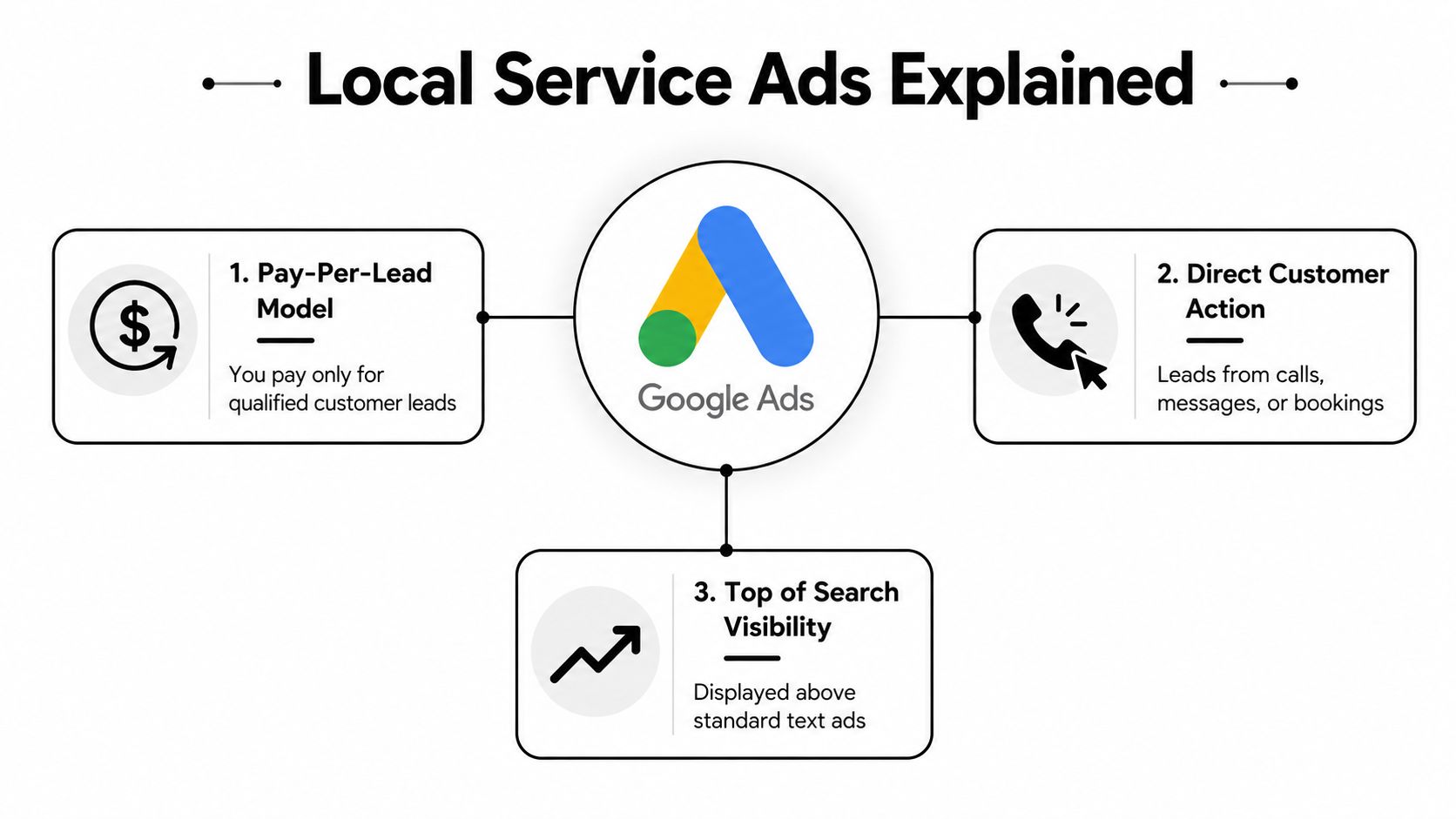
Local Service Ads are a pay-per-lead format, not a pay-per-click format. Google states advertisers pay only when a potential customer contacts them through a phone call, a message, or an appointment booked directly from the ad, so billing starts with a real contact event instead of a simple visit. That distinction changes how you optimize the channel, because the job is to improve lead quality and lead conversion, not just click-through rate. Google's Local Services Ads overview
The trust layer matters just as much. Google's Local Services Ads requirements cover business accuracy, qualifications, licenses, insurance, work experience, service areas, work verticals, prices, and even authorized photos, so the listing has to match the actual business, not just the marketing version of it. That's why the badge and verification layer matter, they're not decoration, they're part of the eligibility and trust structure.
The mechanics in plain English
Start with the searcher. A homeowner types a service query, sees a local service ad, and taps a phone number, message button, or booking path. Google then records that contact as a lead, and the advertiser is billed only for that lead event, not for every impression or click.
That means the channel behaves more like a qualified inquiry marketplace than a normal traffic auction. The business is paying for access to people who are already trying to hire someone, which is why categories, service area selection, and review thresholds all affect visibility.
If you need a practical field reference, the local services ads for plumbers guide from Growth 4 Trades is a useful category-specific walkthrough, especially if you're comparing plumbing LSAs against traditional search campaigns. It's helpful because plumber accounts tend to show the tension between volume and lead quality.
The core mental model is simple, a LSA lead is generated by a customer action, validated by Google's rules, and charged as a lead event rather than a click.
That's why LSAs behave differently from Search Ads even when both sit in Google's ecosystem. You're not buying traffic first, you're buying contact opportunities first.
How LSAs Compare to Traditional Google Search Ads
The easiest mistake is to compare LSAs and Search Ads as if one should replace the other. They don't solve the same problem. LSAs are built for high-intent local contacts, while Search Ads give you far more control over keywords, ad copy, landing pages, and measurement depth.
| Dimension | Local Service Ads | Google Search Ads |
|---|---|---|
| Billing model | Pay per lead, charged when the customer calls, messages, or books | Pay per click, charged when someone clicks the ad |
| Placement | Often appears at the top of local results, with service and trust signals | Appears in standard paid search positions based on auction and relevance |
| Creative control | Limited, profile-driven | Strong, with ad copy, assets, extensions, and landing pages |
| Lead control | Focused on lead quality and dispute handling | Focused on keyword intent, conversion rate, and traffic quality |
| Tracking depth | Structured lead and verification reporting at the campaign level | Broader conversion tracking and query-level analysis |
What LSAs do better
LSAs are better when the buying behavior is simple, urgent, and local. A furnace failure, a burst pipe, or a same-day roof repair request doesn't need a long research journey. It needs a trusted provider, a visible phone number, and a quick answer.
They also fit businesses that care about the appointment, not the session. If the office can answer calls and book jobs fast, LSAs often make the front end of the funnel feel cleaner than Search Ads, because the customer has fewer steps before contact.
What Search Ads still do better
Search Ads still win when you need control over intent capture, niche service messaging, or more complex conversion paths. If you want to own branded terms, test different offer angles, or send traffic to dedicated landing pages, Search is still the sharper tool.
LSAs also can't replace keyword-level strategy. They don't give you the same freedom to isolate informational searches, build granular ad groups, or write multiple angles for the same service. That's why most strong local accounts run both, Search for control and scale, LSAs for direct lead capture.
The budget question is real too. The verified home-service benchmark shows the average business generated 178 unique LSA leads in 2025, up from 132 in 2024, while customer acquisition cost fell to $206.37 per acquired customer and raw book rates improved from 38.7% to 43.78%. Home service LSA benchmark Those numbers don't mean every account looks like that, but they do show why the channel has become a serious line item, not a side bet.
Eligibility, Verification, and the Review Threshold
LSAs are not a “turn it on and see what happens” placement. Google's Local Services Ads requirements make accuracy and trust part of the entry fee, and that's more formal now than it used to be after Google updated the language in June 2026. The platform wants the business identity, service scope, and credentials to line up with reality, not with the broadest possible marketing pitch. Google's Local Services Ads requirements
Readiness checklist
Business profile accuracy. The account has to reflect the business name, service type, hours, and service areas. If the details are sloppy, setup gets harder and trust gets weaker.
Licensing and insurance. Google requires the right trade credentials and proof where applicable. In practical terms, that means the business needs its paperwork ready before the campaign discussion starts.
Background checks. Owners and relevant staff may need screening, which is part of how the platform separates verified providers from casual advertisers.
Review threshold. Google's own guidance recommends 5 or more reviews, and depending on the business type, a business may need 5 reviews to show. That's not just a nice-to-have signal, it can be a visibility gate. Google's review guidance
Photo quality and authorization. Images need to be original, relevant, high quality, and authorized for use. The platform is checking for misleading presentation, not just whether the ad looks polished.
What usually stalls approval
Most stalled applications don't fail because the service is ineligible. They fail because the business can't prove what it says it does. That usually means expired insurance, an unclear service area, mismatched business names, or missing verification documents.
If the office can't pass a basic compliance review, the account won't stay easy to manage later either.
The key takeaway is simple. Start the application only when the business can survive the verification conversation without improvising. That saves time, avoids rework, and makes the account easier to scale once it's live.
Pricing, Budget, and How LSA Billing Works
LSA billing only makes sense when you tie it back to lead quality. For home services, the benchmark points to 178 unique LSA leads in 2025, a 35% year-over-year increase from 132 in 2024, with customer acquisition cost averaging $206.37 and raw book rates climbing to 43.78%. That gives you a better budgeting anchor than guessing from impressions alone.
What the spend really buys
Google bills on the lead, not the click, so the key question is how many calls, messages, or bookings the budget can support and how many of those become customers. Home-service LSAs often deliver leads at roughly $15 to $50 per lead, and that range fits the reality that some categories and markets are much pricier than others. Every account will price differently, so budget planning should start with the local category rather than a national average.
Budget rule: if lead quality is weak, raising budget just scales the problem faster.
The platform also gives partial relief through lead credits. The verified dataset says businesses typically receive 6% to 7% of LSA spend back as credits for unqualified leads, which means dispute handling is part of finance, not just admin. If your team never reviews bad leads, it leaves money on the table.
How the setup decisions affect cost
Budget, service area, and job type choices all interact. A tight service area can raise relevance and reduce garbage leads, while broad targeting can produce more volume but more unqualified contact. The wrong job-type setup can do even more damage, because the channel will happily surface your business for searches you can't fulfill profitably.
In the account setup flow, budget is still one of the first decisions, and once the August 2026 in-account workflow is fully available, that process will happen directly inside Google Ads for eligible advertisers. That does not change the underlying economics, but it does change how quickly teams can adjust pace, review lead flow, and connect results to the rest of the paid search account.
Setting Up Your First LSA Campaign Step by Step
The cleanest setup starts before anything goes live. The business profile needs to be complete, the trade credentials need to be ready, and the service areas need to reflect where the crew can show up without turning every good lead into a scheduling problem. The August 2026 Google Ads integration matters here because eligible advertisers will manage LSAs directly inside the same interface they already use for Search and other campaigns.
The screenshot below shows the kind of landing-page context a team often uses while auditing setup details and service pages.
Build the account in the right order
Start with the business profile and make sure the name, category, hours, and contact details match what customers will see. Then add the service type and only select the work the team can book and perform.
After that, set the service area with enough precision to avoid broad, wasteful coverage. If the crew can only respond quickly in a few zip clusters, that's where the campaign should live.
Next comes the weekly budget. The goal isn't to max out spend on day one, it's to give the system enough room to collect leads while the office proves it can answer them. Then configure lead-response preferences so calls, messages, and booking paths don't fall through the cracks.
The verification uploads come last, but they're not an afterthought. Licenses, insurance, ownership details, and supporting documents feed Google's compliance review, and the same structured data can support QA once the campaign is live.
A practical team can also pull lead, conversation, and verification data through Google's LOCAL_SERVICES API, which exposes campaign controls and read-only reporting for leads, lead conversations, verification artifacts, employees, and business verification data. That's useful when you want QA and attribution workflows that don't depend on manual inbox triage. Google Ads API for local service campaigns
Optimization and Reporting Tactics That Actually Move Numbers
The biggest LSA mistake is treating lead volume as the win condition. Volume is only useful when the calls are answerable, qualified, and worth the gross margin. If the sales team is wasting time on out-of-area callers or bad-fit jobs, the account isn't underperforming, the intake process is.
Focus on lead quality first
Speed-to-lead matters because the channel is built around immediate contact. If a call goes to voicemail or a slow callback queue, the opportunity decays before anyone has a real conversation. Review velocity matters too, because Google uses reviews as both a trust signal and a visibility gate, and stale review profiles usually don't hold position well for long.
Dispute workflows matter for the same reason. Google already gives credits for unqualified leads, so a team that never reviews questionable calls is effectively accepting avoidable waste. That's why the person managing LSAs needs to review call notes, booking outcomes, and service fit, not just the dashboard.
A practical reporting stack should include the raw lead record, the conversation outcome, and the reason a lead was or wasn't qualified. With the LOCAL_SERVICES API, those pieces can be pulled into QA dashboards instead of living in separate inboxes and spreadsheets. That's a cleaner way to spot patterns like repeat spam, wrong-service calls, or service areas that are too wide.
The levers you can actually move
Here's where the work usually pays off:
- Prune service areas: cut the zones that generate low-fit leads or slow response times.
- Tighten job-type selection: only keep services the team can sell and fulfill well.
- Push review requests consistently: not because reviews are vanity, but because they influence visibility and trust.
- Audit invalid leads weekly: file disputes when they qualify, and track what keeps getting through.
- Fix intake first: if calls aren't answered, no reporting cleanup will save the account.
Lead volume without qualification just gives the office more ways to miss the same problem.
If you want the phone tracking side of the workflow to stay clean, the Google tracking numbers guide is useful context for how call routing and attribution can fit into a broader search setup. That's especially relevant when the same team is handling both LSAs and Search Ads.
Integrating LSAs Into a Broader PPC Workflow
LSAs work best when they're treated as part of a local demand system, not as a standalone island. Search Ads still handle keyword control, Performance Max still broadens reach, and LSAs still capture the high-intent call that needs trust and speed. The job is to keep all three from fighting each other.
The first integration step is budget pacing. If LSAs are pulling in qualified calls fast, Search can't be starved of the spend it needs for branded and service-intent queries. The second step is conversion hygiene, because both LSAs and Search should be judged against the same booked-job outcome whenever possible.
A good local account also keeps negative keyword work tight, especially around nearby services that don't fit the business model. That's where tools like Keywordme fit naturally, since its keyword cleanup and negative keyword workflows are built for exactly the kind of account maintenance that keeps Search clean next to an LSA program. For a broader strategic backdrop, the local SEO use cases overview from MapLeads is a good reminder that local visibility rarely comes from one channel alone.
If you're folding LSAs into a larger PPC stack, use this checklist:
- Share the same conversion definition: booked job, qualified lead, or whatever the business values.
- Keep Search and LSA reporting separate, but compare them on the same business outcome.
- Protect Search with negative keywords and query cleanup.
- Let LSAs handle the phone-first, trust-heavy contact path.
- Review budget allocation monthly, not by gut feel.
The clearest way to think about it is this. Search controls intent, LSAs control direct contact, and the account wins when both are tuned to the same local market reality. The Google Ads for local businesses guide is a useful companion if you're mapping how LSAs sit next to other local campaigns inside the same account.
If you want a cleaner way to manage keyword cleanup, negative lists, and account structure across local campaigns, visit Keywordme. It helps PPC teams keep Search accounts tight while they sort out the lead-quality side of local service ads. If LSAs are part of your 2026 plan, that kind of cleanup work makes the rest of the stack easier to trust.
.svg)