
Keywords for Marketing: A Guide to Finding & Using Them
Keywords for Marketing: A Guide to Finding & Using Them


Meta title: Keywords for Marketing That Drive ROI
Meta description: Keywords for marketing drive better SEO and PPC when you match intent, control spend, and cut junk traffic with smarter targeting.
You launch a new campaign, open a blank keyword sheet, and the pressure starts immediately. Pick terms that are too broad and you buy traffic that never converts. Go too narrow without a system and you end up with a scattered account, thin content, and no real momentum.
That’s why keywords for marketing still decide whether a strategy works or burns budget.
In practice, the mistake isn’t usually “we didn’t do keyword research.” It’s that teams stop at keyword discovery. They collect a big list, feel productive, then push those terms into ads or content without asking the only question that matters. What is the searcher trying to do?
That gap shows up everywhere. SEO teams publish pages that attract curiosity but not pipeline. PPC teams bid on attractive-looking phrases, then wonder why search terms are full of junk. Agencies inherit accounts with hundreds of keywords and almost no control over intent.
Good keyword strategy is less about finding more phrases and more about choosing the right ones, applying them properly, and removing the traffic you never wanted in the first place.
Your Marketing Starts with the Right Keywords
A familiar scene in paid search looks like this. Someone builds a campaign around obvious category terms, launches with broad coverage, gets clicks quickly, and assumes the account is moving. A week later, the search term report tells a different story. The budget went somewhere, but not toward people who were ready to buy.
The same thing happens in SEO. A team writes content around topics they want to rank for, not the phrases customers use. The pages may get impressions, but they don’t line up with buying intent, so rankings don’t turn into revenue.
That’s the first reset good marketers make. They stop starting from the offer and start from the search.
What that shift looks like in practice
When someone searches, they’re giving you a compressed version of a need. Sometimes it’s a problem. Sometimes it’s comparison shopping. Sometimes it’s a buying signal. If you treat all of those searches the same, your campaign gets noisy fast.
The difference between strong and weak keyword strategy usually comes down to three habits:
- Listen to real language: Pull phrasing from search terms, sales calls, customer emails, on-site search, and competitor pages.
- Separate curiosity from action: Not every relevant keyword deserves ad budget or a money page.
- Build for control: A keyword list without match type discipline and negative keyword planning is incomplete.
Practical rule: If a keyword sounds relevant but you can’t say what page or ad group it belongs in, it probably isn’t ready for deployment.
Keywords for marketing aren’t just labels in a spreadsheet. They’re routing decisions. They determine which audience sees which message, on which page, with what chance of converting.
Once you start treating keywords that way, the work gets clearer. You stop chasing volume for its own sake. You build around intent, fit, and efficiency.
Understanding the Intent Behind Marketing Keywords
A keyword is not just a phrase. It’s a clue about motive.
When people search, they’re telling Google what they want in the shortest possible way. Your job is to decode that language. A search for “email marketing” doesn’t mean the same thing as “email marketing software pricing.” One is broad interest. The other is much closer to a commercial decision.

Read the verb, not just the noun
The fastest way to judge intent is to look at the modifiers around the core topic. Words like “how,” “why,” or “examples” usually point to research mode. Words like “buy,” “price,” and “discount” point to action.
High-intent keywords are defined by purchase-related terms such as “buy,” “price,” or “discount,” which signal a ready-to-buy attitude. Because websites on the first page of Google capture 91.5% of all traffic, bidding on the right high-intent keywords matters for visibility and conversions, according to Quattr’s keyword statistics.
If you want a deeper breakdown of what those buying signals look like in practice, this guide on high-intent keywords is useful.
Match the page to the intent
A common reason many keyword strategies fall apart is that teams identify the right phrase, then send it to the wrong destination.
A few examples:
- Research queries: Better for blog posts, explainers, comparison content, or video.
- Evaluation queries: Better for product comparisons, category pages, feature pages, and case-led landing pages.
- Buying queries: Better for service pages, product pages, pricing pages, and tightly aligned ad groups.
If the page doesn’t satisfy the intent behind the keyword, rankings and clicks won’t carry much value.
That’s also why AI-assisted workflows can help with content planning when used carefully. If your team is scaling content around search intent, this roundup of AI content generation tools for SEO is worth reviewing for process ideas, not shortcuts.
Search intent is the filter that keeps you from paying for visitors who were never going to buy, and from writing pages that were never going to convert.
When marketers say a keyword “looks good,” that usually isn’t enough. The better question is simpler. What did the searcher mean, and does this page answer that need right now?
Decoding Keyword Types for Better Targeting
Once intent is clear, keyword categories become easier to use. The main job here is organization. You need a structure that tells you which terms belong in awareness content, which belong in commercial pages, and which deserve paid budget.
Short-tail and long-tail are not interchangeable
The broad terms get attention because they feel important. They’re usually obvious, highly competitive, and vague. They can help with discovery, but they often attract mixed intent.
Long-tail terms are different. They narrow the audience and usually improve fit.
According to Embryo’s keyword research statistics, long-tail keywords containing three or more words make up approximately 70% of all search traffic and deliver around 2.5× higher conversion rates than short-tail terms.
Here’s the practical trade-off.
| Attribute | Short-Tail Keywords (e.g., "marketing software") | Long-Tail Keywords (e.g., "best marketing software for small business") |
|---|---|---|
| Specificity | Broad | Narrow and precise |
| Intent clarity | Often mixed | Usually clearer |
| Competition | Typically higher | Often more manageable |
| Traffic quality | Wider but less filtered | More qualified |
| Best use | Awareness, category coverage | Conversion-focused pages and tighter ad groups |
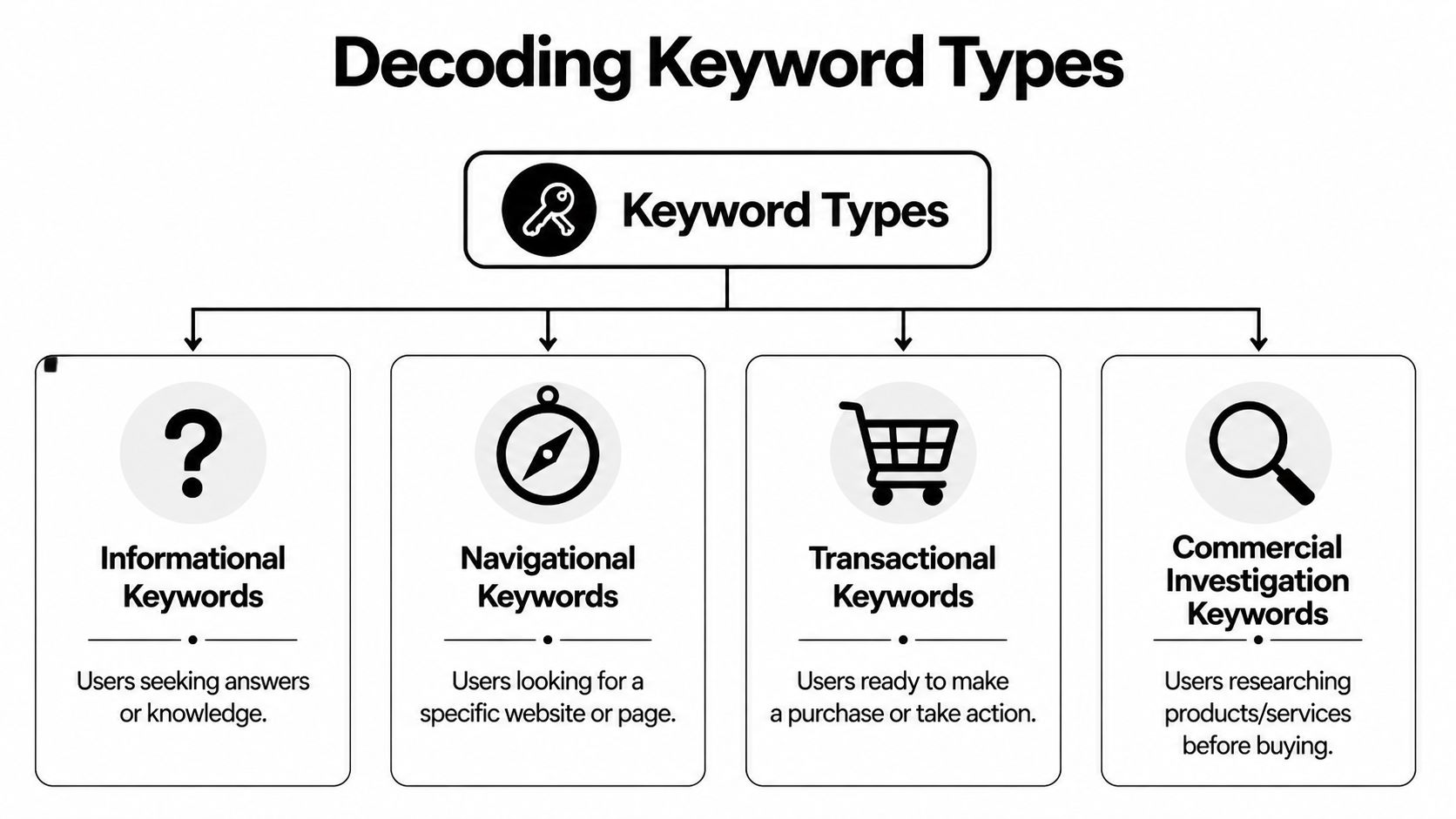
The four keyword types that shape targeting
Most keyword lists improve once you sort terms into these buckets.
Informational keywords
These are questions and learning queries. Think “how to build a demand gen funnel” or “what is quality score.”
They’re useful for SEO, especially when your audience is still problem-aware rather than solution-aware. They’re less useful as direct-response PPC targets unless you have a very deliberate nurture path.
Navigational keywords
These searches are meant to reach a specific brand or destination. Examples include product names, brand logins, or branded support searches.
For your own brand, they’re often defensive. For competitors, they’re tricky and need careful handling.
Commercial investigation keywords
These live in the middle. Searchers are comparing options, reading reviews, or trying to shortlist vendors. Phrases like “best CRM for agencies” or “Semrush alternatives” fit here.
This is often the sweet spot for content that influences pipeline before the final buying search.
Transactional keywords
These show direct action intent. “Buy,” “book,” “pricing,” “demo,” “near me,” and similar modifiers usually belong here.
If your paid search account doesn’t clearly separate these from upper-funnel terms, budget control gets messy fast.
A healthy keyword strategy doesn’t rely on one type. It uses different types for different jobs.
Map keyword type to funnel stage
A simple way to keep this useful is to map each type to a likely role:
- Informational: education and early demand capture
- Navigational: brand access and brand protection
- Commercial investigation: comparison and evaluation
- Transactional: conversion and direct response
That structure gives your keywords for marketing a job description, not just a label.
A Practical Keyword Research Workflow
Many teams don’t need more keyword ideas. They need a repeatable way to sort good ideas from distracting ones.
The workflow that holds up in both SEO and PPC starts with a small seed set, then expands outward through search behavior, competitors, and tools. After that, it gets narrowed hard. That last part matters more than people think.

Start with seed terms from the business
Begin with the obvious core phrases tied to your offer, customer problem, and buying triggers. Not dozens. A short list is enough.
Pull them from places that reflect real demand:
- Sales language: Objections, feature requests, and “we need X” phrasing
- Customer language: Reviews, support questions, demos, onboarding calls
- Site behavior: Internal search, top landing pages, search console queries
- Offer language: Product category, service type, use case, industry fit
This part should feel simple. If it feels complicated, you’re probably trying to over-engineer before you’ve gathered the raw material.
Expand with competitors and search variants
Once you have seed terms, widen the list with related phrases, modifiers, and competitor positioning. Many profitable keywords emerge at this stage, especially when buyers compare vendors or add industry qualifiers.
If you want a structured way to track competitor keywords, competitor analysis tools can help surface patterns that aren’t obvious from brainstorming alone.
Good expansion angles include:
- Use-case modifiers such as “for agencies,” “for ecommerce,” or “for small business”
- Commercial modifiers like “pricing,” “software,” “service,” “tool,” or “demo”
- Pain-point phrases tied to the actual problem, not just the category
- Alternative and comparison searches where buyers are actively narrowing options
For a more PPC-focused process, this walkthrough on how to find profitable keywords is a practical companion.
Score the list before you build anything
A long keyword list isn’t useful until you decide what deserves action. For each term, sort it by three things:
- Intent fit: Does this align with a content page, a landing page, or an ad group?
- Business fit: Does this phrase connect to what you sell?
- Operational fit: Can your team build the right page, ad, and follow-up experience?
That’s the part people skip. They assume relevance equals usefulness. It doesn’t.
Here’s a useful benchmark from competitive PPC. Semrush data cited in the verified dataset shows the keyword “ppc” has a U.S. monthly search volume of 27,100, a keyword difficulty of 92%, and a CPC of $7.32, which is a good reminder that broad head terms can be expensive and hard to win cleanly in both SEO and paid search when intent is loose.
A quick visual explainer helps if you’re documenting this process for a team:
Build one master list, then split by channel
Don’t maintain separate research universes for SEO and PPC at the start. Build one source list first. Then tag terms by likely channel, page type, and intent.
That avoids a common waste of time. Teams doing the same research twice, with different naming conventions, and ending up with fragmented targeting.
How to Apply Keywords in Google Ads
Good research doesn’t save a poorly controlled Google Ads account. Application is where keyword strategy either sharpens performance or falls apart.
The cleanest way to think about match types is this. You’re trading reach for control. The more freedom you give Google, the more you need strong data review and negative keyword discipline to keep the account honest.
Match types are a control system
Broad match can help you explore. Phrase match gives you a middle ground. Exact match is where precision matters most, especially for terms that already show proven buying intent.
According to Semrush’s marketing keyword analysis, using exact match in Google Ads can boost click-through rate by up to 15% and reduce cost-per-click by 10-20% due to higher relevance. The same source notes this precision can cut wasted ad spend on irrelevant queries by 25-40%.
That doesn’t mean exact match should swallow the whole account. It means your most valuable terms deserve tighter control than casual exploratory traffic.
Where most spend gets wasted
The expensive failure point isn’t usually the keyword list itself. It’s the search term report nobody cleaned up.
This shows up when accounts contain:
- Broad ad groups with no exclusions: Search traffic drifts into adjacent topics, low-fit searches, and irrelevant modifiers.
- Mixed-intent keywords in one ad group: Ad copy gets generic, landing pages get diluted, and quality drops.
- No feedback loop from search terms: The account keeps relearning the same expensive lesson.
If you’re not mining search term data every week, Google is choosing your traffic mix more than you are.
That’s why negative keywords are not optional account hygiene. They’re budget protection.
A practical setup that works
For most accounts, a disciplined structure looks like this:
- Keep high-intent keywords tight: Use exact match for proven transactional terms and strong commercial modifiers.
- Use phrase match selectively: Good for controlled expansion around a validated theme.
- Treat broad match as a testing environment: Useful when paired with active search term review, not when left alone.
- Build negative lists by pattern: Brand exclusions, job seekers, support intent, freebie intent, irrelevant industries, and unrelated product terms.
If you’re refining campaign structure, this guide to choosing keywords for AdWords is a good reference for the mechanics.
Google Ads rewards relevance, but it doesn’t enforce discipline for you. That part still belongs to the advertiser.
Streamline Your PPC Workflow with Keywordme
The hardest part of keyword management usually isn’t coming up with ideas. It’s dealing with the mess that appears after launch.
Real search term data is where PPC accounts tell the truth. You see what matched, what clicked, and which searches should never have triggered your ads in the first place. The problem is that cleaning that data manually is slow. Exporting reports, sorting junk terms, formatting negatives, and assigning match types can eat hours every week.

The neglected work that affects ROI fast
Most keyword guides spend their time on expansion. That matters, but expansion without cleanup creates a leak.
The verified data for this article notes that 20-30% of Google Ads budget is wasted on irrelevant queries. It also states that automating negative keyword discovery from real search term data can recover 15% of ad spend and lift ROI by 25% in the first week, based on the referenced analysis from llmrefs.
Those numbers line up with what practitioners see in mature accounts. The search term report usually contains obvious waste. The issue is speed and consistency. Teams know they should clean it. They just don’t do it often enough.
Where automation helps
This is the part of the workflow where a tool such as Keywordme fits naturally. It’s built to handle Google Ads keyword operations around real search term cleanup, negative keyword building, match type assignment, and ad group expansion without the usual copy-and-paste process.
That changes the pace of optimization in a few useful ways:
- Junk term cleanup becomes routine: You can work from actual search behavior instead of assumptions.
- Negative keyword creation scales: Instead of one-off fixes, you can build and apply exclusions in bulk.
- Match type control gets faster: High-intent terms can be moved into tighter structures without manual formatting.
- Expansion stays grounded: New keyword ideas come from proven search terms, not just top-of-funnel brainstorming.
The useful automation in PPC is not the flashy kind. It’s the kind that removes repetitive account cleanup so you can make better decisions faster.
For agencies and in-house teams managing lots of campaigns, that’s usually the actual bottleneck. Not strategy. Repetition.
Common Questions About Marketing Keywords
Can I use the same keyword list for SEO and PPC
Start from the same master list, then split by intent and execution. SEO can support broader education and comparison themes. PPC usually needs tighter commercial control because every mismatch costs money.
How often should I refresh keyword research
Refresh lightly on a regular cadence and review search term data often. In practice, new offers, seasonal shifts, competitor moves, and changes in search behavior are all reasons to revisit the list. For paid search, search term review should happen much more frequently than full research rebuilds.
Should I ignore low-volume keywords
No. Some low-volume terms carry very strong intent and cleaner fit than broader phrases. If a keyword clearly matches your offer and the searcher sounds close to action, it can be more valuable than a high-volume term with muddy intent.
If your Google Ads workflow keeps getting stuck at search term cleanup, match type formatting, and negative keyword management, take a look at Keywordme. It’s built for the practical side of PPC keyword work, especially the repetitive tasks that slow teams down and leave wasted spend sitting in the account.
.svg)