
How to Improve Marketing ROI: A Practical Guide
How to Improve Marketing ROI: A Practical Guide


If you want a better return on your marketing, you have to get back to basics. It boils down to two things: setting goals that actually matter and getting a handle on the numbers that drive your business. No more vague targets. It's time to build a solid financial framework that informs every single marketing move you make.
Setting a Rock-Solid Foundation for ROI
Before you can fix things, you need a clear picture of what success looks like. I've seen too many marketing teams get caught up chasing vanity metrics—clicks, impressions, you name it. These numbers feel good, but they don't always connect to what really counts: business growth.
To genuinely improve your marketing ROI, you have to tie every action back to a real business result. Your goals should be your North Star, ensuring every campaign, every ad, and every blog post has a clear, valuable purpose.
Define Your Goals and Unit Economics
First things first, let's turn those fuzzy ambitions into sharp, specific objectives. Instead of saying, "We want to increase sales," a much better goal is, "Our Q4 Google Ads campaigns need to hit a 5:1 return on ad spend (ROAS)." See the difference? One is a wish; the other is a measurable target.
Just as critical is getting your unit economics right. You absolutely must know how much you can spend to get a new customer and still make money. If you don't know this, you're just throwing money at the wall and hoping something sticks. For a good refresher, check out our guide on what is return on investment.
To nail this down, you need to live and breathe two key metrics:
- Customer Acquisition Cost (CAC): This is the total price tag for getting one new customer. It’s not just your ad spend; it’s everything—salaries, software, you name it—divided by the number of new customers you brought in over a specific time.
- Lifetime Value (LTV): This is the total amount of money you can expect to earn from a single customer over their entire relationship with your business. It’s the long-term prize.
The magic happens when you look at these two numbers together.
The golden rule is beautifully simple: Your LTV must be higher than your CAC. A healthy LTV:CAC ratio is often considered to be 3:1 or better, meaning for every dollar you spend to get a customer, you get at least three dollars back over time.
This simple flow shows how these foundational pieces fit together. You set your goals, figure out the math, and then you can start making smart decisions.
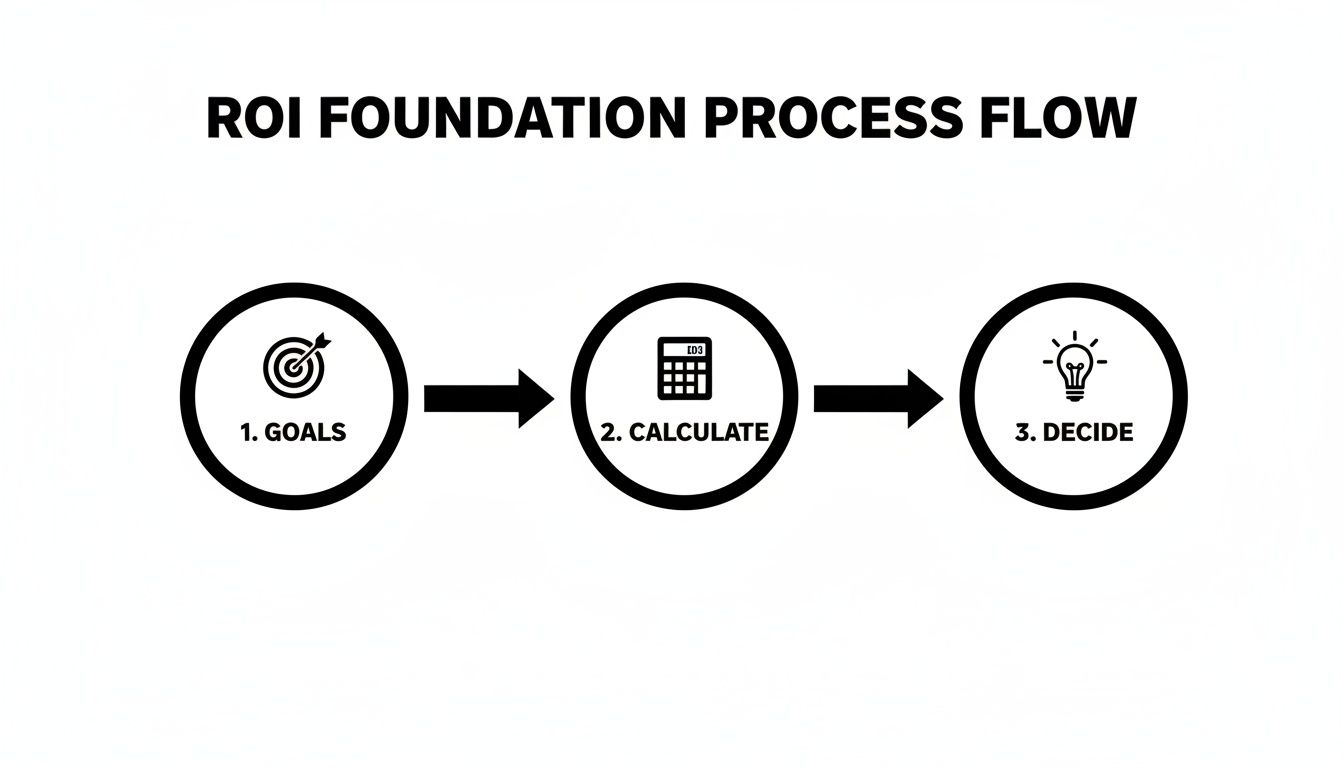
As the visual shows, improving ROI isn't a one-off trick. It’s a strategic process that starts with clear goals and a deep understanding of your business's financial health.
From Theory to Practical Application
Let's make this real. Imagine you run an e-commerce shop selling high-end running shoes.
You dig into your data and find that the average customer spends $450 with you over two years. That’s your LTV. Then you add up all your marketing and sales costs for a year and find that your CAC is $120.
Your LTV:CAC ratio is 3.75:1 ($450 / $120), which is fantastic. You’ve just created a clear financial guardrail for your marketing. You now know, with confidence, that you can spend up to $120 to land a new customer and still run a profitable business.
This one insight changes everything. You’re no longer just "buying ads"; you're making calculated investments. You can now explore a new channel like TikTok, but instead of guessing, you go in knowing exactly what your target cost-per-acquisition needs to be. This is how you stop gambling with your marketing budget and start building a predictable engine for growth.
Get Your Measurement and Attribution Right
Let’s be honest: if you aren't tracking it, you can't fix it. It's really that simple. To get a real lift in your marketing ROI, you absolutely need a bulletproof system to see where your results are actually coming from, not just where you think they are.
This goes way beyond glancing at surface-level metrics. We're talking about building a rock-solid tracking setup that captures every single touchpoint—from the first ad a customer ever saw to the final click that sealed the deal. Nailing this is the secret to putting your budget where it will work hardest for you.

Building a Bulletproof Tracking System
Your top priority is making sure no conversion slips through the cracks. In today's world of browser restrictions and privacy updates, this means a multi-layered approach. You can't just slap a pixel on your site and call it a day anymore.
A modern, reliable tracking system really needs a few key pieces working in harmony:
- Tracking Pixels: These are your classic, client-side tags from platforms like Google, Meta, and LinkedIn. They’re still a must-have for capturing on-site user behavior and letting the ad platforms optimize your campaigns.
- Server-Side Tagging: Think of this as your safety net. It sends conversion data directly from your server to the ad platforms, completely bypassing any browser-based ad blockers. This gives you a much more accurate and complete data set.
- Clean UTM Parameters: These little bits of code you tack onto your URLs are non-negotiable. A consistent UTM strategy is the only way to precisely track which campaigns, ad sets, and even individual ads are driving traffic and sales in your analytics tools.
Getting these three elements in place will give you a much clearer picture of what's going on. A huge part of this is knowing how to measure marketing ROI the right way, as it provides a solid foundation for setting these systems up effectively.
Demystifying Marketing Attribution
Once your tracking is solid, the next big question is: which marketing effort gets the credit for a sale? This is where marketing attribution comes into play, and frankly, it’s a spot where a lot of marketers get tripped up.
Most ad platforms default to a last-touch attribution model. This means they give 100% of the credit to the very last ad a customer clicked before buying. While it's simple, this model is dangerously misleading. It almost always overvalues your bottom-of-funnel channels (like branded search) and completely ignores the channels that introduced the customer to you in the first place.
Don't let the simplicity of last-touch attribution fool you. It tells you what closed the deal, but it completely ignores the entire journey that made the deal possible. Relying on it is like giving all the credit to the cashier instead of the entire store that brought the customer in.
To get a true feel for what’s driving growth, you have to look at other models.
Exploring Different Attribution Models
There's no single "perfect" attribution model—the right one for you really depends on your business and your typical sales cycle. The goal is to pick a model that actually mirrors how your customers buy from you.
Here’s a quick rundown of the most common options:
- First-Touch Attribution: This one gives all the credit to the very first interaction a customer had with you. It’s fantastic for figuring out which channels are your best-kept secrets for generating initial awareness.
- Linear Attribution: This model is the diplomat; it spreads credit evenly across every single touchpoint in the customer's journey. It’s a good way to see the whole path, but it can water down the impact of those really key moments.
- Time-Decay Attribution: Here, the touchpoints closest to the sale get the most credit. This model works on the assumption that the things a customer did right before buying were probably the most influential.
- U-Shaped (Position-Based) Attribution: This is a popular multi-touch model for a reason. It gives 40% of the credit to the first touch, 40% to the last touch, and then splits the remaining 20% among all the interactions in between.
Switching to a multi-touch attribution model gives you a far more sophisticated and realistic view of your marketing ecosystem. You can finally see how that blog post they read three weeks ago (first touch) influenced the social media ad they saw yesterday (middle touch) that led to a branded search today (last touch). This is the kind of insight you need to understand performance across the entire funnel and invest your budget with real confidence.
Slashing Wasted Spend with Ruthless Channel Audits
Alright, you’ve got your goals and measurement dialed in. Now it’s time to plug the leaks that are quietly draining your marketing budget. Every dollar you spend should be an investment, not just an expense. That means it’s time for a ruthless audit of every single channel you’re using.
Think of yourself as a detective. Your mission is to hunt down the underperforming campaigns, the money-pit ad groups, and the irrelevant keywords that are eating your budget alive without adding a single cent to your bottom line. This is where you’ll find some of the quickest wins for boosting your marketing ROI.
Digging into Your Channel Performance
First things first, line up all your marketing channels side-by-side and give them a hard look. Pull the performance data for each one—Google Ads, Meta Ads, LinkedIn, email marketing, SEO, everything.
Your goal here is simple: identify your winners and your losers. Which channels are consistently crushing your target ROAS or CAC? And which ones are just sucking up cash? Don't get sentimental; the numbers don’t lie.
Once you have a clear picture, you can start making some smart decisions. The obvious move is to shift budget away from the channels that aren’t cutting it and double down on what works. If your Google Ads are bringing in customers at a $50 CAC and your LinkedIn ads are costing you $250 for the same kind of customer, the choice is pretty clear.
The Google Ads Search Term Goldmine
Now, let's zoom in on what is often the biggest budget-drainer of them all: Google Ads. It’s an incredibly powerful platform, but if you’re not careful, it can become a black hole for your money. The secret to fixing this lies in one of the most valuable reports you have—the Search Term Report.
This report shows you the actual search queries people typed into Google that triggered your ads. It's an absolute goldmine of insights, showing you exactly where every penny is going. As you dig in, you’ll almost certainly find queries that are completely irrelevant to what you sell.
For example, say you sell "custom software development services." You might find your ads are showing for searches like "free software development courses." Someone looking for a free course is worlds away from being ready to buy your high-end services. Every single click from that search term is 100% wasted spend.
A regular, thorough review of your search term report is non-negotiable for improving marketing ROI. This isn't a 'set it and forget it' task. It’s an ongoing process of pruning away the waste to ensure your budget is only spent on reaching genuinely interested buyers.
In the cutthroat world of digital advertising, ruthlessly managing your negative keywords is one of the most powerful ways to skyrocket your marketing ROI. Think about it: irrelevant searches can easily gobble up 20-30% of your Google Ads budget if you let them. According to some 2025 benchmarks, the average ROAS across industries is a solid 4:1, but smart advertisers using automation are seeing 20% better performance. For a deeper look at industry benchmarks, you can discover more insights about ad performance on elyspace.com.
This checklist breaks down the key areas to focus on when you're auditing your Google Ads account to stop budget leaks and maximize your returns.
ROI Boosting Checklist for Google Ads
A practical checklist to audit and optimize your Google Ads campaigns for maximum ROI, focusing on key areas of improvement.
By systematically working through these areas, you can methodically improve campaign efficiency and ensure your budget is working as hard as possible.
Automating the Cleanup for Faster Results
Let’s be real, manually combing through thousands of search terms is a headache, especially in large accounts. This is where automation tools become a complete game-changer, turning a tedious job into a quick, efficient process.
Tools like Keywordme are built for exactly this. With its Chrome plugin, you can analyze your search term reports right inside the Google Ads interface and add junk terms to your negative keyword lists with a single click. What used to take hours of spreadsheet work now takes minutes.
This kind of automation isn't just about saving time; it makes your audits far more effective. By streamlining the cleanup, you can do these essential reviews more often, keeping your campaigns lean and focused on driving real results. This is a core part of a proactive strategy for conducting regular pay-per-click audits that consistently push your performance higher.
When you conduct these ruthless audits, you create a powerful feedback loop. You cut waste, reinvest those savings into your top performers, and watch your overall marketing ROI climb. This is how you make every single dollar work harder for your business.
Getting Your Hands Dirty: Pro-Level Campaign Optimization
Having a clean campaign structure is great, but it’s just the starting line. The real wins—the kind that lead to explosive growth—come from the daily grind of relentless optimization. Now we’re getting into the nitty-gritty of managing your campaigns to get every last bit of performance out of them. This is where you shift from just running ads to actively engineering a higher marketing ROI.
This isn't about making massive, sweeping changes all at once. It’s about making small, smart tweaks consistently. Think of it like tuning a race car engine; tiny adjustments here and there add up to a huge boost in horsepower.
Nailing Your Audience and Creative
At the heart of any killer campaign are two simple things: who you’re talking to and what you’re saying. Get either one wrong, and you’re basically just shouting into the wind.
First, get laser-focused with your audience targeting. Don't just settle for basic demographics. Layer in behavioral data, look at in-market audiences, and build custom intent segments. Are you targeting people who just visited a competitor's site? Or those who have been actively searching for your product category? The more precise you are, the less cash you'll burn on clicks that go nowhere.
Your ad creative is just as crucial. Generic, one-size-fits-all copy is a recipe for disaster. Your ads need to feel like they were written specifically for one person, touching on their exact problems and what motivates them. A truly great ad connects on an emotional level and makes someone feel completely understood.
The Never-Ending Power of A/B Testing
If you're not testing, you're just guessing. A/B testing (or split testing) is the engine that drives all optimization. It's as simple as pitting two versions of an ad or landing page against each other to see which one comes out on top.
Honestly, you should be testing everything, all the time. Don’t just stop after a few headline tests.
- Headlines & Copy: Try different angles. Does a benefit-driven headline work better than a curious question?
- Visuals: Does a polished product shot outperform a candid lifestyle image? Is a punchy 15-second video more engaging than a 30-second one?
- Calls-to-Action (CTAs): See if "Shop Now" gets more action than "Learn More." Small words can make a big difference.
- Landing Pages: Test everything from the hero image and form length to the offer itself. A tiny 1% lift in your landing page conversion rate can have a massive ripple effect on your overall ROI.
A classic rookie mistake is calling a test too early. You need to let your tests run long enough to get statistically significant results. Don't go shifting your entire budget based on just a handful of conversions.
Once your campaigns start showing some life, the next step is figuring out how to scale your ads for profits, applying these same testing principles to bigger budgets without seeing your efficiency tank. It's a skill every serious marketer needs to master.
Letting Smart Bidding and Automation Do the Heavy Lifting
Trying to manually adjust bids across hundreds—or even thousands—of keywords is a fool's errand. This is where automation, especially AI-powered bidding, becomes absolutely essential for boosting your marketing ROI.
Platforms like Google Ads offer powerful Smart Bidding options like Target CPA (Cost Per Acquisition) and Target ROAS (Return On Ad Spend). These algorithms crunch billions of signals in real-time—a user's device, location, time of day, search history—to set the perfect bid for every single auction.
Putting AI-driven automation to work is a total game-changer. In Google Ads, for instance, precision bidding can slash your CPA by up to 30%. For agencies and freelancers juggling big accounts, tools like Keywordme can be a lifesaver. It integrates right into your workflow with a simple Chrome plugin, helping you apply match types and optimize keywords 10x faster.
The data doesn't lie. In 2025, stats show the top 10% of advertisers are generating over 4x higher ROI than the average, largely by leaning into automation. Google's own benchmarks suggest an average 200% ROI, but that can skyrocket to 800% for campaigns that are dialed in.
When you let the machines handle the tedious micro-decisions, you free up your brainpower for the high-level strategy that really moves the needle—crafting better creative, finding new audiences, and building a better landing page experience. That's the winning formula: human creativity paired with machine efficiency.
From Clicks to Customers: Boosting Conversions and Retention
Getting people to your website is just the opening act. The real magic—and the real money—is in turning those visitors into customers and then making sure they stick around. This is where we stop focusing so much on acquisition and start squeezing every last drop of value out of the traffic we've already earned.
Think of it this way: you can keep pouring more money into ads to get more traffic, or you can make the traffic you already have work harder for you. By zeroing in on conversion and retention, you can seriously pump up your marketing ROI without touching your ad budget.
Making Your Website Work for You: Conversion Rate Optimization (CRO)
Conversion Rate Optimization, or CRO, is all about fine-tuning your website to get more visitors to do what you want them to do. That could be making a purchase, signing up for your email list, or requesting a demo. Even tiny improvements here can have a massive impact on your revenue.
Let's run the numbers. If your landing page converts at 2%, you need 100 visitors to make two sales. Simple enough. But if you can tweak that page and get it converting at 4%, you've just doubled your sales from the exact same traffic. That's powerful stuff.
So, where do you start? The name of the game is reducing friction.
- Simplify Your Forms: Be ruthless. Only ask for what you absolutely need right now. Every extra field you add is another chance for someone to bail.
- Speed Things Up: A slow website is a conversion killer. People have no patience. Use a page speed tool and fix what's slowing you down.
- Have a Killer Call-to-Action (CTA): Your main button needs to pop. It should be obvious and tell people exactly what they get. "Get Your Free Quote" crushes "Submit" every time.
- Build Trust, Fast: People buy from businesses they trust. Sprinkle in social proof like real customer testimonials, star ratings, and trust badges. It makes a huge difference.
One of the biggest mistakes I see is people treating CRO like a one-and-done task. It's not. It’s a continuous loop of testing, learning, and tweaking. What resonates with your audience today might fall flat tomorrow, so you have to keep an eye on user behavior and always be hunting for that next win.
Don't Just Get Customers, Keep Them
Okay, so you got the conversion. High five! But your work isn't over—not by a long shot. Keeping that customer happy and coming back for more is one of the most profitable things you can do. It's almost always cheaper to sell to someone who already knows and trusts you than it is to find a brand-new customer.
This is where retention marketing shines, and your best friends here are email and SMS. These channels are your direct line to building real, personal relationships.
Smart Retention Plays
Forget blasting your entire list with the same generic newsletter. The secret is sending the right message to the right person at the right time.
- Abandoned Cart Nudges: This is the lowest-hanging fruit on the tree. Set up an automated email or SMS to gently remind people about the awesome stuff they left in their cart.
- Post-Purchase Follow-Ups: After someone buys, follow up with a thank you, ask for a review, or maybe even slip them a little discount for their next purchase. Keep the good vibes going.
- "We Miss You" Campaigns: Got a customer who hasn't bought in a while? Send them a special offer to win them back. A little nudge can go a long way.
And don't sleep on SMS. It's become an absolute powerhouse. With open rates reportedly as high as 98%, it’s a direct link to your customer's pocket that’s nearly impossible to ignore. When used for the right things—like flash sales or shipping updates—it can deliver mind-blowing results. I've seen retailers pull in an average of $55 for every $1 spent on a well-run SMS strategy.
When you nail both CRO and retention, you create a self-sustaining growth engine. You get more value from your existing traffic, which boosts your profits, which then gives you more cash to reinvest in finding new customers. It's a beautiful cycle that builds a much stronger, more resilient business.
Answering Your Top Questions About Marketing ROI

We've walked through the entire framework, from defining your goals to running experiments. But I know from experience that even with a solid plan, a few key questions always come up. Let's tackle them right now.
How Do I Calculate Marketing ROI?
Let's cut through the noise. The best way to start is with the classic formula because it answers the most important question: are you making more money than you're spending?
Here it is:
(Revenue from Marketing – Marketing Costs) / Marketing Costs = Marketing ROI
Let's make that real. Say you spent $5,000 on a Google Ads campaign last month. After digging into your analytics, you can trace $25,000 in new sales directly back to that campaign.
Pop those numbers into the formula:
($25,000 - $5,000) / $5,000 = 4
To turn that into a percentage, just multiply by 100. Your marketing ROI is 400%. Simple as that. It means for every single dollar you put in, you got four dollars back.
A quick pro tip: Be honest about your "Marketing Costs." It's tempting to only count ad spend, but for a true picture, you need to include software subscriptions, creative development costs, and even the portion of your team's salaries dedicated to that campaign.
What Is a Good Marketing ROI?
Ah, the million-dollar question. The honest-to-goodness answer is... it depends. A "good" ROI for a high-margin SaaS company will look totally different from a "good" ROI for a low-margin e-commerce store.
That said, a solid benchmark to shoot for is a 5:1 ratio, which is a 500% ROI. This means you’re bringing in $5 for every $1 spent. Anything north of that is fantastic, and if you hit a 10:1 ratio, you're absolutely crushing it.
Just remember that context matters. Some channels, like a well-nurtured email list, can deliver insane ROI because the costs are so low. Others, like paid search in a cutthroat industry, might have a lower ROI that's still wildly profitable. Know your numbers and set goals that make sense for your business.
How Long Does It Take to See Improvements?
This one comes down to what you’re actually changing. Some tweaks give you a boost almost overnight, while others are more of a long-term play.
Here's a rough breakdown of what I've seen in the real world:
Quick Wins (A few days to a few weeks):
- Negative Keyword Cleanup: Cleaning up irrelevant search terms can stop wasted ad spend in its tracks. You'll often see a better ROAS in less than a week.
- Ad Copy A/B Tests: You can usually declare a winner on an ad test within a couple of weeks, giving you a quick lift in clicks and conversions.
- Simple Landing Page Tweaks: Changing a headline, a call-to-action button, or an image can produce a measurable lift in just a few days.
Medium-Term Gains (1-3 months):
- Campaign Restructuring: If you're overhauling your entire account structure, expect it to take a month or two for the new campaigns to stabilize and for the bidding algorithms to find their groove again.
- Content Marketing: A new blog post or guide might start ranking and pulling in organic traffic within a few months, slowly but surely adding to your bottom line.
Long-Term Impact (6+ months):
- SEO: Getting to the top of Google for valuable keywords is a marathon, not a sprint. The payoff is enormous, but it requires serious patience.
- Brand Building: These efforts don't always show up in a neat little attribution window, but over time, they result in more direct traffic and higher conversion rates everywhere.
My advice? Always work on a mix of all three. Bank the quick wins to build momentum and prove value, all while you're laying the foundation for those huge, long-term gains.
Ready to slash wasted ad spend and lock in those quick ROI wins? The Keywordme Chrome plugin makes cleaning up your Google Ads account 10x faster. Start your free trial today and see how easy it is to boost your marketing performance.
.svg)