
How to Improve Marketing Efficiency: Strategies That Drive ROI
How to Improve Marketing Efficiency: Strategies That Drive ROI


We've all been there: pouring time and money into marketing campaigns that just don't seem to move the needle. It’s frustrating, but it's not a permanent problem. The first, and most important, step to getting more bang for your buck is to take a hard, honest look at what you’re currently doing.
By figuring out where your budget and hours are really going, you can quickly spot the bottlenecks, redundant tasks, and time-sucks that are tanking your ROI.
Pinpoint Your Inefficiencies and Find Quick Wins

Before you can build a lean, mean marketing machine, you’ve got to find the rusty parts that are slowing everything down. Think of it like a mechanic running diagnostics on a car—you can’t just start swapping out parts at random. You need to know exactly what's causing the problem.
This isn't about pointing fingers or dwelling on past missteps. It’s all about getting clarity. Marketing teams often get so caught up in the day-to-day grind that they never take a moment to step back and ask, "Is any of this actually working?"
Start with a Marketing Stack Audit
Your collection of marketing tools—the tech stack you use for analytics, campaigns, and everything in between—is the perfect place to begin. A clunky or bloated stack is a massive efficiency killer, forcing your team to waste precious time jumping between platforms instead of focusing on what matters.
Start by asking a few tough questions:
- Are we paying for overlapping tools? Do you have two different social media schedulers or three analytics platforms that all basically do the same job?
- Is our data trapped in silos? If your email platform doesn't talk to your CRM, someone on your team is probably stuck manually exporting and importing spreadsheets. Ouch.
- Are we actually using what we pay for? It’s common for teams to use only about 20% of a tool’s features while paying for the whole thing. That’s just throwing money away.
Finding these issues gives you some immediate, high-impact fixes. For example, consolidating your tools can instantly save money on subscriptions and reduce the mental strain on your team. That’s a textbook quick win.
The point of an audit isn't to create more work—it's to eliminate it. By spotting what's broken, redundant, or underused, you create a simple roadmap for what to fix first, guaranteeing your initial efforts make a real difference.
Look for Budget Drains in Your Campaigns
After you’ve sorted out your tools, it’s time to dig into the campaigns themselves. This is where you can find some serious financial leaks. Plug them, and you’ll free up a ton of cash for your best-performing initiatives.
A classic example I see all the time is running broad match campaigns on Google Ads without a solid negative keyword list. Sure, you might get a lot of clicks, but you’re also paying for totally irrelevant searches. I once worked with a client spending thousands on clicks from job seekers instead of actual customers. A few hours building out a negative keyword list cut their wasted spend by over 30% overnight.
Another big one? Your conversion funnel. Are you spending a fortune driving traffic to a landing page that’s a total dud? That’s a huge efficiency killer. Instead of just pouring more money into ads, focus on Conversion Rate Optimization (CRO). Applying some proven CRO tips can make a massive difference. Sometimes, a simple tweak to a headline or call-to-action can double a page’s conversion rate without spending another dime.
To make this even more practical, let's break down some common red flags.
Marketing Inefficiency Hotspots and Their Quick Fixes
This table highlights some frequent trouble spots I've seen in marketing campaigns and lays out straightforward, high-impact fixes you can implement right away.
By zeroing in on these hotspots, you move from guessing to knowing. You’ll end up with a prioritized list of quick wins—high-impact fixes that require minimal effort but deliver maximum results. This initial momentum is exactly what you need to start making real, lasting improvements to your marketing efficiency.
Stop Wasting Money by Mastering Your Keywords
Let’s get straight to it. The single biggest money pit in PPC advertising? Irrelevant clicks.
If you’ve ever run a Google Ads campaign, you know that gut-wrenching feeling of watching your budget get vaporized by search terms that have zero to do with what you actually sell. It’s an incredibly common problem, but fixing it is one of the fastest ways to make your marketing a whole lot more efficient.
This is where understanding keyword intent becomes your superpower. It’s not just about throwing bids at keywords; it's about getting inside the head of the person searching. Are they just kicking tires and looking for information, or do they have their credit card out, ready to buy? Every single click you pay for should come from someone whose intent actually lines up with your goals.
The Search Terms Report is a Goldmine
Your first port of call should always be the Google Ads Search Terms Report. Seriously, don't think of it as just another report. It’s a literal goldmine of data showing you exactly what people typed into Google right before clicking your ad. If you're serious about plugging budget leaks, digging in here is non-negotiable.
You’re basically hunting for two things:
- The Junk: These are the irrelevant searches actively burning your cash. If you sell "custom wood tables," and you see clicks from searches like "free table manners guide," you've found a leak.
- The Gold Nuggets: These are the unexpected winners. You might uncover some long-tail keywords or specific phrases that are converting like crazy. You can then pull these out and give them their own ad groups for more control.
The problem? Manually sifting through thousands of these search terms is an absolute grind. It’s the kind of mind-numbing, repetitive work that just crushes productivity. This is exactly where modern tools can completely change the game.
The real goal here isn't just to find a few bad keywords to zap. It's about building a system that constantly refines your targeting, making your ad spend smarter and more effective week after week. This process is the bedrock of an efficient PPC strategy.
Let Automation Do the Dirty Work
Imagine cleaning up thousands of irrelevant search terms and building out powerful negative keyword lists in just a few clicks. That's what automation brings to the table.
Tools like the Keywordme plugin are built specifically for this, turning what used to be a painful manual chore into a quick, strategic move. Instead of getting lost in spreadsheets for hours, you can spot and nuke the junk terms almost instantly.
This is about so much more than just saving time; it's about making every dollar in your budget count. A sharp focus on high-intent keywords, combined with diligent negative keyword management, can easily slash wasted ad spend by over 40%. In the dog-eat-dog world of Google Ads, where Search campaigns gobble up 74.97% of all ad spend, marketers who aren't using these kinds of streamlined tools are simply falling behind. You can read more about how the game is changing over at Salt Marketing.
Building a Bulletproof Negative Keyword Strategy
Actively building out your negative keyword lists is one of the highest-impact things you can do to boost your marketing efficiency. Think of it as putting a velvet rope in front of your ads—only the right audience gets past the bouncer.
Your lists need to be living, breathing things, not a "set it and forget it" task. Here’s a simple, practical way to structure them:
- Campaign-Level Negatives: Start broad with the universal words you never want your ads to show up for. This list will almost always include terms like "free," "jobs," "hiring," or "resume."
- Ad Group-Specific Negatives: Now, get more granular. If you have an ad group for "red running shoes," you'd want to add negatives like "blue" or "trail" to keep those ads hyper-relevant to the searcher.
- Thematic Lists: I love creating lists around specific themes. For example, you could have a "competitor brand" list you apply to certain campaigns, or an "informational intent" list (with terms like "how to" or "what is") that you apply to all your bottom-of-funnel campaigns.
This kind of structured approach ensures your budget is laser-focused on the searches that are actually going to make you money. For a much deeper dive, check out our guide on how to find and implement negative keywords effectively.
By automating this workflow and keeping your lists organized, you stop playing defense and start actively steering your budget toward the clicks that matter.
Automate Your Workflows for Maximum Impact
If you’re still manually copying and pasting keywords between spreadsheets and Google Ads, it’s time we had a talk. Automation isn't some futuristic concept anymore; it's a critical part of staying competitive. It's the engine that turns mind-numbing manual labor into strategic time.
The real goal here isn’t just to get things done faster. It’s about building a marketing machine that hums along in the background, freeing you up to think bigger and focus on the creative, high-impact work that actually grows the business.
This flowchart shows exactly how that transformation happens, turning tedious tasks into time for real strategy.
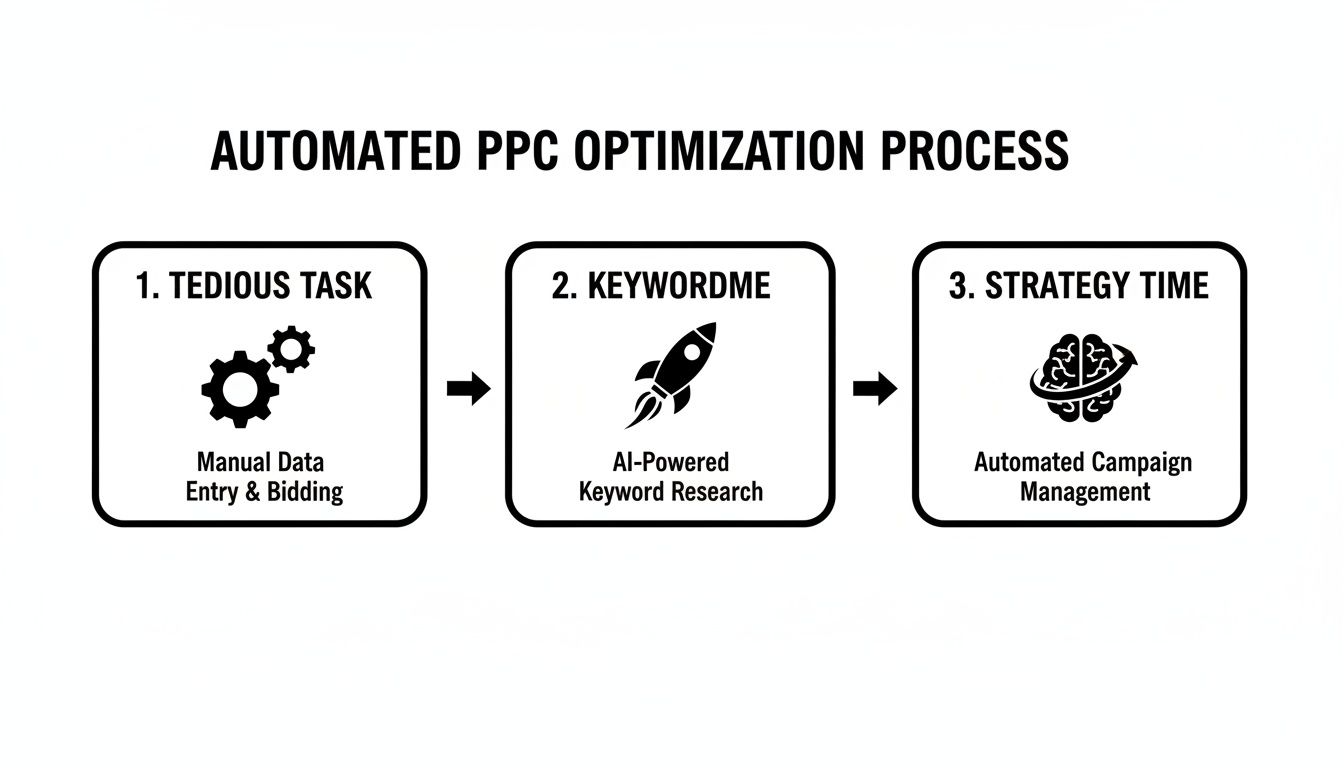
It’s a simple visual, but it gets to the heart of automation: systematically removing manual bottlenecks to create more room for strategic thinking.
Where to Start with Automation
The idea of automating everything at once can feel like a massive project, but you don’t have to do it all overnight. The trick is to start small. Pinpoint the most repetitive, time-sucking tasks that are dragging you down every week. For most of us in PPC, that’s usually keyword management and bid adjustments.
Just think about the hours you've sunk into things like:
- Manually uploading hundreds of new keywords from a spreadsheet.
- Painstakingly applying the correct match types one by one.
- Spot-checking campaigns to pause consistently underperforming ads.
- Tweaking bids based on the latest performance data.
These are the perfect first candidates for automation. You can set up rules and scripts directly within Google Ads to handle these jobs for you. For example, you could create a simple rule that automatically pauses any keyword with a click-through rate below 1% and more than 100 impressions in a week.
Just that one rule saves you from having to remember to check on it yourself, and it ensures your budget is constantly protected from low-quality traffic.
Automation is all about creating systems that execute your strategy flawlessly, even when you're not looking. It's your secret weapon for maintaining peak performance without burning out yourself or your team.
Accelerating Workflows with Smart Tools
While the built-in rules are a great first step, specialized tools are where you really start to see game-changing efficiency. This is especially true when you're trying to expand and optimize campaigns at scale.
Let's walk through a common scenario. You’ve just combed through your Search Terms Report and found 50 new, high-intent keywords you want to add. The old way is a total slog: copy the terms, format them in a spreadsheet, assign match types, and then carefully upload them into the right ad groups. It’s slow, tedious, and a prime opportunity for a copy-paste error to sneak in.
This is where a tool like Keywordme completely changes the game. It plugs right into your workflow, letting you handle bulk uploads like this with a single click. What used to be a 30-minute chore is now done in seconds. This isn't just a minor time-saver; it can make your entire optimization workflow up to 10 times faster.
That kind of speed is a massive competitive advantage. While your competitors are stuck wrestling with spreadsheets, you’re already testing new keywords, refining your targeting, and scaling what works. By using the right tools, you can explore more of our marketing automation best practices and get way ahead of the curve.
The table below breaks down just how stark the difference is between the old manual grind and a modern, automated approach.
Manual Tasks vs Automated Workflows
As you can see, the time savings aren't just incremental—they're transformative.
This kind of impact is well-documented. Businesses that adopt Google Ads automation and smart bidding often see huge improvements. In fact, Google reports an average 14% increase in conversion value for advertisers who switch to strategies like Target ROAS. Other studies, like those from Uproas.io, show CPA reductions of 15-25%. When you pair those platform-level gains with tools that accelerate your personal workflows up to 10x faster, you turn what was once a time-wasting inefficiency into a major profit center.
Ultimately, automating your workflows is about making a fundamental shift—from being a "task-doer" to a strategist. By letting technology handle the grunt work, you reclaim your most valuable asset—your time—to focus on the big-picture thinking that truly moves the needle.
Optimize for Mobile to Capture High-Value Clicks
Let's be blunt: if your marketing strategy isn't built for mobile first, you're already behind. Thinking of mobile as an afterthought to your desktop campaigns is a surefire way to burn through your budget with little to show for it.
The reality is that most of your clicks—and very likely most of your conversions—are already happening on a smartphone. Optimizing for this isn't just about having a website that resizes. It's about understanding the unique behavior of mobile users and completely retooling your approach to meet them where they are.
This behavioral shift is a game-changer for how to improve marketing efficiency. Mobile searches are often shorter, more direct, and heavily influenced by location. Someone searching for "emergency plumber" on their phone is looking for an immediate solution, not a long-winded blog post. Capturing this high-intent traffic requires a completely different playbook.
Building Campaigns for the Small Screen
Simply shrinking your desktop ads and sending that traffic to a desktop-designed landing page is a recipe for a high bounce rate and wasted ad spend. You need to build your mobile campaigns from the ground up, with the mobile user in mind.
This all starts with your ad copy. You have less real estate to work with, so every single word counts. Your message has to be concise, compelling, and laser-focused on solving the user's immediate problem. Think action-oriented language and highlight what makes you the best, fastest, or most convenient option.
- Focus on Brevity: Get straight to the point. Use headlines that grab attention and offer a clear benefit right away.
- Leverage Ad Extensions: Mobile ad extensions like call buttons and location links are non-negotiable. They make it incredibly easy for a user to take the next step without fumbling around your site.
- Create Mobile-Specific Landing Pages: Don't just make your desktop page responsive. Design landing pages specifically for mobile, with big, tappable buttons, simple forms, and content that's easy to scan.
Mobile optimization isn't just a technical box to check; it's a strategic imperative. Your customers are on their phones, ready to act. A seamless mobile experience is the bridge between their immediate need and your solution.
Adapting Your Keyword Strategy for Mobile
Mobile search intent is a different beast altogether. People often use voice search or type shorter, more conversational queries. Your keyword strategy has to reflect this.
A huge part of efficiency is understanding context. A desktop search for "best Italian restaurants" might be for planning a dinner next week. That exact same search on a smartphone at 6 PM likely means, "Where can I eat Italian food right now, near me?"
This is why tools that allow for rapid keyword adaptation are so valuable. The mobile environment moves fast, and you can’t afford to spend days sifting through search term reports. Using a tool like Keywordme lets you quickly spot these mobile-specific, high-intent terms and get them into your campaigns. At the same time, you can build out negative lists to filter out the irrelevant, desktop-oriented searches. That kind of agility is crucial for capturing valuable mobile clicks without wasting money.
The numbers don't lie. Properly optimizing for mobile in Google Ads can lead to up to 46% greater brand awareness and 5x higher effectiveness compared to desktop. With a staggering 63% of all clicks now coming from smartphones, it’s a massive opportunity for efficiency. Yet, so many PPC specialists see subpar results because they lack the tools to quickly adapt their keywords and negatives for this unique user behavior. You can dive deeper into these powerful Google Ads statistics over at wearetenet.com.
Ultimately, mastering mobile isn't just about showing up—it's about showing up with the right message, at the right moment, with a frictionless path to conversion. Get this right, and you’ll tap into a stream of high-value clicks that your desktop-focused competitors are completely missing.
Measure What Matters to Actually Prove Your ROI
Are you still high-fiving over a great click-through rate? It feels good, I get it. But it's often a classic vanity metric—a number that looks fantastic on a report but tells you next to nothing about whether you're actually making money. Chasing clicks and impressions is easy, but it's a surefire way to hide the real story of your marketing efficiency.
Real efficiency isn’t about getting the most eyeballs. It’s about squeezing the maximum return out of every single dollar you invest. It’s time to shift our collective focus from the metrics that stroke our egos to the ones that actually build the business.
When you build a measurement framework that ties every marketing action directly to the bottom line, you stop guessing. You start proving your value. That’s how you transform your team from a perceived cost center into an undeniable profit driver.
Moving Beyond CPC to Metrics That Matter
The first step on the road to real efficiency is graduating from cost-per-click (CPC). Don't get me wrong, it's a useful data point. But it tells you absolutely nothing about the quality of that click. A one-cent click that never converts is infinitely more expensive than a $10 click that turns into a $500 sale.
The real heavy-hitters you need to be obsessed with are:
- Cost Per Acquisition (CPA): This is your all-in cost to land one paying customer. It cuts through the noise and asks the only question that really matters: "How much did we have to spend to get this sale?"
- Return on Ad Spend (ROAS): This is the ultimate proof of profitability. For every dollar you put into ads, how many dollars in revenue came back? A ROAS of 5:1 means you’re generating $5 in revenue for every $1 spent.
Focusing on CPA and ROAS forces you to think about the entire customer journey, not just that first click. It creates a direct line between your ad budget and revenue, giving you a brutally honest picture of what's working and what's a waste of money.
Chasing a low CPC is like trying to win a race by focusing on taking the most steps. It's a measure of activity, not progress. True efficiency comes from focusing on CPA and ROAS—the metrics that actually get you across the finish line.
Identifying KPIs Aligned with Business Goals
Your key performance indicators (KPIs) have to be a direct reflection of your company's big-picture objectives. If the C-suite wants to increase market share in the Southeast, your marketing KPIs can't just be about overall lead volume. They need to be about qualified leads from that specific region.
Think of your KPIs as the vital signs of your marketing health. Without the right ones, you're flying blind.
To dial this in, ask yourself what success really looks like for the business. Is it:
- Generating 20 qualified sales appointments per week?
- Achieving a customer lifetime value (CLV) of over $5,000?
- Driving 500 free trial sign-ups that convert at a 15% rate?
Once you have that answer, you can build your KPIs around it. If that trial-to-paid conversion rate is your North Star, then your primary KPI might be Cost Per Converted Trial. That's a universe away from just tracking "Cost Per Sign-Up." Getting this right can get tricky, which is why a solid grasp of concepts like cross-channel attribution modeling is so crucial for seeing the full picture.
Your Simple and Effective Marketing Dashboard
You don’t need some overwhelming dashboard with 50 different charts blinking at you. A great dashboard tells a clear story at a glance, focusing only on the metrics that drive decisions. Your goal here is clarity, not complexity.
Here’s a simple template for a dashboard that zeroes in on what truly matters:
This simple structure keeps you focused. By tracking ROAS and CPA, you're constantly evaluating profitability. By watching your Lead-to-Customer Rate, you ensure your pipeline isn't full of junk leads. And by keeping an eye on your funnel conversion rates, you can spot and fix leaks before they turn into floods.
When you measure what actually matters, you give yourself the data to make smarter decisions, prove your department's value, and continuously dial up your marketing efficiency in a way that shows up on the bottom line.
Answering Your Top Marketing Efficiency Questions
Before we jump in, know that spinning up your efficiency engine usually sparks a bunch of “what if” doubts. That’s totally normal. Consider this your last pit stop before full throttle.
Is It Better to Use One Big Tool Or Several Specialized Ones
I’ve seen teams that swear by an all-in-one platform and others juggling half a dozen dashboards. Both sides have their merits.
On one hand, patchwork setups feel like Swiss cheese—data seeps out, context switching kills momentum, and subscription fees pile up.
- Too many logins and endless tab-hopping
- Disconnected data silos that slow down reporting
- Overlapping features you’re still paying for
On the other hand, a single, well-integrated suite cuts out the hopscotch. You get a unified view of analytics, campaign management, and content workflows without manual exports.
The smartest move isn’t piling on every tool under the sun. It’s choosing a handful of best-in-class platforms that communicate seamlessly.
In practice, you might pick a core analytics/campaign hub and plug in a dedicated keyword research app. That way, you stay nimble without losing depth.
How Much Time Should I Actually Spend On Audits And Optimization
Audits can turn into bottomless pits—trust me, I once watched a colleague spend a week buried in reports. You don’t need that level of overkill.
Here’s a practical rhythm that keeps you moving:
- Weekly Check-In (1–2 Hours)
Scan your PPC Search Terms Report, add fresh negative keywords, pause underperformers. - Monthly Review (3–4 Hours)
Step back: are your campaigns still hitting target metrics? Any tools collecting dust? - Quarterly Strategy Session (Full Day)
Reevaluate KPIs, align with market shifts, and map out major course corrections.
I swear by this routine because it forces action and prevents optimization from becoming a never-ending chore.
What If I Don’t See Immediate Results
Patience is a tough pill. Nobody wants to tweak negative keywords and wait weeks for feedback. But real momentum builds from small gains stacking up.
Think of efficiency like compounding interest. Trimming CPA by 5% this month might feel modest—but do that every month for a year, and you’ve slashed costs dramatically.
The key is trusting the data and focusing on meaningful metrics like CPA and ROAS, not just clicks. Give each adjustment a few weeks before deciding it didn’t work. More often than not, those tiny wins prove their worth over time.
Ready to stop juggling spreadsheets and start automating your Google Ads workflow? Keywordme is the all-in-one tool designed to slash wasted ad spend, find winning keywords, and accelerate your optimization process by up to 10x. Start your free 7-day trial today and see the difference for yourself.
.svg)