
How to Improve Ad Rank Google Ads: 2026 Guide
How to Improve Ad Rank Google Ads: 2026 Guide


The counterintuitive part of how to improve Ad Rank Google Ads is that a bigger bid is often the weakest lever in the account. Google says Ad Rank is driven mainly by ad quality and landing page experience, or by increasing your bid, and it also says top and absolute top positions depend on those factors plus relevant ad assets like sitelinks, not bid alone (Google Ads Help). In other words, if the ad is misaligned, the page is thin, or the asset coverage is weak, paying more just buys a more expensive version of the same problem.
Most accounts get stuck because teams treat Ad Rank like a score to chase. That misses the point. Ad Rank behaves more like a diagnosis tree, and the three signals that matter most are expected CTR, ad relevance, and landing page experience. If you identify which one is underperforming, you can make a targeted fix instead of spraying budget across the whole account.
Why Most Ad Rank Advice Misses the Point
Bad Ad Rank advice sounds efficient. Raise bids, add keywords, throw in some assets, and hope the auction rewards the effort. That approach confuses activity with progress. Google's guidance ties stronger rank to better ad quality, better landing page experience, and relevant ad formats, while Quality Score guidance also points to tighter ad group themes, more direct ad text, and a more specific offer so the ad matches user intent more closely (Google Ads Help).
The useful way to handle how to improve Ad Rank Google Ads is simpler. Identify which of the three signals is holding the keyword back, then fix that signal first. If expected CTR is weak, the ad hook is off. If ad relevance is weak, the keyword theme and copy do not match. If landing page experience is weak, the page breaks the promise the ad made.
The three-signal model
Expected CTR tells you whether searchers are likely to click. Ad relevance tells you whether your wording matches the query. Landing page experience tells you whether the destination feels useful, fast, and aligned. Google reports Quality Score on a 1–10 scale and says those three components drive it, which makes the breakdown useful as a practical diagnostic tool (Google Quality Score).
Practical rule: do not start with bids when the query, ad, and page are out of sync. Fix the weakest signal first, then decide whether a bid change still makes sense.
Audit the signal, segment the problem, test one change at a time, then measure whether the rank issue moved or whether you only shifted clicks around. The wrong fix can raise spend without improving position quality.
How Google Calculates Ad Rank in 2026
The auction is dynamic, so one bid never explains the outcome by itself. A useful shorthand is Ad Rank = Max CPC bid × Quality Score, with ad assets affecting performance too, while Google's own guidance describes a multi-signal system built from bid, expected CTR, ad relevance, landing page experience, and the expected impact of ad formats and extensions. That is the right frame for Google Ads ad rank formula: bid gets you into the auction, the other signals decide how efficiently you compete, and the system is recalculated for each query, device, location, time, and audience context.
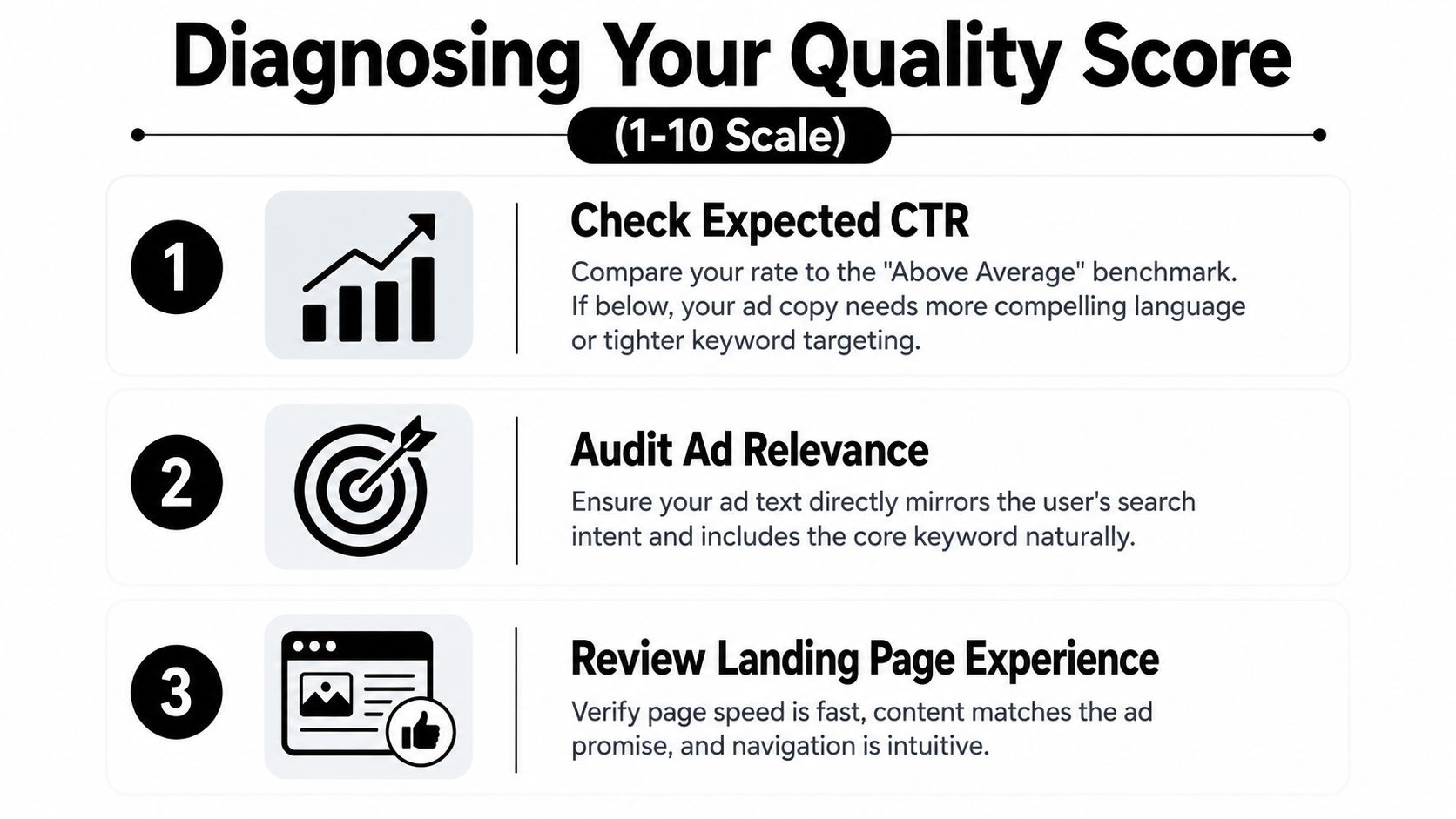
Two advertisers can bid the same amount and still land in different positions because Google weighs the rest of the signal set. Stronger relevance, better predicted click behavior, and stronger supporting assets usually compete more efficiently than a broad, generic setup. Google also says relevant assets can improve expected CTR, which feeds back into auction performance, and the same logic is why a cleaner keyword structure often beats a blunt bid increase.
What changes at auction time
Every eligible query creates a fresh decision. Google considers the search context, the current competition, and whether the ad clears the threshold needed for a top or absolute top position. There is no single fixed rank sitting in the account, waiting to be nudged. There is only the next auction, then the next one after that.
Thresholds matter more than vanity scores. If bids are fine but quality signals are weak, the ad can still miss the better slot. If quality is strong, the same visibility may require less bid pressure. The practical takeaway is simple. Work on the signal that is holding the auction back, not the one that is easiest to change.
For a compact explanation of that logic, the Google Ads ad rank formula breakdown is a useful reference, and how to improve Google Ads Quality Score shows how the same components translate into day-to-day account work.
A simple competitor example
Two competitors can bid the same amount and still end up in different places. One has tighter keyword themes, more specific ad copy, and a page that matches the promise. The other has a broader ad group, generic copy, and a landing page that does not line up with the query. The first account usually wins the stronger auction result because Google can read the signals more confidently.
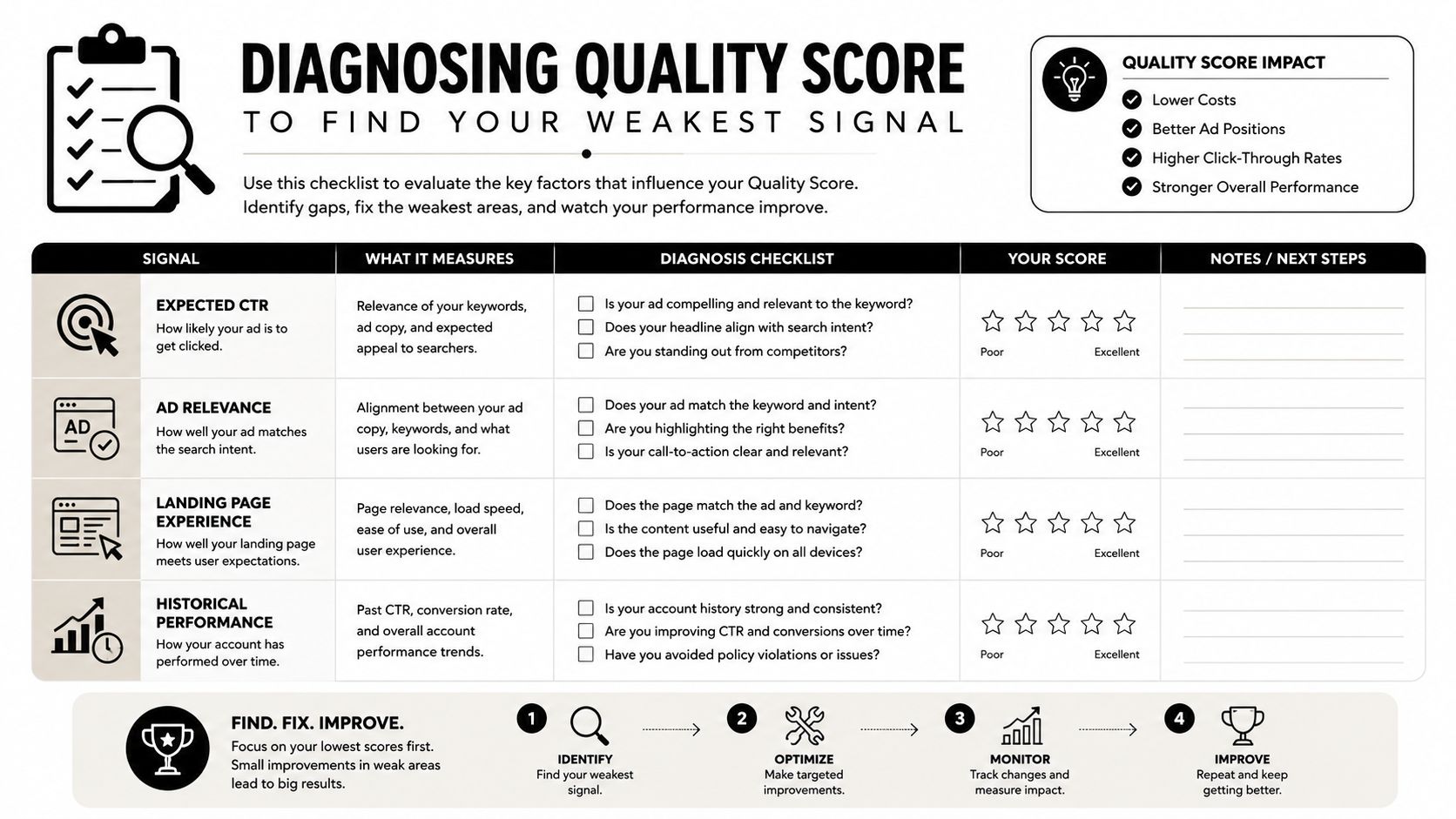
Diagnosing Quality Score to Find Your Weakest Signal
Quality Score only helps when you read it as a diagnostic, not a scorecard. Google describes it as a 1–10 scale shaped by expected CTR, ad relevance, and landing page experience. That means the number is a map of the bottleneck, not a verdict. A keyword that is weak in one area needs a different fix than a keyword that is soft across all three.
Read the components, not just the score
Pull Quality Score at the keyword or ad group level, then sort by the weakest component. If a keyword has acceptable expected CTR but weak ad relevance, the problem is usually structure, not bidding. If relevance looks fine but landing page experience is weak, the page needs work before a bid increase makes sense.
Practical rule: a low Quality Score is a clue, not a sentence. The component ratings tell you where the break is.
The mistakes are predictable. Some account teams confuse impression share with rank, then raise bids after seeing fewer impressions. Others overreact to one weak component even though auction context can shift the reported score from query to query. Ignore the noise and look for the same weakness across related keywords or ad groups.
Bucket keywords by weakest signal
Use three queues. Put keywords with weak expected CTR into a copy queue. Put keywords with weak ad relevance into a structure queue. Put keywords with weak landing page experience into a page queue. That turns a vague audit into a clear workflow, and it keeps you from rewriting headlines when the page is the issue.
For a fuller walkthrough of score interpretation and fixes, the guide on how to improve Google Ads Quality Score is a useful companion. The point is simple. Fix the signal underneath the score, not the score itself.
Tightening Ad Groups and Rewriting RSA Copy
Relevance starts with structure, and structure is where most accounts drift. If one ad group is carrying unrelated keywords, the RSA has to stay generic, and generic copy rarely earns strong ad relevance. Tighten the theme first, then write to that theme. Otherwise you end up asking one ad to do three jobs at once, and none of them well.
The trade-off is simple. Broader ad groups give you fewer assets to manage, but they dilute the message. Tighter ad groups take more work up front, yet they let the headline, description, and offer all point to the same intent. That alignment is what usually moves the signal, not another round of bid changes.
Tight themes beat mixed baskets
A clean ad group maps to one intent cluster, not a pile of loosely related terms. That gives you room to mirror the query in the headline without forcing the ad to sound mechanical. It also makes it easier to see whether weak performance comes from the copy or from the traffic mix.
A practical rebuild usually starts with intent buckets.
- Brand intent: keep brand terms separate, then write copy that reinforces familiarity and trust.
- Problem intent: group queries around the pain point, then lead with the problem and the outcome.
- Service intent: isolate the core service term, then use proof, offer, and CTA language that matches it.
That structure gives each RSA a narrower job. A brand group can speak differently from a service group, and a problem-led group can use sharper language without sounding off-target. If those themes are blended together, the ad has to stay bland to avoid mismatching part of the group.
Rewrite RSA slots with a job for each line
Responsive Search Ads work better when each asset slot has a specific role. One headline should mirror the query. Another should state the outcome. Another should carry the differentiator. The descriptions should handle objections, proof, and the call to action. If every line says the same thing in a different way, the ad looks busy without becoming clearer.
Use the search terms report as raw material, then turn the exact phrasing people already use into copy angles. The page on ad copy examples is a useful reference because it shows how different hooks map to different intent patterns. I also use search term wording to test whether the offer is being described in the same language the market uses. That is usually a better starting point than brainstorming headlines in a vacuum.
The practical version is straightforward. If a broad ad group like “digital marketing services” is carrying paid search, SEO, and social queries, split those themes before you touch the RSA. Then write one set of assets for paid search, another for SEO, and another for social. The copy gets sharper, the query-to-ad match improves, and the ad stops trying to be all things to all clicks. If negative terms are part of that cleanup, the Netco Design negative keyword guide is a solid companion for keeping the wrong searches out of the group.
Search Terms Cleanup as an Ad Rank Lever
Negative keywords look like housekeeping, but they're really a rank protection tool. Google Ads experts consistently recommend reviewing the Search terms report and adding queries that don't match the offer as negatives, because irrelevant traffic drags down expected CTR and wastes budget (Google Ads search match types). Broad match can be useful, but without guardrails it pulls in loosely related searches that create the appearance of scale while hurting quality signals.
The pattern I see in accounts is familiar. Someone widens match types, traffic spikes, and the account calls it growth. Then the Search terms report shows a long list of low-intent queries that never should have been eligible in the first place. After cleanup, the same budget often moves toward cleaner terms, and the account gets a better read on what the campaign can win.
A weekly cleanup rhythm that works
Pull the Search terms report, sort by cost, and tag the irrelevant queries first. Then split the useful queries into the right ad groups instead of leaving them lumped together. Recheck the next cycle to see whether spend is shifting toward higher-intent searches. That's the whole loop.
Here's the practical tradeoff.
| Match Type | Typical Reach | Expected CTR Impact | Recommended Guardrail |
|---|---|---|---|
| Exact | Narrow | Usually stronger relevance | Use for core intent and high-value terms |
| Phrase | Moderate | Balanced | Use when intent is clear but wording varies |
| Broad | Wide | More variable | Pair with negatives and tight ad group themes |
For a more operational cleanup process, the internal guide on how to analyze search terms report efficiently is the right companion. If you want a broader primer on exclusions, the Netco Design negative keyword guide is a useful external reference for the basic mechanics.
Separate intent before you scale
Brand, generic, and competitor terms should usually live in different ad groups. They demand different promises, different proof, and different landing page expectations. Once they're separated, you can stop forcing one RSA to cover every possible search, which is where a lot of quality leakage starts.
Keywordme is one tool that can help here because it supports keyword match type configuration, search-term-based expansion, and negative keyword handling in one workflow. That's not a ranking trick on its own, but it does make cleanup and segmentation less manual.
Landing Page Experience That Earns the Click
A strong ad can still lose the auction if the page feels slow, vague, or hard to use. Google treats landing page experience as one of the three Quality Score components, alongside expected CTR and ad relevance (Google Quality Score). Page quality is part of the rank system, not a post-click vanity metric.

Message match has to be obvious
The headline above the fold should read like the next line of the ad copy. If the ad promised a consultation, the page should not open with a generic brand statement. If the ad promised a specific service, that service needs to be visible immediately. When the promise and the destination drift apart, the page feels less credible and the auction signal weakens.
That is the first thing I check in an audit. If the user has to work to confirm they are in the right place, the page is already losing ground.
Speed and friction matter more than redesigns
Start with load behavior, mobile usability, and form friction. Google's landing page guidance points to relevance, speed, and usability as the core ingredients, not flashy design changes (Google Ads Help). Fixing a bloated hero image or trimming a long form usually does more than rearranging the whole layout.
A page that loads fast but still makes people hunt for the offer is only half fixed. A page that looks polished but stalls on mobile still drags on expected performance.
Keep the page focused on one action. Every extra click, field, or distraction makes the post-click experience harder to trust.
Use simple tests before you call the page better. Compare the current page against a version with a tighter headline, a clearer CTA, and fewer form fields. If the page is more useful and easier to complete, it gives Google a cleaner landing page signal and gives users fewer reasons to bounce.
Bidding, Ad Assets, and Experiments That Move Ad Rank
Bids still matter, but they are the last lever I touch once relevance is in place. Google's guidance treats bid, ad quality, and landing page experience as separate inputs into Ad Rank, so pushing bids alone rarely fixes a weak auction position. In live accounts, I only raise bids after the keyword, the ad, and the page are already doing their jobs.
Ad assets are not decoration. Google includes the expected impact of ad formats and extensions in Ad Rank, so sitelinks, callouts, structured snippets, images, and other assets can help rank by improving expected performance (Jellyfish on Google Ad Rank). The mistake is treating assets like a checkbox or assuming they only matter because they make the ad bigger.
What to change first
If visibility in the auction is weak, start with the queries and the message, then check whether bids are still the limiting factor. If quality signals are already strong but top-of-page visibility is still thin, a bid increase can make sense. If the account is losing mostly on irrelevant traffic, more bid pressure just scales the wrong auctions and makes the problem more expensive.
Use the bid as a finishing lever, not a rescue lever. It works when the rest of the setup is already pulling in the same direction.
The cleanest test plan is simple. Pick one campaign, keep the structure steady, and make one meaningful change, either ad copy, assets, or bid strategy. Watch top impression rate, absolute top impression rate, and the quality of the traffic, not just raw click volume. If clicks rise but the query mix gets worse, the change did not improve Ad Rank in a useful way.
A practical workflow for the next two weeks
- Analyze auction visibility. Check where you are losing, then separate rank problems from budget problems.
- Refine relevance first. Tighten the ad group, refresh the RSA, and clean the search terms.
- Adjust bids selectively. Raise bids only on the keywords that already look strong.
- Test the page or assets. Change one element at a time so you can see what moved the result.
That sequence separates random optimization from controlled progress. Run it consistently, and you stop guessing which lever matters. You start seeing which part of the account is holding back Ad Rank.
Keywordme helps teams manage the keyword cleanup and match type work that sits underneath Ad Rank improvement. If you are dealing with messy search terms, uneven ad group structure, or too much manual negative keyword work, visit Keywordme and see how it fits into your Google Ads workflow.
.svg)