
How to Improve Google Ads Quality Score A 2026 Playbook
How to Improve Google Ads Quality Score A 2026 Playbook


Most advice on how to improve google ads quality score is stuck in an older version of Google Ads. It assumes you can brute-force your way to better scores by carving every campaign into tiny keyword buckets and calling it a day.
That still matters, but it’s no longer the full answer. Google has pushed harder into automation, broader matching, AI-generated assets, and campaign types that don’t hand you the same level of control you had before. If you apply old-school tactics without adjusting for that shift, you can end up with a cleaner account on paper and weaker signal quality in practice.
The fix isn’t choosing between control and automation. It’s knowing where each belongs, and where loose matching, vague copy, and weak post-click experiences drag your scores down.
Why Old Quality Score Advice Is Failing in 2026
The old playbook said this: make your ad groups smaller, mirror the keyword in the ad, send traffic to a relevant page, and Quality Score will rise.
That advice wasn’t wrong. It’s just incomplete now.
Over the last year, Google expanded Performance Max with AI-generated creatives, and DataFeedWatch notes that Quality Scores can drop by 15-25% in automated campaigns without manual interventions like custom negative keywords because broad AI matching dilutes relevance. That’s why a lot of advertisers are seeing an odd pattern. Conversions can look fine while Quality Score slides in the background.
Automation changed the failure mode
In a traditional search campaign, a bad structure usually looked obvious. You’d see broad ad groups, mixed intent, weak copy, and junk search terms slipping through. In newer AI-heavy setups, the problem is murkier. Google can still find converting pockets, but the path it takes to get there often broadens query matching and creative variation in ways that weaken the relevance signals Quality Score depends on.
That creates a trap. Marketers assume the automation is “working,” so they stop auditing the basics.
Broad matching plus AI asset generation can produce acceptable top-line results while quietly degrading the diagnostic signals that keep search campaigns efficient.
The three pillars still matter
Quality Score still comes back to three practical questions:
- Expected CTR. Are people likely to click this ad when they see it?
- Ad relevance. Does the ad closely match the intent behind the query?
- Landing page experience. Does the page fulfill the promise of the ad?
What’s changed is how easily automation can blur those connections.
A hyper-granular structure can still help. But if you force that same rigidity everywhere, especially in campaigns that rely on automated matching, you can create busywork instead of value. The better approach is hybrid. Keep your search campaigns structured tightly where intent is clear. In AI-driven campaigns, protect relevance with exclusions, asset discipline, and regular query review.
What still works and what doesn’t
Here’s the blunt version:
| Approach | Still works | Stops working fast |
|---|---|---|
| Tight keyword themes | Yes, especially in search | Not enough on its own |
| Generic RSA copy | Rarely | Usually tanks CTR quality |
| Weekly query cleanup | Yes | Skipping it gets expensive |
| Blind trust in automation | No | Leads to relevance drift |
If your account has decent spend but stubbornly average scores, that’s usually the pattern underneath it. Not one catastrophic issue. Just too much drift between keyword, ad, and landing page.
Your Quality Score Diagnostic Playbook
If you want to improve Quality Score, don’t start by rewriting ads. Start by figuring out which component is broken.
Too many accounts get “optimized” in the dark. The team changes copy, swaps landing pages, fiddles with match types, and hopes one of those changes sticks. That’s not account management. That’s guesswork.
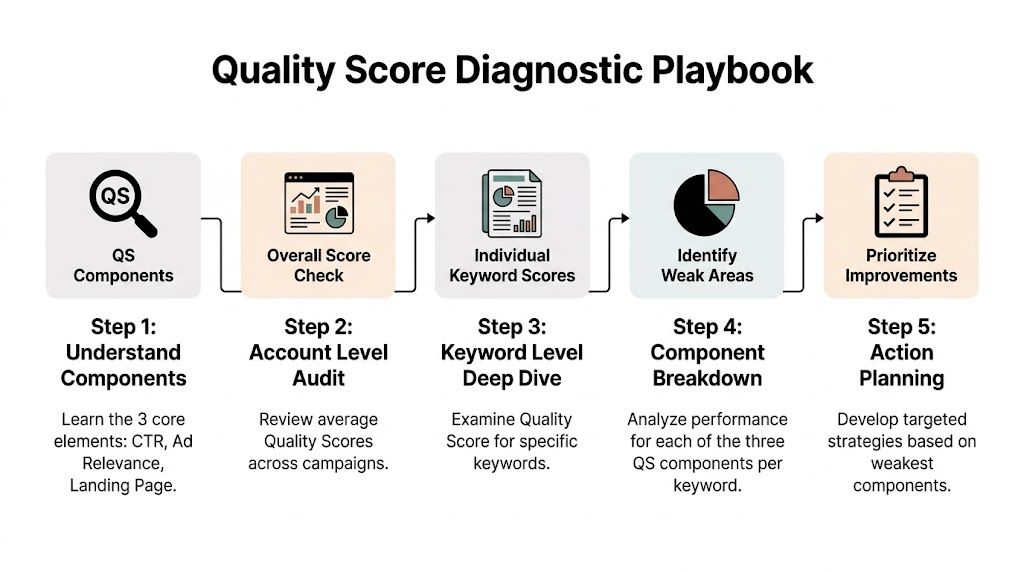
Start inside the keyword view
Quality Score lives at the keyword level. In Google Ads, go to your keywords view and add the columns for:
- Quality Score
- Expected CTR
- Ad relevance
- Landing page experience
If those columns aren’t visible, customize the table and add them. Don’t stop at the campaign average. Averages hide the underlying issues. One strong branded cluster can make the account look healthier than it is.
Build a triage list, not a giant spreadsheet
Once those columns are visible, sort for the keywords that combine two things:
- Low Quality Score or weak component ratings
- Meaningful spend or impression volume
That second part matters. A low-scoring keyword with barely any activity can wait. A weak keyword that absorbs budget every day deserves attention first.
I usually sort findings into a simple working table like this:
| Priority | What I’m looking for | Likely issue |
|---|---|---|
| High | Low score plus strong traffic | Immediate efficiency leak |
| Medium | Average score but important keyword theme | Optimization opportunity |
| Low | Low score with little activity | Monitor, don’t obsess |
That keeps the audit practical. You’re not trying to “fix Quality Score” across the whole account in one pass. You’re trying to fix the pieces that affect cost and rank right now.
Read the component labels correctly
The three component ratings tell you where to go next.
If Expected CTR is weak, the ad likely isn’t compelling enough for that search. Sometimes the copy is bland. Sometimes the search term mix is too loose, so even a decent ad can’t win the click.
If Ad relevance is weak, your keyword grouping is usually the problem. The ad group is too broad, or the ad copy is trying to serve multiple intents at once.
If Landing page experience is weak, the page usually breaks the promise made in the ad. That can mean poor message match, weak mobile usability, or a page that feels like a category dump instead of a destination.
For a deeper breakdown of common root causes, this guide on what causes low Quality Score and how to fix it is a useful companion while you audit.
Audit by cluster, not by isolated keyword
One low keyword score can be noise. A pattern across a theme is signal.
Look for groups of keywords that share the same problem. For example:
- A whole ad group with weak Expected CTR usually points to stale or generic ads.
- A product category with low ad relevance usually means too many unlike terms were grouped together.
- A service cluster with weak landing page experience often means all traffic is hitting the same generic page.
This is also where campaign type matters. In standard search, diagnosis is cleaner because you control the structure more directly. In more automated setups, use search term data and asset-level review to determine whether the system is broadening beyond the intent you meant to target.
Practical rule: Don’t optimize what you haven’t classified. Every low score should be attached to one primary issue before you touch anything.
Use a weekly review rhythm
Quality Score work falls apart when audits happen once a quarter. Query patterns shift too fast for that.
A useful review cycle looks like this:
- Pull keyword-level QS components
- Flag high-impact weak spots
- Review search terms for relevance drift
- Check whether the ad and landing page still match the query theme
- Make one focused fix per problem cluster
That last point saves a lot of confusion. If you change the ad, landing page, and match type all at once, you won’t know what solved the issue.
Good diagnostics feel slower at first. Then they speed everything up because you stop making random edits.
Proven Tactics to Boost Expected Click-Through Rate
If Expected CTR is below average, Google is telling you something simple: your ad isn’t winning enough clicks relative to what users expect for that search.
That doesn’t mean the ad is “bad.” It usually means the ad is too vague, too generic, or too disconnected from the reason someone searched in the first place.

PushFire explains that improving Google Ads Quality Score by increasing CTR can lead to substantial reductions in CPC, and advertisers reaching Quality Scores of 9-10 often do it by tightly aligning keywords, ad copy, and landing pages. That’s the key. CTR improvement isn’t copywriting theater. It’s relevance made obvious.
Match the search language without sounding robotic
A lot of ads lose the click because they talk around the query instead of answering it.
If someone searches for a specific product type or service variant, your headline should reflect that language directly. Not every time, not in every headline, but enough that the ad feels like the right fit at a glance.
Weak approach:
- Generic benefit headline
- Brand slogan
- Broad category wording
Stronger approach:
- Query-aligned headline
- Specific offer or use case
- Clean CTA tied to intent
Here’s the difference in practice:
| Search intent | Weak headline | Better headline |
|---|---|---|
| Commercial search | Premium Solutions for Every Need | Get a Quote for Custom Office Cleaning |
| Product search | Shop Quality Running Gear | Women’s Trail Running Shoes |
| Lead gen search | Trusted Industry Experts | Sign Up for a Demo Today |
The point isn’t to stuff keywords into every line. It’s to remove friction. The user should instantly understand, “Yes, this is about what I searched.”
Use CTAs that fit the intent
Google’s guidance emphasizes testing clear calls to action such as Buy Now, Sign Up, and Get a Quote when they align with keyword intent. That sounds basic, but a lot of advertisers still default to soft, foggy language like “Learn More” when the search clearly signals someone is ready for the next step.
Use the CTA to match the stage of the search:
- Transactional intent calls for action like buy, order, book
- Lead intent works better with get a quote, request pricing, schedule a call
- Evaluation intent may suit compare plans, see features, view demo
If your expected CTR is weak, review your ads and ask a blunt question: does the CTA fit what the user is trying to do right now, or is it just a placeholder?
For more practical examples, this breakdown of how to improve expected CTR is worth keeping nearby while you rewrite.
Make the ad bigger and easier to click
Extensions still matter because they give the ad more surface area and more reasons to engage. Sitelinks, callouts, and structured snippets make the result more useful before the click even happens.
I treat extensions like supporting proof, not decoration.
- Sitelinks work when they map to real next steps such as pricing, services, locations, or contact pages
- Callouts help highlight practical differentiators without forcing them into the headline
- Structured snippets let you show categories, brands, features, or service types in a cleaner format
A sparse ad often loses to a merely decent ad with stronger supporting assets.
Responsive search ads need curation
Responsive search ads can help, but only if you feed them disciplined inputs. Too many accounts dump in a pile of mixed headlines and hope the system sorts it out. What usually happens is that Google assembles combinations that are technically valid and strategically muddy.
Use a tighter RSA build:
- Write headlines around one intent theme
- Include direct query language in several assets
- Add one or two proof-style headlines
- Add CTA-focused headlines
- Keep descriptions clear and promise-driven
Don’t mix different offers, audiences, and value props in the same ad unless they are a natural fit. More combinations aren’t always better.
A good explainer helps if you want to sanity-check your setup before another round of testing:
Expected CTR usually falls for one of four reasons
When I review low-CTR ad groups, the issue is usually one of these:
- The copy is generic. It could apply to almost any query in the category.
- The ad group is too loose. Different intents are competing inside the same cluster.
- The CTA is weak. It doesn’t match what the user wants to do.
- The assets are thin. The ad lacks sitelinks, callouts, or useful supporting detail.
A better CTR doesn’t come from sounding “catchy.” It comes from sounding exactly right for the search.
Fixing Expected CTR is often the fastest Quality Score win because it’s visible in the ad itself. Users either feel the match immediately or they don’t.
Building High-Relevance Ad Groups That Google Loves
Ad relevance is where account structure stops being theory and starts affecting money. If your keywords, ads, and intent themes are jammed together carelessly, Google sees the mismatch before your prospects do.
This is why bloated ad groups still cause so much damage. One ad trying to serve five different search intents usually serves none of them well.

PurplePlanet notes that the foundation of Quality Score improvement lies in granular campaign architecture, and that tightly themed ad groups improve ad relevance because marketers can write highly specific ad copy for each keyword cluster. That principle still holds. What changes in modern accounts is how aggressively you apply it.
Tight themes beat kitchen-sink groups
A lot of weak accounts are built like this:
- One campaign for a broad category
- A few oversized ad groups
- Mixed keyword intent inside each group
- One or two generic RSAs trying to cover everything
That structure saves setup time. It also destroys message precision.
A stronger setup groups by intent and attribute. If you’re advertising shoes, “men’s running shoes,” “women’s trail running shoes,” and “lightweight running trainers” should not live under one catch-all ad group. Those searches call for different wording, different benefits, and often different landing pages.
How granular is granular enough
You don’t need to rebuild everything into absurdly tiny silos. That’s where some older advice goes off the rails.
The useful middle ground looks like this:
| Structure choice | Usually works well | Usually causes trouble |
|---|---|---|
| Theme-based ad groups | Yes | No |
| Mixed-intent category buckets | Sometimes | Often |
| Ultra-fragmented one-off groups | Occasionally | High maintenance |
| Search-term-informed clusters | Yes | No |
The goal is clear clustering, not perfectionism. A tightly themed ad group should let you write an ad that feels made for that search set.
Build from search term reality, not from a brainstorm
Many advertisers waste time. They map ad groups from keyword planner ideas, then ignore the search terms that trigger ads.
The better method is messier, but it works:
- Pull the Search Terms Report
- Identify recurring high-intent themes
- Split unrelated terms apart
- Add negatives for junk or ambiguous queries
- Promote useful query themes into their own ad groups
That process matters because relevance is earned from real query behavior, not from your original account outline.
If you want a practical reference for restructuring, this guide on how to create tight adgroup structure is a solid place to compare your current setup against.
What to cut from existing ad groups
When an ad group is underperforming, I look for three kinds of clutter:
- Variant creep. Similar but meaningfully different searches stuffed together.
- Informational bleed. Research queries mixed with buying queries.
- Cross-category overlap. Product or service types that deserve different selling angles.
One of the easiest wins is removing “almost related” keywords. Those terms are usually what force your ad copy into vague language.
Field note: If your headline has to stay broad enough to fit every keyword in the ad group, the ad group is already too broad.
The hybrid structure that works now
At this point, the modern trade-off matters.
In standard search campaigns, stay fairly granular. Use small, tightly related keyword sets. Keep ad copy specific. Review search terms every week and keep adding negatives.
In automated campaign environments, don’t try to recreate old-school single-keyword structures where the system won’t respect them anyway. Instead, protect relevance around the edges. Use theme-based segmentation, watch query drift, and tighten exclusions so automation has better boundaries.
One practical way teams handle this is with a workflow tool such as Keywordme, which can help clean search terms, build negative keyword lists, expand ad groups from real query data, and apply match types without the usual copy-paste slog. That matters because relevance work is rarely blocked by strategy. It’s blocked by volume and repetition.
A clean ad group should pass this test
Before I leave a restructured ad group alone, I ask:
- Can one ad speak clearly to this whole cluster?
- Would one landing page feel right for every keyword here?
- Are there obvious junk modifiers that should be negatives?
- Does the search intent stay consistent across the group?
If the answer is no to any of those, the structure still needs work.
Ad relevance improves when the account gets easier to read. Not easier for you. Easier for Google and the searcher. That usually means fewer compromises inside each ad group, not more cleverness in the ad copy.
Upgrading Your Landing Page Experience Score
A lot of advertisers obsess over the ad and barely inspect the page after the click. That’s how you end up with a polished search ad sending traffic to a page that feels generic, slow, or off-topic.
Google doesn’t grade landing page experience on design taste. It looks for usefulness, relevance, and a page that doesn’t frustrate the visitor.

Message match comes first
The fastest landing page failure is weak message match. If the ad promises a specific product, service, or offer, the page should confirm that promise immediately.
Not halfway down. Not after a rotating hero banner. Right away.
Check these elements first:
- Headline alignment. Does the page headline reflect the query and ad language?
- Offer continuity. Is the product, service, or CTA the same one the ad promoted?
- Intent fit. Does the page help someone buy, compare, or inquire, depending on the search?
If you want a good outside reference on how to build high-converting pages, that Baslon Digital guide does a nice job connecting conversion thinking with page structure and clarity.
Technical friction kills trust fast
A relevant page can still earn a poor experience if it’s awkward to use. Mobile issues are common here. So are heavy pages loaded with scripts, oversized media, and cluttered layouts.
My landing page review usually starts with this short checklist:
| Area | What to check |
|---|---|
| Speed | Does the page load quickly and feel responsive? |
| Mobile usability | Can someone read, tap, and submit without pinching or hunting? |
| Layout clarity | Is the main action obvious without scanning the whole page? |
| Trust signals | Are contact details, policies, or business identifiers easy to find? |
Google PageSpeed Insights is still one of the easiest tools for spotting obvious performance problems. It won’t fix the page for you, but it will show you where the page is dragging.
Useful beats clever
Some landing pages are too polished to perform well. They’re full of brand language, clever copy, and visual effects, but they don’t answer the visitor’s question quickly enough.
A stronger page usually has:
- A clear headline
- A visible CTA
- Copy that directly supports the search intent
- Minimal distractions near the top of the page
- A structure that makes scanning easy
If the user has to interpret what the page is about, the page is already working too hard.
Audit trust and transparency
This gets missed a lot, especially on lead-gen pages.
If a visitor can’t tell who they’re dealing with, how to contact you, or what happens after they submit, the page feels thin. That hurts conversions and usually doesn’t help Quality Score either.
Look for easy fixes like:
- visible contact details
- clear form labels
- privacy and policy access
- page copy that explains the next step
Landing page experience improves when the page feels like a direct continuation of the ad, not a detour.
Your Ongoing Workflow for Maintaining a High Quality Score
Quality Score work falls apart when it lives as a one-time cleanup project. You tidy the account, scores improve, then a few months later broad queries creep back in, ads drift into generic language, and landing pages stop matching newer search themes.
The accounts that stay healthy usually run on a boring rhythm. That’s a compliment.
Weekly tasks that prevent drift
Every week, review the parts of the account most likely to go stale:
- Search terms review. Look for irrelevant queries, weak-intent modifiers, and themes that deserve negatives.
- Ad inspection. Check whether the live ads still match the query themes driving impressions.
- Keyword cluster review. Split themes that have become too broad through expansion or match type changes.
This cadence matters because relevance problems rarely appear overnight. They accumulate through small mismatches.
Monthly checks that keep structure honest
A monthly pass should be less about firefighting and more about structural cleanup.
That usually means:
- reviewing low-scoring keyword clusters
- checking whether landing pages still align to current ad messaging
- promoting strong search term themes into new ad groups where needed
- pausing or reworking keywords that never fit cleanly
I also like to compare campaign types against each other. Standard search may reveal intent patterns that your automated campaigns are obscuring. That’s often where the next round of negatives or new themed builds comes from.
What good maintenance looks like in practice
A practical workflow is simple:
| Frequency | Focus | Outcome |
|---|---|---|
| Weekly | Query cleanup and negatives | Better relevance control |
| Biweekly | Ad copy review | Stronger CTR alignment |
| Monthly | Structure and landing page audit | Fewer systemic score issues |
That’s enough for most accounts. The important part is consistency.
Quality Score doesn’t usually collapse because someone made one terrible decision. It slips because nobody kept tightening the connection between search, ad, and page.
Where tools actually help
Tools are useful when they reduce repetitive account maintenance, not when they pretend to replace judgment.
If you’re managing lots of search term volume, bulk negative handling and faster keyword grouping can keep the weekly workflow realistic. Without that, teams know what they should clean up, but they postpone it because the task is tedious.
That’s also the mindset shift that matters most. Stop treating Quality Score like a grade you occasionally check. Treat it like an operating signal. When CTR weakens, ad relevance drops, or landing page experience slips, the account is telling you where the user journey broke.
Fix that consistently, and the scores usually follow.
If you want a faster way to handle search term cleanup, negative keyword building, and ad group expansion without all the manual formatting, Keywordme is built for that workflow. It’s a practical fit for teams that want to maintain tighter relevance across campaigns while spending less time inside repetitive Google Ads tasks.
.svg)