
How to Find Niche Keywords That Actually Convert
How to Find Niche Keywords That Actually Convert


Let's be honest, figuring out how to find niche keywords isn't about some complex formula. It really boils down to one thing: targeting those super-specific, long-tail phrases that tell you exactly what a searcher wants. Instead of throwing money at broad, expensive terms, you're zeroing in on the exact language your best customers use right before they decide to buy.
Why Niche Keywords Are Your New Secret Weapon

Let's get real for a second. Chasing a massive keyword like "running shoes" is a fantastic way to burn through your entire ad budget with almost nothing to show for it. You’re going head-to-head with giant brands that have seemingly bottomless pockets. For most of us, that's a fight we just can't win.
This is where a simple shift in thinking can change everything. The smartest marketers I know are absolutely obsessed with niche keywords for one simple reason: they just flat-out work.
The Power of Being Specific
Think about the massive difference in intent between these two searches. One person types in "running shoes." Another types in "best waterproof trail running shoes for wide feet."
The first search is casual, maybe even just browsing. The second one? That’s from someone who has a problem, knows what they need, and is probably ready to pull out their credit card.
Niche keywords are your direct line to these high-intent buyers. This focused approach brings some serious advantages:
- Sky-High Conversion Rates: You're attracting people who have already done their homework and are actively looking for the solution you offer.
- Way Less Competition: Far fewer advertisers are bidding on hyper-specific phrases, giving you a real chance to own that space.
- Lower Ad Spend: By sidestepping the bidding wars on generic terms, you stop wasting money and see a much healthier return on your investment.
The big idea here is to stop shouting into a crowded room. Instead, you get to have a meaningful conversation with a smaller group of people who are actually leaning in to hear what you have to say.
Tapping into the Hidden Majority of Searches
Here’s the kicker: these ultra-specific phrases aren't some tiny fraction of search traffic. Not even close.
Long-tail keywords—those specific phrases with three or more words—make up a staggering 70% of all online searches. What's more, these niche queries tend to convert about 2.5 times better than their short-tail counterparts. For anyone running PPC campaigns, this is why digging through your search term reports for these hidden gems isn't just a good idea, it's essential.
This represents a huge, often-ignored opportunity. While your competitors are duking it out over that obvious 30% of traffic, you can be quietly scooping up all the intent-driven customers they're missing. It completely changes your keyword strategy from a game of chance into a predictable engine for growth.
Laying the Groundwork With Your Seed Keyword List

Before you fire up any fancy keyword tools, we need to create a "seed" list. Think of this as the starting point for everything that follows—a brain dump of all the terms, questions, and problems that orbit your business.
The goal here isn't to find perfect, ready-to-use keywords. Not yet. It’s about casting a wide, intelligent net to gather all the raw material you'll need for the real digging later. This initial list should reflect how real people actually talk and search for what you offer.
Mine Your Own Business for Gold
Honestly, the best ideas are often hiding in plain sight. You know your business better than anyone, and that internal knowledge is a goldmine for your first batch of keywords.
Grab a notebook or open a doc and start jotting down answers to these questions:
- What are the main things you sell? (products or services)
- What big problems do you solve for your customers?
- How would you categorize your offerings? What are their key features?
- What are the common phrases your sales and support teams hear every single day?
So, if you sell high-end coffee gear, your list would probably start with the basics like "espresso machine," "pour-over coffee maker," "burr coffee grinder," and "cold brew system." These are your core concepts.
Spy on Your Competitors and Customers
Okay, now it's time to look beyond your own four walls. Where are your customers hanging out online? What are your competitors spending their ad money on? The answers are breadcrumbs that lead straight to valuable keyword ideas.
A simple but surprisingly effective trick is to just see what your competitors are bidding on. Run a few Google searches for your main products and pay attention to the ad copy. You'll quickly spot phrases like "espresso machine for small kitchen" or "quiet burr grinder for apartments." Those are keepers—add them to your list.
Another fantastic source is online communities.
Forums like Reddit, Quora, and other niche industry forums are absolute treasure troves. People are just describing their needs and frustrations in their own words. It's unfiltered, authentic customer language, giving you incredible insight into how they search.
Check Your Existing Campaign Data
If you're already running Google Ads, you’re sitting on a mountain of pure gold. Your Search Terms Report is arguably the most powerful source you have, showing you the exact queries people typed into Google right before they clicked your ad.
Dig through those reports. Pull out any search term that looks promising, even if it hasn't converted yet. You're looking for specific, multi-word phrases that signal real intent. This isn't just theory; it's hard data from your actual audience. This is a critical step in learning how to find niche keywords that have already proven they’re relevant to your business.
By mixing what you know about your business with competitor research and real user data, you’ll have a seriously powerful seed list. This list becomes the bedrock for the next phase, where we’ll use tools to expand these core ideas into thousands of potential niche opportunities.
Using Smart Tools to Grow Your Keyword List
Alright, you've got your seed list. Now it's time to blow it up and turn that handful of ideas into a massive list of real opportunities. This is where you stop guessing and start using tools to do the heavy lifting for you.
Think of it this way: your seed list is your starting point, but keyword tools are what help you discover all the different ways people actually search. They'll spit out related terms, long-tail variations, and questions you never would have thought of on your own. Platforms like Ahrefs and SEMrush are the big players here for a reason, but there are plenty of others to check out, including these Long Tail Pro alternative tools.
Find Gold in Your Own Data
Standard keyword tools are great for casting a wide net, but the real magic often happens inside your own accounts. The best data is your data. This is exactly why a tool like Keywordme is so powerful—it taps directly into your Google Ads account to analyze your actual search term reports.
Instead of working with third-party estimates, you're looking at the exact, sometimes weirdly specific, long-tail phrases that your customers are already typing into Google to find you. It’s the difference between looking at a weather forecast and just sticking your head out the window.
This is a game-changer. You’re no longer just brainstorming. You’re using proven search query data from your own campaigns to build tightly-themed ad groups that you know have potential. It's the fastest path from raw data to a refined strategy.
Don't Forget About Google's Own Toolkit
While specialized platforms are awesome, don't sleep on the free tools Google gives you. The Google Keyword Planner is still a workhorse for many PPC pros, giving you a solid baseline for search volume and competition levels. If you need a refresher, we've got a whole guide on how to use the Google Keyword Planner to find niche opportunities.
There's a reason the industry built around this stuff is huge. The SEO market, which lives and breathes niche keyword discovery, was projected to hit $107 billion in 2025. This isn't just a number; it reflects the massive business impact of a smart keyword strategy, especially when you consider that 53% of all website traffic starts with an organic search. Finding and acting on these niche terms isn't a luxury anymore—it's how you capture your most valuable customers.
By mixing broad research tools with the hard data from your own campaigns, you get a powerful, repeatable workflow. You'll quickly uncover hundreds, if not thousands, of long-tail keywords that signal real intent. The next step is figuring out how to sort through that mountain of data to find the actual gems worth bidding on.
How to Evaluate and Prioritize Niche Keywords
So, you’ve done the brainstorming and have a massive list of potential keywords. It feels like progress, but honestly, this is where most people get bogged down. An unfiltered list is just noise.
The real magic happens when you switch gears from just finding keywords to evaluating them. It's time to sift through that digital mountain and find the actual gold. This isn't about adding more terms to your spreadsheet; it's about making smart, data-driven decisions that will actually make you money.
Look Beyond Just Search Volume
It’s so easy to get mesmerized by search volume. A keyword with 5,000 monthly searches looks great on paper, but that number alone tells you absolutely nothing about the person searching or if they'll ever buy from you.
I’ve learned this the hard way: the most profitable keywords are often the ones with lower search volumes but laser-focused intent. Instead of just chasing big numbers, you need to look at the whole picture.
- Search Volume: Sure, it gives you a baseline for potential traffic. But is it 100 super-targeted searches or 10,000 window-shoppers?
- Competition: Keyword tools give you a "competition" score, but I don't fully trust it. The real test is a quick, live Google search to see who you're really up against.
- Cost-Per-Click (CPC): What’s the going rate? A high CPC isn't always bad—it often means the traffic converts well. You just need to know if you can afford to play in that sandbox.
- Commercial Intent: This is the big one. Does the search phrase scream "I'm ready to buy!" (like searches including "buy," "for sale," or "service") or "I'm just browsing"?
This simple workflow shows how you take your initial ideas, run them through some tools, and get them ready for this critical evaluation step.
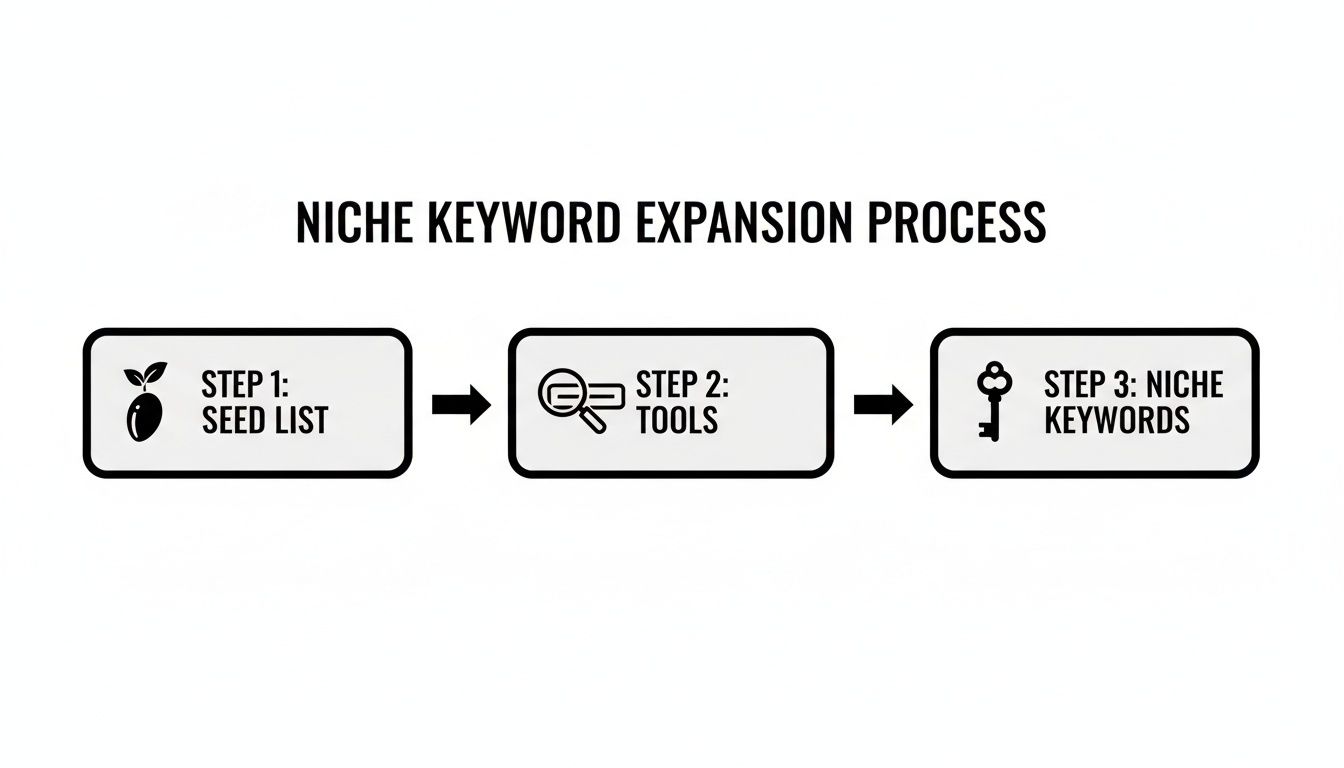
Think of it as moving from a broad concept to a refined list of terms that are actually worth your time and budget.
Niche Keyword Evaluation Checklist
To keep your evaluation process consistent, it helps to have a quick checklist. This forces you to look at each potential keyword through the same lens, making it easier to compare apples to apples.
Here’s a simple table I use to quickly score keywords before adding them to a campaign.
| Evaluation Metric | What to Look For | Red Flag |
|---|---|---|
| Search Volume | Enough traffic to be worthwhile (even if it's just 50-100/mo) | Zero or near-zero searches; too niche to be viable |
| User Intent | Clear commercial or transactional modifiers ("buy," "quote," "service") | Vague, informational terms ("what is," "how to," "ideas") |
| CPC | Within your budget, but high enough to suggest commercial value | Extremely low CPC (e.g., <$0.50) might signal low-quality traffic |
| Competition | SERP shows ads from businesses similar to yours | Dominated by huge brands (Amazon, Wikipedia) or no ads at all |
| Business Relevance | Directly matches a product or service you offer | Tangentially related; requires a stretch to connect to your offer |
Using a checklist like this helps you move past gut feelings and start making objective decisions about where to spend your ad budget.
Validate with Real-World SERP Data
Metrics from tools like Ahrefs or Semrush are fantastic, but they are still just estimations. Before you bet a single dollar on a new keyword, you absolutely have to check it against the one source of truth that matters: the live Google search results page (SERP).
Go ahead, open an incognito window and type in your keyword. What do you see? Is the page plastered with ads? Are your direct competitors there? Or is it all informational blog posts and YouTube tutorials? The SERP gives you instant, real-world feedback.
A keyword might have "low competition" in a tool, but if the SERP is dominated by huge brands, it's going to be a tough fight. Conversely, if you see smaller players ranking with relevant ads, you've likely found a viable opportunity.
Think of it as your final gut check. For example, a search for "emergency plumbing service near me" will be packed with local ads and service providers—that's a clear signal of high commercial intent. On the other hand, a search for "how to fix a leaky faucet" will bring up DIY guides and videos, signaling purely informational intent. This simple five-second search tells you more than any tool’s metric ever could.
Getting Your Niche Keywords Live in Google Ads

Alright, this is where the rubber meets the road. You’ve put in the work, sifted through the data, and built a killer list of high-intent keywords. Now it's time to get them into your Google Ads campaigns and start seeing a return on all that effort.
The whole point is to build your campaigns around tight, thematic ad groups. I can’t stress this enough. The old strategy of just dumping a massive list of keywords into one ad group is dead. When you group similar niche keywords together, you can write super-specific ad copy that hits the searcher’s pain point directly. That’s the secret sauce for better click-through rates and a healthier Quality Score.
Picking the Right Match Types
How you add these keywords is just as important as the keywords themselves. When you're testing out a new niche term, you have to find that sweet spot between having control over your budget and leaving room for discovery.
Here's how I typically approach it:
- Exact Match
[keyword]: I save this for my absolute sure-fire winners. If you know without a doubt that "waterproof hiking boots for wide feet" is your money-maker, lock it down with exact match. You’ll only show up for that exact search. - Phrase Match
"keyword": This is the real workhorse for most of your niche keywords. It gives you some breathing room by showing your ad for searches that include the meaning of your keyword, but it keeps things relevant and avoids totally random clicks. - Broad Match
keyword: Tread very, very carefully here. Broad match can be a budget-killer if you’re not on top of it. I only recommend using it if you’re also running Smart Bidding and have a long, well-maintained list of negative keywords.
For a solid AdWords keyword research strategy, I almost always start new niche terms on Phrase and Exact Match. This gives me a firm grip on my spending while I gather real-world data on how people are searching.
We're seeing a huge shift with AI in search, and it makes this even more crucial. Some forecasts predict a significant drop in classic search volume by 2026 because of generative AI. This means the long-tail keyword data you pull from your actual campaigns is becoming pure gold. It’s where you’ll find the actionable insights to stay profitable.
Speeding Things Up with Automation and Negatives
Let's be honest—grouping keywords, setting match types, and adding negatives by hand is a soul-crushing task. It’s tedious, takes forever, and is a terrible use of your time.
This is exactly why tools like Keywordme are such a game-changer. Instead of getting lost in a sea of spreadsheets, you can clean up junk from your search term reports, organize keywords into new ad groups, and assign match types in bulk with just a few clicks. It takes the grunt work out of campaign build-outs, letting you put your research into action immediately.
And don't forget about your negative keyword list. This is your first line of defense against wasted ad spend. As your campaigns run, you will get some bizarre, irrelevant clicks. A tool that helps you quickly add those junk terms as negatives is invaluable. That’s how you keep your budget focused on the clicks that actually convert.
Got Questions About Niche Keywords? We've Got Answers.
Jumping into niche keyword research can feel like a big change in strategy. It's totally normal to have a few questions before you commit. Getting those questions answered is what turns a bit of uncertainty into a solid, confident plan.
So, let's walk through some of the most common things marketers wonder about when they start digging for niche keywords.
How Long Until I See Results from This?
This is one of the best parts. With niche keywords, you can see an impact way faster than with those broad, super-competitive terms. Why? Because you're targeting people who are much, much closer to pulling out their wallets.
You could honestly see a jump in your click-through rates (CTR) and conversions within a few weeks of launching your new, hyper-specific ad groups. The trick is to make sure your ad copy and landing pages are just as focused as the keywords. Keep an eye on performance, make small adjustments, and you'll see those results start rolling in.
What's a "Good" Search Volume for a Niche Keyword?
Ah, the classic question. The only honest answer is: it depends entirely on your business. There's no magic number here.
Think about it this way: a high-ticket B2B service might find a goldmine in a keyword that only gets 10-20 searches a month. If even one of those clicks turns into a five-figure client, the ROI is huge. On the flip side, an e-commerce store selling a $20 gadget will probably want keywords with 100-500 monthly searches to make it worthwhile.
The real focus should always be on relevance and buying intent, not just raw volume. A keyword with 50 perfect, ready-to-buy searchers is infinitely more valuable than one with 5,000 window shoppers.
Should I Use These for SEO, PPC, or Both?
Both! Absolutely both. The work you put into finding these niche phrases is too good to use in just one place. It’s the foundation for your entire digital strategy.
The same long-tail keywords that drive profitable clicks in a Google Ads campaign are perfect for creating content that search engines love. You can use your list to build out:
- Targeted Blog Posts: Write articles that give a direct, in-depth answer to the specific questions people are searching for.
- Detailed FAQ Pages: Bundle a group of related niche keywords together to create an amazing resource that positions you as the expert.
- Hyper-Specific Product/Service Pages: Optimize your main pages using the exact language your best customers are typing into Google.
When you use your niche keyword list for both paid ads and organic SEO, you create a powerful one-two punch. Your ads bring in the immediate high-intent traffic, while your content builds long-term authority and attracts free, qualified visitors for months and years to come. It's a beautiful thing.
How Many Niche Keywords Should Go in an Ad Group?
The days of stuffing 20, 30, or even 50 keywords into one ad group are long gone. To make a niche strategy work, your ad groups have to be incredibly tight.
A solid rule of thumb is to stick to 3-10 highly related keywords per ad group. This is what allows you to write ad copy that feels like it’s reading the searcher's mind. For instance, "waterproof hiking boots for men" and "men's waterproof hiking boots" are a perfect match for one ad group. But a term like "lightweight hiking boots" needs its own separate ad group with its own unique ad.
This tight-knit structure is exactly how you earn high Quality Scores, lower your costs, and improve performance across the board.
Ready to stop guessing and start finding the niche keywords that actually move the needle? Keywordme plugs right into your Google Ads account and turns those messy search term reports into clean, organized, and profitable ad groups in just a few clicks.
You'll cut your optimization time down dramatically and finally build the campaigns you've been aiming for.
Start your free 7-day trial of Keywordme and see the difference it makes for yourself.
.svg)