
Niche Keywords: How They Drive Traffic & Conversions
Niche Keywords: How They Drive Traffic & Conversions


Let's talk about a concept that often gets overlooked but is a total game-changer for both SEO and PPC: niche keywords. These are the super-specific, multi-word phrases people type into Google when they're not just browsing—they're ready to buy or find a very precise solution.
Think of it this way. Yelling "shoes!" into a packed stadium is a broad approach. But walking up to a store clerk and asking for "men's waterproof hiking boots in a size 11" is a direct line to getting exactly what you want. Niche keywords are that direct line to your best customers.
What Are Niche Keywords and Why They Matter
It’s easy to get caught up chasing the big, flashy keywords with tons of search volume. But the real money is often hiding in plain sight with these more specific terms. This is where you find the gold.
To really get why they're so powerful, it helps to understand what Search Engine Optimization (SEO) is, because these long, descriptive phrases are at the heart of any smart strategy. They signal that someone has done their homework and is serious about taking the next step.
Head Terms vs Niche Keywords at a Glance
To make this crystal clear, let's break down the core differences between the big, broad "head" terms and these hyper-focused niche keywords.
| Attribute | Head Keywords (e.g., 'shoes') | Niche Keywords (e.g., 'vegan running shoes for wide feet') |
|---|---|---|
| Search Volume | Very High | Very Low |
| Competition | Extremely High | Low |
| Cost-Per-Click (PPC) | Expensive | Affordable |
| Searcher Intent | Broad, Informational, Unclear | Specific, Transactional, High Intent |
| Conversion Rate | Very Low | Very High |
| Length | 1-2 words | 3+ words |
This table really highlights the trade-off: you're swapping massive (and expensive) volume for targeted, high-value traffic that actually converts.
The Fishing Analogy
I love using a fishing analogy for this.
- Head Keywords: It's like casting a giant net into the open ocean. You’ll catch a ton of stuff—mostly junk, seaweed, and a few fish you can’t even keep. It’s exhausting and inefficient.
- Niche Keywords: This is more like knowing exactly where the prize fish hang out. You use the perfect lure and drop your line in a small, quiet pond. You won't get as many bites, but nearly every one is a keeper.
This focused approach lets you sidestep the brutal competition for generic terms and speak directly to people who are deep into their buying journey.
The Power of Low Volume and High Intent
Targeting keywords with low search volume might sound crazy, but hear me out. The numbers don't lie. A staggering 94.74% of all keywords get 10 or fewer searches per month! You can dig into more stats like this in AIOSEO's 2026 report.
While your competitors are burning cash fighting for a tiny slice of the high-volume pie, you can quietly dominate these low-volume, high-intent searches.
By ignoring niche keywords, you are essentially leaving money on the table. You're missing out on the most motivated segment of your audience—the people who have already done their research and are ready to convert.
This is how smaller businesses or those with tight budgets can punch way above their weight. Forget trying to outspend a giant corporation on a term like "laptops." Instead, you can own the search for something like "lightweight laptop for travel writers under $800." It’s not just about getting any traffic; it’s about getting the right traffic that turns into happy, paying customers.
How to Find Your Goldmine of Niche Keywords
Alright, so you get the concept of niche keywords. But how do you actually find the ones that will make a real difference for your business? This isn't about throwing spaghetti at the wall and hoping something sticks. It’s about putting on your data-analyst hat and using a few smart methods to uncover terms that lead to real clicks and conversions.
The best place to start is often right under your nose: inside your own Google Ads account. This data is incredibly valuable because it shows you exactly what real people are typing to find you.
Start with Your Search Term Report
Your Search Term Report (STR) is the single best source of truth for finding niche keywords. It’s a raw list of the exact queries people searched for that triggered your ads. Forget guessing what people might search for—this report shows you what they did search for.
Go through this report line by line. You’re hunting for longer, super-specific phrases that signal someone is ready to take action. You might see a decent three-word query, but then you spot a six-word version that practically screams, "I want to buy this now!" Those are the gems you need to pull out and target directly.
A huge mistake I see all the time is letting these amazing long-tail searches get lost in a generic broad match ad group. When you spot one, pull it out. Give it its own ad group, its own ad copy, and its own budget. It deserves the attention.
This process is all about finding what's already working by accident and making it work on purpose. You’re shifting from a passive, hopeful strategy to an active, intentional one.
Perform Competitor Gap Analysis
Why start from scratch when your competitors have already paved some of the road for you? A competitor gap analysis is a clever way to see which keywords your rivals are getting traffic from that you’ve completely missed. It’s like getting a peek at their playbook.
Using a tool like Semrush or Ahrefs, you can plug in a competitor’s website and get a list of the keywords they're ranking for. You're not looking to just copy their list. Instead, you're scanning for valuable niche terms they’re targeting that you might have overlooked.
- Find their money-making terms: Look for keywords with transactional words like "buy," "for sale," or "service." These often have high commercial intent.
- Spot content opportunities: Are they ranking for long-tail informational questions? You can create even better content to answer those same questions.
- Uncover regional winners: See if they are targeting location-specific niche keywords that you could easily compete for in your service area.
For an even deeper dive into this, our guide on how to find niche keywords lays out a few more strategies you can use right away. This helps you plug the holes in your own keyword strategy and stop leaving money on the table.
Expand Your List with Modifiers
Once you have a solid list of base keywords, you can create a massive list of niche variations by adding modifiers. Modifiers are simply extra words that make a search query more specific.
Think of it like building with LEGOs. Your main keyword is the basic brick. Modifiers are all the unique little pieces that turn that simple brick into something much more detailed and specific.
Here are a few types of modifiers you can start tacking on:
- Transactional: "buy," "discount," "deal," "coupon," "free shipping"
- Geographic: "near me," "[city name]," "in [state]"
- Product-specific: "for wide feet," "with bluetooth," "organic," "vegan"
- Audience-based: "for small business," "for beginners," "for seniors"
By taking a core term like "CRM software" and mixing in these modifiers, you can quickly generate hundreds of high-intent variations like "CRM software for small business with free trial" or "best CRM software for real estate agents." This simple method can turn a handful of ideas into a huge, highly targeted portfolio of keywords.
Alright, let's get into the good stuff. Finding niche keywords is one thing, but using them to actually make money with Google Ads? That's where the real skill comes in. This is how you make your ad budget work smarter, not harder.
When you start targeting these super-specific phrases, you're basically speaking the searcher's language. Your ads align perfectly with what they're looking for, and Google absolutely loves that.
This tight alignment almost always leads to a higher Quality Score. A great Quality Score isn't just for bragging rights; it directly translates to lower Cost-Per-Click (CPC) and better ad positions. You literally pay less for a better spot because Google sees your ad as a perfect match for the searcher.
Here’s a simple way to think about the discovery process.
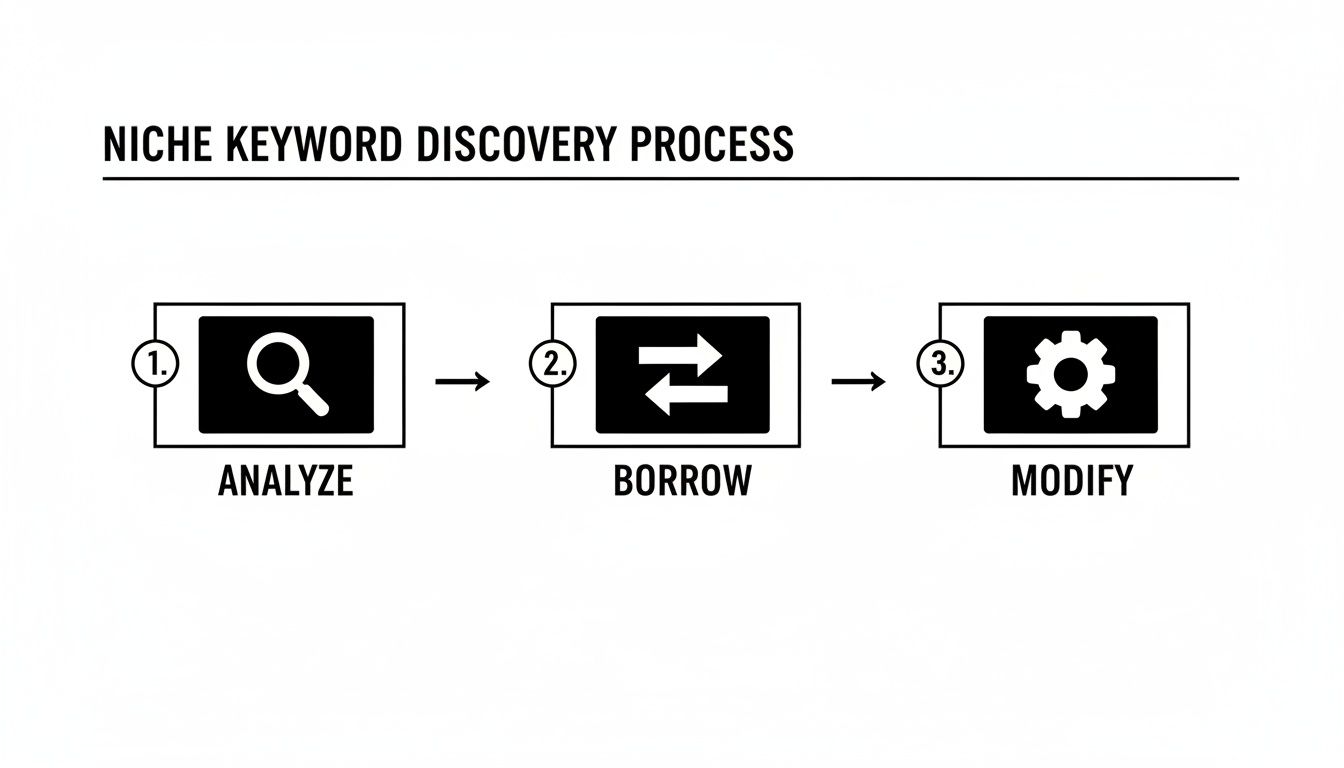
This workflow is a continuous loop: you analyze your own data, borrow what works from your competitors, and modify everything to build an unbeatable keyword list.
Get Control with Match Types
To really squeeze every drop of value from your niche keywords, you have to get a handle on match types. They give you the power to tell Google exactly which searches should trigger your ads.
- Exact Match
[keyword]: This is your sniper rifle. For a niche keyword like[men's size 11 waterproof hiking boots], exact match ensures your ad only shows for that search or something incredibly close to it. It’s all about maximum control and relevance. - Phrase Match
"keyword": This gives you a little more room to breathe but is still highly targeted. An ad for"waterproof hiking boots"could show up for searches like best waterproof hiking boots for men or buy waterproof hiking boots online. It helps you catch relevant variations without straying too far. - Broad Match
keyword: Be very, very careful with this one, especially with niche terms. It can be useful for discovering new keyword ideas, but it's notorious for matching to totally irrelevant searches and burning through your budget.
Pairing your niche keywords with Exact and Phrase match is the secret to turning your ad account from a money pit into a lean, mean, conversion-generating machine. You can find more tips on targeting in our guide on how to find low-competitive keywords.
Don't Forget Your Negative Keywords
Telling Google what you want to show up for is only half the battle. You also have to tell it what you don't want. That's where your negative keyword list comes in. As you comb through your Search Term Report, you’ll find searches that are close, but no cigar.
Adding terms like "free," "jobs," "reviews," or even competitor brand names to your negative list stops your ads from showing up for those searches. This simple move immediately stops wasting your budget and improves your campaign's Click-Through Rate (CTR) and overall health.
A rock-solid negative keyword list is the unsung hero of a great Google Ads account. It’s the gatekeeper that makes sure your ad spend is only used on searchers who are actually likely to buy.
Automate Your Niche Keyword Workflow with Keywordme

Let’s be real. Manually managing hundreds, or even thousands, of niche keywords is a soul-crushing time sink. We've all been there—staring at a Search Term Report, copying promising terms, pasting them into the right ad groups, and then setting the match types one by one. It's tedious, and it’s the exact point where great PPC managers burn out and miss out on some serious ROI.
That entire headache is why we built Keywordme. Think of it as a smart assistant that plugs directly into your Google Ads account, turning hours of mind-numbing work into a few satisfying clicks. You can forget about juggling spreadsheets and having a dozen browser tabs open. Our Chrome plugin works right inside the Google Ads interface you already know.
This means you can analyze your Search Term Report and act on it instantly. Spot a golden long-tail keyword that's converting? With a single click, you can pop it into the perfect ad group with the right match type, all without ever leaving the report.
Clean Up Traffic and Expand Campaigns in a Flash
Just as crucial as finding winners is cutting the losers. Keywordme makes it incredibly easy to stop wasting money on junk queries. When you see those budget-draining search terms, you can instantly add them in bulk to your negative keyword lists. It’s an immediate cleanup that tightens your targeting and boosts campaign performance on the fly.
Keywordme flips your keyword management from a reactive chore into a proactive strategy. You're no longer just cleaning up yesterday's mistakes; you're building a smarter, more profitable campaign structure for tomorrow.
This whole process lets you expand your campaigns up to 10 times faster than doing it all by hand. You can dig deeper into this in our guide on how to automate keyword research. It’s all about making quick, data-driven decisions that immediately impact your bottom line.
More Than Just a Tool
Honestly, think of Keywordme as the most efficient team member you've ever had. It takes care of all the repetitive, grunt work, which frees you up to focus on what really matters—high-level strategy, killer ad copy, and landing page optimization. It automates the "what" so you can finally have time for the "why."
Here’s how it actually works inside your account:
- 1. Analyze Your Search Terms: Just open your Search Term Report in Google Ads like you normally would.
- 2. Select Your Keywords: Tick the boxes next to the valuable niche keywords you want to add and the irrelevant terms you want to block for good.
- 3. Click to Add: The Keywordme interface will pop up, letting you add the good terms to specific ad groups (as Exact, Phrase, or Broad match) and shuttle the bad ones to your negative lists.
That's it. A workflow that used to take an hour is now done in seconds. While Keywordme is built for PPC automation, other great tools like lunabloomai's AI app can also help streamline different parts of your digital marketing.
Ultimately, this is all about making niche keywords scalable and profitable. By getting rid of the manual friction, you empower yourself to build bigger, more granular campaigns that capture high-intent traffic—all without the administrative burnout. You're not just saving time; you're building a better, more effective advertising machine.
Why Niche Keywords Thrive in the Age of AI Search
With all the noise about AI Overviews and generative search, you might be wondering if niche keywords are about to go extinct. Are we all just headed for a world of zero-click searches where an AI just spits out the answer? It’s a fair question, but here’s the twist: this whole shift is actually making niche keywords more valuable than ever.
Think about it from a practical standpoint. AI is a fantastic summarizer for broad, top-of-funnel questions. Ask it "what is a laptop," and you'll get a perfectly fine answer. But the entire game changes the moment a searcher knows exactly what they want.
Your Secret Weapon Against Zero-Click Searches
At their core, AI models are synthesizers. They scrape information that's already out there and mash it into a consolidated answer. That works fine for big, general terms, but it completely falls apart when faced with the specific, nuanced intent behind a real niche keyword.
Someone looking for a "lightweight laptop for travel writers under $800" isn’t just browsing. They have a problem to solve and are probably getting ready to pull out their credit card. An AI summary just can’t compete with that. It can’t offer the detailed product comparisons, build the trust, or convey the unique value that a dedicated landing page can.
Think of AI summaries as a new kind of filter. When the AI’s generic response misses the mark on a super-specific need, the user is primed to click on a link that actually can help them. Your niche-focused page becomes the perfect destination.
Where AI Search Actually Creates Opportunity
The data backs this up. It turns out that AI Overviews are popping up most often for lower-volume searches. A recent Semrush study on AI SEO stats found that over 68% of the search terms that trigger Google's AI Overviews get 100 or fewer monthly searches. The main battleground is right in the heart of niche keyword territory.
This isn’t a threat—it’s a massive opportunity. Your niche content has a distinct advantage:
- You're the Expert: Your page can deliver the depth, user reviews, and specific details that an AI struggles to piece together convincingly.
- You Drive Action: A user with a mission—to buy, book a demo, or sign up—needs to click somewhere. The AI can’t close the deal for them.
- You Build Real Trust: Genuine, hands-on content creates a connection that a bland, machine-generated summary simply can't match.
By doubling down on these hyper-specific phrases, you position your content as the "best answer" that the AI can't easily replace. You become the solution for users who have moved past the basic questions, ensuring you keep driving that high-quality, ready-to-convert traffic straight to your site.
Your Niche Keyword Questions, Answered
Alright, we've gone deep into the world of niche keywords. But I know there are probably still a few questions bouncing around in your head. Let's clear up some of the most common ones I hear so you can feel 100% ready to put this strategy into action.
How Many Searches Is a Good Number for a Niche Keyword?
I get this question all the time, and the honest answer is: there's no magic number. A "good" search volume is completely relative to your industry and what a single sale is actually worth to you.
For a B2B company selling high-end software, a keyword with just 10-20 searches a month could be a goldmine if it brings in one client. But if you're an e-commerce store selling t-shirts, you might be looking for terms in the 50 to 200 monthly search range to make the effort worthwhile.
It’s all about intent, not just volume. I'd rather have five people who know exactly what they want and are ready to buy than a thousand people who are just browsing.
Won't Targeting Only Niche Keywords Kill My Reach?
It’s easy to think that, but it's actually the opposite. You're not limiting your reach; you're focusing it. Think of it as trading a giant, empty stadium for a smaller, packed-out theater where every single person is a true fan. You might get fewer total impressions than you would with broad terms, but you're showing up for the right people.
The goal isn't to depend on a handful of these keywords. The real power comes from building out a huge portfolio of hundreds, or even thousands, of them.
- When you bundle them all together, they add up to a significant slice of the search market.
- You're fishing in a much less crowded pond.
- Most importantly, this part of the market is full of users who are way further down the buying funnel.
This is where automation becomes your best friend. A tool like Keywordme is built to help you manage this massive list of terms without getting lost in spreadsheets for days on end.
Can I Use Niche Keywords for SEO, Too?
Absolutely! This isn't just a PPC trick. The same logic of targeting specific user intent works wonders for your organic search efforts.
When you create content—blog posts, landing pages, or product guides—around these super-specific phrases, you have a much better shot at ranking on page one of Google because the competition is so low. This lets you create a powerful one-two punch with your paid and organic strategies.
You could run a PPC ad for a term to get traffic right now, while your SEO-focused article climbs the ranks over time. Before you know it, you're dominating the entire search results page for a high-value term, pulling in clicks from both your ad and your organic listing.
How Often Should I Hunt for New Niche Keywords?
Keyword research isn't a "set it and forget it" task. It’s more like tuning a guitar—you have to do it regularly to keep everything sounding right.
I recommend diving into your Google Ads Search Term Report at least weekly or bi-weekly. Making this a habit helps you constantly:
- Find new niche phrases real people are using.
- Weed out all the junk searches that are wasting your money and add them to your negative keyword list.
- Stay ahead of new trends and shifts in how your customers search.
This might sound like another chore to add to your list, but with Keywordme, you can turn this hour-long task into a quick 15-minute check-in. It makes staying on top of your keyword game not just possible, but easy.
Ready to stop guessing and start scaling with niche keywords that actually convert? Keywordme plugs right into your Google Ads account, transforming hours of manual work into a few clicks. Try it free for 7 days and see the difference for yourself.
.svg)