
Google Search Ads Optimization: Your 2026 Playbook
Google Search Ads Optimization: Your 2026 Playbook


SEO Title: Google Search Ads Optimization Playbook
Meta Description: Google search ads optimization playbook for faster cleanup, tighter targeting, smarter bidding, and better ROI without drowning in search term work.
Somewhere in your account right now, there’s a campaign spending money on searches you would never have approved if you had seen them sooner.
That’s the part of google search ads optimization that frustrates many teams. The strategy is usually clear enough. Review search terms. tighten match types. add negatives. promote winners. fix bidding. repeat. The problem is execution. You export a report, sort it, tag it, copy useful terms into one sheet, junk terms into another, then spend the rest of the afternoon doing bulk edits that feel like data entry, not marketing.
Most guides stop there. They hand you a checklist and assume you have hours to burn every week.
In practice, strong search performance comes from doing the basics consistently and doing them fast enough that the account stays clean. The teams that win are rarely the ones with the fanciest theory. They’re the ones who catch waste early, turn good queries into keywords quickly, and keep feeding Google cleaner signals.
Stop Drowning in Search Term Reports
The familiar pattern looks like this. You open the search terms report planning to spend twenty minutes. Two hours later, you’re still filtering obvious junk, debating match types, and trying to remember whether a term belongs as a keyword in one campaign or a negative in three others.

That grind matters because Search is still where the intent lives. Google Search ads have an average click-through rate of 3.17% and conversion rates averaging 4.40% globally, while advertisers often achieve an 8:1 ROI through targeted strategies according to these Google Ads statistics. When the channel can perform at that level, sloppy optimization gets expensive fast.
Manual work is the primary bottleneck
Most accounts do not fail because the manager doesn’t know what a negative keyword is. They fail because the workflow is too slow.
A manual process creates three problems:
- Waste stays live too long because bad queries keep spending until someone catches them.
- Winning terms sit buried in the report instead of being promoted into tighter ad groups.
- Match type decisions get delayed because bulk edits are tedious and easy to postpone.
That’s why I don’t treat search term review as a reporting task. I treat it as a control system. If you’re not acting on the data quickly, the report is just a history lesson.
What the faster playbook looks like
The practical version is simple:
- Audit the account first so you know where the leaks are.
- Tighten match types where relevance is drifting.
- Build negatives aggressively to block repeat waste.
- Promote converting queries into focused targeting.
- Adjust bidding only after the inputs are clean.
Tip: If your process still depends on exporting CSVs just to make routine keyword decisions, the workflow is broken before the optimization even starts.
If your team needs a cleaner way to work from live search term data, this guide on the Google Ads search terms report is worth reviewing before you touch bids or budgets.
Your First Move An Account Audit That Works
A useful audit is not a giant spreadsheet with fifty tabs. It’s a fast diagnosis that tells you where money is leaking and where signal quality is weak.
The mistake I see most often is starting with ads or bids before checking account structure. If campaigns are overlapping, match types are loose, and conversions are being credited to messy search traffic, every later decision gets worse.
Start with structure before performance
Open the account and look for friction first.
Check these areas in order:
- Campaign overlap: If multiple campaigns can trigger on similar terms, you’ll muddy reporting and make optimization slower.
- Ad group logic: A tight ad group still matters. When themes are mixed, ad relevance usually slips.
- Location and device settings: Basic settings drift more often than people admit.
- Conversion actions: If the account is optimizing toward the wrong action, every recommendation downstream is suspect.
A quick audit should answer one question: does this account give Google clean signals, or noisy ones?
Use Optimization Score correctly
Google’s Optimization Score is helpful if you treat it as a diagnostic layer, not a scoreboard. Advertisers who increased their account-level optimization score by 10 points achieved a median 14% increase in conversions, according to Google’s campaign recommendations documentation.
That does not mean every recommendation deserves blind approval.
Some recommendations improve coverage. Some improve measurement. Others push automation faster than the account is ready for. I usually sort them into three buckets:
| Recommendation type | What to do with it | Common mistake |
|---|---|---|
| Bidding recommendations | Review after confirming conversion tracking quality | Applying automated bidding to dirty traffic |
| Keyword and targeting recommendations | Check against actual search term relevance | Expanding reach before exclusions are in place |
| Ad asset recommendations | Use when structure and targeting already make sense | Treating assets as a fix for weak intent targeting |
Red flags worth catching early
A strong audit usually uncovers the same patterns.
One campaign may be carrying too many keyword themes. Another may be using broad match in a way that invites irrelevant traffic. Sometimes the account is not broken at all. It’s just bloated, with duplicate logic spread across too many campaigns.
That’s also why agencies often benefit from reviewing how another experienced paid search marketing agency structures account management processes. Not to copy a template, but to compare your current habits against a cleaner operating model.
Key takeaway: An audit should reduce confusion. If your review produces a longer to-do list but no priorities, you have not audited the account. You have only described it.
Keep the audit tight
I like a simple pass/fail filter for the first review:
- Can I tell which campaign owns which intent?
- Can I spot obvious overlap without digging for an hour?
- Do the recommendations align with the primary business goal?
- Would I trust this account to feed a Smart Bidding strategy clean data?
If the answer is no on even one of those, fix the account architecture before making aggressive optimization changes.
Clean Up Keywords and Match Types with Precision
Keyword cleanup is where most accounts either get disciplined or stay messy.
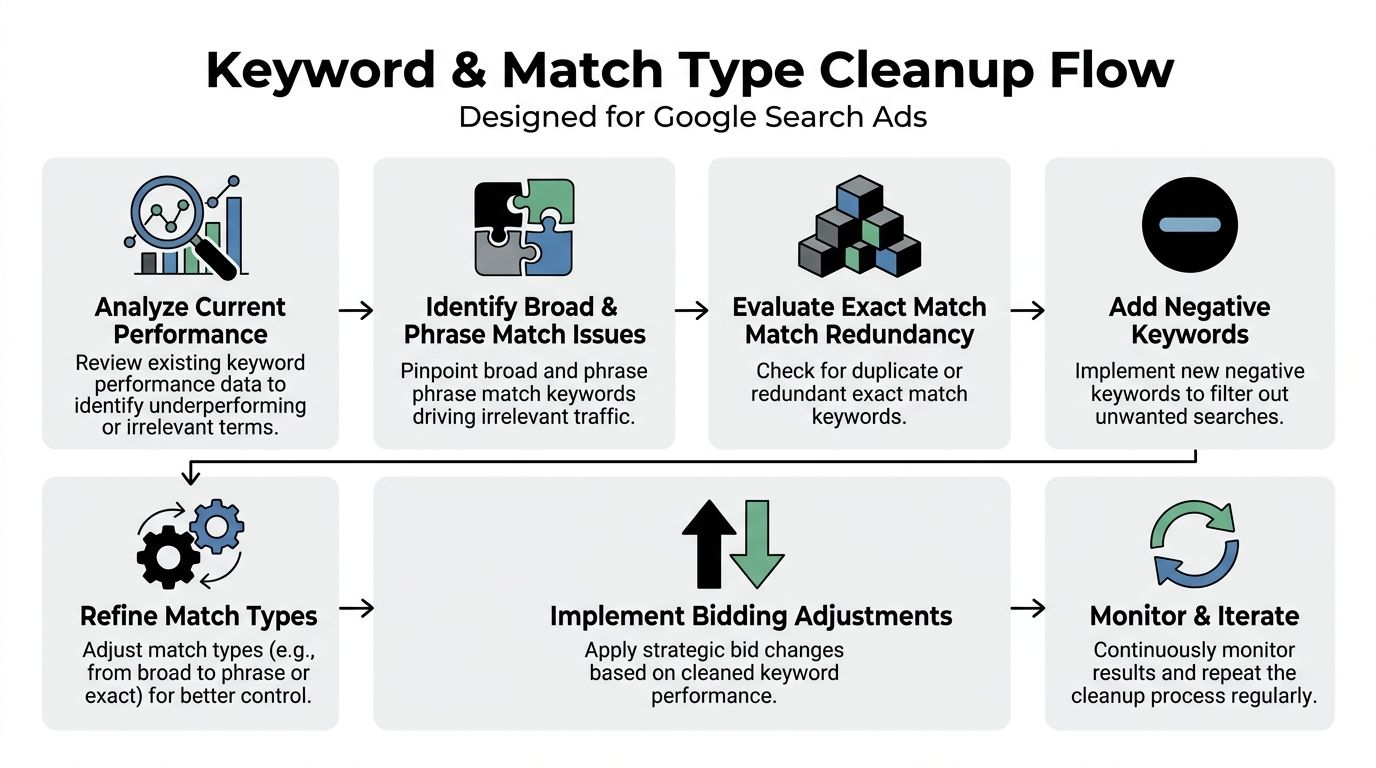
Broad match is not the villain. Phrase match is not a magic middle ground. Exact match is not a guarantee of perfect control. The problem is usually a bad combination of loose targeting, weak exclusions, and no regular review of what people searched.
Aim for relevance, not volume
A useful benchmark exists here. Successful campaigns maintain a search term relevance score above 80%, and when relevance falls below that threshold, keyword controls should be tightened through increased exact match keywords, phrase match restrictions, or expanded negative keyword lists based on this Google Ads optimization methodology.
That threshold is practical because it forces honesty. If too many search terms are only loosely related to what you sell, your account is not “testing new demand.” It’s drifting.
How I clean up match types in real accounts
I do not start by asking which match type is best. I ask what role each keyword needs to play.
Use this framework:
- Broad match for discovery: Keep it where you want to surface new queries, but monitor it closely.
- Phrase match for controlled expansion: Useful when the core meaning matters and you still want some reach.
- Exact match for ownership: Put your clearest commercial intent terms here when you want tighter control over message and spend.
That sounds basic, but the power comes from assigning each keyword a job.
A common mess looks like this:
| Situation | Better move |
|---|---|
| Broad match drives mixed intent | Keep discovery terms, exclude junk, then split winners into tighter match types |
| Phrase match starts pulling tangential queries | Restrict the theme and add negatives around adjacent meanings |
| Exact match duplicates appear across campaigns | Consolidate ownership so one campaign handles that intent cleanly |
Review queries like an editor, not a machine
A search term report is not just a list of words. It’s a list of motives.
When reviewing terms, ask:
- Is this query clearly relevant to the offer?
- Does it belong in its own ad group or remain under discovery coverage?
- Would a tighter match type improve control without killing useful reach?
- Is another campaign already trying to own this same intent?
That last point matters more than generally assumed. Duplicate intent across campaigns muddies data and creates internal competition.
Tip: If a search term is good enough to celebrate, it is usually good enough to isolate.
Bulk edits are where teams lose time
This is the point where strong strategy often turns into busywork. You know what should happen, but changing match types in bulk and sorting terms into the right buckets takes too long inside a manual workflow.
One practical option is Keywordme’s guide to Google Ads keyword match types, especially if you want a faster way to apply exact, phrase, or broad decisions from live search data without the usual copy-paste mess. That kind of setup is useful when the issue is not knowing what to do. It’s doing it quickly enough to matter.
What works and what usually fails
What works:
- Promoting proven queries into tighter control.
- Keeping broad match on a short leash instead of shutting it off entirely.
- Removing keyword duplication that muddies ownership.
- Using the report every cycle instead of doing a giant cleanup once a quarter.
What fails:
- Blanket pausing all broad match because the account had one bad week.
- Adding exact match keywords without exclusions so waste still slips in.
- Leaving old phrase match terms untouched after the market shifts.
- Trying to solve relevance with ad copy alone while keyword targeting stays loose.
Good keyword management is less about choosing the “right” match type and more about tightening the relationship between query, ad, landing page, and business intent.
Automate Negative Keywords to Stop Wasting Budget
Every Google Ads account leaks.
Some leaks are obvious. Job seekers click a lead gen ad. Support queries hit a sales campaign. Research-heavy searches trigger a product ad that was never meant for early-stage traffic. Other leaks are quieter. They come from close-but-wrong searches that look relevant enough to slip past a lazy review.

Negative keywords are how you plug those leaks.
Why this matters more than often acknowledged
Bidding strategy gets the attention. Creative testing gets the attention. Negative keyword work gets postponed because it feels repetitive.
That’s backward.
A bad click does more than waste spend. It pollutes the data you feed into bidding, weakens your sense of search intent, and makes campaign decisions look less certain than they really are. If enough junk slips through, the account starts optimizing around noise.
The practical negative keyword routine
You do not need a heroic process. You need a repeatable one.
A solid review cycle usually includes:
- Spotting intent mismatches: Searches for jobs, support, definitions, free options, or unrelated use cases often belong on a negative list.
- Looking for recurring modifiers: If the same bad pattern keeps appearing, block the pattern instead of chasing individual queries.
- Applying negatives at the right level: Some terms belong at ad group level, some at campaign level, and some should become shared exclusions across large sections of the account.
- Checking collateral damage: Do not block terms so broadly that you cut off good traffic with them.
That last part is where manual work gets tricky. People rush, add a broad negative, and accidentally block a useful cluster.
Manual negative building does not scale well
The old workflow is ugly. Export report. flag junk. normalize spelling. dedupe terms. format match types. upload lists. repeat for every campaign variant.
It works. It also burns time and increases the odds of inconsistency across accounts.
Key takeaway: Negative keyword management is not cleanup after the fact. It is active budget protection.
A more efficient process uses live search term analysis and list building directly in the workflow. If you want that model, this walkthrough on how to build an AI workflow to find negative keywords shows the logic behind turning junk query detection into a repeatable system instead of a spreadsheet project.
A quick visual can help if you train teams on this process:
What to exclude and what to keep testing
The hard part is judgment, not mechanics.
Here’s a simple filter:
| Search term pattern | Usual decision |
|---|---|
| Clearly unrelated intent | Add as a negative quickly |
| Low-intent research language | Often exclude from direct response campaigns |
| Adjacent but plausible use case | Review landing page fit before blocking |
| High-intent query with poor early results | Test more before excluding |
Weaker operators often make the wrong cut here. They see no conversion yet and block a term that belongs higher in the funnel or in a different campaign structure.
The hidden benefit of better exclusions
Negative keyword discipline improves more than spend efficiency.
It also gives your account cleaner learnings. When low-quality traffic drops, it becomes easier to see which search themes are worth promoting. Your ad tests get clearer. Your bidding signals get sharper. Your account becomes easier to manage because there is less garbage in every report you open.
That’s why I treat negatives as one of the most effective parts of google search ads optimization. It is not glamorous work. It is profitable work.
Expand Your Reach with High-Converting Keywords
Once the account is cleaner, search terms stop looking like clutter and start looking like inventory.
Growth usually comes from this approach. Not from brainstorming giant keyword lists in a vacuum, but from taking real queries that already proved they belong and giving them dedicated treatment.

Find the terms that deserve promotion
A good search term report contains three categories:
- obvious junk you exclude
- mixed or uncertain queries you keep watching
- strong intent terms that deserve promotion into targeted keywords
The third group is the one many accounts underuse.
Look for search terms that show clear alignment with the offer, match the buying stage you want, and justify customized ad copy or a more specific landing page. Those terms should not stay hidden inside a broad discovery bucket forever.
Graduate winners into tighter structures
When a term proves itself, give it more control.
That can mean:
- Adding it as an exact match keyword when you want tighter ownership.
- Creating a dedicated ad group so the ad message mirrors the query more closely.
- Sending traffic to a more specific landing page if one exists.
- Adding cross-negatives where needed so campaigns do not compete for the same intent.
Campaign expansion becomes disciplined, not chaotic, through this process. You are not adding more keywords just to look busy. You are promoting validated demand.
Tip: Do not wait too long to graduate a winner. The longer it stays buried in a broad bucket, the longer you delay cleaner data and tighter message control.
Expansion works best after cleanup
Many teams try to scale before they have clear exclusions and match type logic. That creates a bigger mess, not a bigger win.
A cleaner pattern looks like this:
| Query type | Better growth move |
|---|---|
| Clear buyer intent | Isolate and write more specific ads |
| Useful but broader intent | Keep in discovery while watching for enough evidence to split |
| Informational but relevant | Consider a separate funnel or different landing page strategy |
| Brand-adjacent mixed intent | Separate carefully to avoid muddied reporting |
The biggest payoff comes when your expansion structure mirrors how people search, not how your internal product catalog is organized.
Keep expansion connected to reality
The strongest growth terms often look obvious in hindsight. They are phrases your customers naturally use, but your original keyword plan missed.
That’s why I like expansion driven by observed search behavior. It reflects demand already present in the account. It also reduces the chance of bloating campaigns with speculative keywords that sound good in a brainstorm but do not map to live intent.
This is the offensive side of google search ads optimization. You cleaned the account. You stopped the waste. Now you build around what the market is already telling you.
Smarter Bidding and Measurement for True ROI
Bidding gets easier when the account is clean.
That’s a key connection many advertisers miss. Smart Bidding can do useful work, but only if the account gives it signals worth trusting. If search traffic is messy, keyword themes are overlapping, and irrelevant queries are still slipping through, automated bidding has to learn from bad inputs.
Use automation after fixing intent quality
Google’s AI features continue to push search optimization toward broader coverage and stronger automation. In 2025, Google Ads AI updates such as Smart Bidding Exploration drove an average 18% increase in unique search query categories generating conversions and a 19% overall conversion lift according to Google’s internal data, while Demand Gen campaigns reported a 26% increase in conversions per dollar as summarized in this 2025 Google Ads review and outlook.
The takeaway is not “turn on every automated feature immediately.”
The takeaway is this: automation gets more useful when your campaign structure, exclusions, and query quality are already under control. Then broader matching and flexible bidding can extend reach without dragging junk traffic in behind them.
Pick bidding logic that matches the business
I’ve seen plenty of accounts using target ROAS because it sounds advanced, even when the business should be prioritizing lead quality, new customer acquisition, or contribution margin.
That’s why bidding strategy should follow business context, not platform defaults.
A simple approach is to:
- Use conversion-focused bidding when the account has reliable conversion tracking and enough signal quality.
- Use value-focused bidding when different conversions carry meaningfully different revenue or margin.
- Stay cautious with aggressive targets if the account is still cleaning up relevance problems.
What works in one account can wreck another if the economics differ.
In-platform ROAS is not the whole story
This is the blind spot I wish more optimization guides talked about. The disconnect between in-platform Google Ads ROAS and actual business profitability is a major blind spot. Most guides focus on hitting a platform ROAS target without accounting for blended ROAS or contribution margin, which are critical for sustainable bidding strategies and informing true business growth, as explained in this piece on Google Ads profitability mistakes.
That distinction matters.
A campaign can look healthy in Google Ads and still disappoint the business. Maybe it over-indexes on existing customers. Maybe the products sold carry weak margin. Maybe lead quality looks fine in-platform but sales closes tell a different story.
A better measurement habit
When evaluating search performance, I like to compare platform success against business reality.
Ask these questions regularly:
| Measurement question | Why it matters |
|---|---|
| Are conversions coming from the right search intent? | Not all conversions are equally valuable |
| Does reported ROAS align with actual profit? | Revenue is not margin |
| Are we acquiring new customers or recycling demand? | Growth quality matters |
| Did automation improve efficiency or just expand spend? | Scale without discipline can hide inefficiency |
Key takeaway: Better bidding starts with cleaner search data, but true optimization ends outside the Google Ads interface.
The practical operating model
A mature account usually runs on this sequence:
- tighten query relevance
- remove waste
- promote proven demand
- let bidding automation work on cleaner inputs
- judge success by business outcomes, not dashboard comfort
That’s the version of google search ads optimization that holds up under pressure. Not a collection of random tweaks. A system where targeting, exclusions, expansion, bidding, and measurement all support each other.
Frequently Asked Questions about Google Ads Optimization
How often should I optimize a Google Search Ads account
Do the review cadence your spend and search volume justify. High-volume accounts need more frequent search term review because waste compounds faster. Smaller accounts can run on a steadier rhythm, but they still need consistent checks for query relevance, negatives, and newly discovered winners.
A common mistake is batching too much work into occasional giant cleanups.
Will tighter match types reduce reach too much
Sometimes, yes. That is the trade-off.
But reach is not the goal by itself. Relevant reach is. If tightening match types cuts off junk traffic and improves control, that is usually a good exchange. A healthier setup often uses broader matching for discovery and tighter matching for ownership once a term proves itself.
Can this process work for big agency or enterprise accounts
Yes, but only if the workflow scales. Large accounts break when teams rely on manual copy-paste habits across too many campaigns. The underlying principles stay the same. Clear ownership, disciplined exclusions, promotion of strong search terms, and cautious bidding logic all matter more as account complexity grows.
What should I fix first if performance drops suddenly
Start with search terms, conversion tracking, settings changes, and overlap. Those checks usually reveal whether the issue is bad traffic, broken measurement, or structural conflict inside the account. Jumping straight to bid changes can hide the problem.
Should I trust Google’s recommendations automatically
No. Use them as prompts, not commands.
Some recommendations are useful. Others are premature for the account’s current state. If query relevance is weak, adding more automation can magnify the mess instead of fixing it.
What’s the biggest mistake in google search ads optimization
Treating it like a one-time cleanup.
Search accounts drift. New queries appear, intent shifts, and campaigns gradually collect inefficiencies. The accounts that hold performance are the ones with a repeatable operating rhythm, not a heroic one-off optimization sprint.
If your team is tired of doing keyword cleanup, match type changes, and negative list building by hand, Keywordme gives you a faster way to execute the work that keeps Google Ads accounts healthy.
.svg)