
Google PPC Tips: Reduce Waste & Boost ROI in 2026
Google PPC Tips: Reduce Waste & Boost ROI in 2026


Stop Paying for Clicks That Cannot Convert
More traffic doesn't automatically mean better PPC performance. It can just mean you're paying to attract people who wanted a free alternative, a job listing, a tutorial, or a product you don't sell. Before increasing bids or budgets, remove irrelevant demand, align keywords with ads and landing pages, make bidding decisions from reliable conversion data, then use search-term evidence to decide what deserves more investment.
That sequence matters because the economics vary sharply by market. The 2026 Google Ads benchmarks report an average Search Network CPC of $5.42, a 6.64% CTR, an 8.18% conversion rate, and a $66.69 CPL, based on more than 13,000 U.S. search campaigns analyzed from April 2025 through March 2026, according to the 2026 Google Ads benchmark analysis. Those figures aren't targets for every account. They're reminders that click cost, conversion quality, and lead economics must be evaluated together.
The practical Google PPC tips below follow a prioritized optimization loop. Keywordme can speed up the repetitive parts, including bulk match-type changes, negative keyword handling, and campaign expansion, but the strategy still depends on judgment. For more context on preventing inefficient acquisition, see Cometly's guide to wasted ad spend.
1. Google PPC Tips Master Negative Keywords
Negative keywords are the fastest way to stop paying for searches that can't become customers. A premium leather-jacket retailer might exclude “cheap,” “discount,” and “knockoff.” A paid SaaS product may block “free” and “open source,” while a professional local service can filter “DIY” and “how to.” The right exclusions depend on your offer, not on a universal list.
Google Ads supports broad, phrase, and exact negative match types. Broad negative match blocks a search when it contains all negative terms in any order. Phrase negative match requires the terms to appear in the same order, even if other words surround them. Exact negative match blocks only that exact sequence without additional words, as explained in Google's negative keyword documentation.
Review the Search terms report regularly. Google's workflow lets you inspect terms for all keywords or selected keywords, select irrelevant queries, and add them directly as negatives, according to Google's Search terms report instructions.
Practical rule: Block clear irrelevance quickly, but check the full query before adding a broad exclusion. A word that looks wrong in isolation may still appear in a valuable commercial search.
Use shared negative lists for recurring brand or hiring-related exclusions, and campaign-level lists when one campaign should avoid competing with another. Keywordme's negative keyword workflow can reduce spreadsheet work when you're processing many search terms.

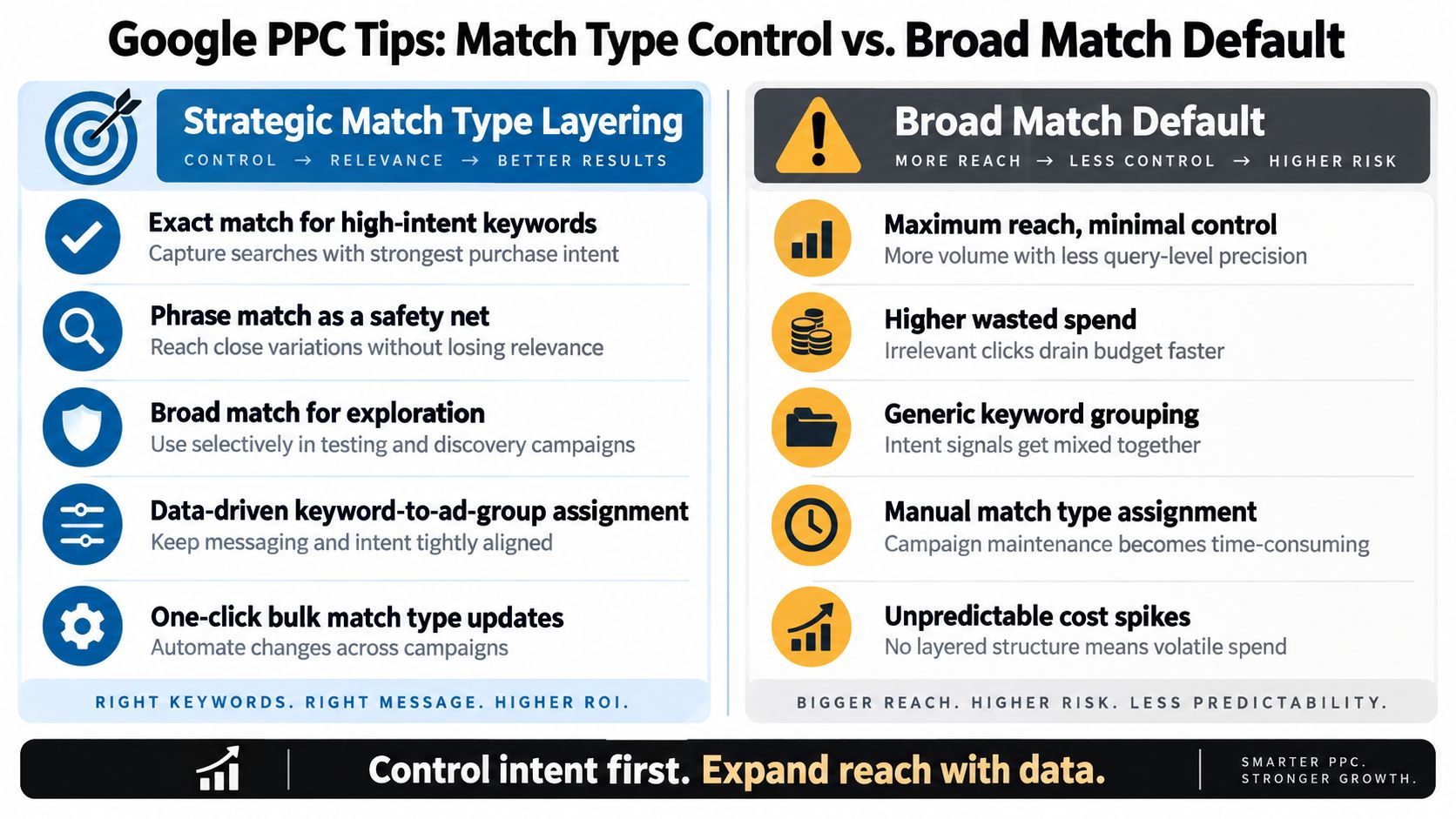
2. Google PPC Tips Optimize Match Types for Control
Match types are no longer a simple ladder from exact control to broad reach. Google introduced close variants for exact and phrase match in 2014, expanded exact match to same-intent queries in 2019, expanded phrase match in 2019, and deprecated broad match modified in 2021. Google's current behavior makes intent control, query review, and negative keywords more important than relying on the label alone, as documented in Google Ads match-type guidance.
Use exact match for tightly defined commercial intent, phrase match to capture legitimate variations, and broad match when you're deliberately exploring related demand. Don't treat broad as an automatic default. Its value depends on conversion tracking, first-party data quality, Smart Bidding signals, and a clean negative-keyword process.
A useful structure separates discovery from control. Put exploratory terms in campaigns where you can monitor search-term drift, then promote proven queries into focused ad groups. Keep brand terms separate so brand performance doesn't hide weak non-brand acquisition.
Keywordme is useful when a campaign contains a large working set. Its bulk match-type assignment helps you apply exact, phrase, or broad formatting consistently instead of editing keywords one by one. For the mechanics and current distinctions, see this Google Ads match-types guide.
The better question isn't “Which match type is safest?” It's “Which match type gives this campaign enough useful reach while keeping query quality reviewable?”
3. Google PPC Tips Build High-Converting Ad Groups
A high-converting ad group gives the writer one clear promise to make. Mixing “commercial treadmills,” “budget treadmills,” and “home gym treadmills” under one generic ad forces the message to become vague. Separate those themes when the searcher's motivation, product, or landing page differs.
Organize by intent, product category, customer stage, or business segment. Branded and non-branded terms deserve separate control because they usually carry different expectations and bidding priorities. A B2B software account might also separate searches aimed at finance leaders from those aimed at marketing teams if the sales message and landing page differ.
Keep each group compact enough that the ad can directly reflect the keywords. Google's auction evaluates bid, Quality Score, and ad or asset context, rather than bid alone. Actual CPC is based on the next competitor's Ad Rank divided by your Quality Score, plus $0.01, according to this breakdown of the Google Ads auction. Tight relevance therefore affects both message quality and the price you may pay.
A practical grouping test
Ask whether one headline and one landing page would make sense for every keyword in the group. If the answer is no, split the group. If two groups consistently attract the same queries and need the same ad, consider consolidating them.
Keywordme can help identify useful keyword expansions from actual search behavior, then reduce the manual formatting involved in building new groups.
4. Google PPC Tips: Use Search Term Data for Expansion
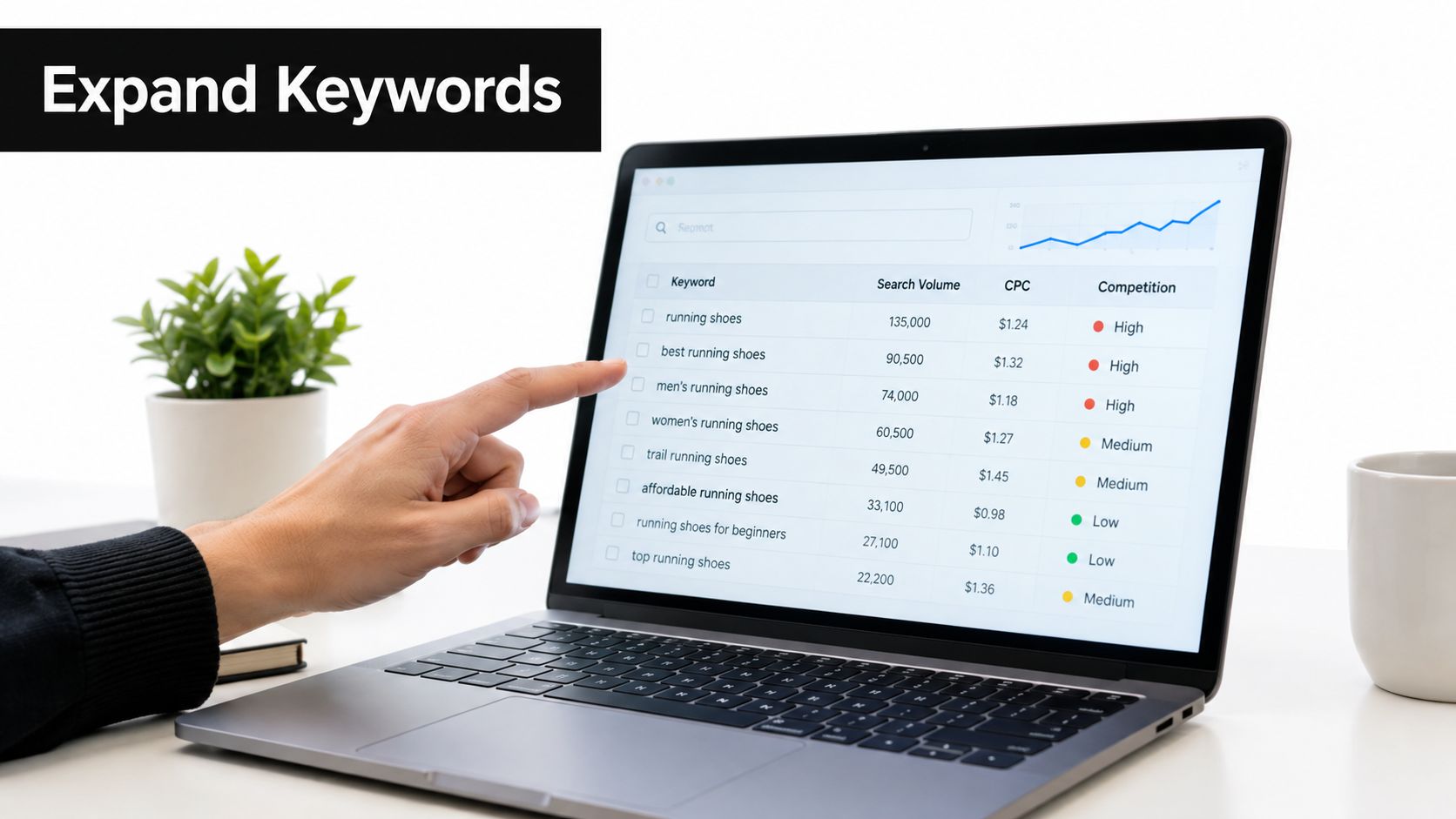
Your keyword list captures what you expect customers to search. The Search terms report captures what they type. Compare the two before expanding the account.
Start by removing irrelevant queries. Then promote repeated commercial phrases and group recurring themes that need different ad copy or landing pages. A running-shoe retailer may find shoppers searching for a specific product feature instead of the broader category. A dentist may see repeated searches about treatment price. A B2B software company may uncover competitor-alternative intent that merits separate messaging and a dedicated landing page.
A conversion alone does not justify promotion. Check the query's context, lead quality, sales acceptance, and cost against your business model. A form submission that never becomes an opportunity should not automatically receive more budget.
Review high-spend campaigns often enough to catch waste early. Smaller accounts need a consistent cadence that provides enough data to separate a recurring pattern from a one-off query. Keywordme can move promising terms into ad groups and help assemble negative lists without repeated copy-and-paste work.
WordStream's benchmark reporting shows why relevance and structure deserve attention. Average search CTR rose from 1.35% in 2015 to 6.64% in 2026, with reported benchmarks of 6.11% in 2023, 6.42% in 2024, and 6.66% in 2025. The WordStream benchmark reference supports prioritizing better query control and ad relevance over buying more clicks.
Use a visual walkthrough to standardize the review process:
5. Google PPC Tips Master Bid Strategy and Automated Bidding
Bid automation should match the reliability of your conversion data. If purchases, qualified leads, or calls are recorded consistently, automated bidding can react to auction conditions faster than manual keyword changes. Incomplete tracking or rare conversions gives the system weak signals and can send spend toward low-value actions.
Set the strategy from the business goal. Maximize Clicks suits early exploration or traffic acquisition, but it optimizes for visits rather than profit. Maximize Conversions uses recorded conversion actions. Target CPA fits accounts with enough lead volume and dependable quality signals. Target ROAS requires trustworthy conversion values, so it generally fits e-commerce better than businesses that cannot assign useful values to leads.
Broad match with Smart Bidding can outperform narrower matching in some mature accounts. The trade-off is tighter input control. Clean first-party data and disciplined negative management determine whether expansion improves results, as explained in this analysis of Google Ads strategies for 2026. One practitioner discussion cites 15 conversions per month as a possible Smart Bidding testing threshold. Treat that figure as a reference, not a rule. For the mechanics behind training automated systems, see this ad algorithm training guide.
Automation doesn't fix bad inputs. It scales the signals you give it.
CPC alone cannot judge a bidding strategy. Compare conversion rate, qualified outcomes, CPL, and profit before changing targets. Costs vary widely by vertical, so a higher CPC may still be acceptable when it produces better-margin customers. The benchmark figures cited earlier provide context, but your own profit data should set the decision rule.
Change targets gradually, record the date and conversion definition, and allow enough time to distinguish a pattern from auction noise. Keywordme can surface terms and query themes that merit bid review, while accurate conversion actions and sensible targets keep the bidding system grounded. Start by removing waste, then automate what the data can support, measure profitable outcomes, and scale only after the account proves its economics.
6. Google PPC Tips Create Winning Ad Copy and Landing Pages
A searcher should recognize the connection between query, ad, and landing page immediately. Someone searching for affordable dog training shouldn't arrive on a generic homepage with no mention of price or the relevant service. That mismatch creates friction before the visitor has a reason to trust you.
Write ad groups around a specific promise. Include the central keyword theme where it fits naturally, address a concrete concern such as price, speed, availability, or expertise, and give the user a clear next step. Responsive search ads can test combinations, but they can't rescue unrelated keywords and generic messaging.
Landing pages need the same discipline. Match the headline, offer, service, and call to action to the ad. If the ad promises an emergency plumbing response, the landing page should make contacting the business easy and explain what happens next. If the ad promotes a software demo, the page shouldn't bury the form beneath unrelated product information.
Test one meaningful change
Change one major element at a time, such as the headline, CTA, benefit, or form design. Record the audience, campaign, test dates, conversion definition, and decision rule before launching. For practical implementation details, use Keywordme's PPC landing-page guidance alongside this WordPress landing-page guide.

Keywordme can surface recurring keyword themes that deserve copy or landing-page attention. Use that evidence to prioritize pages, not to replace customer research or message testing.
7. Google PPC Tips Organize Campaigns by Business Goal
Campaign structure should make budget decisions obvious. If products, audiences, and objectives are mixed together, performance reporting becomes difficult and bidding changes affect too many different business outcomes at once.
An e-commerce account might separate Shopping, branded Search, and non-branded Search. A B2B company could distinguish enterprise leads, mid-market leads, awareness, and retargeting. A local service account may separate emergency calls, quote requests, and brand demand. Each campaign can then have its own budget, conversion target, messaging, and bidding approach.
Start by writing down the primary business outcomes the account must support. Then name campaigns so another person can understand the purpose without opening every ad group. A name such as “Brand Search Lead Gen” is more useful than a label based only on a product abbreviation.
Campaign separation also prevents internal competition and reporting confusion. Apply campaign-level negative keyword lists where necessary, especially when one campaign should exclude brand terms or prevent a service campaign from absorbing queries intended for another offer.
Structure should answer a budget question: if this campaign performs well, what business result are you willing to fund more aggressively?
Don't create separate campaigns merely to make the account look organized. Split when the objective, budget, geography, audience, conversion action, or bidding logic differs. Once the structure is sound, Keywordme can make bulk match-type and negative-keyword updates easier across campaigns.
8. Google PPC Tips Monitor Quality Score and Optimize for It
Quality Score is a useful diagnostic, not a profit metric by itself. Google evaluates expected CTR, ad relevance, and landing-page experience at the keyword level. A weak score points toward a relevance or experience problem, but a strong score doesn't guarantee that the keyword attracts profitable customers.
The most productive fix is usually structural. If one ad group combines several unrelated themes, split it. If the ad doesn't reflect the query, rewrite the message. If the landing page makes the visitor search for the promised offer, improve the page or route traffic to a more relevant destination.
Check the components rather than reacting to the overall score. Low expected CTR may indicate weak positioning or poor intent. Low ad relevance usually points to a keyword-to-copy mismatch. Low landing-page experience can signal a disconnected page, unclear offer, or difficult user journey.
Prioritize commercial impact
Start with keywords that spend materially and underperform on both relevance and conversion quality. A low-volume keyword with a weak score may not deserve immediate attention. A high-spend term tied to an important campaign does.
Keywordme can help identify patterns across keyword sets, such as repeated themes that need new ad groups or negative terms that are creating irrelevant traffic. Use the platform to accelerate diagnosis, then make the actual fix in the ad account and landing-page experience.
Google's auction model makes this work economically relevant because Ad Rank incorporates Quality Score rather than relying on the bid alone. Improving relevance can help you compete more effectively without responding to every expensive click by raising the bid.
9. Google PPC Tips Scale High-Performing Keywords and Ad Groups
Scaling starts with diagnosis. A profitable keyword can be limited by campaign budget, insufficient bid competitiveness, or a lack of closely related search coverage. Each constraint needs a different response.
If the campaign is budget-limited, increase funding carefully and watch whether the new traffic preserves lead or purchase quality. If the term is bid-limited, review impression share, auction conditions, and profitability before raising bids. If the theme is auction-limited, expand through related search terms, new ad groups, or additional landing pages.
Don't scale because a keyword has a good-looking CTR. Scale when it produces business outcomes that survive quality review. For B2B, that may mean sales-accepted leads rather than form fills. For local services, it may mean booked jobs rather than calls alone. For e-commerce, it means contribution margin after advertising cost, not revenue in isolation.
A controlled expansion process works well:
- Promote proven queries: Move relevant search terms into a deliberate ad-group structure.
- Protect the winner: Add negative keywords that prevent adjacent low-intent traffic from diluting performance.
- Increase exposure gradually: Change budget or bids in measured steps, then observe the resulting query mix.
- Watch relevance: If ad relevance or landing-page alignment weakens, pause expansion and fix the message.
Keywordme can help discover related high-intent terms and apply them in bulk. Keep a separate record of the original winner, the expansion terms, and the resulting performance so you know whether the added reach created incremental value.
10. Google PPC Tips Implement Account Audit and Continuous Testing
PPC accounts decay through small inconsistencies. Duplicate keywords, outdated negatives, mismatched landing pages, conversion actions that no longer fire, and campaigns using unsuitable bid strategies can all survive when nobody owns a recurring review.
Run a structured audit that covers campaign objectives, keyword overlap, match types, search terms, ad-group relevance, Quality Score diagnostics, landing pages, locations, devices, schedules, conversion tracking, and budget allocation. Don't treat the audit as a report-writing exercise. Every finding should become a decision, an owner, and a date for review.
Testing should also have a clear hypothesis. Instead of “test new ads,” compare a specific promise against another specific promise. Instead of changing every landing-page element, test the headline or call to action while keeping the rest stable. Document what changed, which campaigns were affected, what outcome mattered, and what you'll do next.
A useful audit record includes: the problem, the proposed change, the expected direction of impact, the evidence used, and the measured result.
Keywordme can speed up bulk inspection, negative-keyword work, match-type assignment, and keyword expansion. That makes implementation less tedious, but it doesn't remove the need to review business quality and conversion validity.
Schedule audits often enough to catch structural drift, and keep a running test log between audits. Prioritize high-spend areas with weak outcomes before polishing low-impact campaigns.
10 Google PPC Tips Comparison
| Strategy | 🔄 Implementation complexity | ⚡ Resources & time | ⭐ Expected outcomes | 💡 Ideal use cases | 📊 Key advantages |
|---|---|---|---|---|---|
| Google PPC Tips: Master Negative Keywords | Low–Medium, ongoing weekly maintenance; risk of over-blocking | ⚡ Low, 15–30 min per campaign/week | ⭐⭐⭐⭐, reduce wasted spend; improve CTR & conversions | All campaigns (e‑commerce, SaaS, local services) | 📊 Immediate spend savings; improved Quality Score; protects brand |
| Google PPC Tips: Optimize Match Types for Control | Medium, needs strategic layering and monitoring | ⚡ Moderate, 10–20 min per ad group with automation | ⭐⭐⭐⭐, better relevance and lower CPA | Large keyword sets; scaling accounts; agencies | 📊 Fine-grained control of reach vs. relevance; easier A/B testing |
| Google PPC Tips: Build High-Converting Ad Groups | Medium–High, account restructuring required | ⚡ Moderate, 2–4 hrs initial; ~30 min/week maintenance | ⭐⭐⭐⭐, higher Quality Score; lower CPC & better CTR | Accounts with mixed/loose keyword groups; product catalogs | 📊 Focused messaging, clearer attribution, improved ad performance |
| Google PPC Tips: Leverage Search Term Data for Expansion | Medium, regular review and signal/noise judgment | ⚡ Low–Moderate, 15–30 min per campaign/week | ⭐⭐⭐⭐, discover high‑intent keywords; increase qualified traffic | Mid-to-large accounts with search term volume | 📊 Real user insights; efficient keyword expansion; negative keyword sources |
| Google PPC Tips: Master Bid Strategy and Automated Bidding | Medium, requires conversion volume and monitoring | ⚡ Low, 15–30 min setup; ~10 min/week monitoring | ⭐⭐⭐⭐, saves management time; can improve ROAS when stable | Accounts with 30+ conversions/month; e‑commerce | 📊 ML-driven bid optimization; scalable without proportional workload |
| Google PPC Tips: Create Winning Ad Copy and Landing Pages | Medium–High, creative work + landing page dev/testing | ⚡ Moderate, 30 min–2 hrs per ad group; dev resources as needed | ⭐⭐⭐⭐⭐, significant CTR and conversion uplifts | Conversion-focused campaigns; product/service pages | 📊 Direct impact on conversions; improves Quality Score and reduces bounce |
| Google PPC Tips: Organize Campaigns by Business Goal | High, requires planning and restructuring | ⚡ Moderate–High, 1–2 days restructure; saves 5+ hrs/week later | ⭐⭐⭐⭐, clearer attribution and optimized budgets | Businesses with distinct objectives (e‑comm, B2B, services) | 📊 Better budget allocation, tailored bid strategies, simplified reporting |
| Google PPC Tips: Monitor Quality Score and Optimize for It | Medium, weekly review and targeted fixes | ⚡ Low, 30 min/week; 1–2 hrs for optimizations | ⭐⭐⭐⭐⭐, potential CPC reduction 40–60%; improved ad rank | Accounts under CPC pressure or with low Quality Scores | 📊 Large cost savings over time; reveals priority fixes (ads/pages) |
| Google PPC Tips: Scale High-Performing Keywords and Ad Groups | Medium, disciplined, staged approach required | ⚡ Low, 20–30 min adjustments; ~15 min/week monitoring | ⭐⭐⭐⭐, potential 2–5x revenue growth when managed | Accounts with statistically significant winners (15+ conv.) | 📊 Revenue acceleration from proven winners; predictable scaling plan |
| Google PPC Tips: Implement Account Audit and Continuous Testing | High, requires analytical skill and time | ⚡ High, 4–6 hrs quarterly audit; 4–8 week test cycles | ⭐⭐⭐⭐, identifies 10–30% opportunities; compounding ROAS gains | Mature accounts, agencies, enterprise-level management | 📊 Systematic improvement, prevents drift, documents wins for teams |
Turn PPC Cleanup Into a Compounding Advantage
Profitable Google Ads management rarely comes from one dramatic setting. It comes from a sequence that keeps the account aligned with actual demand.
Start with waste control. Review search terms, remove irrelevant queries, check negative match behavior, and look for terms that are attracting clicks without a realistic path to conversion. Don't rush to block anything that merely looks unusual. Read the full query, understand the intent, and consider whether the term could reveal a new customer segment.
Next, improve relevance. Group keywords by shared intent, separate brand from non-brand demand, align each ad with its theme, and send traffic to a landing page that delivers the promised answer. Google's historical benchmark trend, from a 1.35% average search CTR in 2015 to 6.64% in 2026, shows a market where stronger relevance and optimization discipline matter increasingly, according to WordStream's benchmark reporting. Don't interpret that as a promise for your account. Use it as context for why passive campaign management is a weak strategy.
Only automate bidding after conversion tracking is dependable and the account has enough useful data for the chosen objective. Broad match and Smart Bidding can be effective in the right conditions, but neither should be used to compensate for broken tracking, weak negatives, or unclear conversion definitions. Judge performance with the metric that reflects the business, whether that's qualified CPL, profitable revenue, or booked work.
Then scale proven winners. Identify whether the constraint is budget, bid competitiveness, or search coverage. Expand carefully, monitor query quality, and slow down when relevance or economics deteriorate. A bigger campaign that buys worse traffic isn't growth. It's a larger bill.
Document every meaningful change. Record what you changed, why you changed it, the expected impact, the measurement window, and the result. That record prevents teams from repeating failed tests and helps you distinguish a genuine improvement from normal account variation.
Keywordme fits the operational part of this rhythm. It can help teams handle bulk keyword changes, assign match types, process negative keywords, and expand campaigns from real search-term data through Keywordme's Google Ads platform. Use it to reduce repetitive work, while keeping strategy, conversion validation, and budget decisions grounded in your own account evidence.
Keywordme helps Google Ads users clean junk search terms, build negative keyword lists, apply exact, phrase, and broad match types, and expand ad groups from useful search-term data. Visit Keywordme to see how it can support your PPC cleanup and optimization workflow.
.svg)