
Google Ads Match Types Explained: Boost ROI in 2026
Google Ads Match Types Explained: Boost ROI in 2026


Your Google Ads campaign is live. Clicks are coming in. The budget is moving. But when you look at the search terms, some of them feel off.
A plumber sees clicks for DIY searches. A law firm gets traffic from people looking for free templates. An ecommerce brand selling premium products pays for searches that clearly belong to bargain hunters. Nothing is technically broken, but the account still leaks money.
That usually comes back to one quiet setting with outsized impact: match types.
If you've ever searched for Google Ads match types explained, you're probably not looking for another dry definition of broad, phrase, and exact. You want to know why your targeting feels looser than expected, why Google keeps matching to “related” queries, and how to regain control without choking off volume. That's the primary task here.
Why Your Ad Spend Is Leaking and How to Fix It
A lot of wasted spend starts the same way. Someone builds a campaign with solid keywords, writes decent ads, points traffic to a relevant page, then assumes Google will stay tightly aligned to those terms. It doesn't always work like that.
Say you run a roofing company. You add a keyword like roof repair. On paper, that sounds reasonable. In practice, your ad might surface for searches from homeowners researching patch kits, students looking up repair methods, or people trying to figure out whether insurance covers damage. Some of those searches might still have weak commercial intent.
Where the leak actually happens
Match types control how tightly Google connects your keyword to a real search. If that control is too loose for your goal, the account starts paying for curiosity instead of buying intent.
A simple way to think about it:
- Broad match casts wide.
- Phrase match narrows the field.
- Exact match aims with the most control.
That doesn't mean one is “good” and the others are “bad.” It means each one needs a job.
Practical rule: When lead quality feels inconsistent, don't start by rewriting ads. Start by checking which match types are opening the door to the wrong searches.
For service businesses especially, match type strategy determines whether ROI is made or lost. If your team is trying to generate contractor leads with Google Ads, match type strategy often matters as much as the ad copy itself. Better query control usually means fewer junk clicks, tighter sales conversations, and cleaner reporting.
The fix is usually simple, not glamorous
You don't need a heroic rebuild on day one. You need three things:
- A clear role for each match type
- Regular search term review
- Negative keywords to block waste
That combination stops the bleeding faster than most “optimization hacks.” It also gives you a framework for using Google's automation without handing over the steering wheel completely.
The Three Core Google Ads Match Types
Google Ads has used three core match types for years: broad, phrase, and exact. What's changed is how Google defines them. Its documentation now frames them around meaning and intent, not strict word-for-word matching, which is why older tutorials often feel outdated. You can see that shift directly in Google Ads keyword match type documentation.
That one change confuses a lot of marketers. They expect formatting to behave like a hard lock. Google treats it more like a directional signal.
Think of match types like fishing tools
If you're trying to catch demand in search, each match type gives you a different tool:
- Broad match is a wide net
- Phrase match is a narrower net
- Exact match is a spear
The wider the tool, the more water you cover. The tighter the tool, the more control you keep.
How the syntax works
The formatting is still simple:
| Match Type | Syntax | What It Does | Best For |
|---|---|---|---|
| Broad match | running shoes | Reaches the widest set of searches related to your keyword's meaning | Discovery, scale, automation-led campaigns |
| Phrase match | "running shoes" | Reaches fewer searches than broad, but more than exact | Controlled expansion |
| Exact match | [running shoes] | Gives the most control and reaches the fewest searches | High-intent targeting and efficiency |
What marketers usually get wrong
They assume phrase means “the phrase must appear” and exact means “only that exact search.” That used to be closer to reality. Today, Google interprets intent, so both phrase and exact have more flexibility than their names suggest.
That matters because the account structure you build has to reflect modern behavior, not the version of match types many people learned years ago.
Match types are no longer just punctuation. They're a control layer for search intent.
A plain-English example
Let's say your keyword is:
- Broad: women's trail shoes
- Phrase: "women's trail shoes"
- Exact: [women's trail shoes]
Broad may reach searches related to the idea behind your keyword. Phrase stays tighter, but still allows more variation than many advertisers expect. Exact gives the strongest guardrails, but it still isn't a character-by-character lock.
The real decision
This is often framed as a basic tradeoff between reach and control. That's still useful, but it misses the bigger point. Match types don't just influence traffic volume. They shape lead quality, reporting clarity, and bidding efficiency.
If your campaign needs data and scale, a wider setting can help. If your sales team is drowning in weak leads, tighter settings usually give you a cleaner path.
Broad Match Reimagined The AI-Powered Default
Broad match used to have a bad reputation for a reason. It could go wandering into loosely related territory and spend money fast. That reputation still lingers, but Google's current positioning is very different.

Google now explicitly frames broad match as the default when you're using Smart Bidding. That shifts the practical question from “which match type is best?” to “which match type works best with automation?” The change is laid out in Google's guide to keyword match types for businesses.
Why broad changed
Broad match isn't just guessing based on similar words anymore. Google uses intent signals, account context, and automation to decide when a search is relevant enough to enter the auction.
That means broad match has a new role. It's not only a reach setting. It's an input layer for AI-driven discovery.
If you're used to old-school account builds, this feels backwards. Many PPC managers were trained to tighten everything first, then expand later. Google's current approach often does the opposite in accounts that already have strong conversion tracking and Smart Bidding in place.
Where broad match actually helps
Broad tends to work best when you need one of these:
- Query discovery for searches you wouldn't think to add manually
- Coverage expansion without building huge keyword lists
- Automation alignment when Smart Bidding is already steering toward conversion intent
Broad can still waste spend if it's unmanaged. That's the catch. It needs oversight, not blind trust.
If you want a deeper breakdown of how practitioners use it in real accounts, Keywordme has a solid explainer on broad match keywords.
A quick visual can help if you're comparing strategy options in a live account:
The modern way to evaluate broad
Don't ask, “Is broad too risky?”
Ask better questions:
- Is conversion tracking reliable enough for Smart Bidding to learn?
- Are negatives in place to block obvious waste?
- Will the team review search terms regularly?
- Is the campaign trying to discover demand or harvest known intent?
Broad match makes the most sense when you want Google to explore meaning, not just mirror your keyword list.
Used well, broad gives you scale and discovery. Used casually, it becomes a budget leak. The difference is usually campaign discipline, not the setting itself.
Phrase and Exact Match for Precision Targeting
When a campaign already knows what “good” looks like, phrase and exact become the workhorses. They don't replace broad. They give structure to what broad uncovers.
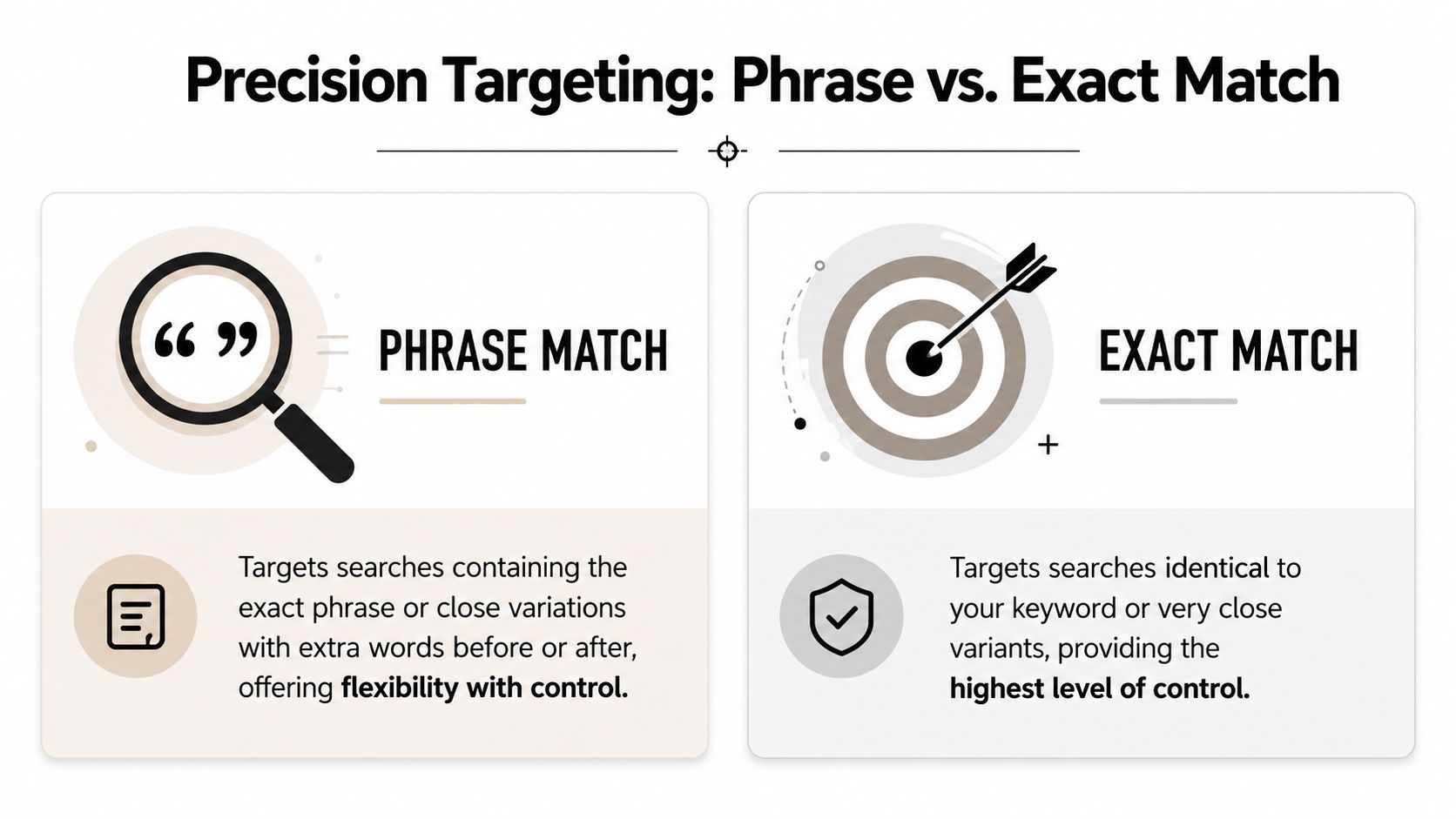
Phrase match sits in the middle
Phrase match is the middle lane. It gives Google room to interpret the search, but it keeps the keyword anchored more tightly than broad does.
If your keyword is "emergency dentist", you might reach searches that stay close to that core intent, even if the wording around it shifts. That's useful when you want more reach than exact, but don't want to open the floodgates.
Exact match is your precision layer
Exact match is where many high-intent searches belong. It's still not a rigid string match, but it gives the most control of the three options and usually creates the cleanest connection between keyword, ad, and landing page.
According to an industry analysis summarized by Adalysis, exact match can produce over double the click-through rate of other match types, and expert guidance in that same source notes that exact match keywords often see 4% to 8% click-through rates in competitive service categories. The same analysis also reported that phrase match showed the highest CPA and the lowest ROAS in that study. You can review that discussion in Adalysis's match type performance study.
How to use both without overthinking it
A practical split looks like this:
- Use phrase match when you want controlled coverage around a topic
- Use exact match when a query already proves strong intent or strong lead quality
- Promote winning search terms from looser targeting into exact when they consistently matter to revenue
What this means in practice: Phrase helps you search the neighborhood. Exact helps you buy the house you already know you want.
A cleaner way to judge ROI
If your goal is qualified leads, exact often becomes the efficiency anchor in the account. That's because tighter query control tends to improve relevance all the way through the funnel. Better-fit searches usually create better clicks, better conversations, and more predictable costs per lead.
Phrase still matters. It catches nearby intent that exact may miss. But if your budget is under pressure and you need cleaner signals, exact is usually where you look first.
Building Your Campaign Structure with Match Types
Knowing what match types do is one thing. Building a campaign around them is where the account starts behaving better.
A lot of older structures were built around tiny ad groups and hyper-granular keyword control. That approach made sense when match behavior was stricter. Today, it often creates more maintenance than value.
Start with themes, not keyword trivia
Instead of building one ad group per tiny variation, group keywords by commercial intent and landing page fit.
For example, a home services account might organize around:
- Roof repair
- Roof replacement
- Storm damage roofing
- Emergency roofing service
Each theme gets its own ads and landing page logic. Then you decide which match types belong in each theme.
A simple structure that scales
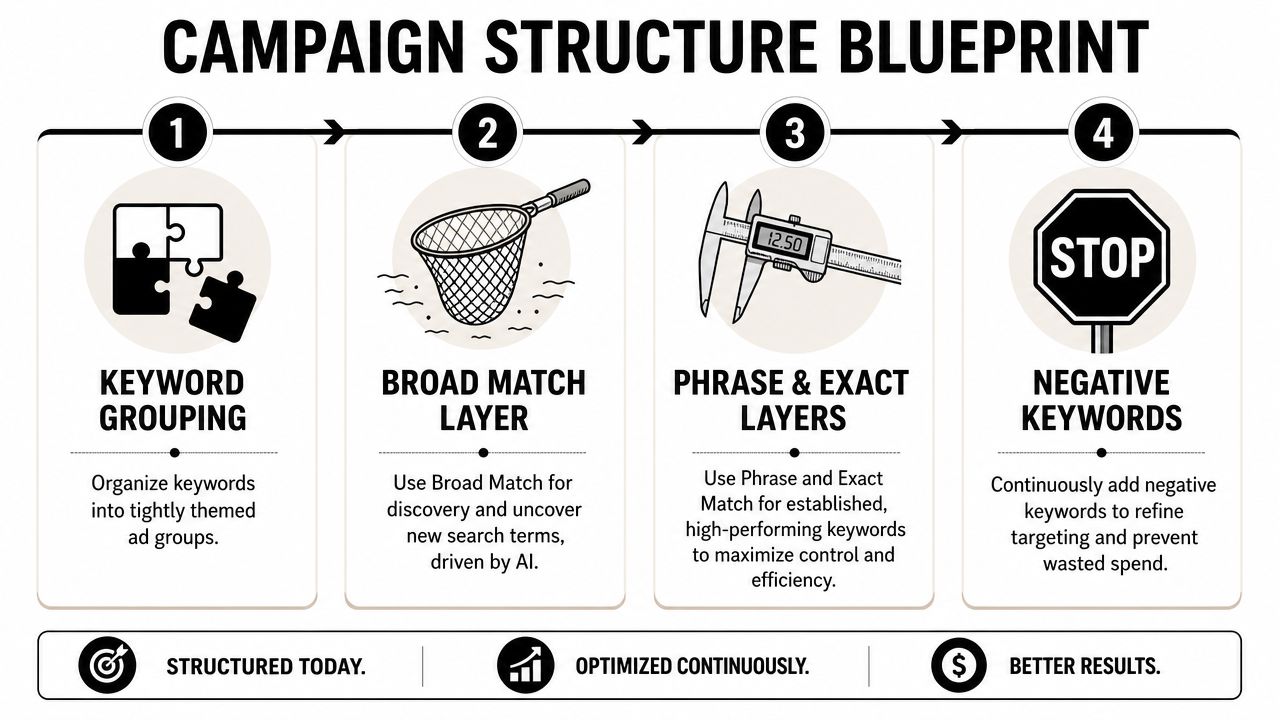
One modern framework works well for many accounts:
Build tight thematic ad groups
Keep the topic coherent enough that one ad message still makes sense for all keywords inside it.Use broad match as a discovery layer
Let it surface real search behavior you may not have predicted.Move proven queries into phrase or exact
When a search term keeps showing buying intent, give it a tighter home.Add negatives continuously
This keeps the discovery layer from drifting into junk traffic.
That last step isn't optional. Broad match is the most expansive option, and strong accounts usually pair it with search-term mining and negative keywords to control wasted spend, as described in Semrush's overview of keyword match types.
What to retire
You don't need to obsess over old single-keyword ad group logic in every account. It often creates duplicate work without giving you meaningfully better control with the current Google Ads setup.
What matters more is whether your structure lets you answer these questions clearly:
- Which themes drive qualified leads?
- Which search terms deserve tighter targeting?
- Where is broad helping discovery?
- Which negatives should be shared across campaigns?
If you want examples of cleaner organization, Keywordme has a useful guide on how to create tight ad group structure.
The best account structures don't try to predict every query upfront. They create a system for discovering, sorting, and tightening over time.
The Critical Role of Negative Keywords
A match type strategy without negative keywords is incomplete. You aren't only telling Google what to match. You're also telling it what to avoid.
That second part is where a lot of wasted spend slips through.
Why negatives matter more than people expect
Even if you're using phrase or exact, Google can still interpret searches through close meaning and intent. That's useful when it expands into relevant demand. It's expensive when it drifts toward the wrong audience.
A few classic examples show up in almost every account:
- Job seekers searching for careers, salary, or training
- DIY researchers looking for how-to information
- Freebie hunters searching for free, template, sample, or cheap
- Competitor terms when you don't want those clicks
If you don't block those patterns, your campaign keeps paying tuition for lessons you already learned.
The workflow that keeps budgets clean
Review the Search Terms report regularly and sort findings into two buckets:
- Promote useful queries into stronger keyword targets
- Exclude weak or irrelevant queries as negatives
That process gets repetitive fast, but it's one of the most impactful habits in search management.
How to think about negative match types
You can apply negatives with different levels of strictness too. The point isn't to memorize every edge case. The point is to block bad-fit intent without accidentally choking off valuable traffic.
A good operating rhythm looks like this:
- Start broad on obvious waste like jobs, careers, free, diy, template
- Use phrase negatives when a pattern repeats in a specific context
- Use exact negatives when one precise query keeps slipping through
If you're cleaning this up at scale, Keywordme's guide on how to add negative keywords is a practical reference.
Good keyword targeting gets you into the right auctions. Good negative keyword work keeps you out of the wrong ones.
Troubleshooting and Optimizing Your Match Types
When performance feels off, don't change everything at once. Start with the symptom, then adjust the match type strategy behind it.
If volume is too low
Your targeting may be too tight for the market.
Try this:
- Add phrase match around proven exact keywords
- Test broad match in campaigns where automation and tracking are already stable
- Expand into adjacent intent themes, not random keyword variants
This is common in niche B2B accounts and local service campaigns with limited search volume.
If click quality is poor
Tighten the system before you raise bids or rewrite landing pages.
Check these first:
- Are broad keywords matching to research-heavy or irrelevant searches?
- Is phrase match covering more territory than expected?
- Are negatives missing obvious exclusions like jobs, DIY, or free?
For ecommerce, poor click quality often shows up as product mismatch. For lead generation, it usually appears as weak form fills or low-value calls.
If exact isn't spending enough
That doesn't always mean exact is “bad.” It may mean you're using it correctly on a narrow slice of intent.
Keep exact on proven commercial queries. Then let phrase or broad help feed it. The point of exact is not to do all the work. It's to protect the highest-intent traffic.
A practical diagnosis flow
- Low impressions means loosen targeting carefully.
- Weak lead quality means tighten match types and negatives.
- Strong search terms in broad means graduate them into phrase or exact.
- Mixed results across themes means restructure by intent, not by tiny wording differences.
Small moves beat full rebuilds. Most match type problems are really diagnosis problems.
Frequently Asked Questions About Match Types
What happened to broad match modifier
Broad match modifier is gone as a separate option. Its old role was largely absorbed into phrase match, which is one reason phrase behaves more flexibly than many advertisers expect.
Do exact match keywords only show for that exact query
No. Exact gives the most control, but it still isn't a character-for-character lock. Google can match to close variants and searches with the same intent.
Should I use the same keyword in broad, phrase, and exact
Sometimes, yes. That can be useful when each version has a clear job in the account. Broad can discover demand, phrase can expand around a topic, and exact can lock onto proven intent. The key is keeping the structure clean enough to read performance clearly.
Which match type is best
There isn't one winner for every campaign. The better question is which match type fits your goal right now. If you need discovery and scale, broad may help. If you need cleaner efficiency and more predictable lead quality, exact often earns a larger role.
Keyword research and match type cleanup get messy fast once campaigns start generating real search term data. If you want a simpler way to sort winners, apply match types, and build negatives without endless spreadsheet work, Keywordme is worth a look.
.svg)